From idea to ETF portfolio in minutes. Build yours now →



Gold and Silver ETF Prices Are Breaking from NAV During Volatile Markets
Recent volatility has pushed some gold and silver ETFs away from net asset value. Here’s why price dislocations happen and when they matter for investors.

Keep up with what matters in ETFs
Get timely ETF insights, market trends, and top ideas straight to your inbox.
Your newsletter subscriptions with us are subject to ETF Central's Privacy Policy and Terms and Conditions.
One of the defining features of the ETF structure is in-kind creation and redemption, which is designed to keep an ETF’s market price closely aligned with its net asset value, or NAV. That mechanism solved a longstanding problem seen in closed-end funds, particularly in commodities.
Closed-end funds (CEFs) that hold physical gold or silver can see their shares trade at a premium to NAV during periods of heavy demand, or at a discount to NAV when sentiment turns.
ETF investors typically do not worry much about this. Even though warnings about premiums and discounts still circulate, the assumption is that arbitrage activity will keep prices in line. Most of the time, that assumption holds. During periods of market stress, however, dislocations can and do occur.
A clear example emerged during the March 2020 COVID-19 selloff, when several bond ETFs briefly traded at sharp discounts to NAV. More recently, sharp intraday moves in precious metals exposed similar behavior. Silver fell by roughly 30% intra-day at one point, while gold dropped close to 10%, and even highly liquid gold and silver ETFs experienced temporary pricing gaps.
For precious metals ETF investors in 2026, these episodes are worth paying attention to. Understanding why they happen and when they matter can help separate structural noise from genuine signals of stress during periods of heightened volatility.
Global ETF Survey 2026 is Live!
With 1,790 new products launched by July 2026, choosing is harder than ever. Our Global ETF Survey 2026, built on 620 professional investors and allocators, shows how active, fixed income, options-based and thematic ETFs are reshaping fund selection.
When Even the Most Liquid Precious Metals ETFs Break from NAV
To illustrate how these dislocations show up, I pulled one-year premium and discount data for the two largest and most liquid precious metals ETFs: SPDR Gold Shares
These funds trade millions of shares on average over a 30-day period, typically carry bid-ask spreads around 0.01%, and have deep options markets with weekly expirations and a wide range of strikes. By most measures, they represent the most efficient vehicles for accessing gold and silver through ETFs.
For most of the past year, prices stayed tightly anchored to NAV, even as precious metals rallied. That relationship began to fray toward the end of 2025 and into early 2026.
On December 12, 2025, SLV traded at a 4.1% discount to NAV. Just two weeks later, on December 26, it flipped to an 8.68% premium. The most extreme move occurred on January 30, 2026, when SLV briefly traded at a 19.33% discount to NAV, while GLD was trading at a 2.84% discount.
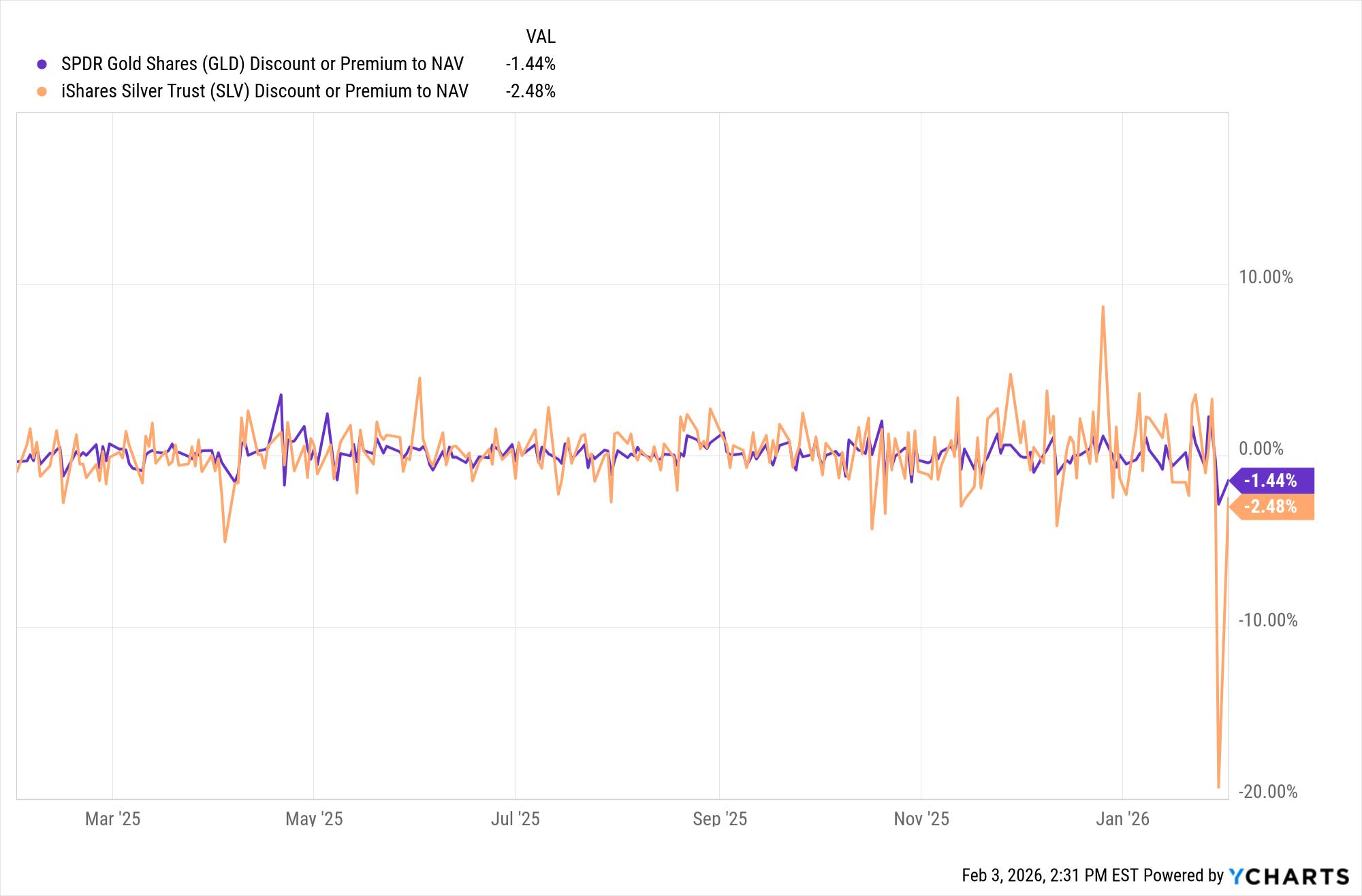
What this shows is not a failure of the ETF structure, but its limits under stress. The creation and redemption mechanism relies on authorized participants stepping in to arbitrage price differences. During periods of intense volatility, liquidity can dry up in the underlying metal markets.
When investors are rushing to buy or sell ETF shares faster than those arbitrage trades can be executed, prices can temporarily detach from NAV. In other words, extreme enthusiasm or panic can overwhelm an otherwise efficient mechanism, even in the most liquid ETFs in the market.
What Can ETF Investors Do?
The first step is to make premiums and discounts to NAV a routine part of ETF due diligence. It is easy to take the ETF arbitrage mechanism for granted, especially in highly liquid products, but recent episodes show that assumption does not always hold during periods of extreme volatility.
Most ETF issuers publish current premium or discount data alongside historical averages, the monthly frequency of premiums versus discounts, and typical trading ranges. Reviewing that information can help investors judge whether they are buying or selling at a reasonable price relative to the underlying assets.
The second takeaway is more subtle. ETFs that hold gold and silver mining equities did not experience the same degree of dislocation. While mining ETFs did trade slightly above or below NAV at times, those deviations were generally in line with historical norms.
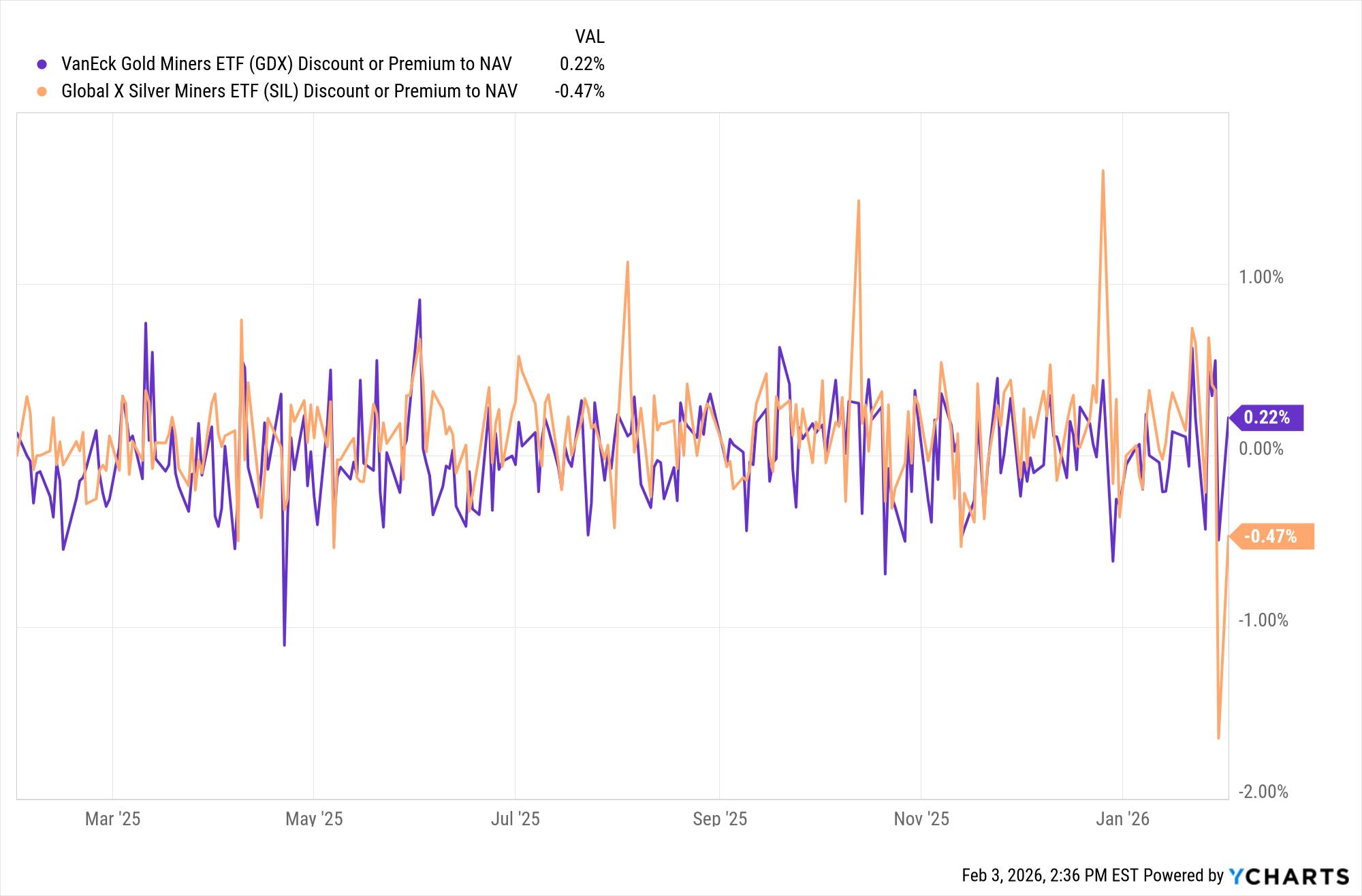
The reason comes down to liquidity and market access. It is far easier for authorized participants to source and exchange publicly traded equities than it is to move physical precious metals or manage exposure through futures and vaulting arrangements during stressed conditions. When markets are under pressure, that difference matters.
For investors, it means that during periods of heightened volatility, the choice between spot precious metals ETFs and mining equity ETFs is not just about exposure, but also about how efficiently that exposure can be priced and traded.
Please note that this article reflects the author’s personal views and does not represent the opinions of the publication or its affiliates. It is for informational purposes only and does not constitute investment advice. It is essential to seek guidance from a registered financial professional before making any investment decisions.

Latest ETF News
See all ETF newsThere's an ETF for That? Humanoid Robotics and Physical AI

How Some ETF Issuers Use Their Own Funds for Cash Management

These Public-Private ETFs Invest in Polymarket and Anduril

There's an ETF for That? Frontier Markets




 Advantages of ETFs over Mutual Funds1/6
Lower Costs
In this guide, we'll explore the advantages of ETFs over mutual funds, giving you valuable insights into why ETFs have gained significant popularity among investors like yourself.
Leveraged ETFs: Unlocking the Potential for Amplified Returns1/6
Understanding Leveraged ETFs
Explore leveraged ETFs: potential for amplified returns & risks. 5 ETFs to consider across equities, commodities & fixed income.
What is a Leveraged ETF?1/6
Introducing Leveraged and Inverse ETFs
In this guide, we'll dive into the world of leveraged ETFs, exploring their definition, mechanics, potential risks, and rewards.
Recent educational content

First Look ETF
First Look ETF: Income, International, and Cash Flow ETFs
In this season 6 episode of First Look ETF, Stephanie Stanton @etfguide examines the latest ETF marketplace trends with NYSE and guests.


ETF Trends
ETF Industry KPIs October 5, 2026
This week’s KPI data overview highlights key metrics and trends shaping the ETF landscape.

ETF Trends
ETF Industry KPIs September 28, 2026
This week’s KPI data overview highlights key metrics and trends shaping the ETF landscape.
ETF Trends
ETF Industry KPIs September 22, 2026
This week’s KPI data overview highlights key metrics and trends shaping the ETF landscape.
Browse all educational columns



ETFs’ Next Act: From Access to Selection
With 1,790 new products launched by July 2026, choosing is harder than ever. Our Global ETF Survey 2026, built on 620 professional investors and allocators, shows how active, fixed income, options-based and thematic ETFs are reshaping fund selection.