Open Now: The Global ETF Survey Take the Survey →



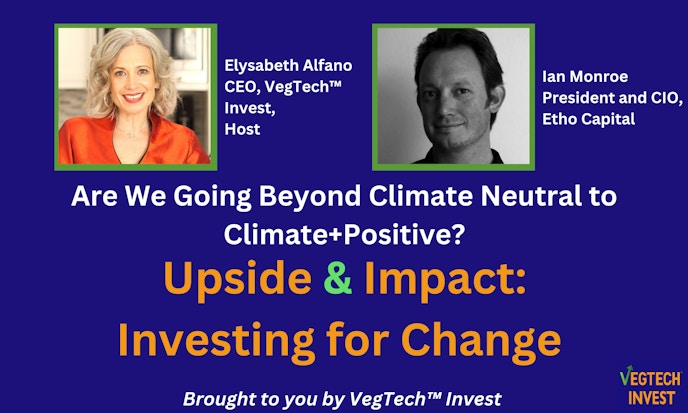
Going Beyond Climate Neutral to Climate+Positive with Ian Monroe
President and CIO of Etho Capital, Ian Monroe, talks about his work developing ESG-related investment strategies for clients and founding the new Climate+Positive Initiative Alliance, of which VegTech Invest is a founding member.

Keep up with what matters in ETFs
Get timely ETF insights, market trends, and top ideas straight to your inbox.
Your newsletter subscriptions with us are subject to ETF Central's Privacy Policy and Terms and Conditions.
As I head to COP28 to discuss how the public markets are driving capital to sustainable food systems transformation, I wanted to share my interview with the President and CIO of Etho Capital, Ian Monroe. We discuss his work developing ESG-related investment strategies for clients and founding the new Climate+Positive Initiative Alliance, of which VegTech Invest is a founding member. What is Climate+Positive and, per the IPCC's recent report on climate catastrophe, how do we get there?
President & CIO of Etho Capital, Ian Monroe, talks about his work developing ESG related investment strategies for clients and founding the new Climate+Positive Initiative Alliance, of which VegTech Invest is a founding member. What is Climate+Positive and, per the IPCC’s recent report on Climate Catastrophe, how do we get there?
- The Climate+Positive Initiative and what it accomplishes,
- Who are the key players in Climate+Positive investing (spoiler alert: you),
- How to invest for Climate+Positive results,
- What is the timeline for Climate+Positive impact.
Listen to the episode here
Like what you're reading?
Stay in the loop — get the latest ETF insights: trends, analysis, and expert picks.
Transcript
Elysabeth: Hey everyone, welcome to the VegTech Invest Upside & Impact podcast. I’m your host, Elysabeth Alfano, the CEO of VegTech Invest, Advisor to the Plant-based Innovation and Climate ETF, EATV. On Upside & Impact I chat with the leaders and movers who are shaping and growing impact investing for meaningful change. We “pull up as we go up” as the expression goes so this podcast is all about making meaningful and productive impact while also managing one’s portfolio for upside. Of course, always managing for upside.
If you’d like more information about VegTech Invest you can visit us at VegTechInvest.com and subscribe to our newsletter. You can also find us on LinkedIn and on Twitter @VegTechInvest. We record live every first and third Wednesday of the month on our LinkedIn page at 1:30pm eastern standard time. So, check us out live and be sure to bring your questions.
Now if you’re listening as part of a podcast, of course subscribe to this podcast right now so that you never miss an episode. And if you’re listening on iTunes, be sure to leave a 5-star review. It really does help.
So now let’s get down to today’s show and thanks for being with me on today’s episode of VegTech Invest’s Upside & Impact. And as always, a reminder, this podcast is for informational purposes only and is not meant to recommend any specific company or investment. Now, onto the show.
Hi everybody, it’s the VegTech Invest Upside & Impact video series today. I’m so happy to have you with me. As you know, every first Wednesday of the month at this time, so that would be 1:30 eastern time, we put together the VegTech Invest Upside & Impact series. We are talking to those movers and shakers and thought leaders who are indeed investing for climate purposes, as well as climate and beyond. Obviously, so many things work into a climate conversation about investing, deforestation, and water pollution. These are all related and we’ll talk about it today.
But I would be remiss if I didn’t also welcome my listeners from the Plantbased Business Hour. As you all know, sometimes I’ll sneak in a VegTech Invest Upside & Impact interview because it is so important to the work, we do at VegTech Invest that I want all my listeners on the Plantbased Business Hour to hear it as well. So, if you’re listening to audio, thanks everybody at the Plantbased Business Hour for welcoming my expert guest today who couldn’t be timelier now that we know that the IPCC, the Intergovernmental Panel on Climate Change, has put out yet another disastrous report about how the end is near. Basically, if we don’t get our act together, I exaggerate, but not by too much. The warning signs have been there for a long time and really no one’s paying heed.
So, we’re going to address that today, which is why I bring on my guest Ian Monroe, who is the President and CIO, Chief Investment Officer, of Etho Capital. Ian, thanks for being with me today.
Ian Monroe: Thanks so much for having me, Elysabeth. I’m excited to be here.
Elysabeth: Yes, okay. So just to give people a level set and a little bit of background, you are President and Chief Investment Officer of Etho Capital. Tell me what you do at Etho Capital and then we’ll dive right into your most recent work of the Climate+Positive Initiative.
Ian Monroe: So, at Etho Capital we’re really focused on creating investment solutions that are really deeply decarbonized and at the same time aligned with overall ESG values. And we’re creating these solutions to be replacements for core broad-based index allocations. So, something that would look similar in terms of diversification to S&P 500, but really be focused on the climate leaders in every industry and then take out ESG bad actors that have problems in terms of other environmental, social, and governance reasons beyond climate as well.
So, our focus with Etho is to show that you can really deeply decarbonize, remove the climate pollution related to your portfolio, still be broadly diversified, and have similar type of performance ideally as what you would be getting with conventional, much more polluting funds.
Elysabeth: I love this. Just to clarify what he’s saying, you can invest alongside your values. You can invest for change, and you can invest to see particular action happen in the world. A common question that I get with the work that I do at VegTech Invest, and perhaps you get it as well, Ian. Do people ever say to you, “Oh, but is there enough to fill an investment portfolio? Are there enough options to execute on the plan that you would like?”
Ian Monroe: The shorter answer is yes, and there’s more and more every day. There really are a whole lot of companies now. It’s certainly in the hundreds that are either specifically putting out climate and overall sustainability solution technologies, or at least getting serious about removing the pollution from their supply chains, removing other environmental, social, and governance problems from their supply chains. No company is perfect, but a whole lot are making serious efforts to move in the right direction.
At the same time, a whole lot still aren’t, so it’s really important that we’re shifting our capital out of the problems into the solutions, and part of the problem with how a lot of people still are investing in 401K plans, and IRAs, and other retirement accounts is increasingly investments have been going into these broad-based index funds, which are great in terms of diversification, but they include basically the whole economy, all the good and all the bad at the same time. We’re showing that you can really take out the bad, focus on the leaders, still have a lot of diversifications in terms of the mix of companies you’re invested in, and be supporting the future that we really want.
Elysabeth: You and I are two sides of the same coin because as you approach climate and then other subjects that touch climate, we approach food and how that impacts climate. And we have a very similar approach to what you do in that we screen in for these really good actors that are changing, that are impacting, and then we screen out for any bad actor that might be having problems in other ESG areas. And we also feel like there are lots of players doing the right thing. Certainly enough for a diversified portfolio and really getting to the action we all want to see. How frustrating to read yet another IPCC report and feel like, well, we know because you told us five years ago and we’re still here, if not worse.
If I believe it, you correct me if I’m wrong and we’ll talk about this later after you do a great slide presentation on the Climate+Positive Initiative that you’ve started, but we are worse than we were five years ago. The IPCC says that there’s just pretty much no way we’re going to hit 1.5 degrees Celsius and that’s upsetting.
Ian Monroe: We still can, but we need to get a lot more serious than we are. And I came into this originally as a climate scientist and engineer. So, my background coming into climate investing is not from finance and business. It’s originally from the science side of things. I think of myself as a sustainability data geek at heart. And it was just seeing what the science was saying about how quickly we needed to not just stop putting more climate pollution up into the atmosphere but draw down the climate pollution that’s already up there that got me working on this climate challenge.
Originally, I just started working on it because I grew up on a small farm in Northern California that I could see from an early age, even in high school, that there were changes with drought and changes in terms of wildfire risk. And unfortunately, a lot of my childhood nightmares have come true now with the crazy wildfires we’ve had in California, including one that destroyed my family’s farm and hundreds of community members and over two dozen family members lost homes overnight. And so, we’ve all experienced this fact that climate change is already causing massive destruction here and now.
It’s not something that’s out there in the future and that should be a wakeup call for all of us that we really need to move money out of problems into solutions as quickly as possible. And the good news is we can. We have all the tools to do it as we’ve been talking about. A lot of companies are already going in the right direction. A lot still aren’t, but we just need to redirect as quickly as we can. And again, I’m optimistic that we can hold warming below or at least at one and a half degrees. But I think it’s important that we don’t think about one and a half degrees of warming as a target. It’s really a limit because the true target is to get back to the healthy stable climate that humans and every other species has evolved with for thousands, even millions of years.
So, it’s not enough just to get to net zero and stop at 1.5 degrees warming. We want to reverse as much as we can of the climate damage that’s already happened.
Elysabeth: I know I’ve talked on this podcast and people can refer to it- for compliance reasons we’re not going to dive into Ian’s ETF or my own. Everyone has all the websites at the bottom of the screen, but generally the work that we do, and I know I’m here to support Ian and all the work that he does. The general work that we do at VegTech Invest shoots for below 1.2 degrees Celsius. So, it’s way below the Paris Accords of 1.5. But a little stat that people might not know about is the global warming potential.
So, we say we shoot for 1.2 in our work. The global warming potential of the S&P 500 Index is 3.2 degrees. So, this is the importance of shifting your investments because if we leave our investments as status quo and we rely only on government policy to move the needle, it’s not going to be enough. Governments alone are not going to do it. It really is going to take all hands-on deck. Would you agree, Ian?
Ian Monroe: Totally, and that’s been part of my own career journey. Originally, I thought I was going to be mostly working on climate solutions as a scientist and engineer. Then I worked in international development, policy, and economics in over 30 countries working with a lot of governments, including the U.S. government, and concluded that that wasn’t moving nearly fast enough. But what was driving things was what was happening in the investment community and technology sector and plenty of problems there as well. But again, that’s where I think we must have the fastest movement.
And a lot of it comes down to just how we manage our own money. It’s not just about ginormous players in the financial system. It’s really about what we own with our own retirement accounts because that is a really substantial piece of the ownership of the companies that are the biggest polluters. And increasingly, we needed to make it a major piece of the companies that are the major solution providers.
Elysabeth: I always say on this show, when you combine your dollars with your voice, you are so incredibly powerful. So, if we’re going to move the needle, it’s going to have to start with all of us. And you invest already. You might say, “I can’t rip off the roof of my house and put on solar panels. Not in the budget this year and we can’t be under construction for whatever reason.” Or “I can’t get rid of my car and buy a new electric vehicle.” Perhaps that thought is going through your head. But you’re already investing. This is nothing new. Just pick the investments that work for you. I would argue the same with diet, by the way. Just let your fingers do the walking in the grocery store and move from that burger that you’re used to to that plant-based burger.
And you see how everyone doing that once or twice a week switching out to plant-based sausage, let’s say, or plant-based deli meat, the list goes on. Once or twice a week, that’s 10% of your eating habits. That moves the needle because nothing moves the needle like money. What do you think, Ian?
Ian Monroe: Agree. And we’re voting every time we spend our money and we’re also voting every time we invest our money. And it’s just important that we really know what we’re voting for and we’re shifting that in the right direction.
That was something that also brought me into Etho Capital, was helping launch with several college friends a beyond tech platform to just track the personal impacts of how our spending is related to climate problems and solutions and turn that into a social game. When we started looking at the climate links to our investment portfolios, that’s when a side project then turned into what we’re doing with Etho Capital. So, I fully agree that both with what we do as consumers, just with our spending, makes a big difference. And what we do with our investment dollars also makes a big difference.
Elysabeth: Now occasionally, I’ll get pushback and I’d love to hear the pushback that you get. Some of the pushback I get is that “I’m one individual. I made no difference. For this to really move the needle we must talk about scale.” No argument there. We do talk about scale an enormous amount here on this show, particularly in terms of the global food supply system and its impact on climate change and how you will not impact climate change sufficiently enough if you don’t also address animal agriculture and in doing so you address that entire supply chain.
Obviously, these are enormous things at scale, but I don’t want to underestimate the power of the individual. So, I want people to take that to heart. But as I switch back to moving things in scale and holding companies accountable, there’s lots of talk- and ESG has taken a bit of a smackdown because of it. 2030, that sort of kicks the can down the road. That’s not demanding action today. 2050 is even worse. What do you think about the timelines that have been put forth in the media and perhaps even by governments and by corporations that say, “Yeah, we agree to put a policy in place by 2050”? That’s a little late. What do you say?
Ian Monroe: Too little too late, and certainly the latest IPCC big UN report on climate is validating that net zero by 2050 is not nearly enough. And really, as a planet, the best science is now saying we need to get to net zero by 2040 at the very latest. And that’s as a planet in terms of the average. And as a refresher for your listeners, net zero is the point where basically there’s no additional buildup of climate pollution in the atmosphere. Because without any intervention, climate pollution with CO2 being the largest chunk of it, stays up in the atmosphere for 1000+ years.
So that’s the reason that climate change is such a challenging problem. It's not enough to just stop the pollution. We need to pull down the pollution that’s already up there, because in absence of that, the warming will continue even if we get to net zero. So, we’re talking about net zero a lot. It’s great that we are talking about net zero in ways that we weren’t a decade ago, but net zero itself is just a transition point. What we really need to do is get to net climate positive, where we’re removing more pollution than we’re putting up into the atmosphere. And again, the best available science is that that transition point as a planet needs to happen at 2040 at the very latest. And really, everybody with money needs to be shifting a lot faster than that to make up for those countries and those individuals that may not have the resources to get there by 2040.
So, investors really need to be looking to get to climate positive as quickly as possible, ideally, within the next few years. And we’re showing that it’s possible. It’s possible to do today. You just must be thoughtful about shifting into solutions and shifting away from pollution. And the tools are there. You can go to Ethocapital.com for more information on that.
Elysabeth: Of course, you can go to vegtechinvest.com for more information on the tools that we have available. What’s the point of an interview if we can’t have a little contention? I have heard the World Business Development Council say on several occasions that it has to be 2030 and that we give ourselves that final date, because it’ll take us another decade to implement it and then you won’t see any of the results until 2050 and beyond. So, I respect your point of view on 2040, but folks, don’t dilly-dally. We really don’t have as much time as that might seem.
Ian Monroe: I’m not going to be contentious. I’m going to agree entirely that the sooner the better. So, 2040 is based on this modeling that’s come out of a few academic institutions kind of updating things because these models constantly must get updated. Since as a planet, we continue to not stop polluting. So basically, the more pollution builds up, the faster we need to then remove it and get to net zero. And that’s part of the reason that “zero by 2050” stuff has been out there is that’s what the model said 20 years ago, if we started seriously decarbonizing, seriously stopping our climate pollution 20 years ago. But of course, we have not.
It’s only continued to build up in the atmosphere more and more every year since then. And that’s why that timeline constantly needs to get pushed up. So, where we’re currently at, we need net zero by 2040 and climate positive thereafter for probably hundreds of years, certainly many decades and the more we delay the faster that net zero target gets pushed up and certainly it would be better for investors to have a target that’s much much sooner than that. And with the Climate Positive Investing Alliance that we’re excited to be collaborating with VegTech on, it’s 2035 at the very latest that our members are signing on to, but most are moving much faster, and many are already there.
Elysabeth: Yeah, a couple little points that I’d like to make, then we’ll dive right into your presentation on the Climate+Positive Initiative and what’s going on there. Folks if you have children, you invest not just for yourself, but any family office will tell you that you invest for the next generation so certainly we don’t want to leave calamity to them, so we keep that in mind.
A shout out to Project Drawdown because we mentioned it here about drawdown initiatives and we’ll just talk about it more with your presentation but just a shout out to that great group. Please Google “Project Drawdown” if you’d like to learn more. I think they’re a wonderful source of information and again we have Etho Capital. That’s Etho without the “s”. Ethocapital.com and VegTech Invest.
As I share my screen and for those of you on audio, I’ll do some narrations so don’t worry. You’ll get all the good points. As I share my screen, I’m hoping that when we get to a couple slides, we can take a stop and really help people understand the difference between carbon, methane and nitrous oxide. They all have different lifetimes in the atmosphere, and some are more potent than others.
Okay everybody, here I go. I’m going to share my screen. I’m not going to show Ian and myself because we’ve got some small print here, so I really want everybody to be able to see. I believe this is the first slide. I will let Ian take it from here. We’re talking about the Climate+Positive Initiative, everyone.
Ian Monroe: Yeah, and this is just a quick intro slide, visualizing this climate positive future that we need to get towards. And again, my background coming into climate investing originally is climate science and engineering. I still teach courses on solving climate change at Stanford University, and just, with another co-author John Kumi, published a textbook called Solving Climate Change. So, this is an image from that.
I’ll get into a little bit how investing in climate solutions fits into this bigger picture of where we need to be working to, to focus on several key levers to decarbonize our entire economy. But you can go ahead and jump to the next slide, which is just a quick illustration. So this is really what the latest and greatest scientists are saying that illustrates how if we want to keep warming below 1.5 degrees Celsius, which is the goal of the Paris agreement that supposedly almost every country on the planet has signed on to, it’s really essential now to get to net zero as a planet by 2040, and that timeline is just going to push up to be sooner and sooner, the more we delay.
And again, net zero is the point where all emissions related to primarily fossil fuel combustion but also as we’ve talked about food and agriculture are big pieces of that as well. All those emissions are balanced out by carbon removals and everything after net zero is when we have net climate drawdown, AKA net climate positive is what we term it. So, to get to this climate positive future, we really need to be removing it to the point of actual zero or our climate pollution as quickly as possible and stopping additional pollution by stopping the use of fossil fuels and minimizing additional emissions that are connected to agriculture and land use.
And again, the transition point based on where we’re at right now is 2040, but really it makes sense to set our targets even sooner than that because the more we delay, the more pollution there is in the atmosphere and effectively the more we must move faster. And certainly individuals, investors and countries with more resources should be moving much faster to make up for those that have fewer resources. So, this is the overall ethos that’s been driving what we’re doing with the Climate Positive Investing Alliance. And if you want to skip to the next slide.
Elysabeth: I do. I just want to comment because I can’t help myself. For those of you who follow animal agriculture and agriculture in general, I find it very interesting that right around 2025, if I’m looking at this correctly, you see this reduction in carbon. And that is about the same time that Boston Consulting Group says that meat will hit a worldwide high in 2025 and start coming down thereafter and Rethink X, a paper of research about our global shifting food supply system, also says around 2025.
So, for me, given my expertise in my area, I think it’s interesting that you see, for those of you on audio, a very stark downward slope in terms of emissions output just when you have a move away from animal meat. Ian, would you say that’s fair?
Ian Monroe: Well, that’s what we need. So, to clarify this, these are not projections of where things are currently headed with businesses’ usual scenarios. These are projections of what we must do as a planet to reach the targets that we’ve signed on to hold warming below 1.5 degrees Celsius and then actually reduce the warming that’s happened and eventually get back to the stable climate that humans and every other species have evolved with. So, it’s important to remember that a 1.5-degree world is still substantially worse than the world we’re already in in terms of climate impacts.
So those of us here in California have been experiencing these crazy wildfires and toxic smoke from the fires for almost a decade now in ways that we’ve never experienced before and that’s only going to get worse in a 1.5-degree world. So, it’s more reason to keep warming as little as possible and then ultimately reverse it and that’s really what we need to be talking about and that’s also why net zero is not a goal, it’s a transition point. The real goal is getting the climate positive as quickly as possible and as deeply as possible to limit and reverse the damage that’s already happened.
Elysabeth: And we have some small print in this slide so not just for my audio listeners but also for my video viewers, you’re looking at 2025, the peak of anthropogenics of humanly induced emissions and then kind of the next big one that I see is by 2055 you’re looking at 100% global renewable energy for us to be bringing down. That’s just the first of many. Oh no, I’m sorry. I see a 2030 here of 35% reduction of global CO2 emissions, a 2035 goal of 60% global CO2 emissions and onwards from there to finally a 2055 100% renewable energy.
So, we’ve got the roadmap, but we must do it. I’m going to move on to the next slide.
Ian Monroe: So how do we move money in the right direction to do it is really what the Climate+Positive Investing Alliance is all about. So, it’s an alliance of investors from individual investors to larger investors, early-stage venture investors, later stage public equity investors, and everything in between, as well as nonprofits that are helping push for climate solution investments that are much more meaningful and climate solution technology companies that are ultimately working on the solutions that can get us to this climate positive future.
So, if you want to learn more about the Climate+Positive Investing Alliance you can check out what’s up on positiveclimate.org and we even have individual investors investing for their retirements signing up. So, you yourself can join. We’ll soon have a list of individual members, not just organizational members that are up there, including several prominent individuals. And I should mention in a big way that VegTech is a proud member as well, and we’re excited to have them as part of the alliance. And there are many other members beyond who you see on this slide as it’s been growing almost every day, certainly every week. And we’ve been pretty under the radar about it so far.
Part of the reason we’ve brought the alliance together is to set a higher standard for climate investing that’s aligned with what science says is necessary, because there are several other climate investing initiatives out there. But a lot of them unfortunately fall into the realm of too little too late. A lot are still connected to outdated “net zero by 2050” targets and don’t really have the rigorous near-term action that’s needed to align with that decarbonization graph that we just showed on the roadmap for where the world needs to decarbonize.
And again, investors really need to be moving much, much sooner. So, at a minimum, everybody who is controlling money that’s signing on to the Climate+Positive Investing Alliance is signing on to shifting their own assets to net climate positive at the latest by 2035. But again, many are going much sooner. They’re moving much faster, and several of them are already there. A number are already almost entirely focused on investing in climate solutions.
So part of what the alliance is also doing, if you can skip on to the next slide.
Elysabeth: Yes, if I could, can I just interject here just for a second? I just want to say how proud and grateful the VegTech Invest company is to be supporting and a founding member of Climate+Positive Investing Alliance. And to reiterate what Ian’s saying, this isn’t just for institutions. It’s also for individuals. So come on board, and if you’re interested in this kind of movement of the world’s crises, I also want to shout out FAIRR, the Farm Animal Investment Risk and Return Initiative at FAIRR.org. They are a wonderful institution helping to educate people about the risks for investing in animal agriculture and how to kind of move out of that.
And of course, VegTechInvest.com, if you’re interested in not just getting away from meat but really seeing change in the world for alternatives. And then of course, ethocapital.com and positiveclimate.org.
Ian Monroe: Great shout out to FAIRR. They are an organization we’re a big fan of at Etho Capital as well, and we were also one of the early members in their organization. So, we’re excited to be a small part of what they’re doing. Part of what we’re doing with the alliance as well- first, we need to be setting more rigorous targets for where portfolios need to decarbonize, how we need to get the pollution out that’s aligned with, again, what the science says is necessary. And then we need to be doing the complete climate math to show that we’re doing that, that we’re removing pollution from our investments and shifting our individual investments and overall portfolios to net climate positive.
And this is a big piece of what Etho has always done with the investment funds that we help create as well as analysis that we’ve done for investors of various sizes, including some of the largest investors in the world, is what’s called Scope 1, 2, and 3 climate accounting, where we look at the full pollution connected to every company, we consider investing in. Including not just what’s going on at a company’s facilities in terms of their operations and electricity use, which are called Scope 1 and 2 emissions, but also importantly, including what’s going on with the company’s supply chain, as well as the climate pollution connected to the products and services that the company puts out into the world. And that’s typically termed Scope 3 emissions.
A part of that downstream Scope 3 emissions can be what are called avoided emissions for climate solution technologies. So, for example, for plant-based foods there’s substantial avoided emissions relative to the meat and dairy products that those foods are replacing. And of course, there’s also avoided emissions for renewable energy relative to the business’s usual grid intensity of electricity that includes fossil fuel pollution and the same goes for electric vehicles, et cetera. So, to ensure that individual investments are net climate positive, you really have to do this full Scope 1, 2, and 3 climate math that includes avoided emissions calculations for climate solution technology companies. And if you’re not doing that, you’re not getting the full picture, and you’re not really seeing if you are investing in solutions and how big a piece of solutions is of decarbonizing a whole portfolio, getting all the pollution out, even to the point where there’s net climate benefit, where your portfolio is net climate positive.
So, a big piece of what the Climate+Positive Investing Alliance is doing for investors of all sizes is helping create standards for doing these calculations and then actually we’ll be creating free tools and data sets that investors can use to do these full calculations and ensure that their individual investments and overall portfolios are shifting to net climate positive.
We get into some more details about overall climate positive Scope 1-3 climate impact calculations on the Etho Capital website, the link right there is ethocapital.com/climate-positive-investing. And I’m happy to reconnect with any of your listeners after the talk and geek out about the details of this. But suffice to say, it’s essential that we’re doing the climate math to show that we are achieving the goals that we’re setting for ourselves. So that’s a big piece of what the Climate+Positive Investing Alliance is doing as well.
Elysabeth: This resonates with me so deeply because at VegTech Invest, we’ve been really working on that climate math and I empathize with the audience when they say, “Oh my god ESG greenwashing, climate zero, climate neutral, I’m lost. I’m lost in the news cycle about what’s going on in the world and what makes sense to me.” I just want to highlight what Ian has said here because it’s so critical. This is where we really focused our climate math with VegTech Invest, and again, you can look at the work we do there if you’re interested in investing for change.
But that emissions avoidance is key to the math if you are to have the most impact possible, and that’s where the shift comes, right? One was focusing their attention on, let’s say, an investment that had a large emission output. And if you shift to something that has less emissions, you are avoiding emissions and that’s getting you to be climate positive.
I also want to underscore here that it’s where we focus a lot of attention for our shareholder engagement work. Getting the data for emissions on scopes 1, 2, and 3 is part of the climate math. It’s very hard to do the math if you don’t have the numbers. So, we’re really encouraging those companies up and down the supply chain to disclose their emissions and that Scope 3 which is way up the supply chain, being so critical. So, if you’re interested in shareholder engagement, please reach out to me. We have a lot of campaigns really encouraging companies to show that data. It makes such a difference for us. So, this is really an important slide, and I’ll let Ian continue, but I just wanted to lay that out.
And one more concept is Ian and I met at COP 27. At COP 27 something very interesting happened. I’d love to hear your feedback on this, Ian. But the zeitgeist shifted with the policy of damage and loss, that concept that the large countries that are emitting emissions must pay for the impact that they have on smaller countries like island nations that are having trouble now growing their own food because the water level has risen to such an extent that their plots of land are filled with salt water. So, this idea from a policy standpoint that you cannot externalize your costs to other entities I think will transfer into the investment world. You cannot be a bad actor, let’s say meat and dairy but others as well obviously, and externalize your costs of pandemic risk, deforestation, dirtying the water, and then expect everybody else to pay for it. That’s why there is this magnifying glass on Scope 3. We can see who’s doing what at what stage so you've got to know the data before you can do the math.
Ian Monroe: Certainly. I know it sounds kind of like “climate geek speaks” but Scope 3 calculations really are essential for your average company. That Scope 3 impact connected to a company’s supply chain and connected to the downstream impacts of the products and services that company puts out into the world: that’s on average over 85% of the company’s climate footprint and for some companies it’s even over 99%. So, if you’re missing the calculations for 85-99% of the impacts obviously you’re missing the most important part of the climate story.
There’s also a lot related to investment risk and investment opportunity and that information as well as climate pollution for most companies is connected to almost every aspect of their supply chain. So, we found with Etho Capital’s analysis that the companies that are more climate efficient, those that have less pollution connected to their supply chain, tend to just be better investments because it’s a proxy for them having more efficient overall operations and probably more thoughtful long-term decision making.
But to your point also about the shift at COP 27, there’s a shift that has been a long time coming. It’s been a decade long struggle at COP by poor, under-resource countries that are on the front lines of climate change to get wealthier countries to acknowledge that they really need to get compensated for this climate damage that’s already happening. I’d argue it’s not just about country versus country. It’s about communities, including my community in Northern California that’s a relatively poor part of the state that’s been hit by this huge wildfire. For these big fires, there’s still lots of marginalized communities and marginalized individuals that are bearing the brunt of climate damages with very little to no support and compensation.
I think what we’ll probably increasingly start seeing is now there’s this acknowledgment from the United Nations community that, yes, those that are suffering from climate damages should be getting cash compensation to help them recover from those climate damages. But of course, then the question is, what does the money come from? It probably shouldn’t just come from other countries; it should come from the companies who have been profiting from these externalities that they don’t have to pay for related to their climate pollution. Of course, the companies that have profited the most from their climate pollution or lack of any price that they must pay for that pollution because of the damages that it’s linked to are the fossil fuel companies and the unsustainable food and ag companies.
From an investment risk perspective that really brings up some huge red flags and as an investor, why would I want to be invested in companies that have this potential huge liability now attached to them? And of course, these companies increasingly are in areas where just technological transition towards renewable energy, towards electric vehicles, towards plant-based foods already are disrupting their business model. So, when you add on this massive potential risk for liability related to the damages from climate change, it really makes them look like even worse investments.
Elysabeth: There’s so much to unpack there, and I hate to pause on your very important presentation but there’s so much to unpack here. If you want to understand more about the risks associated with unsustainable food practices, that would be a system based on animal proteins, please visit FAIRR, farmanimalinvestmentriskandreturn.org. The FAIRR initiative.
Really important, I will talk about economic opportunity in a second, when you invest in the technologies that obviously the whole world’s going to be adapting because it’s going to have to adapt and adopt these technologies if it’s going to impact this plan and we have no choice but to impact this plan by 2035, 2040, 2050. So, there’s obviously economic opportunity there in those technologies when everyone will start utilizing them. But before we get to that, back to the climate math, the importance of knowing that Scope 3 emission isn’t only so that we can do the climate math and really figure out how we can start avoiding emissions.
To avoid emissions, you must know where you must avoid them. So, you must figure that out and that’s going to be in Scope 3. But you also hold companies accountable for the external costs that basically taxpayers have been paying to clean up rivers, to address pandemic risk or illnesses in certain communities because of the pollution that is brought from bad actors. So that climate math of Scope 3 is important for so many reasons.
And then lastly, I’ll say, ESG having taken it on the nose for greenwashing, I don’t think we can get more anti-greenwashing than this webinar here today. We’re really focusing on the logistics right down to the map of how you get to climate positive. And again, I’m so grateful for my guests today. That economic opportunity folks, the world is going to be shifting. I hope you’re a part of it. Ian, can I go to the next slide?
Ian Monroe: Please do, yeah. So just quickly returning to what we’re doing with the Climate+Positive Investing Alliance, you can find out more at positiveclimate.org. And this is just a quick look at the membership pledge that our members are signing on to that directly control investments, even just personal retirement investments or much larger portfolios for professional investors and institutional investors. And then our nonprofit partners and our climate solution technology companies are signing on to support these overall pledge standards. I’m not going to go into details for every piece of the pledge, but suffice to say it’s about setting targets that are aligned with, again, what climate science says is necessary in terms of decarbonizing your investments and then doing the full climate math to ensure that you’re actually reaching those targets and the alliance is trying to make that as painless as possible, as cheap, even free and easy as possible to do. So, there are zero excuses.
Then there is one line in here I want to also highlight that in the early conversations with our founding members like VegTech for the Climate+Positive Investing Alliance, quickly we decided we wanted to have a line in there that goes a bit beyond climate. That climate investments really should still be a minimum still upholding indigenous rights, diversity, equity, inclusion and justice principles and the overall UN sustainable development goals.
So effectively we should still be ensuring that our climate investments are not causing harm elsewhere. So that’s part of our pledge as well. And we’re really doing this together as best as we can and we’re learning while doing, but there are already a lot of resources that are out there. With Etho Capital on the public equity side of things we’ve shown already that entire index portfolios can become net climate positive today, not decades in the future, and align with overall ESG values at the same time. So, it’s quite possible to do now for many types of investments and for the types of investments we can’t quite yet get to net climate positive, we need to figure out ways to get there as quickly as we can.
So that’s what the alliance is all about and if any of your listeners are interested in joining our growing community, there’s zero cost to being involved. The only cost is really that you’re making sincere efforts to get there with us and get there as part of an overall community to push to show that climate positive investing is possible here and now, and at least very soon in the future for those that don’t think it’s quite possible yet. The more we all show it’s possible as alliance members, the more we take away the excuses from those that are still signing on to climate pledges that aren’t aligned with what science says is necessary.
So, we’re trying to shift the whole investment community effectively in this Climate+Positive Investing Alliance direction, but it’s about us first showing what’s possible to then push others to move faster than they think they can.
Elysabeth: Positiveclimate.org, you see it there on your screen along with ethocapital.com and vegtechinvest.com. For many of you who hit me up directly on LinkedIn, you know that I’m always here to discuss and chat. So, my comment about what Ian said is this isn’t hard. It just requires focus. Most people sort of farm out, for lack of a better expression, their finances perhaps to a financial advisor. They just never have time to sit down and talk about this with their financial advisor because they think, “Oh well, they’re on top of it. They’re doing it.” It takes a simple conversation or me or Ian could also speak with them or whatever is most convenient, but it’s just a matter of focus.
All the opportunities to invest for climate positive are there. It just requires a little bit of focus and then you shift without any monetary difference in general. Obviously, you’d have to see what every portfolio is and then you make that switch because it’s meaningful to you. It really isn’t more complicated than that. Is it, Ian?
Ian Monroe: No. I think you hit the nail on the head. It’s entirely doable and it’s important to remember that there’s a whole lot of misinformation about there trying to convince us it’s not doable. There are struggles going on at the regulatory level here in the U.S. as well as in Europe and elsewhere primarily funded by the fossil fuel industry and some large conventional financial players that don’t want to see the status quo changed. They’re pushing to make it so that Scope 3 calculations, for example, which we talked about are the largest climate impact for most companies- they want to make it so that those aren’t mandatory and make it so those are voluntary.
But of course, if you’re doing that for the largest slice of your climate impact, you’re not having the meaningful, full scope of calculations necessary to show that we’re moving in the right direction as companies and investors. And there’s a lot of misinformation specifically from the fossil fuel industry that’s been put out there through various channels now through politicians and a certain party I won’t reference, to try to convince us that divesting from fossil fuels, for example, is somehow going to be an awful thing for our portfolios. Whereas the investment math for many decades now actually shows that already it’s been a good idea for investment portfolio performance in most cases for a long time to not be invested in the fossil fuel industry.
And when you factor in these future liabilities related to climate damages that we’ve been talking about, as well as liabilities we haven’t talked about yet, which is the fact that there’s now an increasing amount of information about how fossil fuels are linked to direct air pollution deaths around the world to the tune of over ten million in several studies coming out of places like the Harvard School for Public Health.
So, when you have all this credible science showing that there’s massive liabilities related to an industry, it doesn’t make a lot of sense to be invested there. But of course, that industry is fighting tooth and nail to shift that narrative and keep us confused and make us think that for some reason it makes sense to stay diversified in our investments into a risky, dangerous industry.
Elysabeth: I can’t help but riff off that. According to the United Nations, the top three reasons for the next pandemic, not the one that we’re in now, the next pandemic are all related to eating meat. The top two are related to the intensification of animal factories. Obviously, animals living in their own feces on top of one another is not social distancing. So, when we think that there are 80 billion animals in factories for only 8 billion people, 90% of the earth’s living and breathing entities are in factories on top of one another. That’s why the UN thinks that these are the top two reasons for the next pandemic.
I probably don’t need to tell people that pandemics create quantitative easing. Quantitative easing leads to quantitative tightening. That is bad for economies. Perhaps you’ve been experiencing that lately, folks. So, there are deep and serious risks to investing in bad actors. Let’s get to this slide that we see here. I love it. You’ve got the eight action pillars of how to- this is about divesting really and investing for change. Can you walk us through this?
Ian Monroe: Yes, so this is an illustration from this textbook that I just co-authored with John Kumi, Solving Climate Change, that’s come out of these courses on solving climate change. We’ve taught at Stanford for years, and we realized that there really wasn’t yet a great overall framework for just everything that we needed to be doing as a planet, but then you can scale this down to organizations and even all of us as individuals, all the pieces that we need to be working on to get to the climate positive future that we need to get to as quickly as possible. And we have that target as net zero by 2040 in the middle, but really, we need to get there even sooner if we can. And the longer we wait, the sooner we need to get there is the irony and that climate math.
So, to get to net climate positive, we need to effectively end all fossil fuel use. We need to minimize our non-fossil greenhouse gas emissions like methane, which is an extremely potent greenhouse gas that I’m sure you’ve talked about in other programs that we still are not talking about enough because a whole lot of the near-term warming that’s happening is because of methane pollution which is extremely potent relative to CO2. It stays up in the atmosphere for less time. It breaks down in the CO2 on average around 12 years in the atmosphere. But basically, methane is a huge part of the warming that we’re currently experiencing.
And of course, the biggest sources of methane pollution are animal agriculture and our meat and dairy industry, as well as the fossil fuel industry, which releases a whole lot of methane in production of natural gas and oil and coal. A lot of leaky natural gas systems all over the place are leaking out methane everywhere. So, we need to minimize that non-fossil greenhouse gas emissions. And then we need to flip our land and our ocean, our biosphere, to become net climate positive, where it’s absorbing more climate pollution than climate pollution that we’re emitting into the atmosphere.
So, to get those key elements together, we have eight action pillars that we talk about in the book, and as investors we can think about how these action pillars relate to where we’re investing our money, and even beyond our investments, how they relate to how we’re living our lives and potentially how we’re giving to nonprofit organizations as well that advance these goals. So, the eight pillars that we outline are electrifying everything as quickly as we can and decarbonizing our electricity. So, it’s making sure the electricity is coming from clean sources. Minimizing our non-fossil greenhouse gas emissions. A lot of that is linked to our food and agriculture, which I’m sure you’ve talked about a lot in other VegTech Invest conversations.
Often when we talk about solving climate change or when we’ve talked about it for the last few decades, we’ve focused on efficiency as being the first low-hanging fruit. It is important to be efficient and optimized, and I would say a plant-based diet is really an efficiency standpoint as well because it’s making our food much more efficient relative to climate pollution and relative to these other negative externalities that we’ve been talking about. And then we also need to be removing the pollution that’s up there.
So, carbon removal is another key pillar. It’s not an either/or. Often there has been pushback on the idea of carbon removal from the atmosphere because there’s been concern that that will delay what we do in terms of reducing our fossil fuel use down to zero and other climate actions that are necessary. But really, if you look at the models, we need all the above. We need to effectively end fossil fuel use, minimize those non-fossil greenhouse gasses, and at the same time, we need to be scaling up technologies to remove the pollution that’s already up there. So those are the technical pillars.
But there’s also some non-technical pillars that are essential for us to be talking about in terms of the bigger picture for solving climate change. And we get into those in the book a bit as well. But they also should factor into how we think about what investments are good investments and necessary investments for solving climate change. So, aligning incentives is essential, just making it so that the climate friendly investment, the climate friendly technology choice is the one that makes sense economically and relative to our other social incentives.
Mobilizing the money, of course, is a big part of what investing is about. It’s also what all of us as consumers, as we talked about early on, should be thinking about in terms of just how we spend our money and what governments should be thinking about as well. And last, but certainly not least, and this really comes into the conversation that we’re having right now, we need to be elevating the truth. We need to be elevating the truth about what the science says is going on in terms of climate change and what’s causing climate change. There’s still a massive disconnect between overall understanding that climate change is happening and it’s bad and an understanding why it’s happening.
It’s happening because of our pollution connected to burning fossil fuels and connected to our unsustainable food systems and land use. And so just elevating the truth about what’s going on with climate change, what’s causing climate change, and importantly, not just the gloom and doom of what’s projected to happen if we don’t do anything, but the good news that we have effectively all the solutions we need right now. It’s just a matter of scaling those solutions up and getting the money out of the problems into those solutions. So, elevating the truth is a big piece of what we need to be doing all just as individual communicators when we’re talking about climate change with our friends and family and community. And it’s certainly something that we all need to do as investors, as companies, as governments as well.
So, all these pillars are necessary pieces of what it takes to solve climate change. And often, particularly those last more systematic pillars, less technological pillars, aligning incentives, mobilizing money, and elevating truth, those have been the real missing pieces in scaling up climate solutions as quickly as necessary.
Elysabeth: So much to unpack there, and I must. I just must. I think elevating the truth is almost the hardest one because the rest is based on data and science. And you can say, well, we only share the data and the science, but our journalism system just doesn’t work like that. And I’m not even sure that our institutions work like that in terms of how they funnel information because their information is often funneled according to who’s funding.
There were some reports that I’m looking into that the meat lobby tried to pressure the IPCC to not include or to downgrade the importance of a plant-based diet, for example, in the recent IPCC report. So, you see this kind of meddling from energy sectors or fossil fuel sectors or what have you, really was quite difficult. But if we leave that for the challenge of our society, and we talk about, let’s say, good news, while methane is eighty times more potent than carbon, it does last less long in the atmosphere, and therefore, it is something we can impact today. We can say, “Hey, I’m going to focus on methane emissions avoidance and I’m switching over from this meat sausage to this plant-based sausage” or “I’m not going to hop on a plane for my vacation this year. I’m going to go hiking.”
I exaggerate because obviously we need to do this at scale, and I don’t want to take away any of the importance from the large institutions that need to shift. And this is why we focus on Scope 3, so we can figure out who needs to shift, and we hold them accountable with money and investing. So it is so dire and important, but just to say that if you start thinking- as I was talking about the zeitgeist that came out of COP 27, and even though we’ve been talking about damage and loss and paying for making reparations, if you will, for what has been done to the planet by the large, bad actors, I don’t know that that ever trickled down to the cultural zeitgeist, the person on the street, thinking in their head, “Hey, I can avoid here.”
Emissions avoidance is this, for me, very critical concept of how we start to get to climate positive. So, you know, I just think some of these things are self-reinforcing. I think good companies, because there are good companies out there as we discussed that you could invest in, they’re going to start putting their carbon footprint on the front of their package and the individual’s going to start really processing, “Oh, this is a good carbon number. This is a bad carbon number. I can choose my purchasing behavior according to more data, more information.” Again, we’re back to where I started with elevating the truth.
I’ve meandered a little bit around a lot of topics there. Hopefully everyone can get the book, Solving Climate Change, A Guide for Learners, and Leaders.
Ian Monroe: It’s designed as a college textbook, but we tried to make it accessible to anybody who’s interested, as well as practitioners, working on climate solutions and the policy world, the investing world, as company representatives, et cetera. So, there’s more info on the overall framework, and we’ll be getting portions of the book online for free at solveclimate.org as well. And just to circle back to elevate the truth and how we as individuals fit into this, I would toss the challenge out to all of us that really, we can’t wait for our companies and our policymakers to be doing the right thing in terms of climate.
And that includes elevating the truth and we can’t wait for our media and governments to really do what needs to be done there to say the truth about what’s going on with climate change and importantly the good news about all the solutions that are out there. We as individuals are the most effective communicators in many cases for our friends, for our family, for our work colleagues. If you look at surveys, the most trusted messengers are generally people you know and not some company and their marketing spend or some government official, given their politicians spend. So really elevating the truth is about all of us. It’s not just about the media. It’s about the conversations that we’re having, and we need to be having more of them and just get into the facts of not just the bad news about climate change but the good news the solutions are there, and we really can move our money into the right places, spend and make lifestyle choices that push things in the right direction.
And the more we do that, the more we put pressure from the bottom up on to politicians on to companies to do the right thing because they see that we actually are sifting through the greenwashing and the misinformation and moving money and moving our lifestyle choices towards what really matters and that’s what we all effectively need to do or at least enough of us need to do it and the more that we do it the more it just becomes the default option and the cultural norm that effectively transitions society at scale. So, I think to get to scale we need a lot more bottom-up pressure from all of us effectively leading by example and that will help bring the top-down policy decision-making that can accelerate things as well as the company decision-making that can help change industries.
Elysabeth: #Retweet. To underscore what Ian is saying and for those listening on audio this great visual that I’ll share on my social media that really shows how we need all hands on deck. It’s showing fossil fuels as well as non-fossil fuels that need to shift and of course elevating the truth as we’ve mentioned so it will be all hands on deck and when we demand better media and when we make those lifestyle shifts of moving let’s say to more of a plant-based diet or when we shift our investments to align with what we already believe in, I do believe that we will see real and powerful change.
The race is on because we only have about a decade folks. So, Ian I think I’m going to stop sharing the presentation- I mean we have our wonderful last here so thank you everybody. There’s ethocapital.com and positiveclimate.org and vegtechinvest.com as well. We have gotten a question or two and I just did want to take that from the comments if you still have time Ian.
Ian Monroe: Certainly.
Elysabeth: Okay there’s just one question here that I wanted to ask from Subramanya T.J. Hi there, thanks for joining us. I really appreciate that. The question is, “What about your views on insect food for cats and dogs?” He said, “Insects grown on food left over the black soldier fly.”
So, I have a take on that. It’s perhaps different than Ian’s, but I’ll just say that according to the United Nations, the top three concerns for the next pandemic are all related to the intensification of animals and that would include insects. So, when I think of insects, I think of you know, much smaller than mammals, for example. And when I think of so many epidemics already, they’re spread from insects. So, I consider insects to be a material risk, and that’s not where I personally would be focusing. But just thought I’d share that. Do you have any thoughts, Ian?
Ian Monroe: I’d say from a climate math perspective, I’ve seen some startups doing compelling things with soldier fly larvae that are very efficient at converting food waste into protein in their bodies. From an animal welfare and disease risk perspective, that’s certainly probably better than our current industrial agriculture system in terms of industrial animal ag. I can’t tell you how to feel about insect lives versus bird lives and mammal lives, and from a climate emissions perspective I’ve seen some technologies like that that certainly look better from a climate perspective. But from an overall organized organism welfare perspective, I can’t tell you how to feel about it.
Elysabeth: Yeah, for me I leave the welfare out of it, and I see the climate positive perspective for sure. But I do worry about that pandemic risk. I see heightened pandemic risk there, and I know there’s lots to talk about but there is already so much pandemic risk within the intensification of mass breeding. And you just think how much breeding would have to take place for insects to be food and I worry about those numbers so I would just say to this viewer, look at the pandemic risk and then you can decide for yourself.
Ian, I think I’m going to stop us there. We said we would be forty minutes and here we are at an hour and five minutes with so much more to still talk about so I hope that you will come back on the VegTech Invest series Upside & Impact. We could go on for a very long time. Hopefully we’ve answered some of your questions folks and to those of you on audio you can always look at the video of this. It’s on the VegTech Invest LinkedIn page and we will have a highlights clip because this was such a long interview.
You can reach out to Ian or myself on LinkedIn and you can also find us on Twitter. Again, it is ethocapital.com, vegtechinvest.com, and positiveclimate.org with another huge shoutout for fairr.org. It’s with this that I say goodbye to everybody on Facebook, LinkedIn, YouTube, and Twitter. Ian, you stick around, but everybody wasn’t he a great guest? I’m so happy to have you with me today, Ian.
Ian Monroe: I just want to say thanks again for having me. It’s really been a pleasure and thanks to all your listeners for doing what they can to help us get to this climate positive future we all need to get to as quickly as possible.
Elysabeth: It’s all hands-on deck everybody. We know our marching orders. I agree with Ian. Thank you for all you do, and I will see you next month on the VegTech Upside & Impact webinar series. Bye everybody.
Thanks for being with me everyone on today’s episode of VegTech Invest’s Upside & Impact. I hope that you’ve found this to be a knowledge drop and I’m always here to answer any questions so please feel free to reach out to me on LinkedIn. Elysabeth Alfano, you can find me there. I’m also on Twitter @ElysabethAlfano and you can find the VegTech Invest pages on both LinkedIn and Twitter.
Sign up for our newsletter at VegTechInvest.com and share this podcast with your colleagues, friends, and clients. And of course, be sure to subscribe to this podcast to never miss an episode. Remember we record live on the VegTech Invest LinkedIn page every first and third Wednesday of the month at 1:30pm eastern standard time. So come find us there to join the conversation live. Until then, thanks for leaving a 5-star review on this podcast app because it really does help.
If you’d like more information about VegTech Invest you can visit us at VegTechInvest.com and subscribe to our newsletter. Okay everyone, great show today. See you next time on VegTech Invest’s Upside & Impact.
VegTech Invest is a registered investment advisor focused on investing in sustainable food and materials. This podcast is for informational purposes only and should not be relied on as the basis for investment decisions. It does not constitute either explicitly or implicitly any provision of services or products by VegTech Invest. All statements made regarding companies and securities are strictly beliefs and points of view held by VegTech Invest or podcast guests and are not endorsements or recommendations to buy, sell, or hold any security. Clients of VegTech Invest may maintain positions in the securities discussed in this presentation. VegTech Invest believes that the information presented is accurate and was obtained from sources that VegTech Invest believes to be reliable. However, VegTech Invest does not guarantee the accuracy or completeness of any information and such information may be subject to change without notice from VegTech Invest.
Certain statements in this presentation may be statements of future expectations and other forward-looking statements that are based on VegTech Invest’s views and assumptions at the time of publication and involve risks that could cause actual results, performance or even events to differ materially from what is expressed or implied by such statements. VegTech Invest’s strategies are actively managed and not intended to replicate the performance of any cited index which may differ materially. You cannot invest directly in an index.
Latest ETF News
See all ETF newsThis is How Calamos Turned Wall Street’s $100 Billion Secret Into an ETF




From Dot-Com to ETFs: How One Entrepreneur Helped Spark an Investment Revolution
How Blossom Social Is Revolutionizing Retail Investing and ETF Marketing

Is 2025 the Year for Financing Food Fast?

 Advantages of ETFs over Mutual Funds1/6
Lower Costs
In this guide, we'll explore the advantages of ETFs over mutual funds, giving you valuable insights into why ETFs have gained significant popularity among investors like yourself.
Leveraged ETFs: Unlocking the Potential for Amplified Returns1/6
Understanding Leveraged ETFs
Explore leveraged ETFs: potential for amplified returns & risks. 5 ETFs to consider across equities, commodities & fixed income.
What is a Leveraged ETF?1/6
Introducing Leveraged and Inverse ETFs
In this guide, we'll dive into the world of leveraged ETFs, exploring their definition, mechanics, potential risks, and rewards.
Recent educational content
Asset TV
The ETF Show - New Autism-Impact ETF Launched
Defiance ETFs has launched the first ETF, $ASD, focused on the autism ecosystem, investing in companies that provide services, products, and research related to autism and neurodivergence.


ETF Trends
ETF Industry KPIs June 1, 2026
The ETF Industry saw 22 New Launches, 1 Ticker Change and 1 closure last week.

ETF Trends
ETF Industry KPIs May 20, 2026
The ETF Industry saw 44 New Launches, 3 Mutual Fund Conversions and 9 closures last week.
Asset TV
The ETF Show - Politics Becomes Investable Trade through ETFs
Dan Weiskopf, Senior Portfolio Manager at Tidal Financial Group spoke with the ETF Show about Subversive ETFs that help investors trade like politicians.
Browse all educational columns



Active Trader Report: Use of Leveraged & Inverse ETFs Way Up
Direxion partnered with Compound Insights and Vanda to explore what’s driving the evolution of active trading — and how active traders are using leveraged and inverse funds across equities, single stocks, commodities, and volatility.