Open Now: The Global ETF Survey Take the Survey →



Geopolitical Tensions Fuel Surge in Defense ETFs
Escalating global conflicts are fueling a surge in defense ETFs, with investors flocking to key funds and issuers rushing to file new offerings.


Keep up with what matters in ETFs
Get timely ETF insights, market trends, and top ideas straight to your inbox.
Your newsletter subscriptions with us are subject to ETF Central's Privacy Policy and Terms and Conditions.
The escalating geopolitical tensions, particularly in the Middle East, have sparked a surge of interest in defense ETFs among investors. The ongoing conflict between Israel and the "Resistance Axis" - comprising Iran, Hezbollah, Yemen, and Iraq - has heightened concerns about a potential broader regional conflict, drawing significant attention to the defense sector.
The ETF Industry Is Evolving Fast
From AI infrastructure to active strategies, the ETF landscape is shifting. Share your perspective in the 7th Annual Global ETF Survey and get exclusive early access to the final report.
Key Defense ETFs Gaining Attention
Two popular choices in the sector have been the Invesco Aerospace & Defense ETF (
See all US-listed defense ETFs performances and flows here
Escalating Conflict in the Middle East
Recent developments have further intensified the situation. Israeli ground forces have entered Lebanon to counter Hezbollah, with airstrikes targeting various areas, including Beirut. Iran has retaliated with missile strikes following the assassinations of key figures, including Hamas leader Ismail Haniyeh, Hezbollah's Hassan Nasrallah, and an Iranian general. Israel is expected to respond to Iran's actions, potentially targeting sensitive sites within Iranian territory.
Increased Defense Spending to Bolster Defense Stocks Appeal
These events are driving expectations of increased defense spending as nations bolster their military capabilities. Investors are gravitating towards defense stocks for several reasons:
For example, the U.S. has provided substantial military aid to Israel, approving $17.9 billion in security assistance since October 2023. This includes $3.5 billion for wartime procurement and $5.2 billion for air defense systems, underscoring the strong U.S.-Israel strategic partnership.
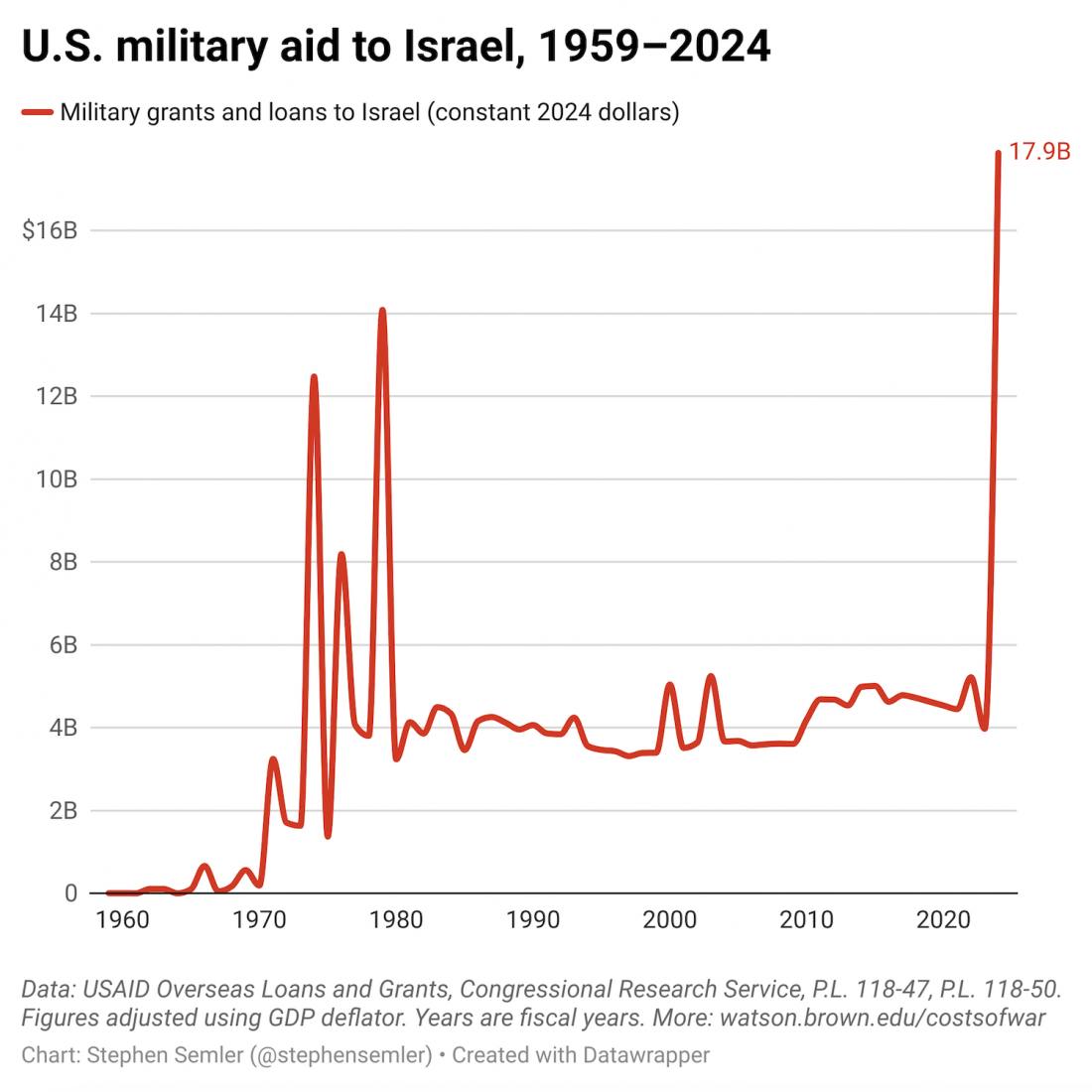
Retrieved from Watson Institute for International and Public Affairs
On the Ukraine-Russia front, the U.S. Congress has passed five bills since the Russian invasion (February 2022) to provide ongoing support to Ukraine, with the latest passed in April 2024. These bills authorize a total of $175 billion in aid, a figure often highlighted by the media. This substantial funding is benefiting a wide range of Ukrainian people and institutions, including refugees, law enforcement, and independent radio stations, though the majority of the aid is focused on military support. In addition to the U.S., dozens of other countries, including most NATO and EU members, are also contributing significant aid packages to Ukraine.
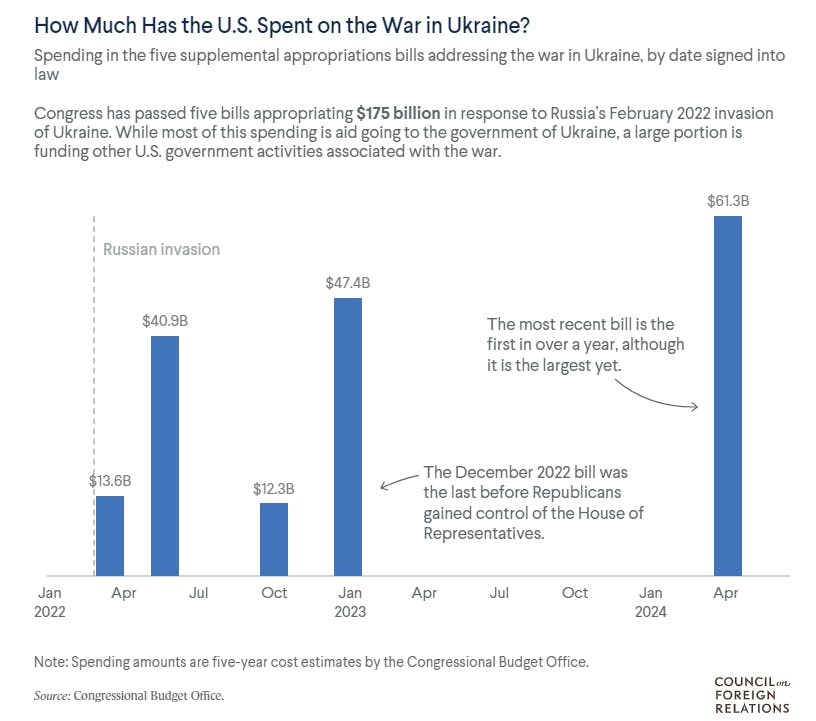
Source: Congressional Budget Office
In response, Russia has recently announced a 25% increase in its defense budget, reaching a record 13.5tn rubles ($140 bn) in 2025. This move reflects Putin's commitment to continuing the war in Ukraine and countering Ukraine’s increased armament.
ETF Issuers Flock to Capitalize on Growing Demand
In response to growing interest, new defense ETFs are being filed. U.S. Global has proposed an ETF focusing on defense, aerospace, and cybersecurity firms, while Pacer ETFs has filed for an ETF tracking emerging defense technologies in U.S. companies. These developments highlight the increasing prominence of the defense sector in the current geopolitical climate.
Please note this article is for information purposes only and does not in any way constitute investment advice. It is essential that you seek advice from a registered financial professional prior to making any investment decision.
Topics
See all
Mentioned ETFs
Further reading
Latest ETF News
See all ETF newsHow Investors can Maximize Tax Efficiency with Income ETFs


Trump Accounts: Here's Which ETFs You Can Invest In

The Two Best Types of Fixed-Income ETFs For Managing Cash

ETF Comparison: Roundhill Generative AI & Technology ETF Versus iShares A.I. Innovation and Tech Active ETF




 Advantages of ETFs over Mutual Funds1/6
Lower Costs
In this guide, we'll explore the advantages of ETFs over mutual funds, giving you valuable insights into why ETFs have gained significant popularity among investors like yourself.
Leveraged ETFs: Unlocking the Potential for Amplified Returns1/6
Understanding Leveraged ETFs
Explore leveraged ETFs: potential for amplified returns & risks. 5 ETFs to consider across equities, commodities & fixed income.
What is a Leveraged ETF?1/6
Introducing Leveraged and Inverse ETFs
In this guide, we'll dive into the world of leveraged ETFs, exploring their definition, mechanics, potential risks, and rewards.
Recent educational content

ETF Trends
ETF Industry KPIs July 20, 2026
This week’s KPI data overview highlights key metrics and trends shaping the ETF landscape.

ETF Trends
ETF Industry KPIs July 13, 2026
This week’s KPI data overview highlights key metrics and trends shaping the ETF landscape.

First Look ETF
First Look ETF: Cash Deployment, Bond, and Hedged ETFs
In this season 6 episode of First Look ETF, Stephanie Stanton examines the latest ETF marketplace trends with NYSE and guests.

ETF Trends
ETF Industry KPIs July 6, 2026
This week’s KPI data overview highlights key metrics and trends shaping the ETF landscape.
Browse all educational columns



Active Trader Report: Use of Leveraged & Inverse ETFs Way Up
Direxion partnered with Compound Insights and Vanda to explore what’s driving the evolution of active trading — and how active traders are using leveraged and inverse funds across equities, single stocks, commodities, and volatility.