From idea to ETF portfolio in minutes. Build yours now →



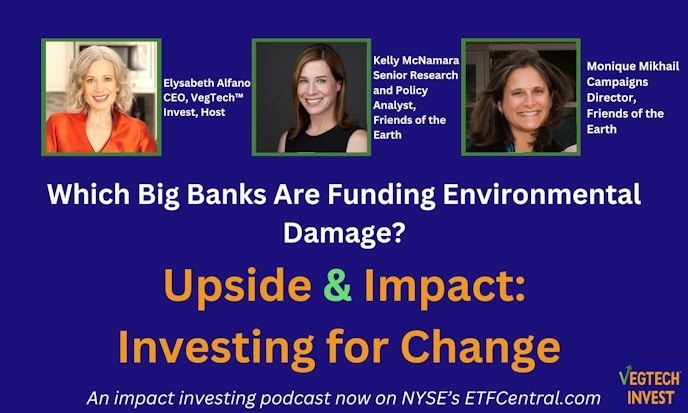
Who Funds the Most Environmentally Damaging Sectors? A New Report on the Banking Industry
Discover the alarming insights from the Bull in the Climate Shop report with Monique Mikhail and Kelly McNamara, revealing the banking industry's impact on climate change.

Keep up with what matters in ETFs
Get timely ETF insights, market trends, and top ideas straight to your inbox.
Your newsletter subscriptions with us are subject to ETF Central's Privacy Policy and Terms and Conditions.
Monique Mikhail, Former Senior Program Manager, Climate and Agriculture Finance Program, and Kelly McNamara, Senior Research and Policy Analyst, at Friends of the Earth join CEO of VegTech Invest and host Elysabeth Alfano, to reveal some shocking environmental statistics from their recent report, Bull in the Climate Shop, of the banking industry's funding of animal agriculture.
Specifically, they discussed
- What prompted the Bull in the Climate Shop report?
- How was the study conducted? What were the results?
- Why would Bank of America, Citigroup, and JPMorgan Chase put themselves at this kind of risk?
- What has been done with the results? Has there been any reaction from the banking industry regarding their climate footprint from this industry? Will there be any fallout?
- From a societal perspective, can the banks stop funding this industry? Is there any mandate to continue to fund them?
Get data on 14,000+ ETFs
Access Trackinsight's reliable and comprehensive data with 500M+ points on 14,000+ ETFs.
Listen here
Full Transcript
Elysabeth: Hey everyone, welcome to the VegTech Invest Upside & Impact podcast. I’m your host, Elysabeth Alfano, the CEO of VegTech Invest, Advisor to the Plant-based Innovation and Climate ETF, EATV. On Upside & Impact I chat with the leaders and movers who are shaping and growing impact investing for meaningful change. We “pull up as we go up” as the expression goes so this podcast is all about making meaningful and productive impact while also managing one’s portfolio for upside. Of course, always managing for upside.
If you’d like more information about VegTech Invest you can visit us at VegTechInvest.com and subscribe to our newsletter. You can also find us on LinkedIn and on Twitter @VegTechInvest. We record live every first and third Wednesday of the month on our LinkedIn page at 1:30pm eastern standard time. So, check us out live and be sure to bring your questions.
Now if you’re listening as part of a podcast, of course subscribe to this podcast right now so that you never miss an episode. And if you’re listening on iTunes, be sure to leave a 5-star review. It really does help.
So now let’s get down to today’s show and thanks for being with me on today’s episode of VegTech Invest’s Upside & Impact. And as always, a reminder, this podcast is for informational purposes only and is not meant to recommend any specific company or investment. Now, onto the show.
Hi everyone, it’s Elysabeth Alfano. I am the CEO of VegTech Invest and the host of Upside & Impact: Investing for Change, distributed by the New York Stock Exchange. Thank you to NYSE for distributing this podcast there. I hope that you are enjoying the very hot days of summer. These hot days are getting hotter, and it makes us think that maybe we might be starting to focus on climate change.
I wanted to bring to everyone’s attention that usually when we think of asking corporations to lower their greenhouse gas emissions for the betterment of climate change, we again, focus on those corporations. But maybe we should focus on who is funding those corporations. I bring on my two guests today, Kelly McNamara who is the Senior Policy Advisor and Research person at Friends of the Earth and Monique Mikhail who is the Senior Program Manager at Friends of the Earth. Thank you both for being with me today.
Monique Mikhail: Thanks for having us.
Elysabeth: The reason I bring you on today is that Friends of the Earth with Profundo have done in-depth research as to the banking industry and what they are funding specifically in reference to animal agriculture. So, if we maybe take a break from focusing on the stakeholder engagement of getting the corporations to lessen their greenhouse gas emissions, but we focus on those funding those corporations, those sectors, and those entities, then maybe there will be some traction and success there.
So, I don’t want to steal the thunder of these incredible results and I will be sharing this visually for all of you listening to audio. I will be sharing this visually to the people live today, the report Bull in the Climate Shop, which really focuses on the banking sector and then narrows it down to a couple top offenders, if you will, and their history in funding animal agriculture and what kind of impact that has had.
So, before we dive into those results, I will let you all take the stage and let’s start with Monique and say what prompted this report? Why did you decide to focus on the banking sector, specifically for animal agriculture?
Monique Mikhail: Thanks for much, it’s great to be here today. While everyone knows that we need to keep fossil fuels in the ground for climate change, not everyone knows that industrial livestock is one of the highest emitting sectors globally. As an environmental organization, Friends of the Earth U.S. is very concerned about industrial livestock’s negative impacts on the climate, as well as the myriad of other negative impacts of the sector.
For those who don’t know, industrial livestock production exacerbates deforestation, biodiversity loss, freshwater depletion, air, water, and soil pollution, violation of land and labor rights, antimicrobial resistance, the spread of infectious disease and zoonotic pandemics, and animal cruelty. There are massive impacts from this industry, and while climate is just one impact, it is arguably one of the most important and immediate.
So, in fact, we found in our report that the greenhouse gas emissions of just the 56 largest global corporations reviewed in our report are higher than the emissions of Japan, which is the world’s eighth largest emitter. So, it’s an industry with massive climate impacts and it is the bank loans to meat, dairy and feed corporations that these corporations use to expand their production which is driving more and more emissions.
This is why Friends of the Earth’s Agriculture and Climate Finance program, that’s the program that we’re part of, is focused on engaging with banks, both multilateral development banks on the public bank side, so taxpayer dollars, as well as the private banks and I’ll get into private banks in a moment. Their continued support for this expansion of this industry is really damaging at a time when scientists, global leaders, even some of the banks themselves have openly acknowledged that reducing global production levels is essential for limiting global warming to 1.5 or even below two degrees.
At the same time, banks have made commitments to address their role in greenhouse gas emissions. Many global banks, including the three U.S. banks that we focus on in our report, Bank of America, Citi Group, and JP Morgan Chase, which we refer to as the big three, they have signed up to the Net Zero Banking Alliance, through which they have committed to set net zero targets by the end of 2024 of this year for agriculture, and none of them have done so.
The banks need to be held accountable for their stated climate commitments. They themselves acknowledge that climate risk is financial risk and a major way that banks can address that climate risk is by acting on a small portion of their portfolio that goes to these global meat, dairy and feed corporations. So, with this information we reached out to the banks to engage them in dialogue about their support for meat, dairy and feed corporations, the impact of this support on their finance and facilitated emissions and their need to reduce these emissions as part of any coherent set zero strategy that they might have.
Elysabeth: Oh my gosh, so much to unpack there. Let’s start with the very beginning and then I’ll throw a question to Kelly, but I love that you decided to focus on this sector from a very basic standpoint. I mean, the point of this podcast, as I always tell everyone, is we’re here to share knowledge. It’s a volunteer activity for me. We’re just here to get out the data. Most people don’t realize the damaging impact and the ripple effect of this one sector.
Climate change, deforestation, biodiversity loss, food insecurity, you named them all. Antibiotic resistance, pandemic resistance. I don’t know if you mentioned labor rights. You had so many things in there, farm worker rights and labor rights and animal welfare and health care costs. These issues are all growing. None of them are diminishing. They’re all growing. So, I love that you’re highlighting a sector that most people don’t realize has the damaging impact that it does.
But then you said something else that I loved. You talked about private and public banks, so you were saying taxpayer dollars. I don’t know if people realize because, of course, everyone is allergic to any kind of tax that would raise the costs. I want taxpayers, so listeners, to understand they’re already paying the costs. So, there’s a great report from the Food and Agriculture Organization that says that the externalized cost to the general taxpayer from the global food system, which is based on animal agriculture, is $12.7 trillion, 10% of global GDP.
So, folks, this impacts you, whether you know it or not, you are paying the cost of the environmental damage of people being sick and so not being able to put out enough production or not enough production but their potential of full GDP, et cetera. So, the risks are there. Maybe I’ll throw it to Kelly now and say if you could give us- because I do want to get into the exact stats of the big three and again help people understand the impact of methane and why this report is just so important. But Kelly, maybe you can tell us a little bit of how this report was done just so people can understand the methodology.
Kelly McNamara: Sure, thanks. So, to generate the financed and facilitated emissions data from the big three, we partnered with a Netherlands-based data provider, Profundo. We first identified the largest global corporations across six sub-sectors of the industrial livestock production chain. This is beef, pork, poultry, dairy, animal feed, and the soy trade. Some of the corporations are active across more than one sub-sector, but in the end, this leads to a grouping of the 56 largest global corporations and the ones that are most attractive to the commercial banks and our targets or our big three.
So Profundo then extracted self-reported company financial and emissions data from Affinitive for these corporations and for the banks. Then Profundo additionally drew on information from company reports, company register fillings, and media and analyst reports. Profundo also used the most recent livestock emissions calculation methodology provided by the Food and Agriculture Organization, or FAO. With this, they applied a production-based methodology to the meat and dairy companies’ emissions.
This methodology filled in some important gaps that the definitive data or the company’s self-reported data could not address. So, after all this data gathering, we then looked at which U.S. banks were financing the big 56 corporations through loans and underwriting and came to understand the associated finance and facilitated emissions from this financial support. In the meantime, we also drew on our own research of industrial livestock’s negative impacts on climate and other environmental impacts, and we consulted with a variety of subject matter experts, including financial analysts and investment professionals to understand were we right? Are we getting the message across that banks’, financed, and facilitated emissions from the sector are critically important for them to address if they’re going to meet their net zero commitments?
Elysabeth: It’s just incredible, the depth at which you’ve gone to really make sure you got this accurate. Let me just say, and I’m going to share my screen here, before we get into the numbers, it is believed, as I understand it from having read the report, that all the companies that the banks finance, you believe that they under report and to some extent quite a large amount. Let me see if I can focus here and get you a little bigger view.
So, it seems that 56% of the companies don’t report at all. 22% only report Scopes 1 and 2, which is not where the emissions are. 85% of the emissions are in Scopes 3. So, you’re looking at 78% who don't report in full or don’t report at all, and I’ll bring everyone’s attention to self-reported JBS is 71 million tons of CO2, but it is believed that they really put out approximately 240 million tons. Am I reading this right, everyone?
Monique Mikhail: Yes, would you like us to go into that?
Elysabeth: Yes. So, I’ll just go with Kelly and then we’re going to get into the actual specifics with Monique. So, I really can’t wait to share the real data. Is this a fair representation, Kelly, that they all- I mean obviously JBS is maybe the most egregious under reporter here, but at least they’re reporting. Is it fair to say that these animal agriculture industry companies are not reporting in full?
Kelly McNamara: According to our research, that is fair to say. So as the graph above indicates, 56% are not reporting. Of those that are reporting, they’re not fully reporting Scope 3, then they’re under reporting. What you see in the graph that you had before is this huge differential for JBS between 71 and 240. What you’re seeing there is the company’s self-reported data, and the company also selects which categories of Scope 3.
So, for example, they report on executive travel, but not on purchased goods and services, which one needs to get into in a bit. So, they’re self-selecting here. The 239+ million figure is based on their production. So, this is where we used the FAO’s Gleam 3.0 methodology and looked at JBS’ actual output and calculated from there what their emissions would be. So that’s why this is so different. We have self-selected self-reporting and we have actual production-based methodology. We use the FAO’s methodology because it’s industry standard and it’s one that we give the most credible figures.
So, we’re very confident in these figures as you see them even though they’re so striking. We think this applies across the board. In fact, our research bears out that this under reporting applies across the board.
Elysabeth: I’ll just say, I think it’s important here that you mention the FAO because many consider the FAO to be neutral or maybe even slightly deferential, we’ll say, to the existing industry. So, you’re not using some skewed data that is meant to push an argument forward. This would be very much accepted industry standard data. So, let’s not keep people waiting. Monique let’s get into the data. I’ll let you share it, although if you listen to this podcast on a regular basis, you know that I quote this data all the time, but please tell me what were the results of this study?
Monique Mikhail: Absolutely. So, zooming back out a little bit to the first part, we found that there are 58 US banks that are providing financing to these 56 meat, dairy and feed corporations. That collectively is a staggering $134 billion in financing between 2016 and 2023 that they provided to fund the expansion of these corporations. This financing led to over 63 million metric tons of carbon dioxide equivalent emissions in 2022 alone.
So, to make that crunchier for people, it’s equivalent to the emissions from approximately 14 million cars driven for a year. That’s the same number of cars registered in the state of California. So, this really highlights the significant environmental impact of the bank financing of this sector. Bank of America, Citi Group, and JP Morgan Chase then emerged as the key players in the financing of those 58 banks.
They were collectively responsible for over half of the U.S. bank financing of the meat, dairy and feed corporations which is why we ended up dubbing them the big three and focusing our efforts on engaging those specific banks. I think most importantly, the real central fact of the report which we found, which even we were quite shocked by ourselves, was that the lending from these big three banks to the meat, dairy, feed and food processing and agri-commodity corporations that we reviewed in the report represents a tiny fraction, just a quarter of 1% of the big three loans outstanding, but actually roughly 11% of the reported financed emissions.
So, a quarter of a percent of their portfolio and 11% of their emissions. So, it has a massively outsized impact on their emissions compared to their actual portfolio. So, the emissions footprint from financing these companies, that’s a 44 times greater impact than the proportion of the bank’s lending portfolio, which is staggering. We also then looked at who the biggest climate culprits were that they were funding.
The meat giants, food processing corporations, and agri-commodity traders that supply animal feed are the highest emitters among this set from the big three, and specifically Cargill, ADM, Bungee and Nestle accounted for the bulk of financed emissions. Nestle, Cargill and ADM accounted for the dominant shares of facilitated emissions. Really interestingly, Bank of America should take note that their underwriting of JBS alone accounted for 87% of their facilitated methane emissions. So just the financing going to JBS has a massive impact.
So, to us, the conclusions just really jumped out as very clear. For the big three, curtailing support for meat, dairy and feed corporations would affect only a tiny fraction of their portfolio but result in significant reductions in their financed emissions and enable major progress towards their climate commitments. So, it’s one of the most climate positive choices that the banks could actually make to curtail the finance for this sector.
In addition to the under reporting that you mentioned and the lack of transparency that is basically effectively masking the true extent of the climate impact of the financing of these companies, we also found that methane emissions, which have 80 times the warming potential of carbon dioxide constitute up to 70% of the total emissions financed by the banks in the meat and dairy sectors. That’s using the GWP 20 metric, not the GWP 100 metric, but even with the GWP 100 metric it’s quite large.
So, this really underscores the urgent need to address methane emissions from financing industrial livestock activities, which just further underscore the point that I think we’re trying to make to the banks. We know that the banks know that climate risk is financial risk, but their support for continued expansion of the industry extends beyond their portfolios and their enterprise value to the broader climate system, the sustainability of financial markets, the long-term portfolio returns, which economic growth relies on. So, there is a ripple effect from their continued financing of this sector.
Ultimately then our report concludes by demanding that the big three and other banks take swift and meaningful action to reduce and ultimately eliminate the financing for these corporations because of their climate impact and shows them that acting on this sector can really help propel them towards meeting their climate commitments and drive forward the urgent adaptation and transformation of agricultural and food systems that we urgently need.
Elysabeth: It’s wonderful. Oh my gosh, so much to unpack there. I want to do a little bit of background before I jump in and further the conversation. You said facilitated emissions. Help everyone understand what that is.
Monique Mikhail: So, facilitated emissions are the emissions that come from the underwriting of these corporations. So, the financed emissions are the direct lending to the companies and then through underwriting, that’s what’s considered facilitated emissions. So, we split them out, but collectively they are the impact of the lending from these banks.
Elysabeth: Okay, so we’re talking about lending and underwriting. For the top three, I just want to repeat this here. For the top three, we’re looking at 0.25% of their portfolio of lending and underwriting is producing 11% of their greenhouse gas emissions and CO2 footprint.
Monique Mikhail: Of their reported ones, yes.
Elysabeth: Of their reported ones, right. We already established that they’re really underreporting so it could be much, much greater. It’s a very freaky number. I don’t know what else to call it except freaky that one company could produce so much damage. 87% of this is really focused on JBS for Bank of America.
Monique Mikhail: For Bank of America of their methane emissions.
Elysabeth: Of their methane emissions, great. Let me highlight this for people. So, of the greenhouse gas emissions, methane is the more nefarious, if you will, in that it’s much more impactful in a much shorter amount of time. Now, the silver lining is you can impact it now and have meaningful results in a shorter amount of time, unlike carbon, which is going to sit in the air for as I understand it, hundreds of years. So, you can impact methane now and reduce greenhouse gas emissions if you focus on methane.
32% of the world’s global methane emissions comes from the animal agriculture sector. 37% of the U.S.’s methane emissions come from this sector. So, methane is really a key target here and maybe even we’ll say JBS, a key target company. But please, go ahead.
Monique Mikhail: Just to add, I think the key there is addressing methane allows us to buy time to reduce the impact of other gasses, right? So, it’s super important because it has such a high potency. If we actively addressed it, it has such a positive impact by buying time for the longer-term gasses.
Elysabeth: Yeah, I always say on this podcast, we’re about to go into 2025. We pretty much know that nothing has been done for those 2030 targets and you’ve only got five and a half years to address those to even come close to your targets. Food is that fast, cheap lever to do that, specifically animal agriculture. So that’s the silver lining to the story. As egregious as this industry is, you can also have a very fast and relatively speaking inexpensive impact by addressing it straight out. So, I’m hopeful.
Maybe this will be a question at the end of the podcast. I’m hopeful that we’ll see diversified proteins, regenerative agriculture, and other options in five-year plans for corporations and governments as we had into 2025. We’ll talk about that a little bit later. Let’s get back to the actual results here.
This quarter point is producing 11% of the carbon footprint as reported by these top three. That’s Citi Group, JP Morgan Chase, and Bank of America. So, my question to Kelly and chime in Monique as well if you would like, is why? Why would they put themselves at this kind of risk? These are publicly traded companies. They’re not having the interest of their shareholders at heart. You could wipe out that 0.25% and you wouldn’t even notice it in your portfolio. You would still be making the same returns, but you would immediately reduce that carbon footprint, which is becoming a financial risk which they already accept. Why are they putting themselves in harm’s way like this?
Kelly McNamara: Yeah, that’s a great question and frankly we have that question ourselves. I think that part of the answer is that there’s a lack of awareness of just how much these emissions are contributing to the bank’s footprints. Citi themselves has said that it’s too complex to calculate the agricultural emissions. Monique and I would say, “Well, we did it.” So that’s frankly our response to that.
There hasn’t been attention on the sector, and I know this is coming up. We had COP28 and it’s rising to the surface, but for so many years, I think as we know, it’s been creeping up the agenda but just hasn’t been on the banks’ radar. So, they haven’t had to address it. So, I think that their investment in the sector has just been a business as usual, diversified portfolio, opportunistic sort of routine investing. So, I think a big piece of this is education and calling it out.
This is why this report, this is why the campaigning, this is why this is so helpful to be on your podcast and reach your listeners. So, to help them just raise awareness, to account for the reasons, exactly the reasons you point out. These are publicly traded companies, the banks I’m referring to. They have an obligation to shareholders’ diversified portfolios that are going to be at risk because of climate change being driven in no small part by industrial livestock. So that’s my high-level answer.
I think for the banks themselves, again, a great question, but I think it comes down to how the banks are currently perceiving relevant risks. So, by company financial risk, from a lending perspective, there’s a chance that the meat, dairy and feed corporations will struggle under various conditions. So increased regulation, physical risks, transition risks, shifting consumer preferences that can involve reputational risks, etc., all of which could impair a company’s ability to repay debt. So, there’s that.
There’s also the risk to banks of not meeting their net zero commitments, which it seems clear to us that they cannot if they’re ignoring more than 10% of their carbon footprint. How are they going to meet their net zero commitment? So again, as investor and regulator concerns about emissions from agriculture continue to intensify, I don’t think banks are going to be able to get away with saying, “Sorry, it’s too hard to set net zero decarbonization targets for some part of our portfolio” and investors will continue to just go along with that.
I think that’s changing and that’s going to be increasingly on the bank’s radar and a bigger and bigger risk for them. Just one last point, there are these risks, and I would say those are rising on the agenda and this is why the educational piece is important. But even more than this, and this is part of our responsibility, and we’re trying to advance this thinking is that in the longer term, the broader risks are more important than any of this. As we point to in our own report, banks themselves rely on the relative stability of global markets and we know climate change is on track to increase volatility to levels that banks, and asset managers cannot diversify away from.
So, we all know that arguments from the long term are hard to make, and yet they’re real and important and especially when the window of the long term is closing all the time. As you pointed out, 2030 is around the corner.
Elysabeth: Yeah, we talked about this last week or two weeks ago with Shareholder Commons and talking about how these externalized costs really can disrupt the market as well as our healthcare systems. These larger, maybe we’ll call them mildly esoteric concepts, are what is the fabric of our society that makes it run. So, it might be hard for one to process mentally that these systems could break down. These large-scale overriding systems, but that’s kind of what we’re up against right now.
It seems that I’ll point again to JBS. It’s bizarre to me that one company can have such an outsized impact and at the same time, it’s bizarre to me that such a small group of people- how many people are really at JBS? It’s not the workers, so how many people at JBS are really getting the benefit of all this lobbyist protection and policy protection? A very small group of people, while 99.99% of the world is feeling their impact. That’s incredibly unbalanced. I know Mighty Earth is working against having JBS go public in the United States.
We’ll see if this company continues to receive such great protection, but that question of protection is what makes me bring up my next question which is maybe they are lending and underwriting to the banks because there’s some kind of mandate. Have you in all your research found that maybe the government is asking them to do this, worried about food systems or worried about not feeding people? This is my own opinion. The government hasn’t invested enough R&D capital to really find alternatives and lentils, chickpeas, protein, stopping monocropping, and bringing out other alternatives for protein sources. We haven’t done this kind of innovation and research, so maybe there’s some government pressure to continue to lend. What do you think, Monique?
Monique Mikhail: I’m going to let Kelly answer this one.
Elysabeth: Great.
Kelly McNamara: Sure, so we’re not aware of any mandate, right? But to your point, Elysabeth, I do think that it’s not an unreasonable assumption or guess or intuition. I think that’s entirely possible. What I can tell you is that we’ve heard from the banks that they are concerned about food security and that this is playing into their decisions about continuing to invest in the sector. Where that comes from, I can’t say per se, but we have heard that.
Our response has been a business-as-usual scenario, which is what they’re supporting. A business-as-usual scenario for meat and dairy production puts the goals of the Paris agreement and therefore a relatively stable economy in a livable planet squarely out of reach. Such a future also involves climate conflict, famine, food security, and forced migration. All unmanageable negative impacts on the world’s most vulnerable populations.
We find a lack of coherence in talking about food security and expanding industrial livestock production, which in most part doesn’t serve the world’s most vulnerable populations and does not serve the 800 million people who are currently food insecure and hungry. It feeds people who are overconsuming, which has risks of its own. Systemic financial risks, health risks, public cost risks, taxpayer risk. It has all kinds of risks of its own. We don’t really get a good response to that, to be honest.
We also raise the point that the reality is that feeding animals instead of humans exacerbates food security. I know you’re aware of this, but for your listeners' benefit we know that food experts and scientists from around the world have sounded the alarm about this. The UN reports that 10% of the world’s population is suffering from hunger while factory farmed animals consume 75% of the world’s soy and 36% to 40% of all cereals. Essential foods that could be devoted to alleviating hunger and malnutrition.
The impacts of animal products markedly exceed those of vegetable substitutes to such a degree that aquaculture, eggs, and dairy use 83% of the world’s land, contribute about 60% of the food sector’s emissions while providing just 30% of our protein and 18% of our calories. That’s radically inefficient. You add to this water shortages, water from irrigation, water from pollution, the fact that half the world’s population will be living in areas experiencing water scarcity as soon as next year, and this is a radically inefficient system that is not serving vulnerable populations and that threatens to put the food security of all of us at tremendous risk. So again, part of our educational mandate is to point this out.
Elysabeth: I’m so happy that you’ve given us all those stats. Monique started this interview by giving a long list of negative impacts from this sector, and here we’re really talking about food justice. This is where it can get disappointing how short-sighted both the companies and the government policies are. When you have food insecurity around the globe, that becomes an issue of national security. People just don’t hang out without food and water. They go to places where there is food and water for them.
So, these food injustices, disparities, this imbalance, and larger portions of the world going hungry is an issue of national security. Governments don’t get reelected when they have this kind of volatility or they’re even having trouble feeding their own people. Two weeks from now, we will have the undersecretary of the USDA, Sanah Baig, who will talk about how food insecurity in the U.S. is on the rise.
Most of the U.S. will never go hungry of course, but even that’s up 25% in 2023 from 2022 in the U.S. It’s kind of an unfathomable stat, and you’ve already given us so many unfathomable stats. So now I’ll broaden my question to say, not only did the banks put themselves at risk, but governments seem to put themselves at- I won’t even say long-term risk. I’ll say medium-term risk because if you take anything away from this podcast today, listeners, is that our current global food supply system does not work.
We saw this during Covid, and we saw it with the Ukraine War. The minute there’s a small pressure on a food supply system, and its long supply chains and its inefficiency that feeds animals and not people, it breaks down. I’ll ask then, since the banks say it’s too hard to report, which is very lame at this point. I don’t even know if there’s a better sort of business term, except I’ll say that’s very lame. It’s to claim that they don’t know their own data. If they don’t know their own data, they certainly should. I believe that’s also one of their responsibilities as publicly traded companies to their shareholders. What has the bank’s response been to this report? Monique?
Monique Mikhail: Yeah, we have engaged with two of the three banks off the back of this report. We’ve had open dialogue with them, and I’d say discussions are ongoing and we continue to welcome the opportunity to and reach out to the third bank and hopefully they will ultimately also dialogue with us. Perhaps I think most importantly, what the results have done has helped us to refine what we’re asking of the banks to reduce their exposure to this subsector.
I’d like to share those three main demands. I think I shared the top line before, but really, we’re asking them to halt all new financing that enables the expansion of this production. So not even just get out of the industry, but just don’t continue to help expand. The second one is around requiring these meat, dairy and feed clients to disclose third party verified 1.5 degree C targets and action plans that align with the IPCC or an equivalent science-based sectoral pathway.
The third demand is that they address the additional social and environmental harms that we’ve mentioned from industrial livestock production by requiring that these corporations do a bunch of things including halt deforestation of biodiversity loss, respect human and labor rights, enact zero tolerance for violence against human rights defenders, establish robust grievance mechanisms, and adopt strong animal welfare criteria. So, we do have a whole set of demands of the companies, and we are discussing those in the dialogue with them.
Even one step back from that this year, to follow through on their commitment to set Paris-aligned targets for agriculture, and specifically for industrial livestock production. So, the first step is just do what they already said they were going to do and do it, right? Follow through on what they said they were going to do. I think in doing that, we can then get into all the details of what that looks like in specificity.
So that’s been the result of engaging with the banks, trying to get them on this path of understanding what this sector means to the world, what this sector means to them, and to their portfolios and to their own financial risk, and what they can actually do about it in a meaningful way.
Elysabeth: I’ll be a little bit Pollyanna again and find a silver lining here. While they may not be fully aware prior to your report of their impact, we’ll give them some grace here and what they can do to make change, they do know that they are powerful. Banks know that without their lending, things don’t happen and with their lending, things do happen. So at least they start there from a basic understanding that they can impact change and be an agent of change. How have the dialogues been doing?
Monique Mikhail: Well, we’re just at the very beginning of the dialogues and as I said, two of the three have entered that with us and its ongoing. I think we can broadly say that the issue of ag emissions and particularly industrial livestock emissions is rising on their radar. Now they’re aware if they weren’t before. Although all three of the banks had made bold statements about the importance of the food and agriculture sector before we put out a report. So, they were aware that it was important. They just hadn’t done much about it.
I don’t think they had gone into the detail of what specifically industrial livestock means to them and to their portfolios. So, giving them the benefit of the doubt, they now are aware of that impact and are entering into these conversations with us. Also, I’d like to say the climate biodiversity nexus is also rising on the agenda, especially with the upcoming convention of Biological Diversity COP that is happening this fall, which means that the negative impacts of industrial livestock production and the relevant risk for financiers is also rising in awareness.
That said, it’s early days for concrete action in the sector. The fossil fuel finance movement has been going on for quite some time and they’ve been making some progress, but they’re still a long way to go. We’re really in the early stages of understanding and awareness. Hopefully, we can accelerate that faster than it’s gone for the fossil fuel industry. I would say, I think what’s different maybe between this sector and fossil fuels is that fossil fuels are a much larger part of these banks’ portfolios than the meat, dairy and feed corporations, as we’ve said is a teeny tiny percentage.
So, the action on this sector is much easier, relatively much easier than action on the fossil fuel industry. That doesn’t mean they shouldn’t act on fossil fuels. They absolutely 100% should follow through on actions that are being demanded on that side. For this sector, it’s not as big of a deal for them. So, it’s important that they act on it, and they can do it much more quickly than I think on the fossil fuel side. So, you know, the reality of climate change is setting in. Food and Ag is rising on the agenda finally of the importance to climate and biodiversity loss. It may be more easily disrupted than say oil and gas. So, I think that it’s incumbent on the banks to act on this portion of their portfolio.
Elysabeth: In many ways, it’s not a big ask because it’s only 0.25% of their portfolio. So, they only have upside here. That’s why I asked the mandate question from governments. They only have upside. Let me just do a quick change. Hopefully everybody can see this. According to the Boston Consulting Group, if you were to invest in diversified proteins or other green technologies such as alternative building materials, new energy, or electric vehicles, one would see that diversified proteins are three times to forty times more impactful at reducing greenhouse gas emissions than the other green technologies.
That’s primarily because the cost needed to impact change, the capex for further fermenting proteins where that technology is already available, is much less than re-electrifying the grid for the entire country or the entire globe for electric vehicles. So, the capex to impact change is much lower. Therefore, you can change and impact faster. So, I just thought I would share that.
Let me ask you a couple more questions, Monique, about dialoguing with the banks. They have all put out those targets for 2030. This is a nuanced question. Is there any sort of bashfulness, I’ll say, maybe not a word usually used to describe banks, or not shame. I don’t want to say that. Is there timid acknowledgement that yes, they’re very far off from their goals? Is there any sort of humility around how far away they are from where they promised they would be? It’s a subjective question, so you don’t have to answer it if you don’t want to but there's such a gaping disparity between what they’ve put out publicly and what they’re doing. I wondered if there’s any notion of that reasoning with them.
Monique Mikhail: I think it depends on who you talk to inside the bank, but I would say, honestly, I think that I’d like to give them a bit of grace on this sector because they have been so focused on the fossil fuel industry. I think our colleagues that work more on the fossil fuel side would have a lot more to say about the engagement in those sectors. I think they are falling short from not just what they’ve committed but what they should be doing. Even what they’ve committed isn’t enough as compared to what they should be doing and their role in really averting climate disaster.
That said, this sector is relatively new for them, and I think we are trying to expand the spotlight. Not turn it but expand the spotlight to say that there are other massive high emitting sectors beyond fossil fuels. When they signed up to the net zero banking alliance, they did agree to open that spotlight. They were going to start with specific fossil fuel industries like oil and gas and then they were going to widen to other high emitting sectors, including agriculture.
Now is the time that they widen to other sectors and specifically agriculture. Within agriculture, the highest emitting section of agriculture, which is industrial livestock production and we’re making that case to them. So, I’d like to say, I think they’re in that process of expanding their gaze beyond fossil fuels and starting to see the importance of this sector.
Elysabeth: Wonderful, and good news for them. So, they might come close to those goals if they focus on this sector because it plays such a large role and it’s not really that big of an ask, as we said, it’s 0.25%. So that’s kind of good news for them. Your last point about your dialogues was that you’re encouraging the banks to require from the industry that they address some of the social ills that they’ve played a part in creating such as worker injustice, food insecurity, climate change, biodiversity damage, and climate change damage.
Basically, you’re asking them to internalize costs that they have been externalizing to society for a very long time. Do you have any insight into how those dialogues are going between the banks and the animal agriculture sector? Or is that just really two early days?
Kelly McNamara: Yeah, I’m happy to take that one. I would say it is early days, but these banks do have policies or are developing policies that can cover some of this. So, there’s no deforestation policies coming into place. There are labor policies coming into place, not just child labor, but other sorts of forced labor, labor safety, and labor justice policies. So, there’s this strange thing that happens when banks are divided, and some policies overlap, or policymakers don’t always speak to the investors or it doesn’t apply to certain industries. It gets sort of complex.
I would say the good news is that these systemic crises, I would say, are inspiring banks to come up with some high-level policies that should apply to this sector. So increasingly, we should be able to say, “Apply your no deforestation policy to JBS because there’s no way that they fall in line with your no deforestation policy,” for example. So, I think that’s the good news.
On the sort of bad news side are the exceptions for the industry and the arguments for staying in it. If there is a government mandate, maybe that’s why they’re in it. I’m not sure if there’s some behind the scenes force that we’re not aware of. Then there’s exceptions to this rule and this is like this net zero target. They say, “We’re going to cherry pick the sectors. We’re going to decide what the emissions intensity reductions we’re going to ask for this sector are.” That’s very, very specific and very bank dependent. It’s not, “We’re going to ask our oil and gas clients to reduce their absolute emissions by X.” You don’t see that anywhere, right? How does this play out in practice?
I think that’s the bad news that it’s not clear how banks can or will ask, demand, or put requirements on lending of these companies that would result in these companies reducing their harms. I’m not sure it’s going to happen. Our job is to agitate, to educate, to elevate awareness, to get shareholders involved, to raise these issues, and that’s what we’re trying to do. So, I can say, perhaps back on the good side, that we will continue to do that. We will try to not let the door close on this and to keep the noise level up and see where we get. So, I would say I’m balanced. I'm relatively hopeful.
Elysabeth: Relatively hopeful. I love it. I am as well. With that, maybe I’ll go to the final question. I’ll start it with Kelly and then we can hear from Monique. So, we’re kind of inching into next steps. What might be the next steps that we’d like to see or really what I’d like to know is what do we think we will realistically see? Now we are approaching 2025. We’ve got those five-year goals and 2030 is around the corner. What realistically do you think we will see? Starting with Kelly and then going to Monique and then I’ll chime in as well. What would you like to see?
Kelly McNamara: Sure. So, from what we will realistically see, I would say that as I was mentioning before, banks having no deforestation policies, labor policies, so I think we’re going to see the codification of more of these across the board. In no small part because they align with regulations like the EUDR. I think that this CSRD is going to have an impact and this CSDDD is going to have an impact.
All these global players have exposure in different markets. They’re going to have to come up to standards that are ahead of the U.S. standards, which they haven’t had to yet, but I think they’re going to have to.
Elysabeth: Many of the listeners don’t know what any of those acronyms are.
Kelly McNamara: Apologies.
Elysabeth: What are you talking about?
Kelly McNamara: The EUDR is the EU Deforestation Regulation. So, this is about requiring that companies not procure products that have exposure to deforestation before 2020. The CSRD is the Corporate Sustainability Reporting Directive, again out of the EU, but is this similar to the SEC scope rule, but the CSRD is stronger, and it involves many more aspects of general sustainability, so corporates have to report on their impacts on climate, on biodiversity, and on other natural resource elements. That’s a CSRD.
The CSDDD is the Corporate Sustainability Due Diligence Directive. This is about financial players included. What kind of due diligence are they doing into the companies that they’re investing in to make sure that those companies are abiding regulations and standards and accounting for their sustainability impacts? So, I hope that’s clear.
I guess the high note for your listeners is that the EU is significantly ahead of the U.S. on these standards. We’re dealing with U.S. banks, but again, these U.S. banks have subsidiaries. They have operations in other countries and similarly to the conglomerates they’re invested in, they’re going to have to rise to the occasion. I don’t think there’s any way of getting out of this. All these EU regulations are coming into effect incrementally, but they’re going to get stronger. We anticipate they’re going to get stronger. Maybe fingers crossed on that, but I think that’s going to have an impact.
This is, again, what makes me sort of hopeful that we’re going to see high level policies. I do think that we will see emissions reduction targets for agriculture. I don’t think we’ll see them in the next year. Monique may differ with me on that. I’m going to defer to her next. So, I don’t see that in the very near term. What I do see is an open acknowledgement that goes beyond the little reports that have come out from different pockets of banks talking about who is important but going much more beyond that and talking about the risks to the banks and the risks to the broader economic system of continuing to invest in the expansion of this industry. So those are my thoughts, and I’ll turn to Monique.
Monique Mikhail: Maybe I’ll do what we’d like to see. What we’d like to see is obviously that all of our demands in the report are met, but basically we’d love to see that the banks actually put their actions where their mouths are and they actually follow up on setting Paris-aligned targets in agriculture and specifically focus on livestock as a high-emitting sector and take it seriously and that they at least start on a trajectory of addressing their emissions impact in this sector and that would be by stopping funding for the expansion of the sector. That would be a great first step after setting these targets. That would be part of any net zero plan that they might set.
I think importantly to mention, there is an increasing number of organizations beyond Friends of the Earth that we ally with who are focusing on the harms of industrial livestock and who are focusing on the importance of curtailing finance to the sector to stop the expansion of this damaging industry. As we head into the fall and the upcoming climate week in New York, the upcoming climate COP, we are going to keep spreading the word that banks’ climate goals can really be credible only if they treat industrial livestock as a high-emitting sector. They must do that to be credible in these commitments that they’re making. Otherwise, they’re basically meaningless.
They need to take swift and meaningful action to stop supporting expansion of this industry. For them, it’s a no-brainer in our minds because it’s a tiny portion of their portfolio and can have an outsized impact on their ability to honor their climate commitments. So, we’ll just keep making our points. We’ll keep talking with the banks. We’ll keep raising the noise level, as Kelly said, and hopefully make some progress with the banks along the way.
Elysabeth: Well, thank you both for all you do and thank you to Friends of the Earth and Profundo for this incredible report. I’ll say that as we approach 2025, regardless of an election, I do think that climate change as a financial risk will continue to be a reality and any multinational company wanting to do business in Europe better take this seriously. So, whether U.S. policy or not, U.S. elections or not play a role as maybe even secondary to how business will function in the future as you see these stronger European guidelines.
So, I do think we will see in 2025, perhaps more attention paid to this sector. We always talk on this podcast about how you just won’t impact climate change in the time you need to do it if you don’t address the animal agriculture sector. So, I think that will become more apparent in 2025. I will say that something I would like to see from the banks is you can’t just ask people to stop eating something and have no replacement and you can’t ask them not to fund this and then have no option for replacements so that replacement can take the form of regenerative agriculture and stopping mono cropping and bringing out more things like fava bean and chickpea for either straight chickpea and rice dishes that I make at home or a chickpea burger.
This is an investing podcast. Innovation, as my listeners know, is really where growth is. No one makes money because a firm went up 2% or not. They make money because there is a novel innovation that is mass adopted at scale. That’s where real wealth is created. That’s where real change is created. I’d like to see those banks that were funding harmful entities start funding the non-harmful replacements. I’d like them to be an indicator to government policy to follow.
I’d love to say that the government comes first. I don’t know that that’s always the case, but I do know that they work hand in hand. So, I call on the banks to take a leading role here and then go ahead, write the press release of how you have impacted the world. We will let you take the accolades. So go ahead and make the smart move. It’s only an upside for the banks. So that’s my two cents before we really leave because I know we’re all up against time.
One word answer from each of you, maybe one sentence answer, starting with Monique and ending with Kelly. Monique, when you’re having a very tough day and you don’t have time for lunch, what’s your go-to snack?
Monique Mikhail: I always eat lunch. My meals are very important to me as Kelly knows, but I will say I really like peanut butter pretzels.
Elysabeth: That’s been a thing lately. Everyone’s showing up with peanut butter pretzels all over the place. That’s fantastic. I just had peanut butter bananas and maple syrup for lunch yesterday. I know, call me strange. Kelly, what is your go-to snack on a busy day?
Kelly McNamara: I love a good trail mix, especially if I can get some vegan dark chocolate chips in there. That’s my go-to.
Elysabeth: Oh my god, preaching to the choir here. I want to thank Monique Mikhail and Kelly McNamara from Friends of the Earth for putting out the Bull in the Climate Shop report on how banks are lending to a very damaging sector that is animal agriculture and how they can stop lending to this sector. It’s not really a big ask. It’s only 0.25% of their portfolio of lending and underwriting to get 11% reduction in their carbon footprint. So, I love this report. It will be in the notes for the podcast. It will be on social media.
Thank you both for doing the report and of course your teams. I say goodbye to Kelly and Monique, but you guys don’t go away. Everybody else on Facebook, LinkedIn, YouTube, and X, I will see you next week. Thanks everybody.
Thanks for being with me everyone on today’s episode of VegTech Invest’s Upside & Impact. I hope that you’ve found this to be a knowledge drop and I’m always here to answer any questions so please feel free to reach out to me on LinkedIn. Elysabeth Alfano, you can find me there. I’m also on Twitter @ElysabethAlfano and you can find the VegTech Invest pages on both LinkedIn and Twitter.
Sign up for our newsletter at VegTechInvest.com and share this podcast with your colleagues, friends, and clients. And of course, be sure to subscribe to this podcast to never miss an episode. Remember we record live on the VegTech Invest LinkedIn page every first and third Wednesday of the month at 1:30pm eastern standard time. So come find us there to join the conversation live. Until then, thanks for leaving a 5-star review on this podcast app because it really does help.
If you’d like more information about VegTech Invest you can visit us at VegTechInvest.com and subscribe to our newsletter. Okay everyone, great show today. See you next time on VegTech Invest’s Upside & Impact.
VegTech Invest is a registered investment advisor focused on investing in sustainable food and materials. This podcast is for informational purposes only and should not be relied on as the basis for investment decisions. It does not constitute either explicitly or implicitly any provision of services or products by VegTech Invest. All statements made regarding companies and securities are strictly beliefs and points of view held by VegTech Invest or podcast guests and are not endorsements or recommendations to buy, sell, or hold any security. Clients of VegTech Invest may maintain positions in the securities discussed in this presentation. VegTech Invest believes that the information presented is accurate and was obtained from sources that VegTech Invest believes to be reliable. However, VegTech Invest does not guarantee the accuracy or completeness of any information and such information may be subject to change without notice from VegTech Invest.
Certain statements in this presentation may be statements of future expectations and other forward-looking statements that are based on VegTech Invest’s views and assumptions at the time of publication and involve risks that could cause actual results, performance or even events to differ materially from what is expressed or implied by such statements. VegTech Invest’s strategies are actively managed and not intended to replicate the performance of any cited index which may differ materially. You cannot invest directly in an index.
Segments
See all
No specific market segments were tagged
Mentioned ETFs
No specific ETFs were tagged
Further reading

Latest ETF News
See all ETF newsThis is How Calamos Turned Wall Street’s $100 Billion Secret Into an ETF




From Dot-Com to ETFs: How One Entrepreneur Helped Spark an Investment Revolution
How Blossom Social Is Revolutionizing Retail Investing and ETF Marketing

Is 2025 the Year for Financing Food Fast?

 Advantages of ETFs over Mutual Funds1/6
Lower Costs
In this guide, we'll explore the advantages of ETFs over mutual funds, giving you valuable insights into why ETFs have gained significant popularity among investors like yourself.
Leveraged ETFs: Unlocking the Potential for Amplified Returns1/6
Understanding Leveraged ETFs
Explore leveraged ETFs: potential for amplified returns & risks. 5 ETFs to consider across equities, commodities & fixed income.
What is a Leveraged ETF?1/6
Introducing Leveraged and Inverse ETFs
In this guide, we'll dive into the world of leveraged ETFs, exploring their definition, mechanics, potential risks, and rewards.
Recent educational content

ETF Trends
ETF Industry KPIs September 14, 2026
This week’s KPI data overview highlights key metrics and trends shaping the ETF landscape.

ETF Trends
ETF Industry KPIs September 8, 2026
This week’s KPI data overview highlights key metrics and trends shaping the ETF landscape.
ETF Trends
ETF Industry KPIs August 31, 2026
This week’s KPI data overview highlights key metrics and trends shaping the ETF landscape.
ETF Trends
ETF Industry KPIs August 24, 2026
This week’s KPI data overview highlights key metrics and trends shaping the ETF landscape.
Browse all educational columns



Build and Analyze Your ETF Portfolio Like a Pro
Create your own ETF portfolio in minutes and instantly see allocations, exposures, performance, and risk. Visualize diversification across asset classes, regions, and sectors. Stress-test ideas, compare benchmarks, and refine your strategy with professional-grade analytics.