Ready-made ETF portfolios built for real investor needs. Explore now →



Fixed Income 101: Understanding U.S. Corporate High-Yield Bonds
Domestic high-yield bonds can be a way to obtain higher monthly income but at the cost of greater credit risk. Here's all you need to know.


Keep up with what matters in ETFs
Get timely ETF insights, market trends, and top ideas straight to your inbox.
Your newsletter subscriptions with us are subject to ETF Central's Privacy Policy and Terms and Conditions.
When it comes to fixed income investing, many investors typically start with aggregate bond ETFs, a popular choice due to their broad exposure. These ETFs typically include a diverse assortment of investment-grade corporate bonds and government treasuries, offering a blend of stability and returns.
However, they usually exclude a particular type of bond that stands apart in terms of risk and return: high-yield bonds, commonly referred to as "junk bonds." High-yield bonds are distinct within the fixed income asset class, primarily due to their unique risk-return profile, which we will explore later.
Like many assets in the modern investment landscape, high-yield bonds can be accessed affordably, transparently, and with good liquidity through ETFs.
This accessibility allows investors to incorporate these higher-yielding, higher-risk bonds into their portfolios without the need for direct bond purchases, which can be complex and less liquid.
However, before diving into a high-yield bond ETF, it's crucial to understand the unique characteristics of these bonds, how they fit into an overall investment strategy, and the potential risks and rewards they bring. Here's all you need to know about high-yield bond ETFs.
Global ETF Survey 2026 is Live!
With 1,790 new products launched by July 2026, choosing is harder than ever. Our Global ETF Survey 2026, built on 620 professional investors and allocators, shows how active, fixed income, options-based and thematic ETFs are reshaping fund selection.
What is a High-Yield Bond ETF?
A high-yield bond ETF is a type of investment vehicle that primarily holds a collection of high-yield bonds as its underlying assets.
These bonds, commonly known as “junk bonds,” are characterized by their ratings below investment grade, typically BB or lower, as assessed by major rating agencies.
The classification of these bonds as below investment grade reflects the heightened risk associated with their issuers, who are considered more likely to default on their debt obligations.
This default risk could manifest in the form of missed interest (coupon) payments or failure to return the principal amount.
Despite the increased risk of default, high-yield bonds offer a significant advantage: they typically provide much higher yields compared to investment-grade corporate bonds. This higher yield compensates investors for the additional risk they undertake.
Moreover, as a bond investor, one still enjoys the hierarchical benefit in the capital structure, meaning in the event of a company’s liquidation, bondholders are prioritized over equity and preferred stockholders for any payouts.
High-yield bond ETFs offer several advantages over purchasing individual high-yield bonds. One of the primary benefits is diversification. By investing in a high-yield bond ETF, you gain exposure to a broad range of bonds, thereby spreading out and potentially reducing the risk associated with any single issuer.
Another advantage is the frequency of income distribution. While individual high-yield bond issues typically pay interest semi-annually, high-yield bond ETFs often provide monthly distributions, offering a more regular income stream. This feature can be particularly attractive for investors seeking consistent cash flows from their investments.
Advantages of High-Yield Bonds
Historically, high-yield bonds as an asset class have provided competitive total returns, falling somewhere between aggregate bonds and domestic total equity market returns.
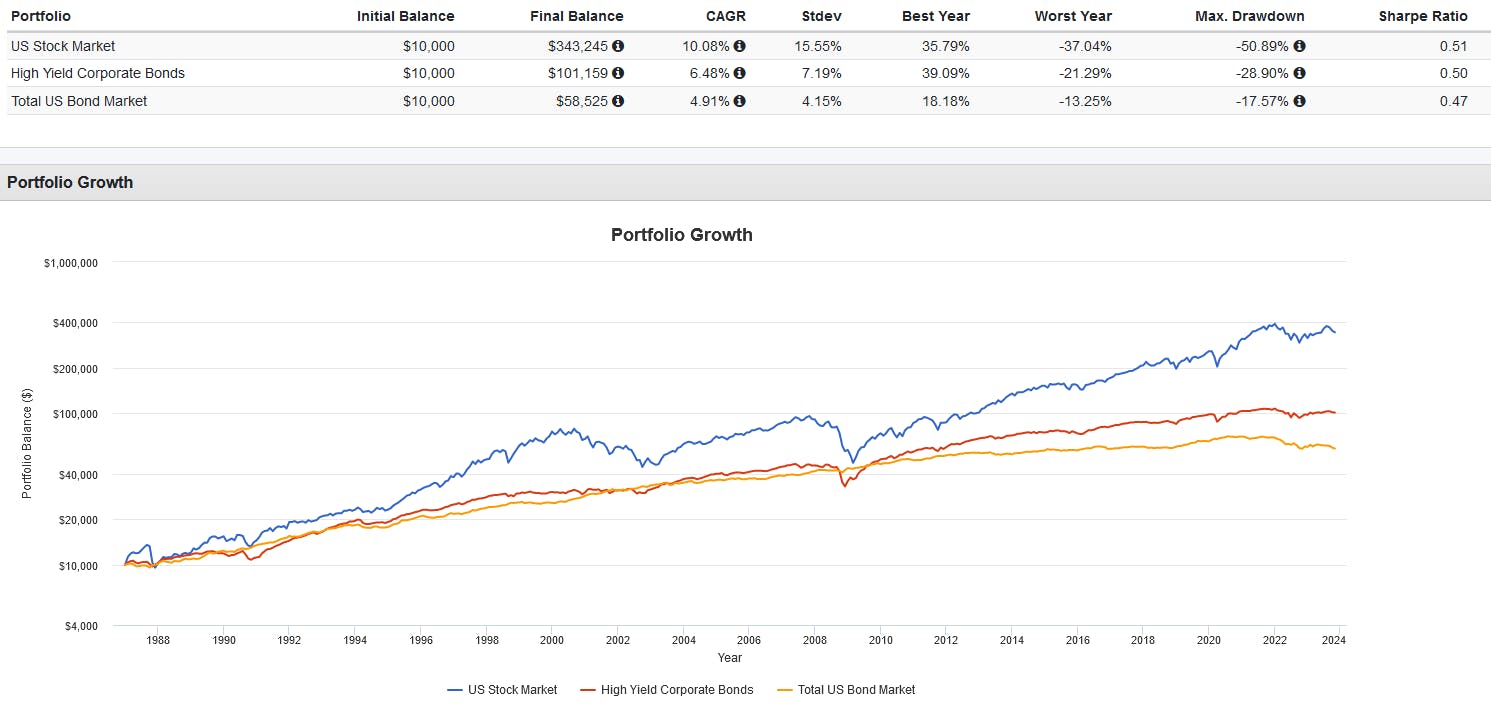
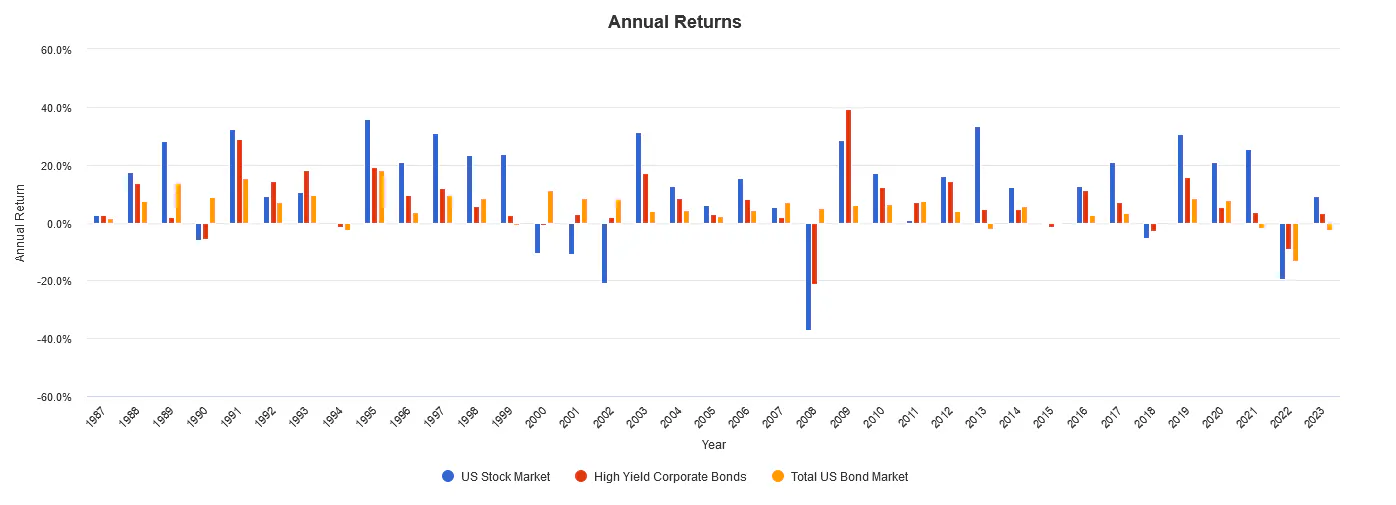
As seen above, high-yield bonds returned an annualized 6.48% from 1987 to the present, compared to 10.08% for the U.S. stock market and 4.91% for aggregate bonds. Risk-adjusted returns were competitive too, with a Sharpe ratio of 0.50.
The current yields investors can expect with a high-yield bond ETF are nothing to sneeze at. Examples like the WisdomTree US High Yield Corporate Bond Fund (WFHY) and the SPDR Bloomberg High Yield Bond ETF (JNK) and are paying a yield to maturity of around 8.5% right now despite having a fairly low duration (a measure of interest rate risk).
Disadvantages of High-Yield bonds
These stellar yields come at a cost though. The much higher credit risk of these bonds has historically resulted in steep drawdowns during various economic crises. When turmoil strikes, worries of their issuers defaulting come to the surface, and these bonds can sell-off.
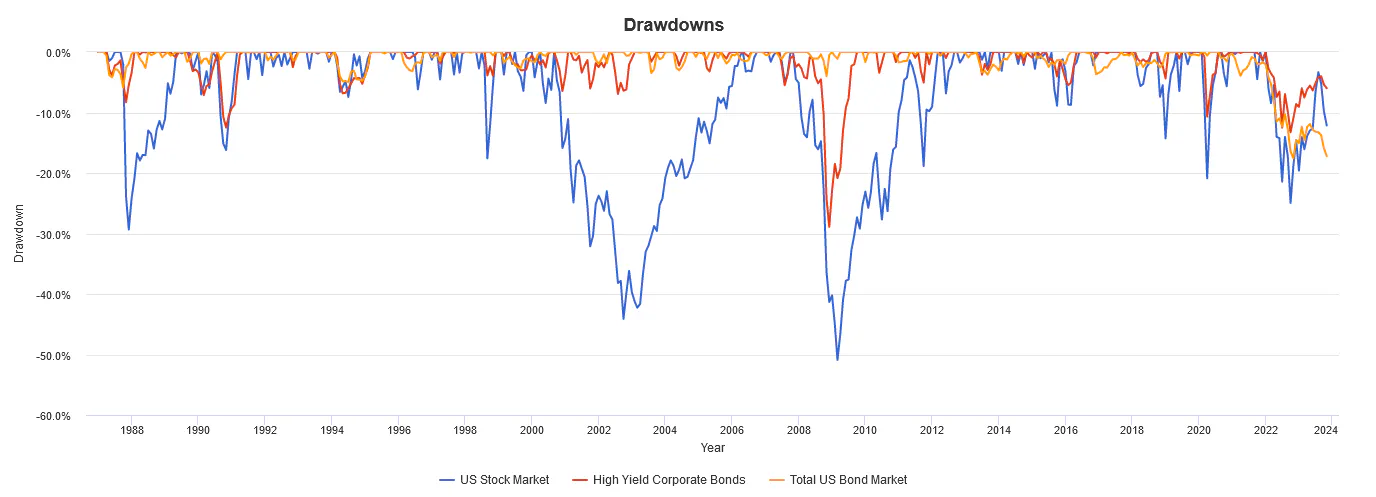

As seen above, the drawdowns experienced by high-yield bonds fall somewhere between aggregate U.S. bonds and equities. Investors should not expect that these bonds are a free lunch – for example, they fell by 28.46% during the depth of the 2008 financial crisis.
Please note this article is for information purposes only and does not in any way constitute investment advice. It is essential that you seek advice from a registered financial professional prior to making any investment decision.
Latest ETF News
See all ETF newsThere's an ETF for That? Humanoid Robotics and Physical AI

How Some ETF Issuers Use Their Own Funds for Cash Management

These Public-Private ETFs Invest in Polymarket and Anduril

There's an ETF for That? Frontier Markets




 Advantages of ETFs over Mutual Funds1/6
Lower Costs
In this guide, we'll explore the advantages of ETFs over mutual funds, giving you valuable insights into why ETFs have gained significant popularity among investors like yourself.
Leveraged ETFs: Unlocking the Potential for Amplified Returns1/6
Understanding Leveraged ETFs
Explore leveraged ETFs: potential for amplified returns & risks. 5 ETFs to consider across equities, commodities & fixed income.
What is a Leveraged ETF?1/6
Introducing Leveraged and Inverse ETFs
In this guide, we'll dive into the world of leveraged ETFs, exploring their definition, mechanics, potential risks, and rewards.
Recent educational content

ETF Trends
ETF Industry KPIs October 5, 2026
This week’s KPI data overview highlights key metrics and trends shaping the ETF landscape.

ETF Trends
ETF Industry KPIs September 28, 2026
This week’s KPI data overview highlights key metrics and trends shaping the ETF landscape.
ETF Trends
ETF Industry KPIs September 22, 2026
This week’s KPI data overview highlights key metrics and trends shaping the ETF landscape.

First Look ETF
First Look ETF: Income, Corporate Arbitrage, and Growth and Value Investing
First Look ETF September 2026: iCapital, Mast Investments and North Square unpack new ETFs targeting monthly income, merger arbitrage and complementary growth and value exposure.

Browse all educational columns



ETFs’ Next Act: From Access to Selection
With 1,790 new products launched by July 2026, choosing is harder than ever. Our Global ETF Survey 2026, built on 620 professional investors and allocators, shows how active, fixed income, options-based and thematic ETFs are reshaping fund selection.