Global ETF Survey Is Live! 600+ ETF Professionals Weigh In. See Results →



Fixed Income 101: The Ins and Outs of U.S. Aggregate Bond ETFs
U.S. aggregate bond ETFs are a highly popular, "one-size-fits-all" option for fixed-income allocations. Here's a look at some of the most notable choices out there.


Keep up with what matters in ETFs
Get timely ETF insights, market trends, and top ideas straight to your inbox.
Your newsletter subscriptions with us are subject to ETF Central's Privacy Policy and Terms and Conditions.
As of November 15th, according to the ETF Central screener, the current universe of fixed income ETFs is vast and diverse, comprising approximately 619 offerings.
Out of these, 345—or about 56%—are passively managed, meaning they track a specific index rather than relying on active management decisions.
Within this category, the most popular bond ETFs, in terms of assets under management (AUM), often include terms like "aggregate" or "total" in their names.
These ETFs are, in many ways, the fixed income counterpart to broad or total stock market index ETFs. They provide exposure to a wide range of bonds, encapsulating the diversity of the bond market in a single investment vehicle.
U.S. aggregate bond ETFs are therefore designed for investors looking for a comprehensive, one-size-fits-all solution for their fixed-income allocation.
These funds typically track a benchmark index that includes a mix of government, corporate, and other types of bonds, offering a balanced approach to bond investing.
In this guide, we'll dive into how these ETFs work, what makes them a suitable choice for many investors, and explore some alternatives for those seeking different types of exposure in the bond market.
Global ETF Survey 2026 is Live!
With 1,790 new products launched by July 2026, choosing is harder than ever. Our Global ETF Survey 2026, built on 620 professional investors and allocators, shows how active, fixed income, options-based and thematic ETFs are reshaping fund selection.
What is an Aggregate Bond ETF?
An aggregate bond ETF is a type of exchange-traded fund that tracks a broad-based index covering a significant portion of the U.S. bond market.
A prime example of such an index is the Bloomberg Aggregate Bond Index, often referred to as the "Agg." This index is characterized by a few notable features:
- It includes a range of bond types, such as U.S. Treasury bonds, mortgage-backed securities (MBS), and investment-grade corporate bonds (rated BBB and above).
- The index encompasses bonds with a variety of maturities, ranging from less than one year to over 20 years. On average, the bonds in the Agg have a maturity of about 8.5 years and a duration of around 6 years, with duration being a measure of the sensitivity of a bond's price to changes in interest rates.
- The focus of the Agg is predominantly on the domestic U.S. bond market.
However, the Agg does exclude certain types of bonds, such as non-investment grade high-yield bonds (commonly known as junk bonds), floating-rate notes, senior loans, Separate Trading of Registered Interest and Principal Securities (STRIPS), Treasury Inflation-Protected Securities (TIPS), and tax-exempt municipal bonds.
The primary goal of this index, and the ETFs that track it, is to provide comprehensive exposure to the overall bond market.
Similar to how investors utilize low-cost total stock market ETFs as core components in their portfolios for broad market exposure ("cheap beta"), ETFs tracking the Bloomberg Aggregate Bond Index serve a similar purpose in the fixed-income space.
They offer investors a simple, cost-effective way to gain extensive exposure to a wide cross-section of the U.S. bond market.
Some notable NYSE-listed options in this niche include the iShares Core U.S. Aggregate Bond ETF (AGG) and the JPMorgan U.S. Aggregate Bond ETF (BBAG), which charge expense ratios of just 0.03% and 0.07% respectively.
Benefits of Aggregate Bond ETFs
The main advantage of aggregate bond ETFs lies in their ability to offer a cheap and straightforward way to lower volatility and drawdowns in a portfolio.
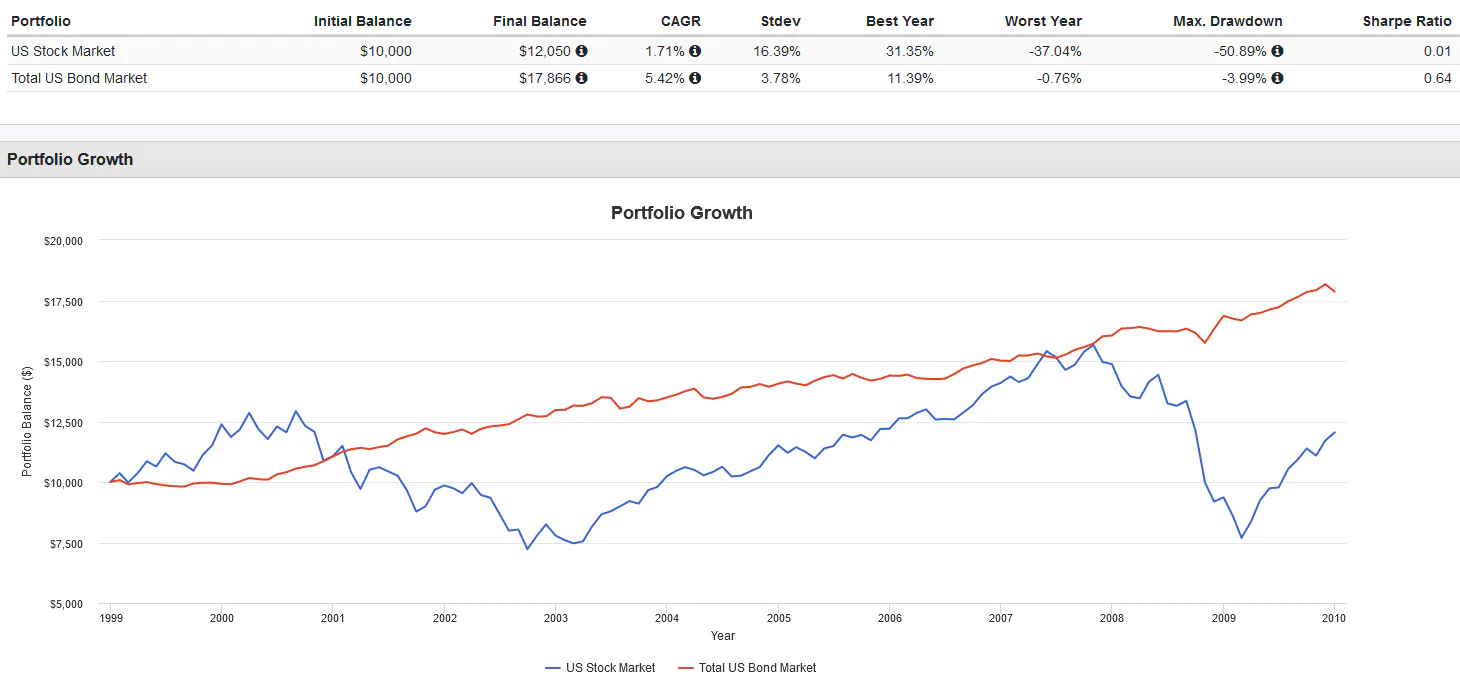
While many people assume that stocks always outperform bonds, there have been significant periods, such as the lost decade from 1999 to 2009, where U.S. stocks underperformed bonds amidst market upheavals like the dot-com bubble and the 2008 financial crisis.
Additionally, popular aggregate bond ETFs like AGG and BND provide excellent liquidity and diversification with their thousands of bond holdings.
For an individual investor, achieving such extensive diversification by purchasing individual bonds over the counter would be a daunting task. These ETFs simplify access to a broad range of bonds through just one ticker and with minimal bid-ask spreads.
Disadvantages of Aggregate Bond ETFs
However, the one-size-fits-all approach of these ETFs can also be seen as a disadvantage, especially regarding credit risk and duration risk.
For credit risk, some investors might find these ETFs too conservative. They might be seeking the potentially higher returns of corporate or high-yield bonds, while others may prefer the safety of an all-Treasury portfolio.
As for duration risk, the average duration of about 6 years can be a concern, especially in an environment of rising interest rates, like what was experienced in 2022. Longer-duration bonds tend to be more sensitive to interest rate changes, leading to significant losses in such conditions.
Furthermore, the passive nature of these ETFs means they lack the ability to make tactical adjustments or take defensive stances in response to market shifts, a flexibility that actively managed funds possess.
To offset these limitations, investors can pair aggregate bond ETFs like AGG with an actively managed bond ETF via a "core and explore" strategy for their fixed income allocation.
For example, one could use BBAG for 75% of their fixed income allocation, while adding in the actively managed JPMorgan Ultra-Short Income ETF (JPST). The latter charges 0.18% and is able to tactically adjust its holdings depending on market conditions, reducing volatility and risk.
Please note this article is for information purposes only and does not in any way constitute investment advice. It is essential that you seek advice from a registered financial professional prior to making any investment decision.
Latest ETF News
See all ETF newsBeyond Big Tech: The Increasing Specialization of AI ETFs

There's an ETF for That? Humanoid Robotics and Physical AI

How Some ETF Issuers Use Their Own Funds for Cash Management

These Public-Private ETFs Invest in Polymarket and Anduril

There's an ETF for That? Frontier Markets



 Advantages of ETFs over Mutual Funds1/6
Lower Costs
In this guide, we'll explore the advantages of ETFs over mutual funds, giving you valuable insights into why ETFs have gained significant popularity among investors like yourself.
Leveraged ETFs: Unlocking the Potential for Amplified Returns1/6
Understanding Leveraged ETFs
Explore leveraged ETFs: potential for amplified returns & risks. 5 ETFs to consider across equities, commodities & fixed income.
What is a Leveraged ETF?1/6
Introducing Leveraged and Inverse ETFs
In this guide, we'll dive into the world of leveraged ETFs, exploring their definition, mechanics, potential risks, and rewards.
Recent educational content

First Look ETF
First Look ETF: Income, International, and Cash Flow ETFs
In this season 6 episode of First Look ETF, Stephanie Stanton @etfguide examines the latest ETF marketplace trends with NYSE and guests.


ETF Trends
ETF Industry KPIs October 5, 2026
This week’s KPI data overview highlights key metrics and trends shaping the ETF landscape.

ETF Trends
ETF Industry KPIs September 28, 2026
This week’s KPI data overview highlights key metrics and trends shaping the ETF landscape.
ETF Trends
ETF Industry KPIs September 22, 2026
This week’s KPI data overview highlights key metrics and trends shaping the ETF landscape.