Global ETF Survey Is Live! 600+ ETF Professionals Weigh In. See Results →



Finetuning Value and Growth ETF Allocations Beyond the Russell 1000 Index
Here’s why a fundamental indexing approach to growth and value with a quality tilt makes more sense.


Keep up with what matters in ETFs
Get timely ETF insights, market trends, and top ideas straight to your inbox.
Your newsletter subscriptions with us are subject to ETF Central's Privacy Policy and Terms and Conditions.
The Russell 1000 Index has become a formidable benchmark for domestic equity exposure, providing a broader subset of companies and a less subjective ruleset compared to the S&P 500.
Like its counterpart, it also offers sub-indices focused on value and growth stocks, giving investors a way to tailor their exposure.
But how do ETFs tracking the Russell 1000 Value and Growth indexes measure up when compared to options that use a fundamental indexing approach with a quality tilt?
As you’ll see, sometimes the most popular ETF for a given style doesn’t always deliver the best results. Let’s explore why a more nuanced approach to value and growth might make sense for your portfolio.
Global ETF Survey 2026 is Live!
With 1,790 new products launched by July 2026, choosing is harder than ever. Our Global ETF Survey 2026, built on 620 professional investors and allocators, shows how active, fixed income, options-based and thematic ETFs are reshaping fund selection.
A better approach to growth stocks
The Russell 1000 Growth Index identifies its constituents based on several main metrics:
- Higher price-to-book ratios: Companies with higher valuations relative to their book value are prioritized.
- Higher forecasted medium-term (2-year) earnings growth: Emphasis is placed on companies expected to grow earnings significantly in the near future.
- Higher historical sales-per-share growth (5 years): Tracks companies with strong revenue growth trends over the past five years.
The index is reconstituted annually, adding or dropping companies based on these criteria. As FTSE Russell’s data below illustrates, the index does exhibit stronger growth characteristics compared to the broader Russell 1000 Index:
This is where the WisdomTree U.S. Quality Growth Index shines. Unlike the Russell 1000 Growth Index, this benchmark introduces a fundamental weighting methodology and evaluates companies on a composite score of growth and quality:
- Growth:
50% weight to median analyst earnings growth forecast.
25% weight to trailing 5-year EBITDA growth. 25% weight to trailing 5-year sales growth.
This broader approach ensures a more comprehensive growth analysis. - Quality:
50% weight to trailing 3-year average return on equity.
50% weight to trailing 3-year average return on assets.
These metrics assess how efficiently a company generates profits, reducing exposure to high-growth companies with weaker fundamentals.
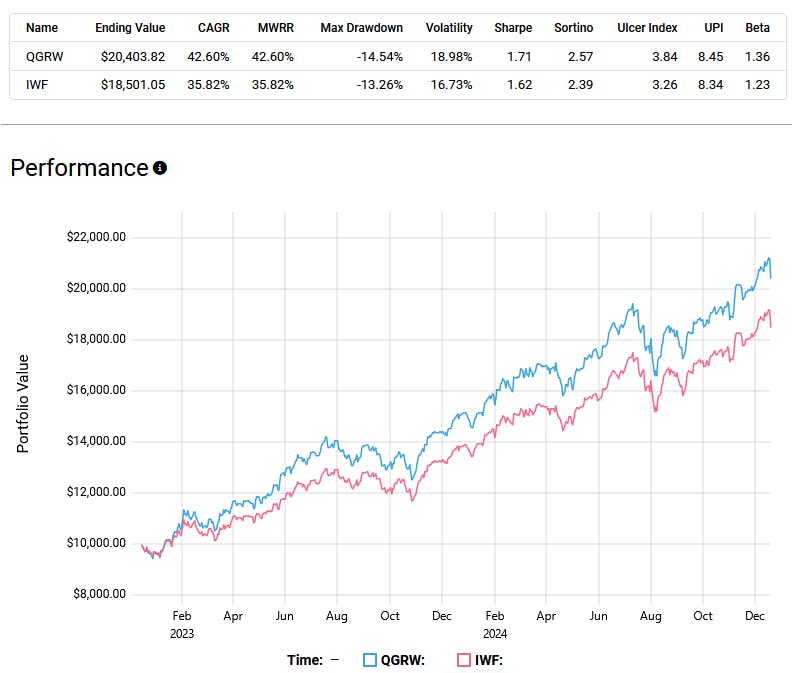
When applied in practice via the WisdomTree U.S. Quality Growth Fund
Over the period from December 15, 2022, to December 18, 2024, QGRW delivered a CAGR of 42.60%, compared to 35.82% for the iShares Russell 1000 Growth ETF
A better approach to value stocks
A similar pattern emerges when examining the Russell 1000 Value Index, which essentially flips the criteria of the Russell 1000 Growth Index. Instead of screening for higher price-to-book, earnings growth, and sales-per-share growth, it focuses on the lower end of these metrics.
This results in a value-oriented composition, as seen in the table below. Compared to the broader Russell 1000 Index, the Value subset exhibits lower valuations and a higher dividend yield, though it comes at the expense of slower earnings growth:
While the index delivers on value metrics, it doesn’t screen for quality, leaving the door open for companies with weaker fundamentals.
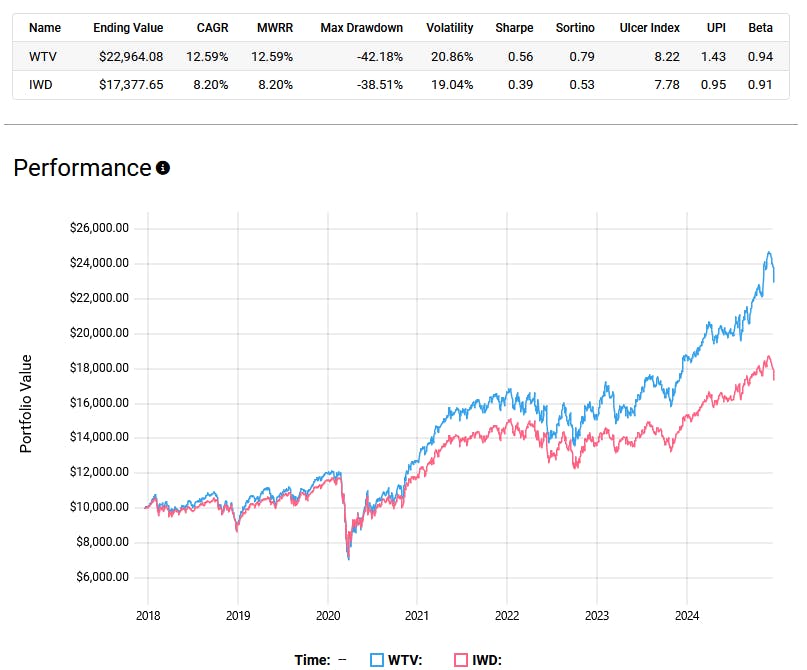
A better-performing alternative has been the WisdomTree U.S. Value Fund

WisdomTree succinctly explains the appeal of this metric below:
“The type of company that is paying a dividend and also buying back stock probably has something going right in its day-to-day business. In contrast, companies that pay their shareholders nothing and also dilute them may be the type of firm whose income statement is splashed with red ink. Half the battle is picking up great companies that keep buying back stock, but the other part of the battle is getting out of the way of the proverbial sitting ducks.”
Beyond shareholder yield, WTV incorporates additional quality screens in the form of ROE and ROA, the same as QGRW. These ensure the fund excludes companies that rely on debt-fueled buybacks, focusing instead on financially sound firms. The methodology selects 100-200 companies, emphasizing a 50/50 composite of shareholder yield and quality.
This approach has delivered significant outperformance. Over the period from December 15, 2017, to December 18, 2024, WTV achieved a CAGR of 12.59% compared to just 8.20% for the iShares Russell 1000 Value ETF
This article is for informational purposes only and does not in any way constitute investment advice. The author may express their own opinions, which may not represent the opinions of ETF Central or its affiliated partners. It is essential that you seek advice from a registered financial professional prior to making any investment decisions.
Latest ETF News
See all ETF newsBeyond Big Tech: The Increasing Specialization of AI ETFs

There's an ETF for That? Humanoid Robotics and Physical AI

How Some ETF Issuers Use Their Own Funds for Cash Management

These Public-Private ETFs Invest in Polymarket and Anduril

There's an ETF for That? Frontier Markets



 Advantages of ETFs over Mutual Funds1/6
Lower Costs
In this guide, we'll explore the advantages of ETFs over mutual funds, giving you valuable insights into why ETFs have gained significant popularity among investors like yourself.
Leveraged ETFs: Unlocking the Potential for Amplified Returns1/6
Understanding Leveraged ETFs
Explore leveraged ETFs: potential for amplified returns & risks. 5 ETFs to consider across equities, commodities & fixed income.
What is a Leveraged ETF?1/6
Introducing Leveraged and Inverse ETFs
In this guide, we'll dive into the world of leveraged ETFs, exploring their definition, mechanics, potential risks, and rewards.
Recent educational content

First Look ETF
First Look ETF: Income, International, and Cash Flow ETFs
In this season 6 episode of First Look ETF, Stephanie Stanton @etfguide examines the latest ETF marketplace trends with NYSE and guests.


ETF Trends
ETF Industry KPIs October 5, 2026
This week’s KPI data overview highlights key metrics and trends shaping the ETF landscape.

ETF Trends
ETF Industry KPIs September 28, 2026
This week’s KPI data overview highlights key metrics and trends shaping the ETF landscape.
ETF Trends
ETF Industry KPIs September 22, 2026
This week’s KPI data overview highlights key metrics and trends shaping the ETF landscape.