Global ETF Survey Is Live! 600+ ETF Professionals Weigh In. See Results →



ETFs & Markets with Todd Sohn: Does Anyone Even Want to Own Energy Anymore?
This week, ETF Expert Todd Sohn explores whether the Energy sector still holds appeal, and where its allocations may be heading.

Keep up with what matters in ETFs
Get timely ETF insights, market trends, and top ideas straight to your inbox.
Your newsletter subscriptions with us are subject to ETF Central's Privacy Policy and Terms and Conditions.
Hi everyone, this is Todd Sohn from Strategas Asset Management. Happy June! In this week's video, we're going to touch on two different topics — one, the energy sector — and ask the question: does anyone even want to own energy anymore?
And two, a quick update on international equities and an important chart on how we are investing internationally as well.
▶️ Watch the video here, or read the transcript below.
So, to start with the energy sector — every once in a while we take a little deep dive into some of the sector flows and activity going on there. It has been almost 11 years since the S&P 500 Energy Sector ETF hit a new all-time high.
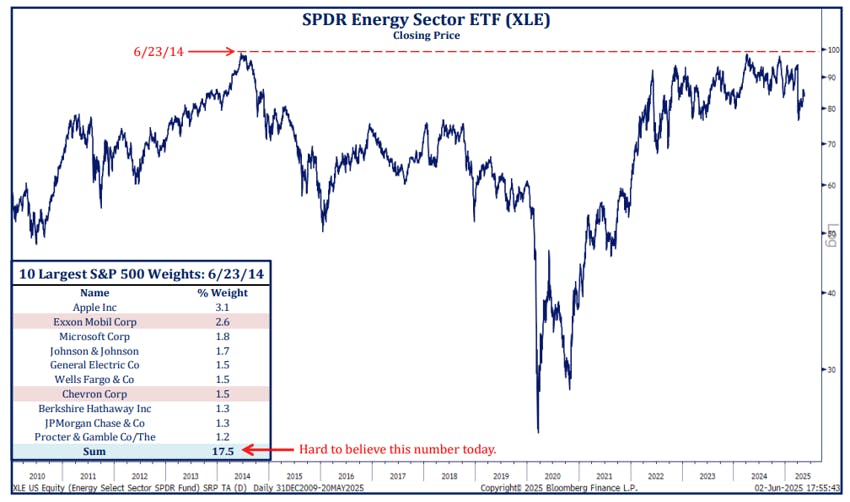
It's hard to find many assets that have gone that long. But here we are with energy. We also have a table here that shows what the composition of the ten largest S&P 500 weights was back then. Exxon and Chevron were both part of that cohort. It's also hard to believe that the top ten weights only added up to about 17.5%.
That's a much different backdrop than today. So there's clearly a waiting game and an opportunity cost with energy here.
But the interesting part — and why we’re wondering if anyone still wants to own energy — is the flows. Since the April 8th low, energy is near the bottom of our category chart book. Meanwhile, you have flows going to thematic funds, which perhaps have watered down the energy sector.
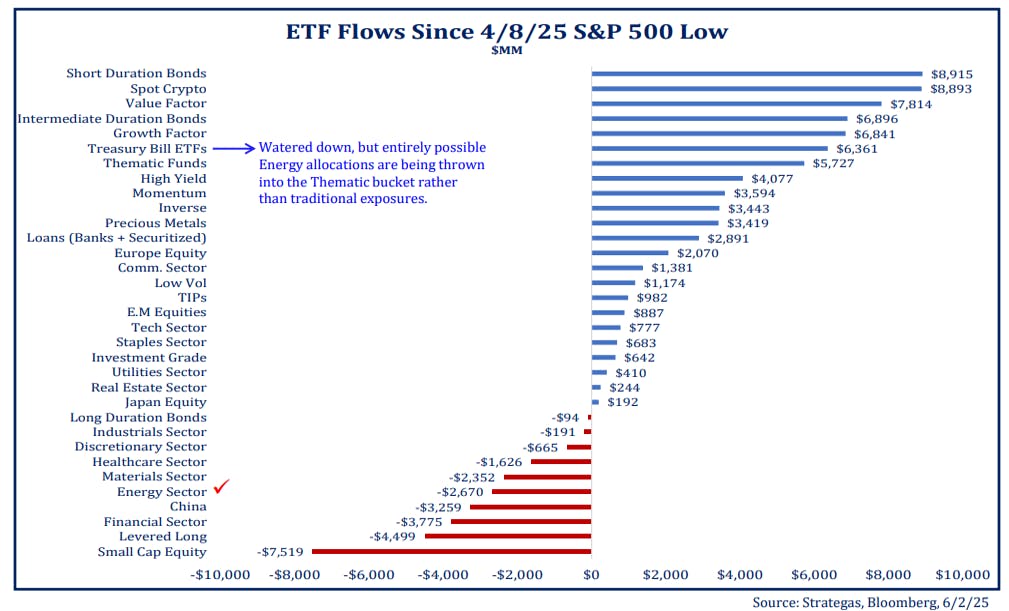
But I do wonder if they are perhaps stealing allocations away from traditional energy ETFs. So if you're buying a natural resources ETF or an infrastructure ETF, you're getting energy exposure — and probably more than the 3% weight that you get from energy in the S&P 500.
So that's something to consider. I also found this chart interesting: back during 2020 to early 2022, during the inflation wave of the COVID cycle, a massive amount of money flowed into the energy sector — upwards of $23 billion.
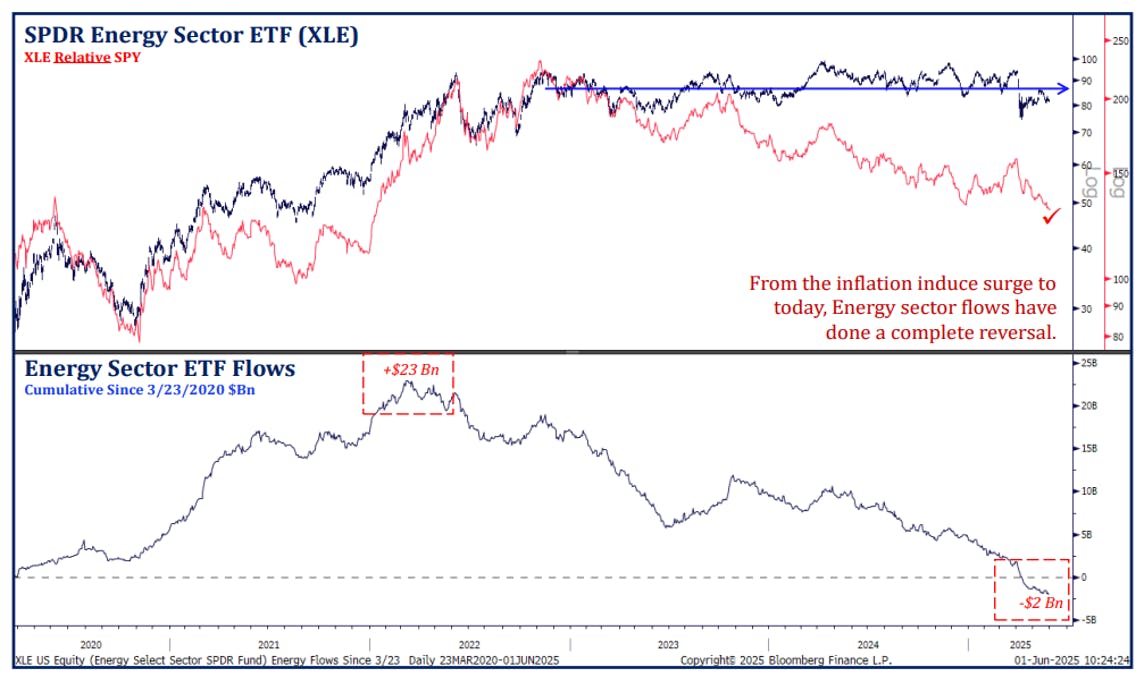
Today, all that money has now reversed and left the sector, obviously because energy has underperformed. It hasn’t worked. It’s been remarkably inconsistent and frustrating. But if you're just trying to think about the psychology of investors toward this sector — everyone has left. So that could make for an interesting sentiment perspective going into the back half of the year. It remains to be seen if energy could start to work, but we just like to put this on investors’ radars.
I would say the same thing with health care too, where there has been a big exodus of outflows from that sector as well. If you're just looking for anything away from Mega-Cap exposure. So that’s what we have on energy.
Looking internationally, we remain fans of diversification rather than honing in on just U.S. equities. The MSCI EAFE Index continues to make new all-time highs — for the first time in quite a few years — on a durable basis. Japan was last year's favorite.
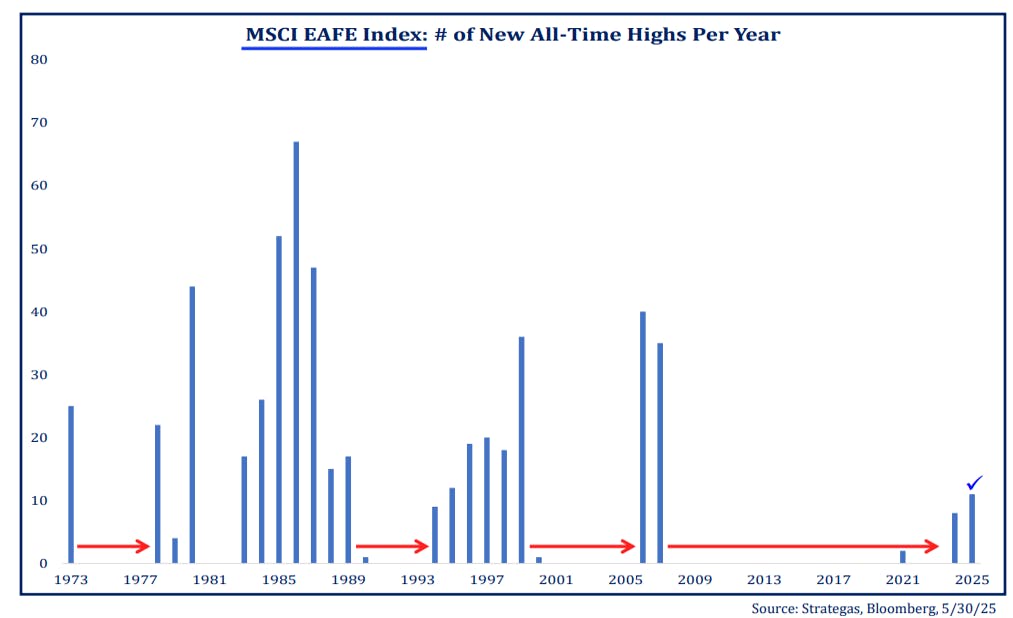
Now we have European equities acting very well. And I would say, importantly, the way we are allocating to Europe has changed. You now have what's in the Euro Stoxx 600 — that’s the benchmark index in Europe.
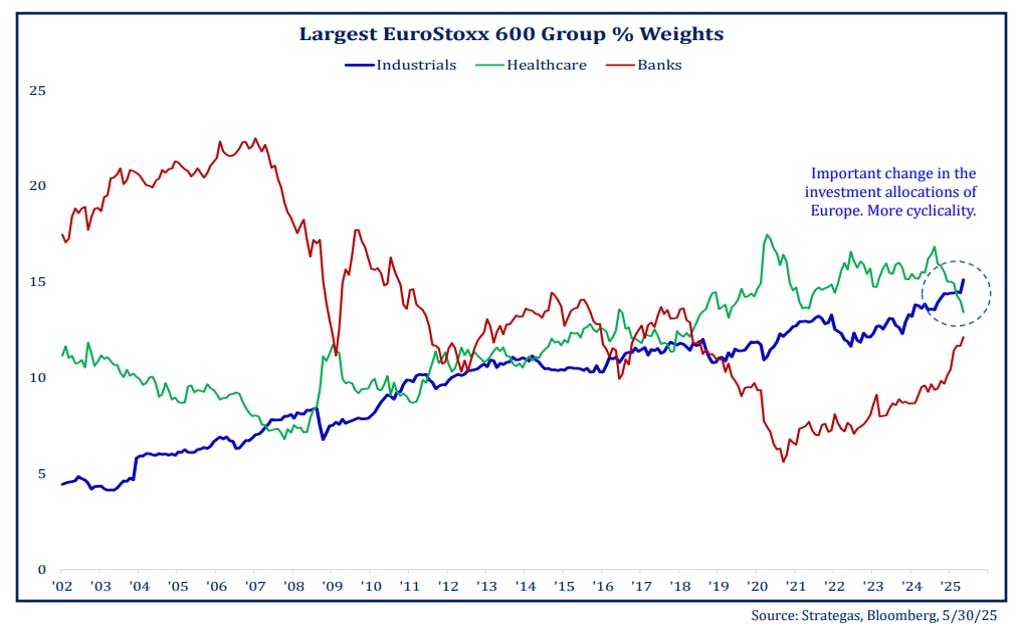
The industrial sector is the largest group weight there. For years it was banks and financials, and that was always a bit of a headwind because of the crises involved.
Then health care took the baton. Now, you have industrials — particularly defense, which has been very strong — as the largest weight. So we think there's more cyclical exposure now when you buy European stocks, as opposed to just being a financials- or yield-heavy play. And we think that’ll benefit the region in the long run and support the diversification aspect of international equities.
So that's what we have today. I hope this was helpful. Please reach out if you have any questions or if we can be a resource for you and your team.
Like what you're reading?
Stay in the loop — get the latest ETF insights: trends, analysis, and expert picks.
Definitions
- The S&P 500 is a stock market index tracking the stock performance of 500 of the largest companies listed on stock exchanges in the United States.
- An exchange-traded fund (ETF) is a pooled investment security that can be bought and sold like an individual stock.
- Fund flows represent the cash that goes into or out of companies, financial assets, sectors, or other market categories.
- Sector ETFs focus on groups of companies that are pursuing the same type of business, like energy, health care, utilities, or technology, for example.
- “Weighted” is a description of adjustments to a figure to reflect different proportions or "weights" of components that make up that figure.
- Cumulative asset flow is the total cash flow over a specific period of time, and it provides a view of a company's financial performance. It's calculated by adding the current period's net cash flow to the previous cumulative cash flow.
- Energy Select Sector SPDR Fund (XLE), commonly known as the Energy Sector XLE, is a US Energy sector index with a strong emphasis on the Oil industry.
- The MSCI EAFE Index is a stock market index that measures the performance of large- and mid-cap companies across 21 developed.
- The Euro Stoxx 600 is a broad index of 600 companies representing the European stock market, providing investors with a comprehensive view of the region's largest, mid-cap, and smaller companies.
- Cyclicality refers to how closely correlated a company's share price is to the fluctuations of the economy.
This communication was prepared by Strategas (“we,” “us,” or “our”), a brand that offers investment advisory services through Strategas Asset Management, LLC, an SEC Registered Investment Adviser, and provides research to institutional investors through Strategas Securities, LLC, a broker-dealer and FINRA member firm and an SEC Registered Investment Adviser. This communication represents our views as of 10/08/2024, which are subject to change, and presented for illustrative purposes only. The information contained herein has been obtained from sources we believe to be reliable, but no guarantee of accuracy can be made. This communication is provided for informational purposes only and should not be construed as an offer, recommendation, nor solicitation to buy or sell any specific security, strategy, or investment product. This communication does not constitute, nor should it be regarded as, investment research or a research report or securities recommendation and it does not provide information reasonably sufficient upon which to base an investment decision. This is not a complete analysis of every material fact regarding any company, industry, or security. Additional analysis would be required to make an investment decision. This communication is not based on the investment objectives, strategies, goals, financial circumstances, needs or risk tolerance of any particular client and is not presented as suitable to any other particular client. Past performance does not guarantee future results. All investments carry some level of risk, including loss of principal.
Strategas Asset Management, LLC and Strategas Securities, LLC are affiliated with Robert W. Baird & Co. Incorporated ("Baird"), a broker-dealer and FINRA member firm, and an SEC Registered Investment Adviser, although the firms conduct separate and distinct businesses.
The ETFs described herein are referenced solely for illustrative purposes and should not be construed as an investment recommendation. An investment in exchange traded funds involves risk, including the possible loss of principal. For important disclosures and risks relating to each ETF referenced herein, see each respective funds’ prospectus or contact your financial professional.

Latest ETF News
See all ETF newsWhat To Watch This REIT Earnings Season - Q3 2026



Your ETF Is a Tool. Investors Will Decide How to Use It.


How Much ETF Infrastructure Do You Really Need?





 Advantages of ETFs over Mutual Funds1/6
Lower Costs
In this guide, we'll explore the advantages of ETFs over mutual funds, giving you valuable insights into why ETFs have gained significant popularity among investors like yourself.
Leveraged ETFs: Unlocking the Potential for Amplified Returns1/6
Understanding Leveraged ETFs
Explore leveraged ETFs: potential for amplified returns & risks. 5 ETFs to consider across equities, commodities & fixed income.
What is a Leveraged ETF?1/6
Introducing Leveraged and Inverse ETFs
In this guide, we'll dive into the world of leveraged ETFs, exploring their definition, mechanics, potential risks, and rewards.
Recent educational content
First Look ETF
First Look ETF: Income, International, and Cash Flow ETFs
In this season 6 episode of First Look ETF, Stephanie Stanton @etfguide examines the latest ETF marketplace trends with NYSE and guests.


ETF Trends
ETF Industry KPIs October 5, 2026
This week’s KPI data overview highlights key metrics and trends shaping the ETF landscape.

ETF Trends
ETF Industry KPIs September 28, 2026
This week’s KPI data overview highlights key metrics and trends shaping the ETF landscape.
ETF Trends
ETF Industry KPIs September 22, 2026
This week’s KPI data overview highlights key metrics and trends shaping the ETF landscape.