NYSE CRTR Economy Event Watch the replay →



ETFs & Markets with Todd Sohn: Is Tech’s Buy-the-Dip Mentality Fading?
Is the buy-the-dip mentality in tech ETFs fading, and what does it mean for active management and portfolio diversification?

Keep up with what matters in ETFs
Get timely ETF insights, market trends, and top ideas straight to your inbox.
Your newsletter subscriptions with us are subject to ETF Central's Privacy Policy and Terms and Conditions.
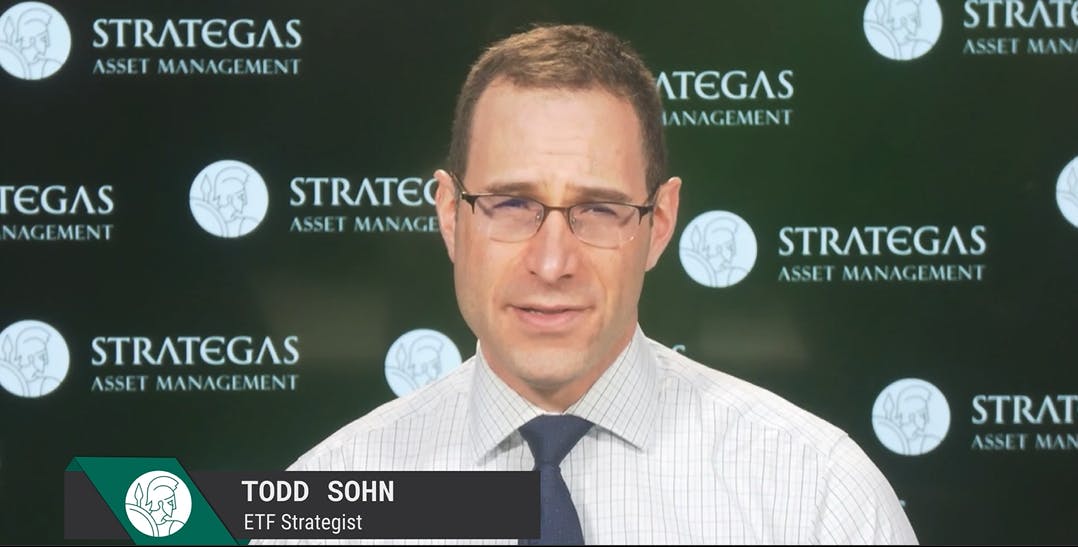
This is Todd Sohn from Strategas Asset Management. I hope you're having a great week. By the time you're watching this, it is likely Valentine's Day. This week, I’ve got a sort of a box of chocolates—a box of charts—for everyone here.
The ETF Industry Is Evolving Fast
From AI infrastructure to active strategies, the ETF landscape is shifting. Share your perspective in the 7th Annual Global ETF Survey and get exclusive early access to the final report.
▶️ Watch the video here, or read the transcript below.
We're going to touch on concentration risk, the buy-the-dip mentality in tech ETFs, active ETFs, and two areas that I think are very interesting based on flows and volume. It is early February, and this is a chart we like to run every month, showing the concentration of the ten largest and the five largest weights in the S&P 500.
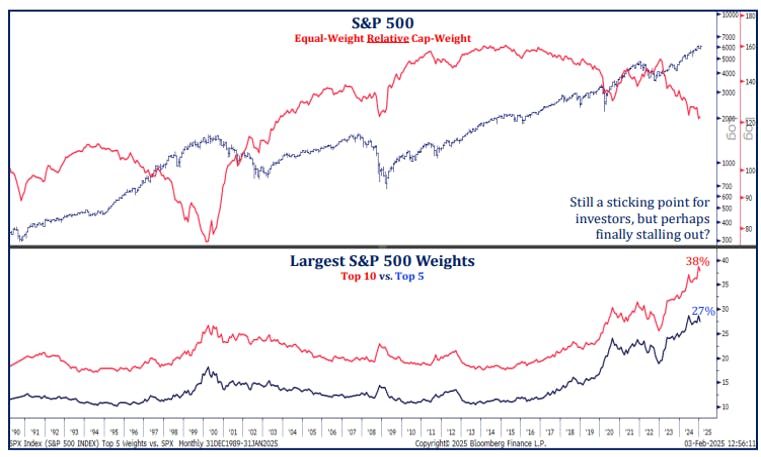
I'm starting to wonder if concentration has peaked. Of course, we do not have a magic ball for the future, but this has been a very important sticking point for investors. The ten largest stocks have been almost 40% of the S&P 500 weights, but there has been some stalling out among some of the more significant names within that cohort.
I’m just curious if maybe we’re finally in the process of seeing these stocks lose influence. I think that would be helpful for diversification.
What also suggests this is the continued buy-the-dip mentality toward technology ETFs. This is a scatterplot of January’s ETF flows versus the trailing one-year flows for these major sectors.
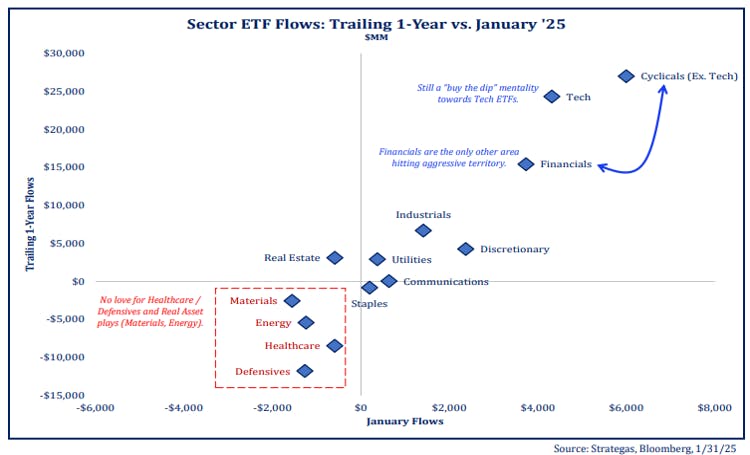
As you can see, tech continues to have inflows despite relative performance peaking roughly eight months ago. That’s on a cap-weighted basis. I just tend to wonder when this buy-the-dip mentality may start to fade. You kind of think about when anxiety will finally start to pick up for technology.
Even though other areas like industrials, discretionary, and somewhat of healthcare are starting to outperform, the flows there are not exactly aggressive. I’m curious if concentration risk starts to dry up and when the buy-the-dip mentality for tech finally starts to really fade once underperformance becomes more evident to investors.
Where this is important is for the growth of actively managed ETFs, especially for equity ETFs. There’s been a major surge into actively managed strategies.
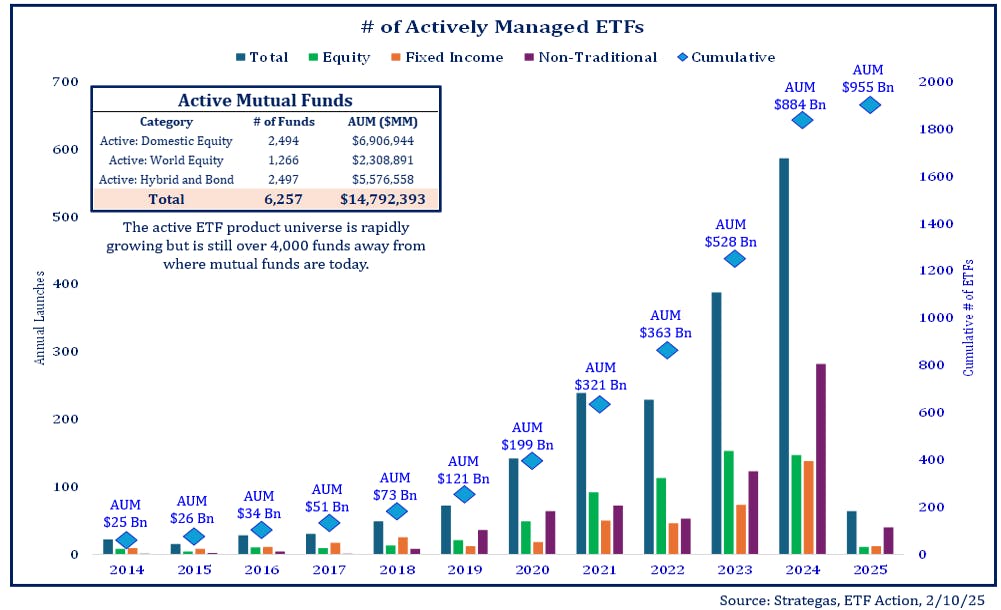
Part of this comes from the transition from mutual funds to ETFs in recent years. But as this chart shows, we’re almost at $1 trillion in actively managed ETFs across equity, fixed income, and nontraditional strategies that use leverage, derivatives, and more complex portfolio strategies.
Seeing concentration risk stall out is ideally helpful for managers who have perhaps watered down Mag-7-type large-cap tech exposures. We continue to expect the actively managed space to benefit no matter what the marketplace looks like, as demand grows for different strategies within portfolios.
Moving away from tech and active management, I want to highlight two interesting areas in terms of flows. The first is European financials.
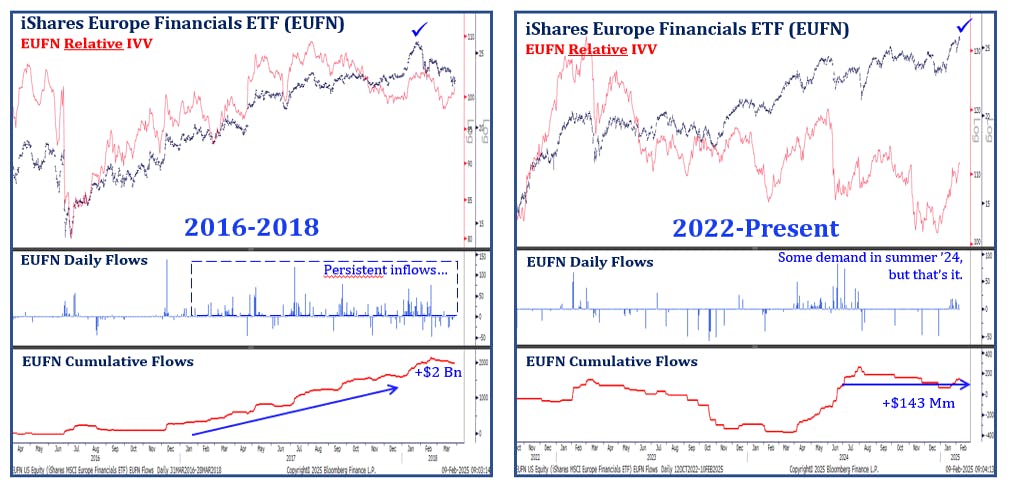
Here’s a European financials ETF that hit a new high as of early February. This suggests there’s no major credit crisis because whenever there’s a credit crisis, European financials are usually in trouble.
What’s interesting is that when you compare the current environment to the 2016–2018 period, this fund took in roughly $2 billion during 2016–2018 when performance was strong. However, demand is much less intense this time, which I think is interesting. It highlights the kind of ignorance towards Europe’s strength and why we think Europe is in a favorable position, making it a great area for diversification in portfolios.
We’ll keep an eye on this to see if there are any further inflows, but so far, so good for Europe and the contrarian case for what’s happening there.
Lastly, I want to take a look at gold. Gold has been a great diversifier for portfolios. I want to keep a close watch on the dollar volume for gold ETFs. Usually, when you see a spike in gold ETF volume, it can coincide with short-term peaks. However, we haven’t seen much interest there.
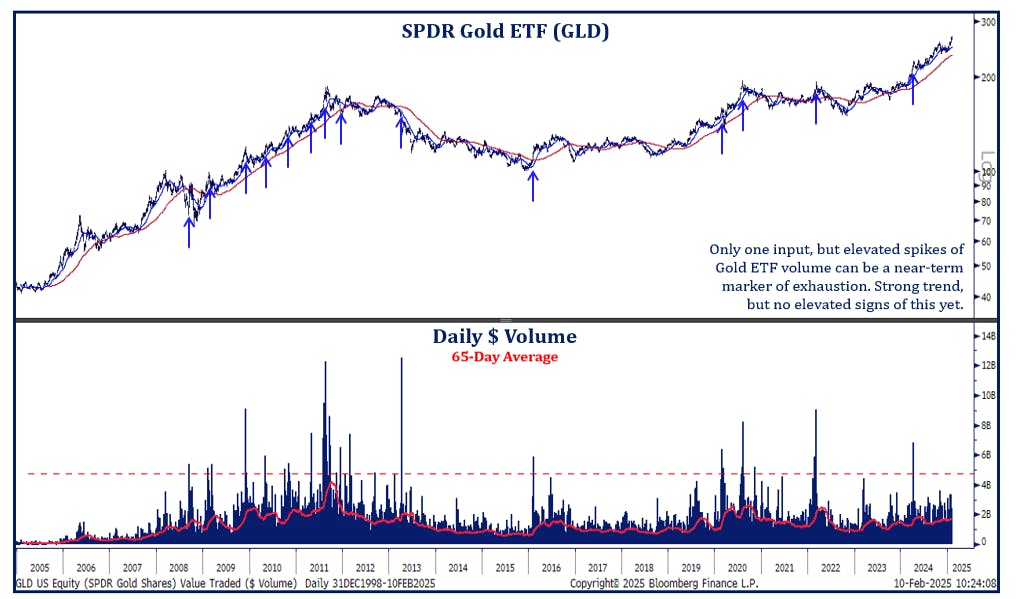
I wonder if it’s because stocks have been so strong, cash is yielding 4–5%, and crypto has been an interesting momentum play, leading people to forget about gold. There hasn’t been much inflow, no big spike in volume for gold ETFs. We actually like that. While gold may be a little stretched in terms of trend, our sentiment work does not indicate excessive enthusiasm towards gold. That’s a positive sign for its continued role as a portfolio diversifier.
That’s what we have today. I hope this was helpful, and let us know if you have any questions.
This communication was prepared by Strategas (“we,” “us,” or “our”), a brand that offers investment advisory services through Strategas Asset Management, LLC, an SEC Registered Investment Adviser, and provides research to institutional investors through Strategas Securities, LLC, a broker-dealer and FINRA member firm and an SEC Registered Investment Adviser. This communication represents our views as of 10/08/2024, which are subject to change, and presented for illustrative purposes only. The information contained herein has been obtained from sources we believe to be reliable, but no guarantee of accuracy can be made. This communication is provided for informational purposes only and should not be construed as an offer, recommendation, nor solicitation to buy or sell any specific security, strategy, or investment product. This communication does not constitute, nor should it be regarded as, investment research or a research report or securities recommendation and it does not provide information reasonably sufficient upon which to base an investment decision. This is not a complete analysis of every material fact regarding any company, industry, or security. Additional analysis would be required to make an investment decision. This communication is not based on the investment objectives, strategies, goals, financial circumstances, needs or risk tolerance of any particular client and is not presented as suitable to any other particular client. Past performance does not guarantee future results. All investments carry some level of risk, including loss of principal.
Strategas Asset Management, LLC and Strategas Securities, LLC are affiliated with Robert W. Baird & Co. Incorporated ("Baird"), a broker-dealer and FINRA member firm, and an SEC Registered Investment Adviser, although the firms conduct separate and distinct businesses.
The ETFs described herein are referenced solely for illustrative purposes and should not be construed as an investment recommendation. An investment in exchange traded funds involves risk, including the possible loss of principal. For important disclosures and risks relating to each ETF referenced herein, see each respective funds’ prospectus or contact your financial professional
Mentioned ETFs
Further reading


Latest ETF News
See all ETF news

Why ETF Spreads Often Mislead Investors








 Advantages of ETFs over Mutual Funds1/6
Lower Costs
In this guide, we'll explore the advantages of ETFs over mutual funds, giving you valuable insights into why ETFs have gained significant popularity among investors like yourself.
Leveraged ETFs: Unlocking the Potential for Amplified Returns1/6
Understanding Leveraged ETFs
Explore leveraged ETFs: potential for amplified returns & risks. 5 ETFs to consider across equities, commodities & fixed income.
What is a Leveraged ETF?1/6
Introducing Leveraged and Inverse ETFs
In this guide, we'll dive into the world of leveraged ETFs, exploring their definition, mechanics, potential risks, and rewards.
Recent educational content
Asset TV
The ETF Show - New Autism-Impact ETF Launched
Defiance ETFs has launched the first ETF, $ASD, focused on the autism ecosystem, investing in companies that provide services, products, and research related to autism and neurodivergence.


ETF Trends
ETF Industry KPIs June 1, 2026
The ETF Industry saw 22 New Launches, 1 Ticker Change and 1 closure last week.

ETF Trends
ETF Industry KPIs May 20, 2026
The ETF Industry saw 44 New Launches, 3 Mutual Fund Conversions and 9 closures last week.
Asset TV
The ETF Show - Politics Becomes Investable Trade through ETFs
Dan Weiskopf, Senior Portfolio Manager at Tidal Financial Group spoke with the ETF Show about Subversive ETFs that help investors trade like politicians.
Browse all educational columns



Expert-Built ETF Portfolios, All in One Place
Don’t start from scratch. Discover ready-made ETF portfolios built by professionals to match different goals, timelines, and market views. Use them as inspiration or as a starting point for your own allocation.