NYSE CRTR Economy Event Watch the replay →



ETFs & Markets with Todd Sohn: Froth Fades, Fear Spikes, Flows Shift
This week, ETF expert Todd Sohn discusses the major spike from Inverse ETF volume, what the VIX spike means historically, and excess continuing to ease via leveraged ETFs.

Keep up with what matters in ETFs
Get timely ETF insights, market trends, and top ideas straight to your inbox.
Your newsletter subscriptions with us are subject to ETF Central's Privacy Policy and Terms and Conditions.
Hi everyone, this is Todd Sohn from Strategas Asset Management. I hope you're having a great week outside of the markets, where it's been a little bit of a tough tide. Coming to you today with a few observations on where we stand in the market—inverse ETFs, leverage, and an update on sector flows.
▶️ Watch the video here, or read the transcript below.
Like what you're reading?
Stay in the loop — get the latest ETF insights: trends, analysis, and expert picks.
So, just to take stock of where we are today post-”Liberation Day” correction, the S&P 500 is in the 15% to 20% correction bucket.
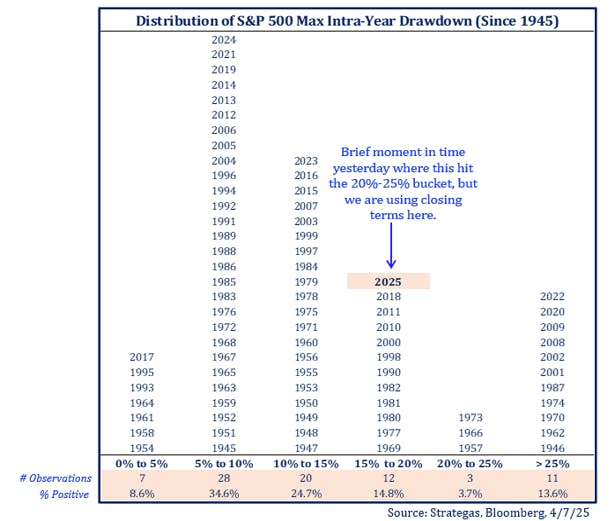
That's happened about 15% of the time over the last 70 years. So, we're joining years like 2018, 2011, and 1998. This is just a distribution of the max intrayear calendar drawdown for each year. There was a brief moment recently where we hit that 20% to 25% bucket, which is very rare. But on a closing basis, we're still in that 15% to 20% bucket.
So, just take stock of that. It's not unprecedented. The pace of the correction obviously is not very fun, but we have made it through environments like this before. The way the market has been reflecting this is through inverse ETFs.
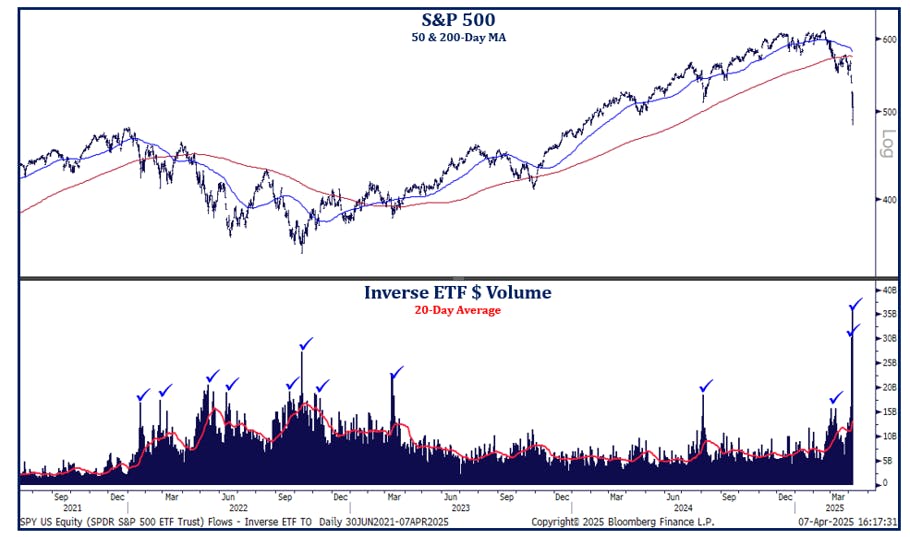
We always find inverse ETFs to be an interesting lens into the psychology of how traders are feeling about the market.
Recently, we've seen back-to-back record inverse ETF volumes—$30 billion late last week and $35 billion on April 7th. We think that's a reflection that perhaps things are a little bit overdone to the downside. Look for, say, a tactical low to form.
Typically, what happens in the historical roadmap is you get these massive downside cascades, a bounce, and then perhaps a retest of the lows on much less intense volumes and whatnot.
We've also seen this correction really ease the froth of the market. Using our levered long versus inverse ETF assets under management, at the start of the year this was a 12-to-1 ratio.
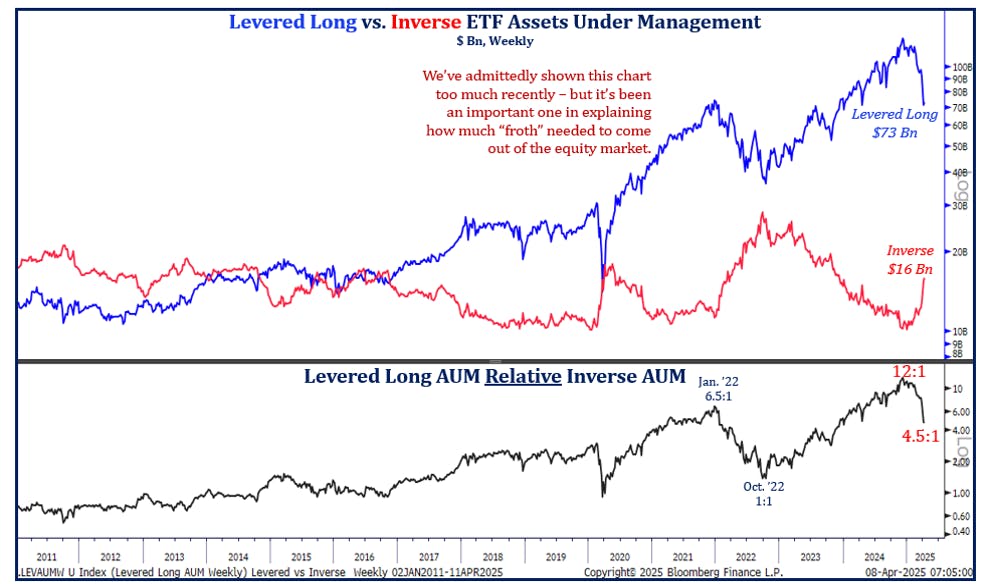
We thought it was a little bit offsides—bull market effect—but very extreme relative to our data. That's now corrected back to 4.5-to-1. Excesses eased. Of course, it's entirely possible that we see this go back down to, say, 2- or 3-to-1. But for now, we're comfortable with this erasing of the froth and excess that was in the equity market.
Along with the correction in equities, we've seen the VIX really spike. Volatility is meaningfully higher—that's what happens in these types of environments. At one point, the VIX hit 50 on April 7th.
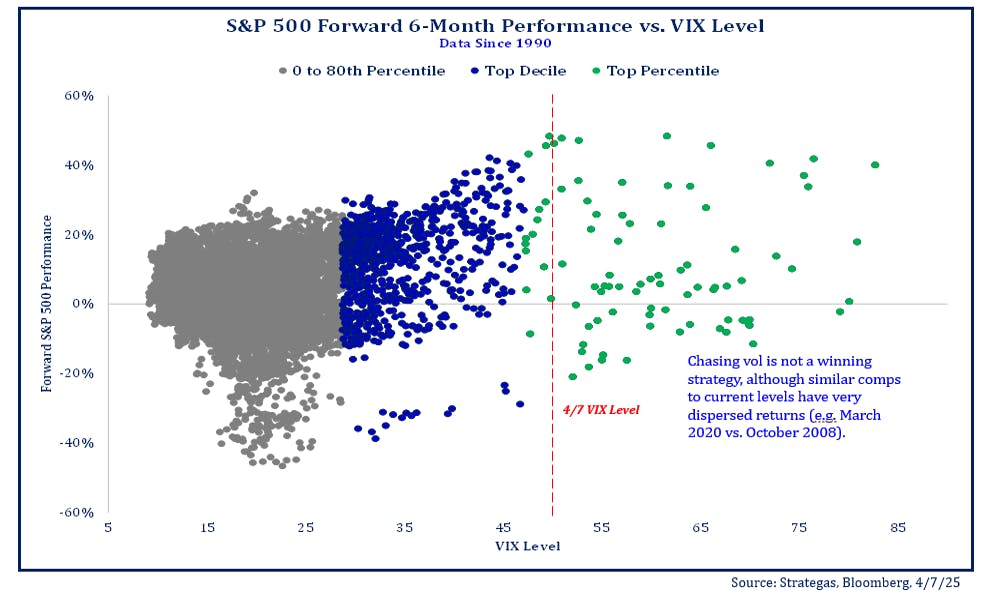
Now, historically, a top-decile VIX is where a lot of really strong returns can be found. When you hit the top percentile—the top 1% of all observations historically going back to 1990—the returns can be strong, although you are littered with examples here from, say, October 2008 and December 2008. That was close to the bottom in March 2009, but it still took some more pain before all was said and done.
So, I just want to be careful of that. The opposite was March 2020, where we had a V-bottom following a major, major, major spike in the VIX. So, good for returns six months out—but just be mindful, there are some misses here historically.
We’ll continue to see how the market plays that, and what the economic and fundamental backdrop looks like.
But at least we have seen extremes on the downside. That says to us things are a little bit overcooked and we're looking for a reprieve rally.
And then lastly, just to update on sector ETF flows: what we're doing here is breaking down sector chips by Election Day to the S&P 500 peak back in February, and then flows since that February 19th, 2025 peak through the first week of April.
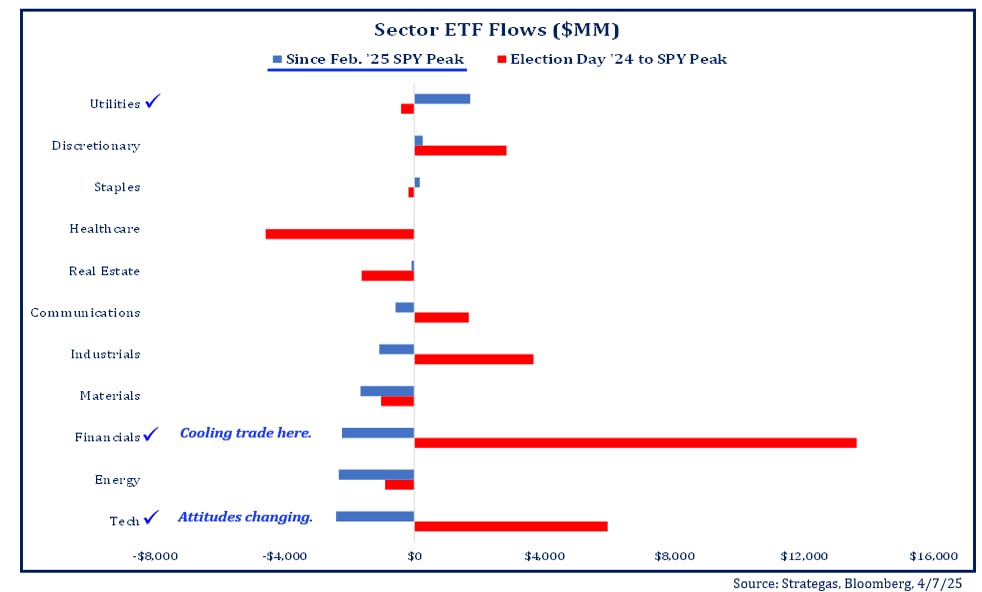
And what I would tell you here is that flows following the election—right, we had clarity, we had a winner, things cleared up—flows went to financials, industrials, and tech.
Now, since then, we are seeing attitudes change. Tech is leading sector outflows, followed by financials. That’s a cooling trade. And energy—surprisingly, there's not much demand for energy.
Meanwhile, at the top of this list you're seeing more defensive areas such as utilities and a very modest bite to staples in terms of the sector flows.
So, we think that the cooling of attitudes towards tech is helpful—a helpful psychological reset—as well as seeing cyclical outflows from those sectors. That’s also good as part of the washed-out process that comes with corrections.
We think it's a good reset. It's a painful reset, but helpful in changing how positioning looks. So, that's what we have today.
Again, we are pretty washed out on the downside, the VIX has spiked, we've seen leveraged ETF assets decrease, and inverse volume spike.
Now it's a process of: okay, where to from here? What does risk appetite look like, and where do the flows continue to go? Do they exhibit fear or more risk-on seeking? We're going to take stock of that week by week. But if I could be a resource for you and your team, please let me know. And thanks for watching.
This communication was prepared by Strategas (“we,” “us,” or “our”), a brand that offers investment advisory services through Strategas Asset Management, LLC, an SEC Registered Investment Adviser, and provides research to institutional investors through Strategas Securities, LLC, a broker-dealer and FINRA member firm and an SEC Registered Investment Adviser. This communication represents our views as of 10/08/2024, which are subject to change, and presented for illustrative purposes only. The information contained herein has been obtained from sources we believe to be reliable, but no guarantee of accuracy can be made. This communication is provided for informational purposes only and should not be construed as an offer, recommendation, nor solicitation to buy or sell any specific security, strategy, or investment product. This communication does not constitute, nor should it be regarded as, investment research or a research report or securities recommendation and it does not provide information reasonably sufficient upon which to base an investment decision. This is not a complete analysis of every material fact regarding any company, industry, or security. Additional analysis would be required to make an investment decision. This communication is not based on the investment objectives, strategies, goals, financial circumstances, needs or risk tolerance of any particular client and is not presented as suitable to any other particular client. Past performance does not guarantee future results. All investments carry some level of risk, including loss of principal.
Strategas Asset Management, LLC and Strategas Securities, LLC are affiliated with Robert W. Baird & Co. Incorporated ("Baird"), a broker-dealer and FINRA member firm, and an SEC Registered Investment Adviser, although the firms conduct separate and distinct businesses.
The ETFs described herein are referenced solely for illustrative purposes and should not be construed as an investment recommendation. An investment in exchange traded funds involves risk, including the possible loss of principal. For important disclosures and risks relating to each ETF referenced herein, see each respective funds’ prospectus or contact your financial professional
Mentioned ETFs
Further reading


Latest ETF News
See all ETF news

Why ETF Spreads Often Mislead Investors








 Advantages of ETFs over Mutual Funds1/6
Lower Costs
In this guide, we'll explore the advantages of ETFs over mutual funds, giving you valuable insights into why ETFs have gained significant popularity among investors like yourself.
Leveraged ETFs: Unlocking the Potential for Amplified Returns1/6
Understanding Leveraged ETFs
Explore leveraged ETFs: potential for amplified returns & risks. 5 ETFs to consider across equities, commodities & fixed income.
What is a Leveraged ETF?1/6
Introducing Leveraged and Inverse ETFs
In this guide, we'll dive into the world of leveraged ETFs, exploring their definition, mechanics, potential risks, and rewards.
Recent educational content
Asset TV
The ETF Show - New Autism-Impact ETF Launched
Defiance ETFs has launched the first ETF, $ASD, focused on the autism ecosystem, investing in companies that provide services, products, and research related to autism and neurodivergence.


ETF Trends
ETF Industry KPIs June 1, 2026
The ETF Industry saw 22 New Launches, 1 Ticker Change and 1 closure last week.

ETF Trends
ETF Industry KPIs May 20, 2026
The ETF Industry saw 44 New Launches, 3 Mutual Fund Conversions and 9 closures last week.
Asset TV
The ETF Show - Politics Becomes Investable Trade through ETFs
Dan Weiskopf, Senior Portfolio Manager at Tidal Financial Group spoke with the ETF Show about Subversive ETFs that help investors trade like politicians.
Browse all educational columns



Have you tried our ETF Compare tool?
Compare ETFs like a pro. Analyze fees, performance, exposure & holdings side-by-side.