From idea to ETF portfolio in minutes. Build yours now →



ETFs & Markets with Todd Sohn: Reading the Risk-Off Signals in ETF Flows
This week, ETF expert Todd Sohn touches on the magnitude and duration of the current S&P 500 decline, ETF flows since the S&P 500 peak, and the parabolic activity from Gold ETFs.

Keep up with what matters in ETFs
Get timely ETF insights, market trends, and top ideas straight to your inbox.
Your newsletter subscriptions with us are subject to ETF Central's Privacy Policy and Terms and Conditions.
Hey, everyone, this is Todd Sohn from Strategas Asset Management. I hope you had a nice Easter, and if you were on spring break, it was a nice spring break as well. In today's video, I want to give you a couple of items to take stock of.
▶️ Watch the video here, or read the transcript below.
Like what you're reading?
Stay in the loop — get the latest ETF insights: trends, analysis, and expert picks.
Now that we are about two months past the S&P 500 peak closing price, we're going to look at flows, where this decline stands relative to history, and a couple of outliers in terms of some other asset classes.
So just to give you some context on where this decline looks compared to historic S&P 500 declines: about 19% peak to trough.
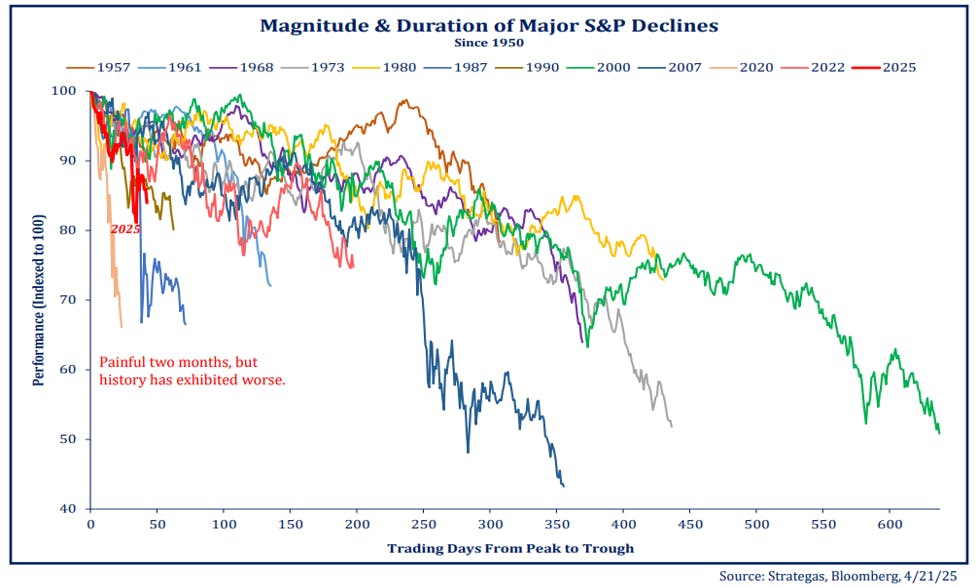
We've bounced a little bit since the early April low point. But if we're going to get worse from here, there's plenty of historical examples of where the magnitude and duration of declines have gone on for longer. So, yes, painful, but we are nowhere near any sort of historical extremes. I think if you are going to enter into one of those more challenging environments, keep an eye on credit conditions.
Spreads have widened. We've seen outflows from credit-sensitive ETFs, which we'll talk about in a second. But credit conditions will likely be the tell on if the 19% was it, we just chop around here for the summer, or if we're entering some sort of more crisis-like environment—like a tech bubble, like the financial crisis, or something back in the ‘70s when inflation was a big problem.
As for flows since the peak two months ago, starting on the outflow side, you've had money out of economically sensitive areas—cyclical sectors such as financials, industrials, small caps, and even bitcoin.
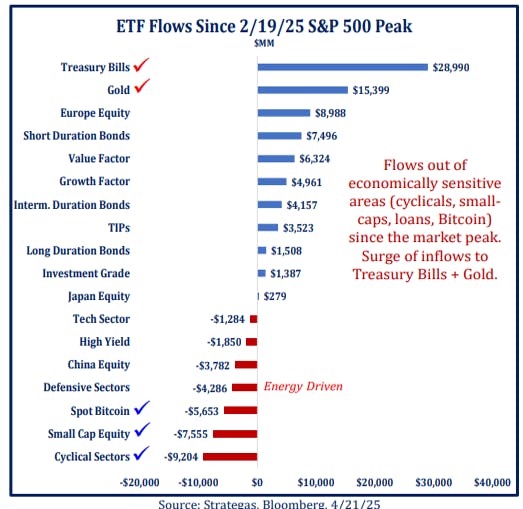
And also, credit- and loan-related products like CLOs and high yield, which is curious to me given that they were such a solid low-vol addition for portfolios.
That's changing at this point in the cycle. And conversely, on the inflow side, you see a massive amount of money going to Treasury bill ETFs, right? Cash is really the safest thing in the environment. You're still getting 4% yield on that.
And as well as gold, which we'll touch on in just a second. But both of those scream defensive, risk-off type activity to me. I think that's actually supportive in a sense that we are getting through this correction, and sentiment via these flows is very pessimistic.
And just to add to that, you've only had inflows to the utility sector out of all the sectors out there. So ten out of eleven sectors have seen outflows. There's no conviction out there outside of buying utilities, which can be much more traditionally defensive in this type of environment.
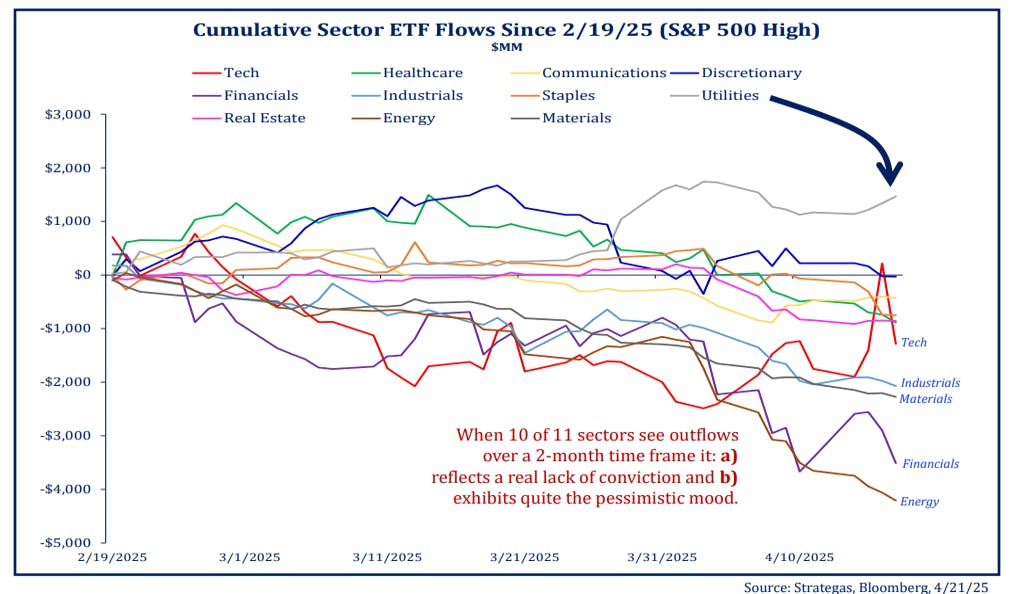
And I would just point out energy, financials, industrials, and materials at the bottom of this list. Financials had a pretty good sugar high post the election last year, now seeing that trade reverse. And energy we do count among defensive sectors, arguably because of the yield in the inflationary environment. But there's just no love there at all.
And here is our aggregate of cyclical sector flows over the last one and three months.
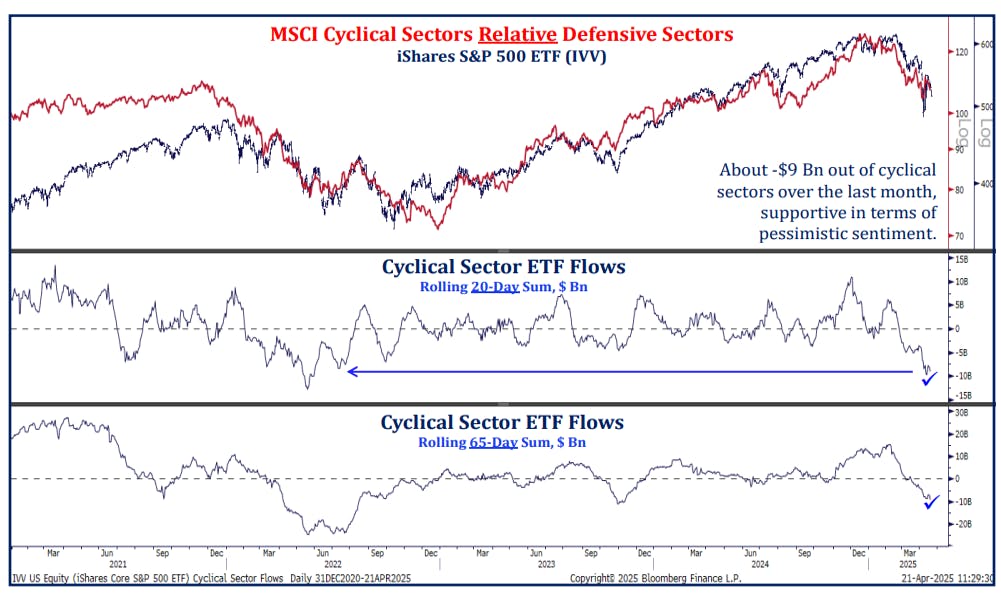
You've had a pretty good purge. That's a much different backdrop than late 2024. So it is painful. It is a different risk tone than we have seen in the last year and a half to two years, but again, reflective of sentiment moving in the right direction. So, perhaps we're not there yet, but maybe in the ballpark of trying to find some sort of low going forward.
And that'll be a good reset given the rinsing from sentiment that we have.
And then lastly, on gold: we have gold prices going parabolic. You're trading three standard deviations above a one-year average, and you have gold flows going parabolic.
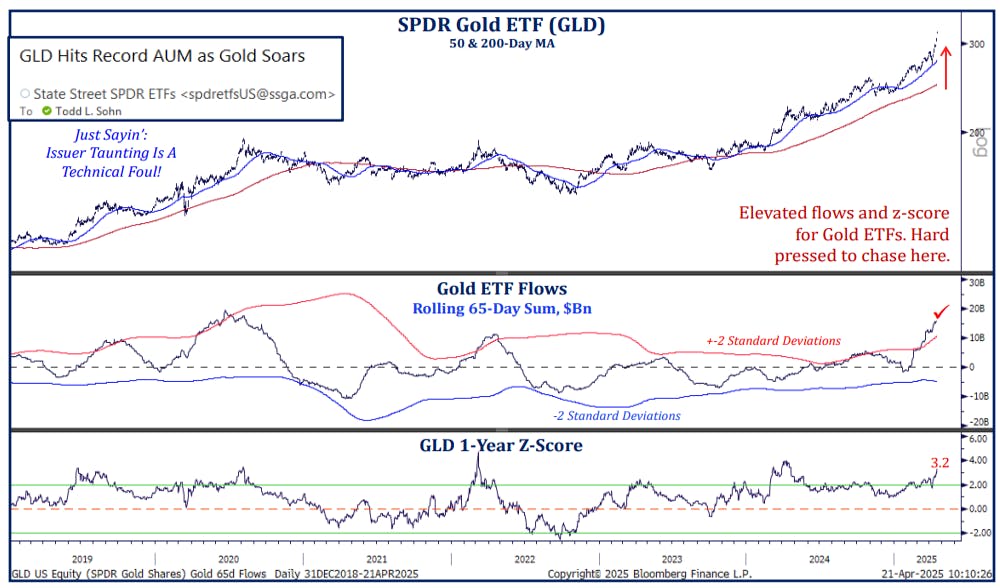
So you're seeing allocations across the gold ETF spectrum really accelerating. That’s going to be the products that are highly liquid, the most traded gold ETFs along with the more—what I would call—advisor-friendly, which tend to be low-cost but still tracking gold. Flows are going there. And it wasn't lost on us as well that we had some issuers touting gold assets under management in their ETFs too, as the price resurged. So, flows sentiment getting hot, price sentiment getting hot, and anecdotal sentiment getting hot.
We would just be perhaps a little bit careful chasing gold here in the near term, even though it has been a good portfolio diversifier. So that’s what we have today. Again, flows are very economically sensitive. Risk-off while you're seeing more defensive areas—such as Treasury bills and gold—see inflows sharply rise. And so it supports the sentiment backdrop overall.
But we're yet to get through this correction just yet. Stay patient. And we’ll be looking for further signs of credit stabilizing and perhaps some internal improvement underneath the surface as we try to retest the early April lows. Let us know if you have any questions. And thanks for watching.
This communication was prepared by Strategas (“we,” “us,” or “our”), a brand that offers investment advisory services through Strategas Asset Management, LLC, an SEC Registered Investment Adviser, and provides research to institutional investors through Strategas Securities, LLC, a broker-dealer and FINRA member firm and an SEC Registered Investment Adviser. This communication represents our views as of 10/08/2024, which are subject to change, and presented for illustrative purposes only. The information contained herein has been obtained from sources we believe to be reliable, but no guarantee of accuracy can be made. This communication is provided for informational purposes only and should not be construed as an offer, recommendation, nor solicitation to buy or sell any specific security, strategy, or investment product. This communication does not constitute, nor should it be regarded as, investment research or a research report or securities recommendation and it does not provide information reasonably sufficient upon which to base an investment decision. This is not a complete analysis of every material fact regarding any company, industry, or security. Additional analysis would be required to make an investment decision. This communication is not based on the investment objectives, strategies, goals, financial circumstances, needs or risk tolerance of any particular client and is not presented as suitable to any other particular client. Past performance does not guarantee future results. All investments carry some level of risk, including loss of principal.
Strategas Asset Management, LLC and Strategas Securities, LLC are affiliated with Robert W. Baird & Co. Incorporated ("Baird"), a broker-dealer and FINRA member firm, and an SEC Registered Investment Adviser, although the firms conduct separate and distinct businesses.
The ETFs described herein are referenced solely for illustrative purposes and should not be construed as an investment recommendation. An investment in exchange traded funds involves risk, including the possible loss of principal. For important disclosures and risks relating to each ETF referenced herein, see each respective funds’ prospectus or contact your financial professional


Latest ETF News
See all ETF newsForm 4 Has 20 Transaction Codes. None Say "Section 351 ETF Swap"


Who Really Owns a White-Label ETF?


What If a Futures-Based ETF Never Had to Roll Again?

How Do You Build a Winning ETF Business?

Losers Of Q2 2026 REIT Earnings Season


Winners of Q2 2026 REIT Earnings Season


 Advantages of ETFs over Mutual Funds1/6
Lower Costs
In this guide, we'll explore the advantages of ETFs over mutual funds, giving you valuable insights into why ETFs have gained significant popularity among investors like yourself.
Leveraged ETFs: Unlocking the Potential for Amplified Returns1/6
Understanding Leveraged ETFs
Explore leveraged ETFs: potential for amplified returns & risks. 5 ETFs to consider across equities, commodities & fixed income.
What is a Leveraged ETF?1/6
Introducing Leveraged and Inverse ETFs
In this guide, we'll dive into the world of leveraged ETFs, exploring their definition, mechanics, potential risks, and rewards.
Recent educational content

ETF Trends
ETF Industry KPIs September 8, 2026
This week’s KPI data overview highlights key metrics and trends shaping the ETF landscape.

ETF Trends
ETF Industry KPIs August 31, 2026
This week’s KPI data overview highlights key metrics and trends shaping the ETF landscape.
ETF Trends
ETF Industry KPIs August 24, 2026
This week’s KPI data overview highlights key metrics and trends shaping the ETF landscape.
What’sTheFund
What's the Fund | Ocean Park Diversified Income ETF (DUKZ)
James St Aubin, Chief Investment Officer at Ocean Park Asset Management, discuss the DUKZ ETF, exposing investors to the whole spectrum of asset classes in the fixed income markets, through their rules-based process.

Browse all educational columns



Active Trader Report: Use of Leveraged & Inverse ETFs Way Up
Direxion partnered with Compound Insights and Vanda to explore what’s driving the evolution of active trading — and how active traders are using leveraged and inverse funds across equities, single stocks, commodities, and volatility.