Global ETF Survey Is Live! 600+ ETF Professionals Weigh In. See Results →



ETFs for Exposure to the "Magnificent Seven" Stocks
Discover high-performance NYSE-listed ETFs providing targeted exposure to the dominant mega-cap stocks driving the U.S. market's growth.


Keep up with what matters in ETFs
Get timely ETF insights, market trends, and top ideas straight to your inbox.
Your newsletter subscriptions with us are subject to ETF Central's Privacy Policy and Terms and Conditions.
CNBC's Jim Cramer recently put forth an argument in favor of sticking with what he dubs the "Magnificent Seven" — the seven U.S. mega-cap stocks currently driving the market: Apple, Amazon, Alphabet, Meta, Microsoft, Nvidia, and Tesla, which can be thought of as the new FAANG-esque cohort of 2023.
He expressed the ease and assurance in investing in these high-performing stocks, noting that their price targets consistently head north. He underlined that despite potential short-term disturbances such as the Nasdaq 100 rebalancing, bond market shifts, or negative inflation news, analysts continue to have a wealth of reasons to recommend these stocks.
Maintaining a diversified portfolio is key, according to Cramer, but he stresses that certain companies, especially those among his Magnificent Seven, simply offer superior long-term value in his opinion. For investors that believe Cramer, mega-cap ETFs could offer a simple way of investing in these top stocks.
With Cramer's argument in mind, let's look at three NYSE-listed ETFs that offer concentrated exposure to the Magnificent Seven, offering investors a simple yet effective way to capitalize on U.S. mega-cap stocks. However, at the end I'll also offer you my contrarian argument against why investing in the Magnificent Seven may not be the best strategy.
Global ETF Survey 2026 is Live!
With 1,790 new products launched by July 2026, choosing is harder than ever. Our Global ETF Survey 2026, built on 620 professional investors and allocators, shows how active, fixed income, options-based and thematic ETFs are reshaping fund selection.
iShares S&P 100 ETF (OEF-0.59%)
OEF tracks the S&P 100 Index, a somewhat outdated index that in many ways is the "bigger brother" of the more well-known S&P 500. This index consists of 100 mega-cap U.S. stocks selected by the S&P Index Committee. This makes it a concentrated play on America's largest publicly traded companies.
OEF has been around since October 2000, but has only attracted around $8.5 billion in terms of assets under management, or AUM. Not many investors know about this ETF and its index compared to the S&P 500, and its higher expense ratio of 0.20% may also be a deterrent.
Exposure to the Magnificent Seven as of July 18, 2023: 41.07%.
Invesco S&P 500 Top 50 ETF (XLG-0.46%)
XLG is another mega-cap U.S. equity ETF that provides concentrated exposure to the Magnificent Seven. The XLG follows the S&P 500 Top 50 Index, which as its name suggests comprises a subset of the 50 largest and most influential companies within the S&P 500.
The methodology used by the XLG gives more weight to the largest companies, thereby offering more significant exposure to the Magnificent Seven compared to broader market ETFs. It costs the same 0.20% expense ratio as OEF and currently has around $2.4 billion in AUM.
Exposure to the Magnificent Seven as of July 18, 2023: 50.14%
Vanguard Mega Cap Growth ETF (MGK-0.31%)
Vanguard offers MGK, a growth-focused ETF which holds a considerable allocation to the Magnificent Seven. This ETF tracks the CRSP US Mega Cap Growth Index, which includes companies that exhibit growth characteristics among the largest U.S. firms.
The main advantage MGK holds over both OEF and XLG is with respect to fees. With an expense ratio of 0.07%, MGK is significantly more cost effective compared to both of the prior ETFs. It also pays has a 0.52% 30-day SEC yield as of June 30, 2023, making it a fairly tax-efficient ETF.
Exposure to the Magnificent Seven as of July 18, 2023: 56.49%
Why I don't like the Magnificent Seven
To put it bluntly, I disagree with Cramer (and if you do too, you can bet against him using the Inverse Cramer ETF). I'm not a fan of his endorsement of the "Magnificent Seven" and the implicit assumption that these tech behemoths are fail-safe investments.
While these companies have indeed delivered impressive returns and are current market leaders, this line of thinking can lull investors into a false sense of security, overlooking the inherent risks of such a highly concentrated portfolio.
Drawing on historical parallels, I'm reminded of the "Nifty Fifty" in the 1960s and 70s - a set of blue-chip stocks considered to be solid buys and hold forever by the market pundits of that era. These companies, which included giants like IBM, Xerox, and Polaroid, were viewed as invincible, and their stocks were seemingly always a good buy, no matter the price.
However, the 1980s told a different story, as many of these firms struggled, and their stock prices plunged during the subsequent bear market, leaving investors with substantial losses. Do you see any of these companies leading notable market indexes these days?
In a similar vein, placing too much faith in the Magnificent Seven could expose investors to considerable risk. It's not a question of the quality of these companies – they are undoubtedly pioneers in their respective fields and have solid fundamentals.
However, relying heavily on them for portfolio returns can be precarious. Market dynamics, regulatory changes, or even company-specific issues can impact the stocks' performance. Just as we saw with the Nifty Fifty, the market's darlings of one era can face challenges in the next.
Indeed, all three of the aforementioned ETFs have run up heavily year-to-date, as seen below. I would be cautious to chase hot performance at the risk of buying the top and experiencing poor returns afterwards. Remember, it's not sufficient to just buy good assets – investors also need to pay a good price for them.
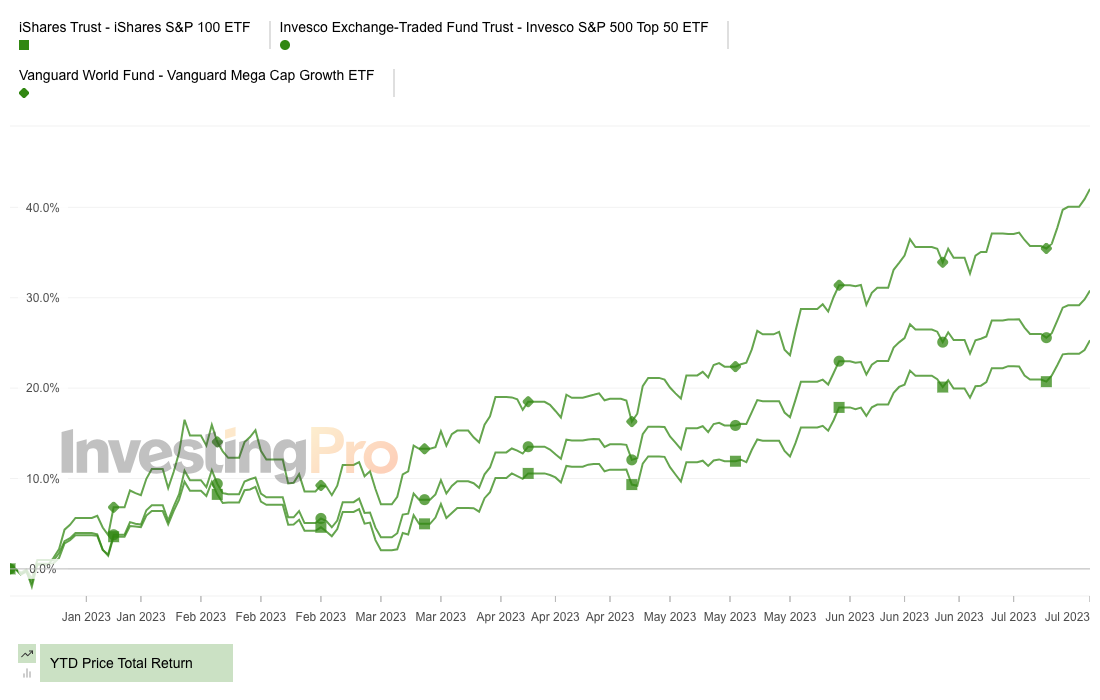
Source: https://www.investing.com/pro/ - Investing.com Pro
Hence, while Cramer's Magnificent Seven captures the current zeitgeist of the tech-driven market, prudent investors might want to be wary of falling into the same trap as the Nifty Fifty. Mega-cap ETFs can provide exposure to these tech giants, but it's crucial to balance this with diversified investments across other sectors and market caps.
Please note this article is for information purposes only and does not in any way constitute investment advice. It is essential that you seek advice from a registered financial professional prior to making any investment decision.
Latest ETF News
See all ETF news
Beyond TLT: Treasury ETFs For the Long Duration Trade

MoneyShow Chart of the Day 9/30/26: Are Hyperscalers the New "Sovereigns?"


Which Fixed-Income ETFs Benefit from Rising Interest Rates?




 Advantages of ETFs over Mutual Funds1/6
Lower Costs
In this guide, we'll explore the advantages of ETFs over mutual funds, giving you valuable insights into why ETFs have gained significant popularity among investors like yourself.
Leveraged ETFs: Unlocking the Potential for Amplified Returns1/6
Understanding Leveraged ETFs
Explore leveraged ETFs: potential for amplified returns & risks. 5 ETFs to consider across equities, commodities & fixed income.
What is a Leveraged ETF?1/6
Introducing Leveraged and Inverse ETFs
In this guide, we'll dive into the world of leveraged ETFs, exploring their definition, mechanics, potential risks, and rewards.
Recent educational content

First Look ETF
First Look ETF: Income, International, and Cash Flow ETFs
In this season 6 episode of First Look ETF, Stephanie Stanton @etfguide examines the latest ETF marketplace trends with NYSE and guests.


ETF Trends
ETF Industry KPIs October 5, 2026
This week’s KPI data overview highlights key metrics and trends shaping the ETF landscape.

ETF Trends
ETF Industry KPIs September 28, 2026
This week’s KPI data overview highlights key metrics and trends shaping the ETF landscape.
ETF Trends
ETF Industry KPIs September 22, 2026
This week’s KPI data overview highlights key metrics and trends shaping the ETF landscape.