ETF model portfolios designed for real investor needs. Discover →



ETF Tax Loss Harvesting: How to Use the ETF Central Comparison Tool
Here's my quick guide on how you can use the new ETF Central comparison tool to screen potential tax-loss harvesting pairs.


Keep up with what matters in ETFs
Get timely ETF insights, market trends, and top ideas straight to your inbox.
Your newsletter subscriptions with us are subject to ETF Central's Privacy Policy and Terms and Conditions.
Tax-loss harvesting is a strategy that allows you to manage your investment taxes proactively, especially useful in years where your investments might not perform as expected.
Despite 2023 and 2024 predominantly featuring bull market conditions, maintaining a plan for those not-so-great investment decisions or contrarian bets is crucial. That's where tax-loss harvesting comes in.
This strategy essentially involves selling securities that have incurred losses and replacing them with similar ones to offset the capital gains on other investments.
However, having the right tools to identify potential tax-loss harvesting pairs is essential, and ETF Central's new comparison tool can be leveraged for this purpose.
In today's guide, I'll walk you through how the tool works and show you how to strategically use it to enhance your tax-loss harvesting strategy. By the end, you'll have a clearer understanding of how to navigate tax implications more effectively, ensuring you're set to capitalize on this strategy during downturns or less favorable market conditions.
Like what you're reading?
Stay in the loop — get the latest ETF insights: trends, analysis, and expert picks.
Tax loss harvesting: a recap
When you sell an investment in a non-tax-advantaged account (like regular brokerage accounts, not tax-sheltered accounts such as Roth IRAs or 401(k)s) at a price higher than what you paid, you are liable for capital gains tax.
This tax has two rates: if you've held the investment for at least a year and a day, it's taxed at the long-term capital gains rate, which could be 0%, 15%, or 20% depending on your income. If held for less than a year, gains are taxed at your ordinary income rate, which can be as high as 37%.
Conversely, selling an investment at a loss allows you to claim a capital loss, which can offset capital gains. Here's how it works: short-term losses (on investments held for less than a year) offset short-term gains first, and long-term losses (on investments held for more than a year) offset long-term gains. If your losses exceed your gains, you can use up to $3,000 of the excess to reduce other kinds of income.
However, there's a crucial rule to follow to ensure you can legally claim this loss: the wash-sale rule. This IRS regulation prohibits you from claiming a loss on a sale if you buy a "substantially identical" security within 30 days before or after the sale.
The IRS hasn't clearly defined what "substantially identical" means, which creates a grey area. It generally suggests you avoid buying the same or a very similar stock or ETF. If unsure, it's wise to consult a tax professional to navigate these nuances effectively.
How to use the ETF Central comparison tool
Suppose we're back in 2022's bear market. You're holding the popular Vanguard Total Stock Market ETF (VTI) and you're considering some tax-loss harvesting. Here's how to use the ETF Central comparison tool to find a potential tax-loss harvesting partner:
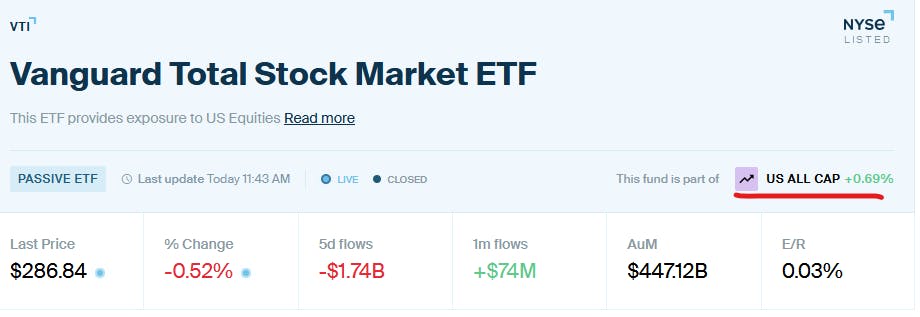
- Visit ETF's Page: Navigate to VTI's page on ETF Central. At the top, you'll notice a banner labeled "This fund is part of US ALL CAP," indicating its market segment. Clicking this link will show you VTI's peers, setting the stage for finding a suitable tax-loss harvesting partner.
- Check 'Movers' Section: Start with the 'movers' section which highlights ETFs that have performed the best or worst and those with significant inflows or outflows over the week. This variety helps identify viable partners since investor sentiment in these funds tends to align.
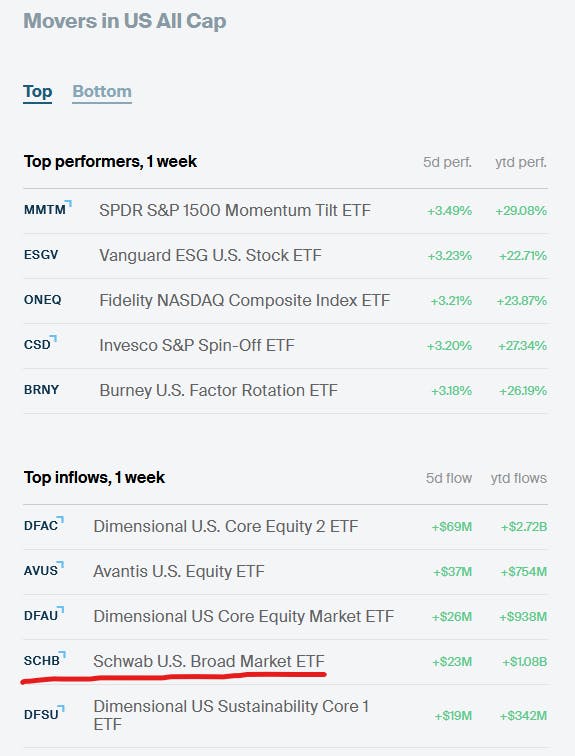
- Select a Partner: For this example, let's consider the Schwab U.S. Broad Market ETF (SCHB). To compare them, click the "Compare ETFs" link to put VTI and SCHB head-to-head.
- Analyze Key Data:
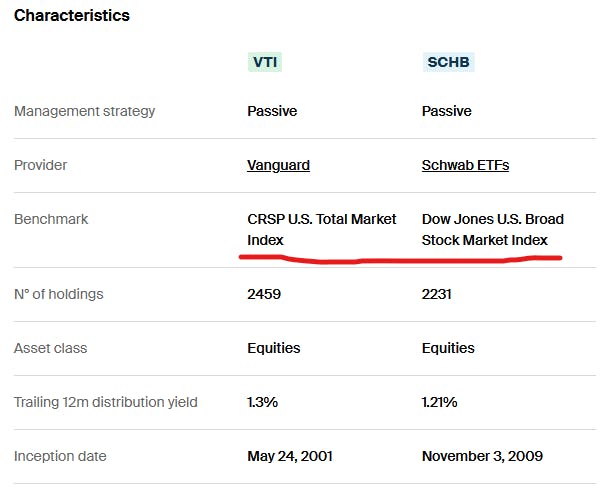
- Characteristics: Examine the benchmarks each ETF tracks. VTI follows the CRSP U.S. Total Market Index, whereas SCHB tracks the Dow Jones U.S. Broad Stock Market Index. This difference suggests they are likely not "substantially identical," important for meeting IRS guidelines against wash-sales.
- Underlying exposures: Ensure both ETFs have similar sector allocations and share several top holdings. This similarity means that even though you're harvesting losses, you're maintaining a comparable market exposure.
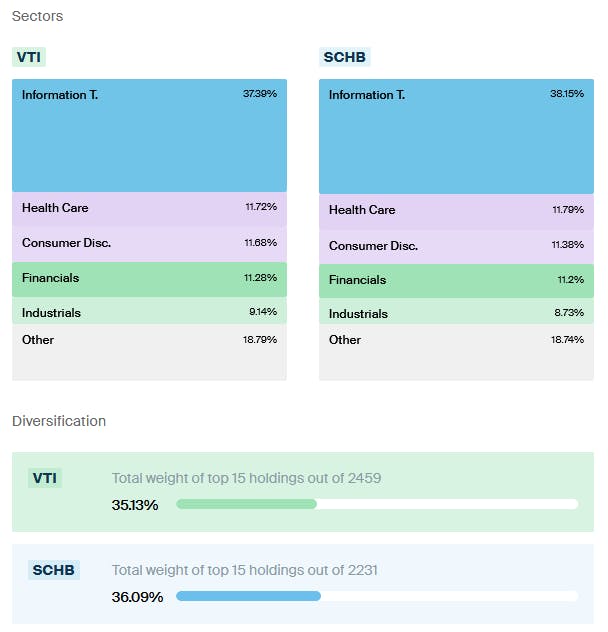
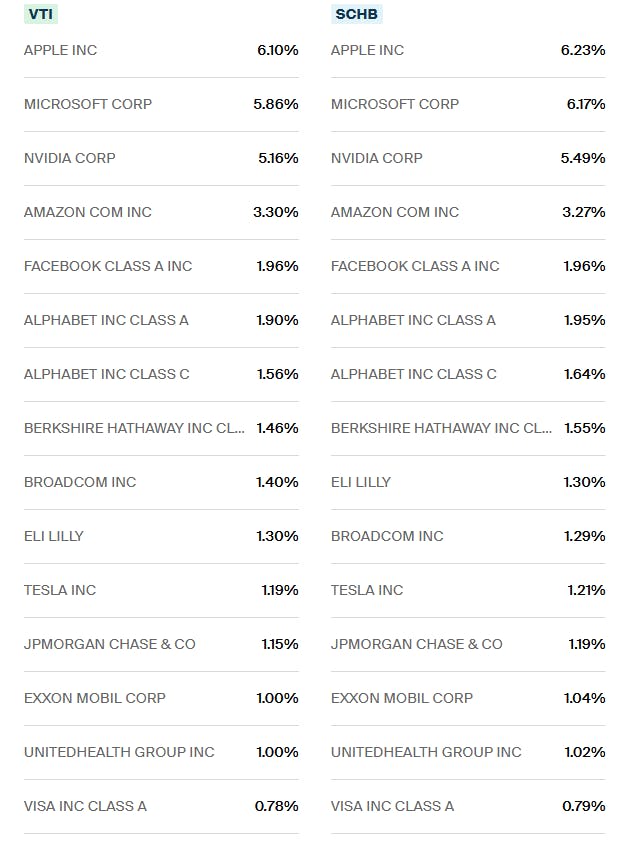
- Performance and Volatility: Finally, review their historical performance and volatility to confirm if they behave similarly in various market conditions. This similarity further supports their use as tax-loss harvesting partners.
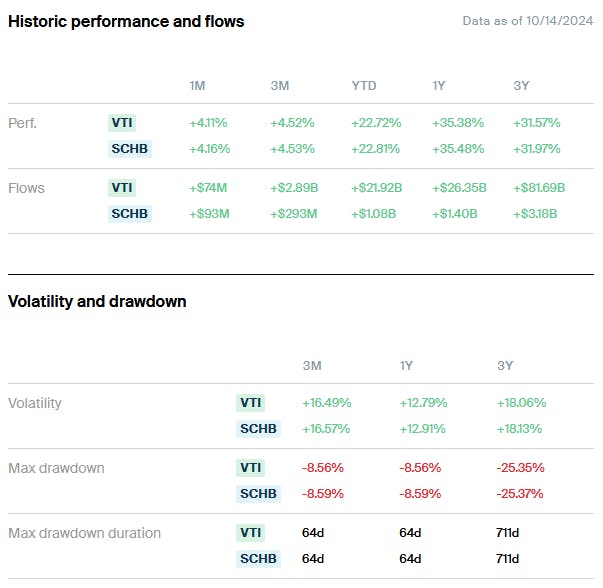
By carefully following these steps, you can potentially use SCHB to replace VTI in your portfolio temporarily, managing your tax situation effectively without deviating from your investment strategy.
Please note this article is for information purposes only and does not in any way constitute investment advice. It is essential that you seek advice from a registered financial professional prior to making any investment decision.


Latest ETF News
See all ETF newsCould Water ETFs Be the Next AI Bottleneck Trade?

What is a Boomer Candy ETF?

ETF Comparison: NEOS Nasdaq-100 High Income ETF (QQQI) Versus Goldman Sachs Nasdaq-100 Premium Income ETF (GPIQ)





 Advantages of ETFs over Mutual Funds1/6
Lower Costs
In this guide, we'll explore the advantages of ETFs over mutual funds, giving you valuable insights into why ETFs have gained significant popularity among investors like yourself.
Leveraged ETFs: Unlocking the Potential for Amplified Returns1/6
Understanding Leveraged ETFs
Explore leveraged ETFs: potential for amplified returns & risks. 5 ETFs to consider across equities, commodities & fixed income.
What is a Leveraged ETF?1/6
Introducing Leveraged and Inverse ETFs
In this guide, we'll dive into the world of leveraged ETFs, exploring their definition, mechanics, potential risks, and rewards.
Recent educational content

ETF Trends
ETF Industry KPIs September 8, 2026
This week’s KPI data overview highlights key metrics and trends shaping the ETF landscape.

ETF Trends
ETF Industry KPIs August 31, 2026
This week’s KPI data overview highlights key metrics and trends shaping the ETF landscape.
ETF Trends
ETF Industry KPIs August 24, 2026
This week’s KPI data overview highlights key metrics and trends shaping the ETF landscape.
What’sTheFund
What's the Fund | Ocean Park Diversified Income ETF (DUKZ)
James St Aubin, Chief Investment Officer at Ocean Park Asset Management, discuss the DUKZ ETF, exposing investors to the whole spectrum of asset classes in the fixed income markets, through their rules-based process.

Browse all educational columns



Build and Analyze Your ETF Portfolio Like a Pro
Create your own ETF portfolio in minutes and instantly see allocations, exposures, performance, and risk. Visualize diversification across asset classes, regions, and sectors. Stress-test ideas, compare benchmarks, and refine your strategy with professional-grade analytics.