From idea to ETF portfolio in minutes. Build yours now →



ETF Model Portfolios: The Warren Buffett 90/10
The Oracle of Omaha favors a 90/10 split between the S&P 500 and short-term Treasurys. Here’s how to put it in play with low-cost ETFs.

Keep up with what matters in ETFs
Get timely ETF insights, market trends, and top ideas straight to your inbox.
Your newsletter subscriptions with us are subject to ETF Central's Privacy Policy and Terms and Conditions.
At the end of 2025, Warren Buffett officially stepped down from Berkshire Hathaway. In an interview with the Wall Street Journal, he acknowledged that age was catching up to him. It is not surprising. The Oracle of Omaha was born on August 30, 1930, making him 95 years old as of writing.
He leaves behind a capable successor in Greg Abel, who has reinforced confidence by reinvesting his entire after-tax salary, roughly $15 million, back into Berkshire Hathaway shares. He has also resumed share buybacks, signaling that he views the stock as reasonably valued relative to its book value.
That said, Buffett has long planned for what comes next. In past interviews, he has been clear about how he wants his wealth managed after his passing. His instructions to the trustee of his wife’s estate are simple: allocate 90% to a low-cost S&P 500 index fund and 10% to short-term U.S. Treasurys.
If it is good enough for Buffett, it is worth a closer look. Using ETF Central’s new model portfolio tool, this piece breaks down how the 90/10 approach would have performed and highlights a few low-cost ETFs that can be used to implement it today.
Like what you're reading?
Stay in the loop — get the latest ETF insights: trends, analysis, and expert picks.
90% in the S&P 500
Buffett has long been one of the most vocal advocates for the S&P 500 as a core holding. His reasoning is simple. Broad exposure to American businesses has historically been one of the most reliable ways to build wealth. As he famously put it, “never bet against America.”
That philosophy has shown up in Berkshire Hathaway’s own portfolio at times, with holdings in S&P 500 index funds alongside its individual stock positions. For most investors, though, Buffett has been clear that trying to pick stocks is unnecessary. A low-cost index fund does the job.
I prefer ETFs over mutual funds for implementing this. On average, they come with lower expense ratios, they trade throughout the day like stocks, and they are generally more tax-efficient due to the in-kind creation and redemption mechanism, which helps minimize capital gains distributions.
There is no shortage of S&P 500 ETFs, and Buffett has often pointed to Vanguard’s lineup. My preferred option is the State Street SPDR Portfolio S&P 500 ETF
Formerly known as SPLG, it recently changed its ticker and now stands as the lowest-cost option in the U.S. market with a 0.02% expense ratio. It is also well capitalized with $113 billion in assets under management and highly liquid, with a 0.01% 30-day median bid-ask spread.
Beyond cost, I like the S&P 500 itself as an index. While there is a committee involved, the inclusion criteria around market capitalization, liquidity, and consistent earnings introduce a mild quality screen. Combined with market-cap weighting, you also naturally capture momentum, as the winners become a larger share of the index over time.
10% in Treasury Bills
Buffett and Berkshire have always maintained a strong preference for cash. In the company’s latest disclosures, Berkshire holds roughly $373 billion in cash and cash equivalents.
A significant portion of that supports the insurance float, but Buffett has consistently emphasized the value of keeping dry powder available to deploy during market dislocations.
In this model, that philosophy is scaled down to a more practical 10% allocation, held in short-term U.S. Treasurys. While “short-term” can technically extend out to one to three years, I interpret Buffett’s intent as Treasury bills, which are securities with maturities of one year or less.
Treasury bills do not pay a coupon. Instead, they are issued at a discount and mature at face value, with the difference representing your return. When packaged inside an ETF, the constant rolling of maturing holdings results in regular income distributions, typically paid monthly.
For this sleeve, I prefer the State Street SPDR Bloomberg 3–12 Month T-Bill ETF
Putting It All Together
The portfolio is about as simple as it gets. Allocate 90% to SPYM and 10% to BILS, and rebalance once a year. The weighted average expense ratio comes out to just 0.032%, which is extremely low.
Over most backtests, this mix will lag a 100% S&P 500 allocation. That is expected, especially in strong bull markets where holding cash creates a drag. However, that 10% allocation to Treasury bills helps reduce volatility and improve risk-adjusted returns. You see this show up in a higher Sharpe ratio, as well as shallower drawdowns during market stress.
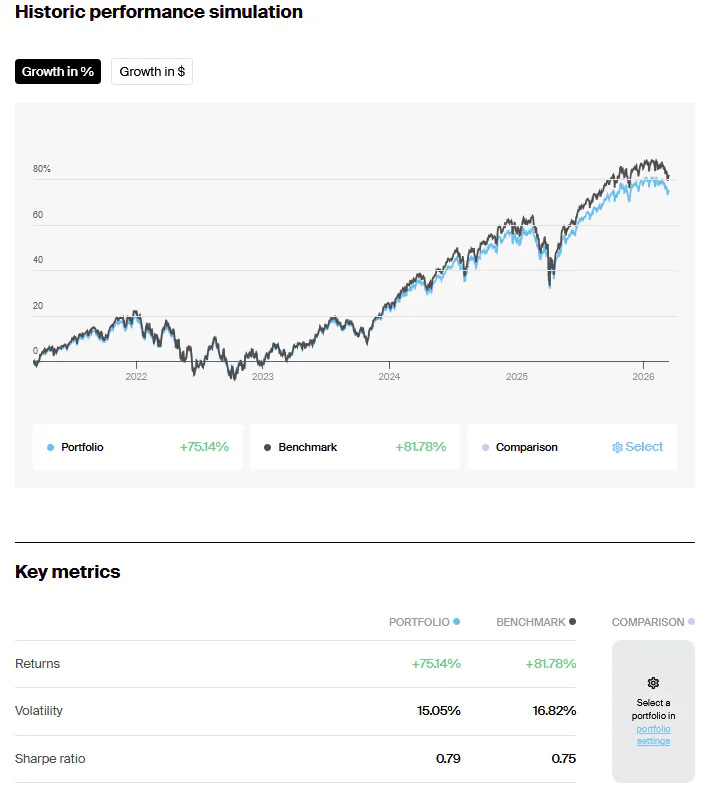
For investors who remain bullish on U.S. equities but want to take a small amount of risk off the table, this is a straightforward allocation that is easy to understand, easy to implement, and most importantly, easy to stick with over the long term.
Please note this article is for information purposes only and does not in any way constitute investment advice. It is essential that you seek advice from a registered financial professional prior to making any investment decision.






 Advantages of ETFs over Mutual Funds1/6
Lower Costs
In this guide, we'll explore the advantages of ETFs over mutual funds, giving you valuable insights into why ETFs have gained significant popularity among investors like yourself.
Leveraged ETFs: Unlocking the Potential for Amplified Returns1/6
Understanding Leveraged ETFs
Explore leveraged ETFs: potential for amplified returns & risks. 5 ETFs to consider across equities, commodities & fixed income.
What is a Leveraged ETF?1/6
Introducing Leveraged and Inverse ETFs
In this guide, we'll dive into the world of leveraged ETFs, exploring their definition, mechanics, potential risks, and rewards.
Recent educational content

ETF Trends
ETF Industry KPIs September 28, 2026
This week’s KPI data overview highlights key metrics and trends shaping the ETF landscape.

ETF Trends
ETF Industry KPIs September 22, 2026
This week’s KPI data overview highlights key metrics and trends shaping the ETF landscape.
First Look ETF
First Look ETF: Income, Corporate Arbitrage, and Growth and Value Investing
First Look ETF September 2026: iCapital, Mast Investments and North Square unpack new ETFs targeting monthly income, merger arbitrage and complementary growth and value exposure.

ETF Trends
ETF Industry KPIs September 14, 2026
This week’s KPI data overview highlights key metrics and trends shaping the ETF landscape.
Browse all educational columns



Build and Analyze Your ETF Portfolio Like a Pro
Create your own ETF portfolio in minutes and instantly see allocations, exposures, performance, and risk. Visualize diversification across asset classes, regions, and sectors. Stress-test ideas, compare benchmarks, and refine your strategy with professional-grade analytics.