Ready-made ETF portfolios built for real investor needs. Explore now →



ETF Model Portfolios: The Cockroach Portfolio
This simple, yet defensive combination of five-low cost ETFs has historically delivered very good risk adjusted returns.


Keep up with what matters in ETFs
Get timely ETF insights, market trends, and top ideas straight to your inbox.
Your newsletter subscriptions with us are subject to ETF Central's Privacy Policy and Terms and Conditions.
The idea behind my Cockroach Portfolio is straightforward: build something that can survive just about anything the market throws at it. Not by trying to predict the next crisis, but by combining exposures that historically behave differently across economic environments.
In ETF terms, that means leaning on diversification instead of expensive hedging. No options overlays, no constant negative carry. Just a handful of low-cost ETFs that, when combined, have historically delivered strong risk-adjusted returns relative to both the S&P 500 and a traditional 60/40 portfolio.
Using ETF Central’s new portfolio tool, my five-ETF mix stands out for its ability to reduce drawdowns, smooth volatility, and still participate meaningfully in upside. Here’s how it’s built.
Like what you're reading?
Stay in the loop — get the latest ETF insights: trends, analysis, and expert picks.
The 60% stock allocation
Instead of broad market exposure, the equity sleeve is split evenly across three defensive sectors: the Health Care Select Sector SPDR Fund
Each of these ETFs draws from the S&P 500, which means you are still getting exposure to large, liquid, profitable companies. But the sector tilt matters. These are businesses tied to inelastic demand.
Healthcare companies provide essential treatments and services. Utilities supply electricity, water, and gas. Consumer staples cover everyday goods like food, hygiene products, and household items. Demand for these does not fall off a cliff during recessions.
These sectors tend to have lower beta than the broader market, meaning they move less during both rallies and selloffs. The goal here is not to chase maximum upside, but to avoid the kind of deep drawdowns that take years to recover from.
The 20% bond allocation
The bond sleeve is allocated to the iShares U.S. Treasury Bond ETF
Its role is diversification. Treasury bonds are driven by interest rates and macro conditions, not corporate earnings. That makes them a different return stream from equities, and historically, they have often moved in the opposite direction during periods of market stress.
By focusing on Treasurys instead of corporate bonds, the portfolio avoids credit risk and leans into the traditional “flight to safety” behavior. This is meant to act as a stabilizer when equities sell off.
The 20% gold allocation
The final piece is gold, held through the iShares Gold Trust Micro
Gold brings something different to the table. It has low correlation to both stocks and bonds and tends to perform well in environments where traditional assets struggle together, such as inflation shocks or currency concerns.
It does not produce income, and it does not rely on earnings growth. But that is precisely why it works here. It adds a third, distinct source of return that can help offset periods when both equities and bonds are under pressure.
Using an ETF structure avoids the logistical issues of holding physical gold, such as storage and transaction costs, while still providing direct exposure to the underlying metal.
Putting it all together
Implementation is straightforward. Allocate 20% to each of the five ETFs and rebalance quarterly. That brings the weighted average expense ratio to just 0.076%.
Against the S&P 500 total return index, this portfolio has lagged over the past five years, which is expected in a strong equity bull market. But the tradeoff shows up clearly in the Sharpe ratio, which increases to 1.08 from 0.67. In other words, you are getting more return per unit of risk taken.
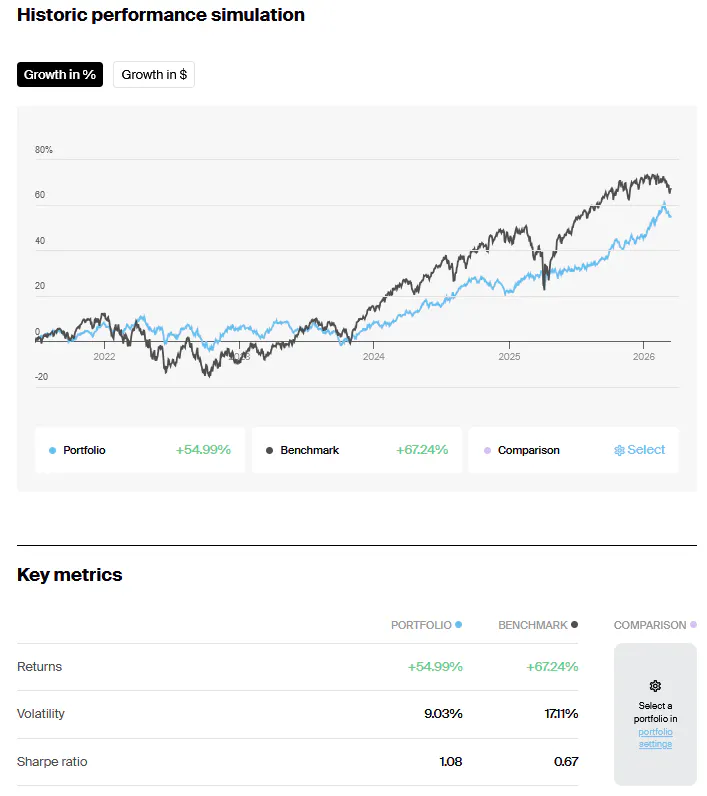
Volatility drops materially, from 17.1% for the S&P 500 down to 9% for this portfolio. Downside volatility is cut nearly in half as well, falling from 10.44% to 5.4%. Correlation to the S&P 500 also declines to 0.56. Skewness and kurtosis, which measure the asymmetry of returns and the likelihood of extreme tail events, are both reduced.
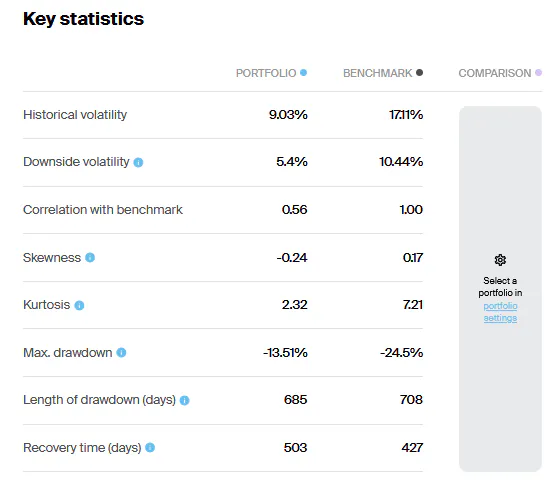
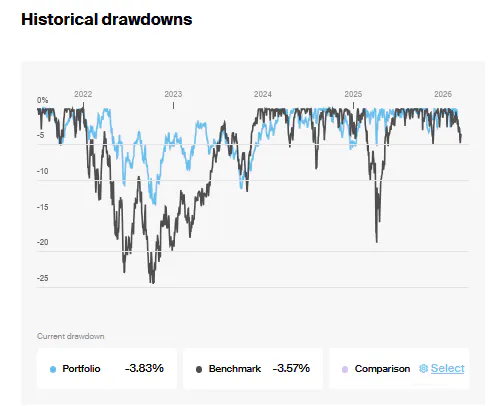
Maximum drawdown length is nearly cut in half, and the number of days spent in drawdown is also lower, pointing to faster recoveries.
Across multiple value-at-risk measures, including historical, Gaussian, Cornish-Fisher, and conditional VaR, the Cockroach Portfolio consistently comes out with lower downside risk than the S&P 500.
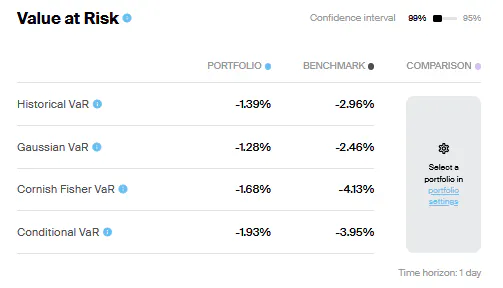
This is not a portfolio designed to shoot the lights out. It is designed to endure. For investors looking for a more balanced, cost-efficient alternative to complex and expensive all-weather strategies, this is a practical way to get there using just a handful of low-cost index ETFs.
Please note this article is for information purposes only and does not in any way constitute investment advice. It is essential that you seek advice from a registered financial professional prior to making any investment decision.






 Advantages of ETFs over Mutual Funds1/6
Lower Costs
In this guide, we'll explore the advantages of ETFs over mutual funds, giving you valuable insights into why ETFs have gained significant popularity among investors like yourself.
Leveraged ETFs: Unlocking the Potential for Amplified Returns1/6
Understanding Leveraged ETFs
Explore leveraged ETFs: potential for amplified returns & risks. 5 ETFs to consider across equities, commodities & fixed income.
What is a Leveraged ETF?1/6
Introducing Leveraged and Inverse ETFs
In this guide, we'll dive into the world of leveraged ETFs, exploring their definition, mechanics, potential risks, and rewards.
Recent educational content

ETF Trends
ETF Industry KPIs September 22, 2026
This week’s KPI data overview highlights key metrics and trends shaping the ETF landscape.

First Look ETF
First Look ETF: Income, Corporate Arbitrage, and Growth and Value Investing
First Look ETF September 2026: iCapital, Mast Investments and North Square unpack new ETFs targeting monthly income, merger arbitrage and complementary growth and value exposure.

ETF Trends
ETF Industry KPIs September 14, 2026
This week’s KPI data overview highlights key metrics and trends shaping the ETF landscape.
ETF Trends
ETF Industry KPIs September 8, 2026
This week’s KPI data overview highlights key metrics and trends shaping the ETF landscape.
Browse all educational columns



Expert-Built ETF Portfolios, All in One Place
Don’t start from scratch. Discover ready-made ETF portfolios built by professionals to match different goals, timelines, and market views. Use them as inspiration or as a starting point for your own allocation.