From idea to ETF portfolio in minutes. Build yours now →



ETF Model Portfolios: High Asset, Low Obsolescence (HALO)
A DIY HALO model portfolio: five Vanguard sector ETFs, equal-weighted, at a 0.09% expense ratio.

Keep up with what matters in ETFs
Get timely ETF insights, market trends, and top ideas straight to your inbox.
Your newsletter subscriptions with us are subject to ETF Central's Privacy Policy and Terms and Conditions.
Wall Street loves its acronyms. There was FAANG, referring to Facebook, Amazon, Apple, Netflix and Google, followed by the Magnificent Seven: Apple, Microsoft, Alphabet, Amazon, Nvidia, Meta Platforms and Tesla. Before either of those, investors had the Nifty Fifty, a group of highly regarded large-cap growth stocks that dominated market enthusiasm during the late 1960s and early 1970s.
Contrarians have their own acronyms, too. One gaining attention amid the artificial intelligence boom, or bubble, depending on your perspective, is HALO, short for "high asset, low obsolescence."
Rather than concentrating on technology companies developing AI, HALO emphasizes businesses with substantial physical assets that are difficult, expensive, or impractical to replace. Think utilities, energy infrastructure, industrial machinery, transportation networks and other capital-intensive operations whose economic value depends on owning and operating real-world infrastructure.
The investment thesis is that while AI could disrupt software businesses, professional services and other relatively asset-light industries, companies controlling essential physical infrastructure may face less direct technological displacement. Some could even benefit from the additional electricity, construction, transportation and industrial capacity required to support AI adoption.
ETF issuers have already begun packaging this concept into dedicated thematic products. Examples include the Roundhill HALO ETF
Still, I think investors can build a reasonable approximation of the HALO strategy themselves using inexpensive, broadly diversified sector ETFs. With the ETF Central Model Portfolio tool, it's relatively straightforward to combine several complementary exposures into a portfolio without paying a thematic management premium.
That's what we'll do today using an equally weighted allocation to five Vanguard sector ETFs. State Street also offers an excellent lineup of low-cost sector funds, but its traditional Select Sector SPDR ETFs are generally restricted to S&P 500 constituents. Vanguard's sector ETFs draw from a broader U.S. equity universe that includes large-, mid-, and small-cap companies, providing somewhat better representation across the market-capitalization spectrum.
For a strategy built around physical assets and established industries, I think that broader coverage makes sense. Let's look at the five sector ETFs that could form the foundation of a DIY HALO portfolio.
Global ETF Survey 2026 is Live!
With 1,790 new products launched by July 2026, choosing is harder than ever. Our Global ETF Survey 2026, built on 620 professional investors and allocators, shows how active, fixed income, options-based and thematic ETFs are reshaping fund selection.
The Five HALO Sector ETFs
In no particular order, the five ETFs I've selected for this HALO model portfolio are the Vanguard Utilities ETF
Utilities are among the most straightforward examples of the HALO concept. Electricity, water and natural gas distribution require extensive physical infrastructure, much of which operates within regulated service territories with high barriers to entry. Electric transmission is particularly attractive because building high-voltage transmission lines requires substantial capital, regulatory approvals and rights-of-way that competitors cannot easily replicate. AI may change how electricity networks are managed, but the physical grid remains essential, especially as data center power demand increases.
Energy infrastructure is another natural fit, particularly midstream businesses operating pipelines, storage terminals and processing facilities. These assets are expensive to construct, difficult to duplicate and often benefit from long-term contracts or volume-based transportation fees. A pipeline connecting major production basins to refineries or export terminals can retain considerable economic value regardless of advances in AI. VDE also holds oil and gas producers, refiners and integrated energy companies, so investors should recognize that commodity prices remain an important driver of returns.
Industrials offer several compelling HALO business models, especially railroads and waste management companies. Rail networks benefit from enormous replacement costs, established rights-of-way and limited direct competition along many routes. Waste management businesses have similarly durable advantages through landfill ownership, collection routes, transfer stations and municipal contracts. Landfill permitting can be particularly difficult, creating barriers to entry for new competitors. VIS also includes aerospace, machinery and transportation businesses, although these can be more cyclical and exposed to technological change than railroads or waste collection.
Materials companies control the physical inputs required for construction, manufacturing and infrastructure development. Mining businesses are an obvious example, since mineral deposits are geographically fixed and cannot be replicated by software. However, aggregates producers may be an even cleaner HALO example. Crushed stone, sand and gravel are essential for roads, buildings and concrete, while their low value relative to transportation costs makes nearby quarries particularly advantageous. Permitting new extraction sites can also be difficult, helping established operators maintain local competitive positions. VAW provides exposure to these businesses alongside chemicals, metals and other materials producers.
Real estate is the most literal interpretation of the high-asset component of HALO. Buildings and land are tangible assets that remain necessary regardless of how advanced AI becomes. Within the sector, residential REITs are particularly interesting because housing fulfills a recurring, essential need. Apartment communities, manufactured housing and other residential properties can benefit from persistent demand, while desirable locations and development restrictions may limit competing supply. VNQ also holds industrial, retail, healthcare, and specialized REITs, introducing additional diversification, although property valuations and financing costs remain sensitive to changes in interest rates.
Putting the Portfolio Together
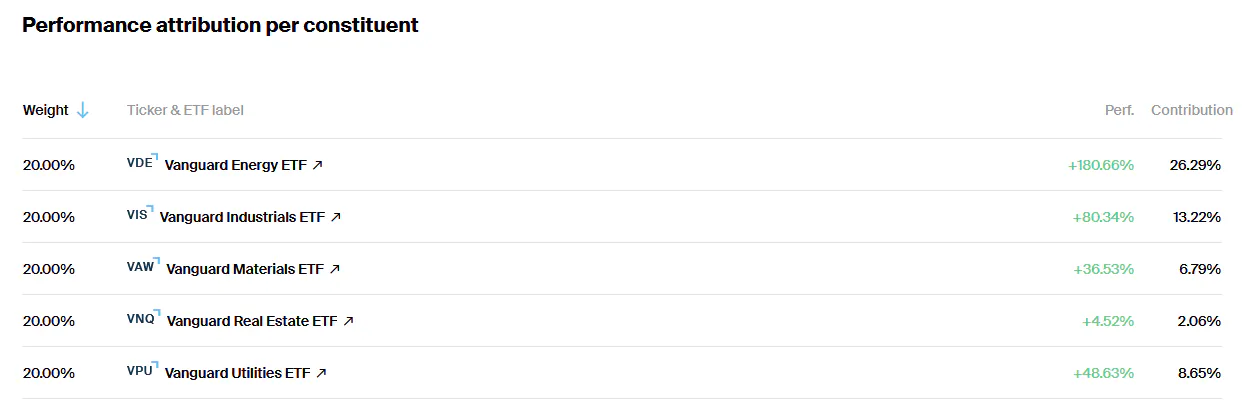
For simplicity, I'm assigning an equal 20% weight to each of the five ETFs: VPU, VDE, VIS, VAW, and VNQ. I'll also assume annual rebalancing rather than quarterly or monthly adjustments, which helps reduce turnover and the potential for realizing capital gains in taxable accounts.
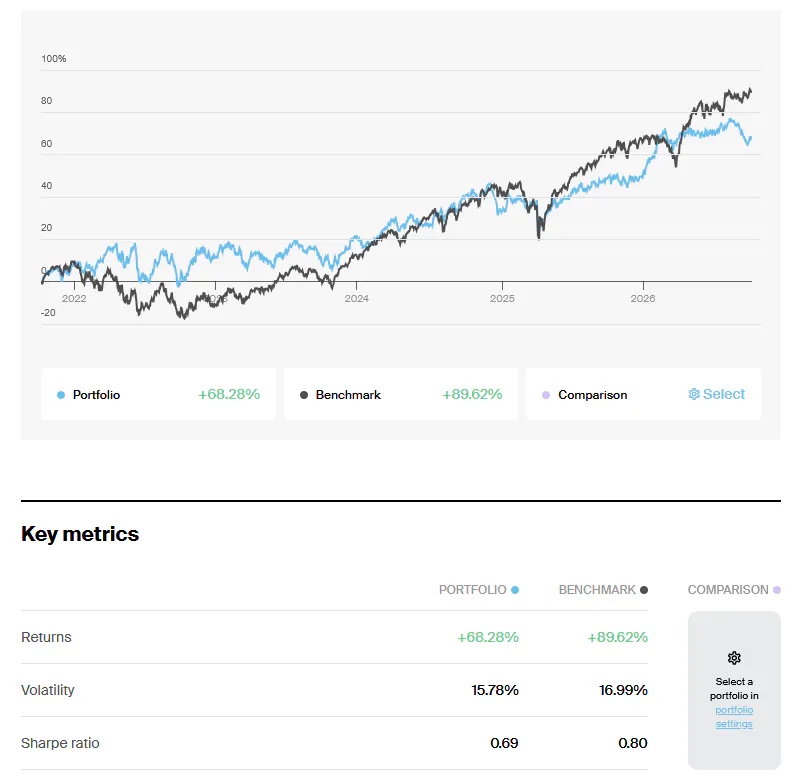
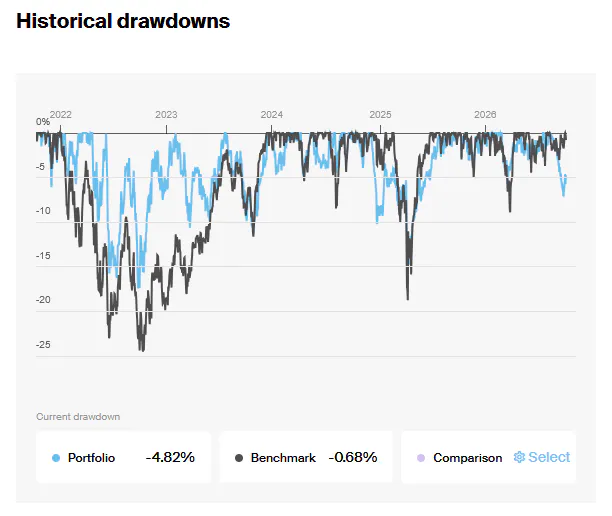
Using ETF Central's Model Portfolio Builder, I backtested this allocation from mid-2021 through the present against the S&P 500 Total Return Index. Over the full period, the HALO portfolio underperformed on both an absolute and risk-adjusted basis.
However, the portfolio demonstrated its potential resilience during the inflationary environment of 2022. While the S&P 500 suffered a double-digit decline, this real-asset-heavy allocation actually finished the year with a positive return. Exposure to energy, utilities and other physical-asset-intensive businesses helped offset weakness elsewhere in the portfolio.
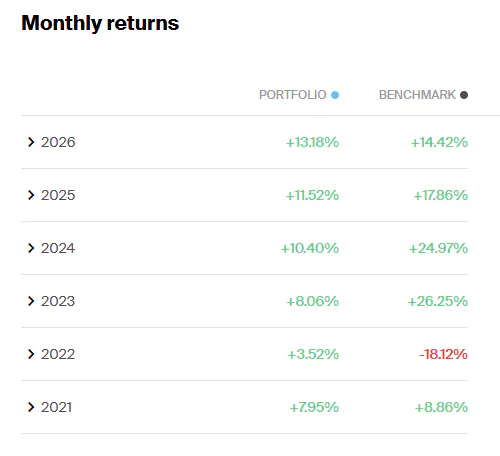
The following years were considerably less favorable. The HALO allocation lagged the S&P 500 substantially as mega-cap growth stocks drove much of the market's gains. That's understandable given the portfolio's construction. It excludes information technology and communication services entirely, along with consumer discretionary companies, leaving it with little direct exposure to the major beneficiaries of the AI investment boom.
I actually see that as a potential advantage for investors who already maintain a substantial core allocation to U.S. large-cap equities. Rather than replacing an S&P 500 ETF, this HALO portfolio could serve as a satellite allocation, providing exposure to sectors and business models that are relatively underrepresented in today's technology-heavy benchmark.
It's also worth noting that year-to-date in 2026, the HALO portfolio has kept pace with the S&P 500 reasonably well despite having little exposure to the market's most prominent AI winners.
If the AI trade eventually loses momentum and market leadership broadens toward more traditional industries, this allocation could benefit. The same applies if inflation remains elevated, given the portfolio's exposure to energy, materials, infrastructure and other businesses with substantial tangible assets. Neither outcome is guaranteed, and the portfolio would still face risks from economic slowdowns, commodity cycles and higher financing costs.
Finally, implementation is inexpensive. With all five ETFs charging 0.09%, the portfolio's weighted-average expense ratio is also just 0.09%, substantially below the fees charged by dedicated HALO ETFs.
And because each underlying ETF is market-cap weighted, successful companies can naturally grow into larger positions within their respective sector allocations. Annual rebalancing maintains the intended balance across the five sectors without requiring investors to constantly adjust individual holdings.
For investors looking to complement a growth-heavy core portfolio with exposure to established, asset-intensive businesses, I think this is a straightforward and cost-effective way to express the HALO thesis.
Please note that this article reflects the author’s personal views and does not represent the opinions of the publication or its affiliates. It is for informational purposes only and does not constitute investment advice. It is essential to seek guidance from a registered financial professional before making any investment decisions.
Segments
See all
Mentioned ETFs
Further reading

Latest ETF News
See all ETF newsETF Model Portfolios: The Anti-Inflation and Rising Interest Rate Allocation
ETF Model Portfolios: The Geopolitical Risk Thematic Hedge

ETF Model Portfolios: The Boglehead Couch Potato





 Advantages of ETFs over Mutual Funds1/6
Lower Costs
In this guide, we'll explore the advantages of ETFs over mutual funds, giving you valuable insights into why ETFs have gained significant popularity among investors like yourself.
Leveraged ETFs: Unlocking the Potential for Amplified Returns1/6
Understanding Leveraged ETFs
Explore leveraged ETFs: potential for amplified returns & risks. 5 ETFs to consider across equities, commodities & fixed income.
What is a Leveraged ETF?1/6
Introducing Leveraged and Inverse ETFs
In this guide, we'll dive into the world of leveraged ETFs, exploring their definition, mechanics, potential risks, and rewards.
Recent educational content

First Look ETF
First Look ETF: Income, International, and Cash Flow ETFs
In this season 6 episode of First Look ETF, Stephanie Stanton @etfguide examines the latest ETF marketplace trends with NYSE and guests.

ETF Trends
ETF Industry KPIs October 5, 2026
This week’s KPI data overview highlights key metrics and trends shaping the ETF landscape.

ETF Trends
ETF Industry KPIs September 28, 2026
This week’s KPI data overview highlights key metrics and trends shaping the ETF landscape.
ETF Trends
ETF Industry KPIs September 22, 2026
This week’s KPI data overview highlights key metrics and trends shaping the ETF landscape.