Create, analyze, optimize your ETF portfolio. Start now →



ETF Insights: Top 5 Fund Flows and Segments for March 2023
A brief look at the ETF segments and solutions that have received the most net fund flows in March 2023.

Keep up with what matters in ETFs
Get timely ETF insights, market trends, and top ideas straight to your inbox.
Your newsletter subscriptions with us are subject to ETF Central's Privacy Policy and Terms and Conditions.
In a month that was mostly defined by bank failures and wavering investor confidence regarding the strength of the economy, the asset classes that had the greatest net flows were indicative of the prevailing sentiment of the market. For March 2023, the ETF segments that had the greatest net fund flows were US Government Bonds ($20.09 bn), Money Market Bonds ($7.37 bn), US Multi-Factor ($6.56 bn), US Large Cap Growth ($ 3.54 bn), and US Aggregate Bond ($2.90 bn).
Like what you're reading?
Stay in the loop — get the latest ETF insights: trends, analysis, and expert picks.
A look at each Segment and ETF Flows
US Government Bonds

US investors engaged in a flight to safety for the month of March, as the US Government Bond asset class took in the greatest flows. As evidenced from the data, intermediate and long-term dated treasuries that offered higher interest rates were the preferred choice among investors. Among asset managers, BlackRock’s iShares offerings held three of the top five category leading funds, with iShares 7-10 Year Treasury Bond ETF (IEF), iShares Core U.S. Treasury Bond ETF (GOVT), and iShares 20+ Year Treasury Bond ETF (TLT) being the leading recipient of flows. Regarding performance, TLT was the standout performer of the group.
Money Market Bonds
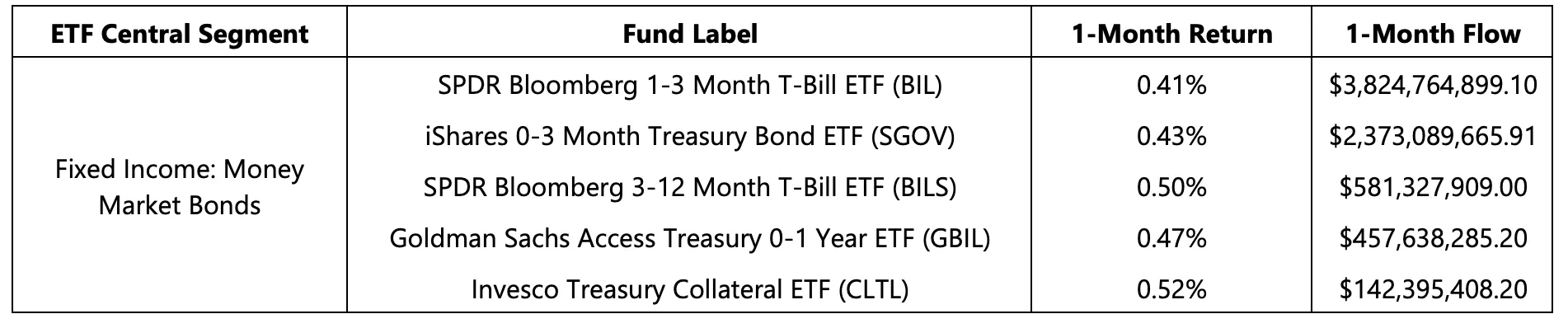
As well as US government bonds, investors also allocated significant capital to money market instruments throughout March. With the failure of three regional banks occurring in rapid succession during the month, deposit flight became a real occurrence among many banking institutions. For individuals and investors that were seeking a safe haven for their monies, money market instruments became a viable landing spot, due to the opportunity cost and perceived loss many believed they were facing. Looking forward, the US Federal Reserve has intimated that future rate hikes may be slowing, but a decision will be predicated on incoming data; ultimately, we will wait to see what impact such policy decision-making will have on the net flows of this category. Regarding performance, the return of all top five funds was similar in nature.
US Multi-Factor

The US Multi-Factor segment saw the third most flows for the month, as safety for many investors meant investing in quality companies that have established business models and a proven track record of generating consistent earnings over time. Among the top five funds in this category for the month, the Quality investing factor was the overarching theme, with the iShares Edge MSCI USA Quality Factor ETF (QUAL), Invesco S&P 500® Quality ETF (SPHQ), and WisdomTree U.S. Quality Dividend Growth Fund (DGRW) being present. Both SPHQ and QUAL had strong performances for the month, returning 5.18% and 4.79% respectively. As uncertainty about the US economy remains, it’s possible that flows into this category will continue to grow, as investors will feel safest investing in companies that have proven their ability to navigate through different stages of the economic cycle and remain fundamentally intact.
US Large Cap Growth

The growth investing factor performed exceedingly well for the month of March, outperforming its value investing counterpart in a truly material manner. Though the top performing funds in this category are managed by two prominent asset managers, Vanguard and BlackRock, the difference in performance amongst the funds is where the intrigue lies. In the case of Vanguard Mega Cap Growth ETF (MGK) and Vanguard Growth ETF (VUG), while they broadly share a similar investment objective, the former’s focus on ‘mega cap’ growth results in a portfolio that has more concentrated holdings. MGK’s incrementally higher exposure to the technology sector helped it outperform VUG for the month. The same conclusion can be drawn for iShares Russell Top 200 Growth ETF (IWY) versus iShares Russell 1000 Growth ETF (IWF). Though developments in the broader economy have made investors wary of growth-oriented companies, the strong performance of and flows into the category for March are notable and could be a sign of investor outlook and risk appetite going forward.
US Aggregate Bonds

Within the US Aggregate Bond Segment, the iShares Core Total Bond Market ETF (IUSB) garnered the most flows for the month. Given the uncertainty stemming from regional bank failures, investors engaged in a flight to safety, pivoting towards US Treasuries, US Government Bonds, or Multi-Sector fixed income solutions, such as IUSB. Though IUSB has the most net flows, the Vanguard Total Bond Market ETF (BND) had a better return performance for the month. As mentioned previously, with the US Federal Reserve indicating its intention to slow future rate hikes, based on incoming data, we will wait to see what impact it will have on the flows into this category going forward.
Important: While fund flows represent a snapshot of where investor dollars are currently moving en masse, understanding how a particular solution fits within one’s overall portfolio is paramount. In examining ETF fund flows, investors can gain a general understanding of what asset classes and strategies are of interest within the broader landscape and assess their suitability for one’s own wealth generation journey.
Please note this article is for information purposes only and does not in any way constitute investment advice. It is essential that you seek advice from a registered financial professional prior to making any investment decision.
Latest ETF News
See all ETF newsWhich Fixed-Income ETFs Benefit from Rising Interest Rates?


MoneyShow Chart of the Day 9/16/26: Oil? Surging. Oil Stocks? Not So Much.


MoneyShow Chart of the Day 9/4/26: Don't Just Watch Oil. Watch THESE.
Chart of the Day 8/14/26: The Great "Hot Money" Migration




 Advantages of ETFs over Mutual Funds1/6
Lower Costs
In this guide, we'll explore the advantages of ETFs over mutual funds, giving you valuable insights into why ETFs have gained significant popularity among investors like yourself.
Leveraged ETFs: Unlocking the Potential for Amplified Returns1/6
Understanding Leveraged ETFs
Explore leveraged ETFs: potential for amplified returns & risks. 5 ETFs to consider across equities, commodities & fixed income.
What is a Leveraged ETF?1/6
Introducing Leveraged and Inverse ETFs
In this guide, we'll dive into the world of leveraged ETFs, exploring their definition, mechanics, potential risks, and rewards.
Recent educational content

ETF Trends
ETF Industry KPIs October 5, 2026
This week’s KPI data overview highlights key metrics and trends shaping the ETF landscape.

ETF Trends
ETF Industry KPIs September 28, 2026
This week’s KPI data overview highlights key metrics and trends shaping the ETF landscape.
ETF Trends
ETF Industry KPIs September 22, 2026
This week’s KPI data overview highlights key metrics and trends shaping the ETF landscape.

First Look ETF
First Look ETF: Income, Corporate Arbitrage, and Growth and Value Investing
First Look ETF September 2026: iCapital, Mast Investments and North Square unpack new ETFs targeting monthly income, merger arbitrage and complementary growth and value exposure.

Browse all educational columns



Expert-Built ETF Portfolios, All in One Place
Don’t start from scratch. Discover ready-made ETF portfolios built by professionals to match different goals, timelines, and market views. Use them as inspiration or as a starting point for your own allocation.