Keep tabs on your favorite ETFs with a personalized weekly tracker. Create a Watchlist now →



ETF Ideas for the Debasement Trade
ETF investors are leaning into the “debasement trade” as the dollar weakens and real assets outperform—here’s how the trend is taking shape.

Keep up with what matters in ETFs
Get timely ETF insights, market trends, and top ideas straight to your inbox.
Your newsletter subscriptions with us are subject to ETF Central's Privacy Policy and Terms and Conditions.
Every once in a while, Wall Street comes up with a fancy-sounding name for a trade idea. A few months ago, it was the “TACO trade,” short for “Trump Always Chickens Out”—a bet on buying the dip whenever new tariffs were announced, with the expectation they’d soon be walked back, delayed, or canceled.
In October, though, it’s all about the “debasement trade.” The idea revolves around two linked forces: the gradual erosion of the U.S. dollar’s role as a reserve currency, and the simultaneous outperformance of real assets like gold.
Together, they make for an elegant pairs trade—and easy talking points for goldbugs like Peter Schiff—but what does it mean for ETF investors? Here’s my best attempt to break down the why behind the debasement trade, and the how—the ETFs that stand to benefit, or have already started to.
Get data on 14,000+ ETFs
Access Trackinsight's reliable and comprehensive data with 500M+ points on 14,000+ ETFs.
The debasement trade visualized
To be honest, calling it a “trade” undersells what’s really a long-term structural story that investors are only now recognizing.
The following chart tells that story better than any headline could. It shows three data lines: the purchasing power of the U.S. dollar (purple), the size of the M2 money supply (orange), and total U.S. public debt outstanding (blue).
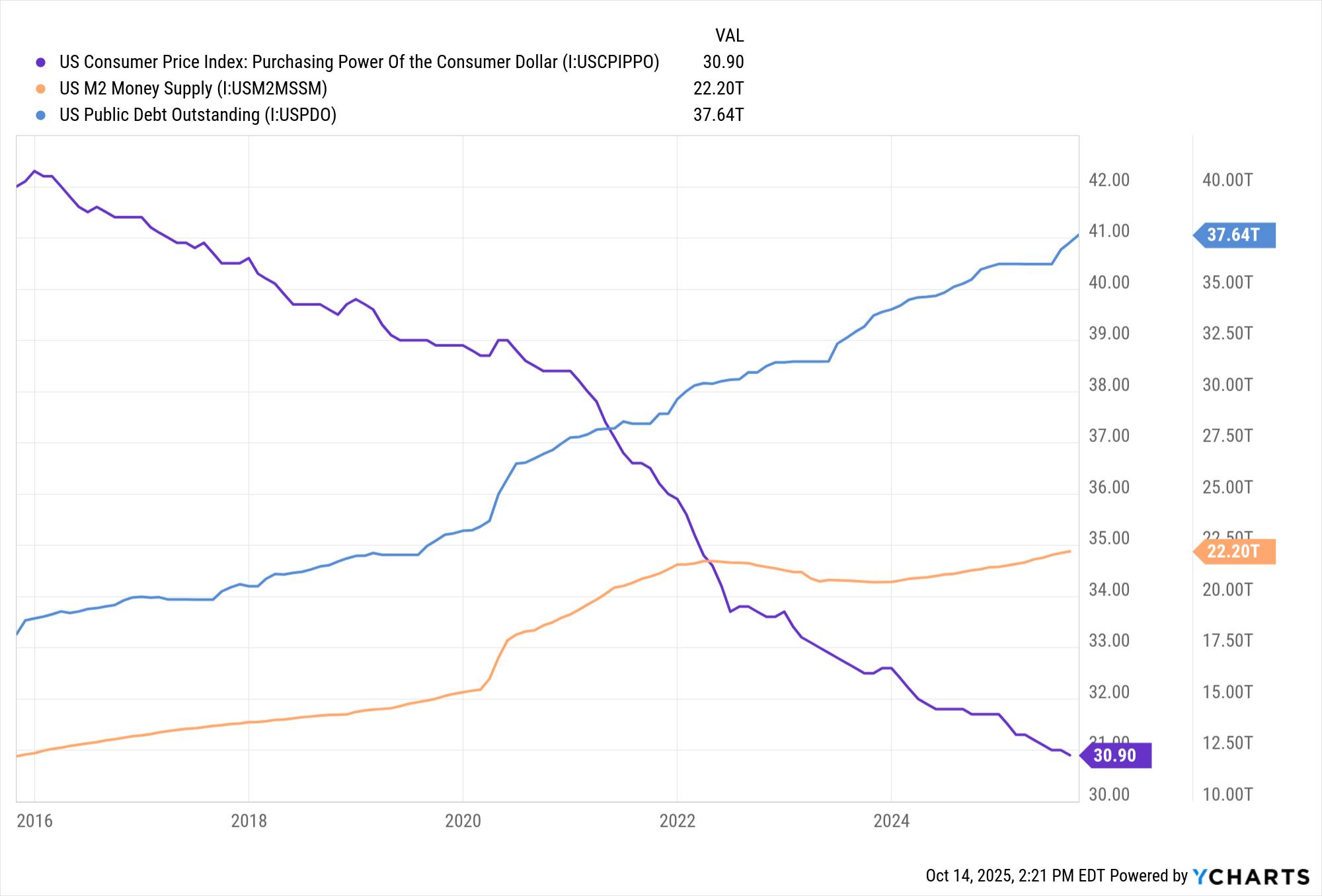
Over the past decade, those lines have moved in exactly the directions you’d expect if you believe in “debasement”—the dollar’s purchasing power down, money supply and debt up.
The inflection point came after 2008, when near-zero interest rates and multiple rounds of quantitative easing made it normal for the Federal Reserve to expand its balance sheet whenever growth wobbled.
Then came the pandemic. Between 2020 and 2021, the M2 money supply jumped by more than 40% as stimulus checks, loan programs, and asset purchases flooded the system. That same period saw federal debt cross $30 trillion for the first time in history.
Once inflation took hold in 2022, the damage to purchasing power became permanent. Even though nominal GDP recovered, real wages lagged, and the consumer dollar today buys roughly 30% of what it did in 1980. Meanwhile, debt keeps compounding faster than output, forcing policymakers to choose between higher taxes, higher inflation, or both.
So, while the “debasement trade” has become a trendy label, the underlying forces—monetary expansion, fiscal excess, and structural inflation—have been compounding for decades. It’s a wake-up call showing what happens when debt and money creation outpace productivity for too long.
ETFs for the debasement trade
There are three main ways I look at capitalizing on debasement through ETFs. And to be clear, despite the name, this isn’t a short-term “trade.” It’s a long-term, structural positioning around the erosion of purchasing power that’s been underway for decades.
The first is owning ETFs tied to assets that can’t be debased. Historically, “debasement” meant something literal—kings thinning out the silver content in their coins, replacing it with cheaper metals like zinc to stretch resources further. Today, the same thing happens through monetary policy rather than mints. The value of money declines as more of it is created.
Gold and bitcoin stand out because neither can be produced out of thin air. Gold must be mined, and supply grows only marginally each year. Bitcoin has a hard cap of 21 million coins, with its issuance rate halving roughly every four years. That scarcity is why both have recently hit new all-time highs, and why spot ETFs in each have seen surging inflows.
The second way is through assets that can generate cash flows rising faster than inflation. Real estate and infrastructure fit that description well. Both tend to benefit from pricing power—landlords can raise rents, and operators of pipelines, toll roads, or utilities often have inflation-linked contracts.
ETFs targeting REITs and infrastructure companies give you diversified exposure to these underlying cash-generating assets, without the complexity of owning them directly. You also get the benefit of quarterly or monthly distributions and eligibility to hold in tax-sheltered accounts.
The third approach is to short what’s most exposed to debasement: long-term government bonds. Buying those is essentially lending to a borrower with a worsening fiscal position. After the U.S. credit downgrade, that risk is no longer theoretical.
Rising debt levels and persistent deficits make the real return outlook for Treasurys unattractive. Investors can position for this through put options on Treasury ETFs or through inverse ETFs that use swaps to deliver opposite exposure to long-duration bonds.
Taken together, these ETF strategies reflect different sides of the same structural theme—protecting capital and purchasing power in a world where money itself is slowly being diluted.
Please note that this article reflects the author’s personal views and does not represent the opinions of the publication or its affiliates. It is for informational purposes only and does not constitute investment advice. It is essential to seek guidance from a registered financial professional before making any investment decisions.
Segments
See all
No specific market segments were tagged
Mentioned ETFs
No specific ETFs were tagged
Further reading
Latest ETF News
See all ETF newsCould Water ETFs Be the Next AI Bottleneck Trade?

What is a Boomer Candy ETF?

ETF Comparison: NEOS Nasdaq-100 High Income ETF (QQQI) Versus Goldman Sachs Nasdaq-100 Premium Income ETF (GPIQ)





 Advantages of ETFs over Mutual Funds1/6
Lower Costs
In this guide, we'll explore the advantages of ETFs over mutual funds, giving you valuable insights into why ETFs have gained significant popularity among investors like yourself.
Leveraged ETFs: Unlocking the Potential for Amplified Returns1/6
Understanding Leveraged ETFs
Explore leveraged ETFs: potential for amplified returns & risks. 5 ETFs to consider across equities, commodities & fixed income.
What is a Leveraged ETF?1/6
Introducing Leveraged and Inverse ETFs
In this guide, we'll dive into the world of leveraged ETFs, exploring their definition, mechanics, potential risks, and rewards.
Recent educational content

ETF Trends
ETF Industry KPIs September 8, 2026
This week’s KPI data overview highlights key metrics and trends shaping the ETF landscape.

ETF Trends
ETF Industry KPIs August 31, 2026
This week’s KPI data overview highlights key metrics and trends shaping the ETF landscape.
ETF Trends
ETF Industry KPIs August 24, 2026
This week’s KPI data overview highlights key metrics and trends shaping the ETF landscape.
What’sTheFund
What's the Fund | Ocean Park Diversified Income ETF (DUKZ)
James St Aubin, Chief Investment Officer at Ocean Park Asset Management, discuss the DUKZ ETF, exposing investors to the whole spectrum of asset classes in the fixed income markets, through their rules-based process.

Browse all educational columns



Active Trader Report: Use of Leveraged & Inverse ETFs Way Up
Direxion partnered with Compound Insights and Vanda to explore what’s driving the evolution of active trading — and how active traders are using leveraged and inverse funds across equities, single stocks, commodities, and volatility.