Open Now: The Global ETF Survey Take the Survey →



ETF Entrepreneur Matthew Tuttle is At It Again with a New Pair of Anti-Woke and Gun-Focused ETFs
Just when you thought the wacky thematic launches may have finally died down.


Keep up with what matters in ETFs
Get timely ETF insights, market trends, and top ideas straight to your inbox.
Your newsletter subscriptions with us are subject to ETF Central's Privacy Policy and Terms and Conditions.
The ETF industry is becoming increasingly politicized, a trend exemplified by the rise of funds like the jingoistic God Bless America ETF (YALL) and Subversive Capital's duo of ETFs (NANC and KRUZ) tracking stock trades by Republican and Democrat members of Congress.
Also making mainstream headlines recently is ETF firm Strive Asset Management. Co-founded by Republican presidential candidate Vivek Ramaswamy, Strive recently crossed the $1 billion assets-under-management mark, thanks in part to its overtly anti-ESG stance [1].
Founded in 2022 and backed by investors such as Bill Ackman and Peter Thiel, the firm currently operates 11 ETFs and champions the Friedman doctrine, stating on their website: "We live by a strict commitment to shareholder primacy – an unwavering mandate that the purpose of a for-profit corporation is to maximize long-run value to investors."[2]
However, it's worth noting that this advent of thematic, politically oriented ETFs hasn't been all smooth sailing. For example, the anti-ESG themed Constrained Capital ESG Orphans ETF (ORFN) was liquidated earlier in June due to an inability to attract sufficient investment assets [3].
Tuttle himself has faced setbacks; his earlier controversial ETF, the Long Cramer Tracker ETF (LJIM), which went long on Jim Cramer's stock picks, was liquidated on September 11 [4]—though its short-oriented cousin, the Inverse Cramer Tracker ETF (SJIM), still exists.
Undeterred, Tuttle is doubling down on thematic plays with his latest offerings: the Tuttle Capital Inverse Socially Conscious ETF and the Tuttle Capital Self Defense Index ETF.
Trading under the provocative symbols "GWGB" (Go Woke, Go Broke) and "GUNZ," respectively, these funds promise to ignite discussion and perhaps controversy in an already polarized market environment.
"We prefer to think outside the box on investment trends that investors should be taking advantage of," Tuttle told me. "If inside the box was the place to be then the Forbes 400 would be the Forbes 40,000."
Here's all you need to know about GWGB and GUNZ before they debut.
Get data on 14,000+ ETFs
Access Trackinsight's reliable and comprehensive data with 500M+ points on 14,000+ ETFs.
GWGB Breakdown
GWGB will be an actively managed ETF that aims to invest in U.S.-listed mid and large-cap equities that align with either politically conservative or politically neutral criteria, while taking short positions in companies it considers "woke," making it a long-short fund of sorts.
The ETF defines politically conservative criteria as adherence to values like "American Exceptionalism," individual liberty, and free enterprise, while politically neutral companies are those that abstain from political activities and focus solely on profits and sales.
On the other hand, the ETF defines "woke" companies are those viewed as hostile to conservative values, often engaging in activities or supporting causes that alienate conservative stakeholders.
As an actively managed ETF, GWGB will rely on Tuttle's discretion in selecting which companies make it into the ETF but does offer some guidelines. According to its prospectus, the selection process begins with a broad pool of U.S.-listed mid and large-cap stocks.
Companies deemed "woke" following research are immediately eliminated from consideration. Next, the remaining companies are screened for environmental, social, and governance (ESG) factors, with companies having high ESG scores eliminated.
After this, the advisor applies a fundamental research screen to identify companies with strong financial metrics, like revenue growth potential and return on capital, before finally selecting those that meet the fund's politically conservative or neutral criteria.
GWGB's thesis is that companies following "woke" policies will have a negative impact on shareholder value and alienate conservative shareholders. To capitalize on this perceived value erosion, the advisor may short 10 to 20 such companies.
The exact composition of GWGB is yet to be determined, but it is likely that it will have a significant tilt towards technology and consumer discretionary stocks, as its prospectus has specifically outlined both as "Sector Risk(s)." The ETF will charge a 0.75% expense ratio.
GUNZ Breakdown
GUNZ is making its entrance into the relatively untapped aerospace and defense ETF sector, a segment where competition is not as fierce compared to other market segments.
The largest fund in this space is currently the iShares U.S. Aerospace & Defense ETF (ITA), boasting just over $5.2 billion in assets under management (AUM). Other notable competitors include the Invesco Aerospace & Defense ETF (PPA), and the SPDR S&P Aerospace & Defense ETF (XAR). All of these ETFs are index based.
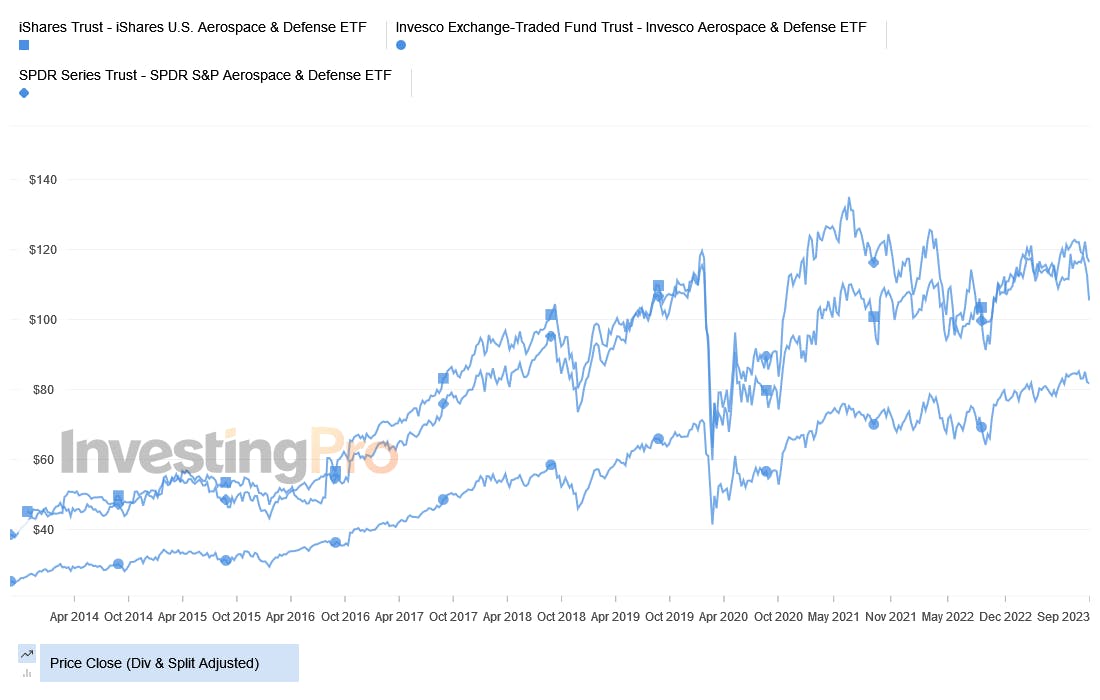
Source: Investing.com Pro
Unlike GWGB, GUNZ will be passively managed just like its competitors, aiming to replicate the performance of the proprietary AJN Self Defense U.S. Equity Index.
The index will include U.S. companies engaged in sectors like firearms, home security, and emergency management systems, as well as companies that manufacture, service, supply and distribute personal and law enforcement defense equipment and protection services. It uses an equal-weight approach and undergoes quarterly rebalancing.
The use of a proprietary index may allow GUNZ more flexibility compared to traditional defense ETFs. For instance, the most popular ETF, ITA is top-heavy, holding nearly 36% of its assets in Boeing and RTX, whereas GUNZ has the freedom to diversify its holdings. Its equal-weight index may make it similar to XAR, which has a higher concentration in small and mid-caps.
The expense ratio for GUNZ is yet to be determined but is expected to be around 0.75%, a common rate for thematic ETFs. For comparison, existing competitors like XAR, ITA, and PPA charge 0.35%, 0.40%, and 0.58% respectively.
[2] https://www.strivefunds.com/
Please note this article is for information purposes only and does not in any way constitute investment advice. It is essential that you seek advice from a registered financial professional prior to making any investment decision.
Latest ETF News
See all ETF newsMoneyShow Chart of the Day 7/16/26: Good News/Bad News on Inflation (and the Fed)


MoneyShow Chart of the Day 7/1/26: The H1 Scorecard – and What Comes Next

MoneyShow Chart of the Day 6/22/26: Are World Cup Videos Helping US Companies Clean Up?

MoneyShow Chart of the Day 6/3/26: AI. AI. AI. (And a Handful of Other Stocks, Too)




 Advantages of ETFs over Mutual Funds1/6
Lower Costs
In this guide, we'll explore the advantages of ETFs over mutual funds, giving you valuable insights into why ETFs have gained significant popularity among investors like yourself.
Leveraged ETFs: Unlocking the Potential for Amplified Returns1/6
Understanding Leveraged ETFs
Explore leveraged ETFs: potential for amplified returns & risks. 5 ETFs to consider across equities, commodities & fixed income.
What is a Leveraged ETF?1/6
Introducing Leveraged and Inverse ETFs
In this guide, we'll dive into the world of leveraged ETFs, exploring their definition, mechanics, potential risks, and rewards.
Recent educational content

ETF Trends
ETF Industry KPIs July 13, 2026
This week’s KPI data overview highlights key metrics and trends shaping the ETF landscape.

First Look ETF
First Look ETF: Cash Deployment, Bond, and Hedged ETFs
In this season 6 episode of First Look ETF, Stephanie Stanton examines the latest ETF marketplace trends with NYSE and guests.

ETF Trends
ETF Industry KPIs July 6, 2026
This week’s KPI data overview highlights key metrics and trends shaping the ETF landscape.
Asset TV
The ETF Show - The Evolution of Leveraged & Inverse ETFs
Leveraged and inverse ETFs have exploded in popularity over the past decade capturing more assets as retail traders seek to capture volatility.

Browse all educational columns



The ETF Industry Is Evolving Fast
From AI infrastructure to active strategies, the ETF landscape is shifting. Share your perspective in the 7th Annual Global ETF Survey and get exclusive early access to the final report.