From idea to ETF portfolio in minutes. Build yours now →



ETF Comparison: Vanguard FTSE All-World ex-US ETF (VEU) Versus iShares Core MSCI Total International Stock ETF (IXUS)
Looking for affordable international stock market exposure? Here's how to choose between these two highly popular index ETFs.

Keep up with what matters in ETFs
Get timely ETF insights, market trends, and top ideas straight to your inbox.
Your newsletter subscriptions with us are subject to ETF Central's Privacy Policy and Terms and Conditions.
For most retail investors, purchasing individual ADRs and GDRs to achieve international stock exposure might seem a bit over the top. Why bother, when for just a few basis points, passive broad market index ETFs offer instant global diversification with a single trade?
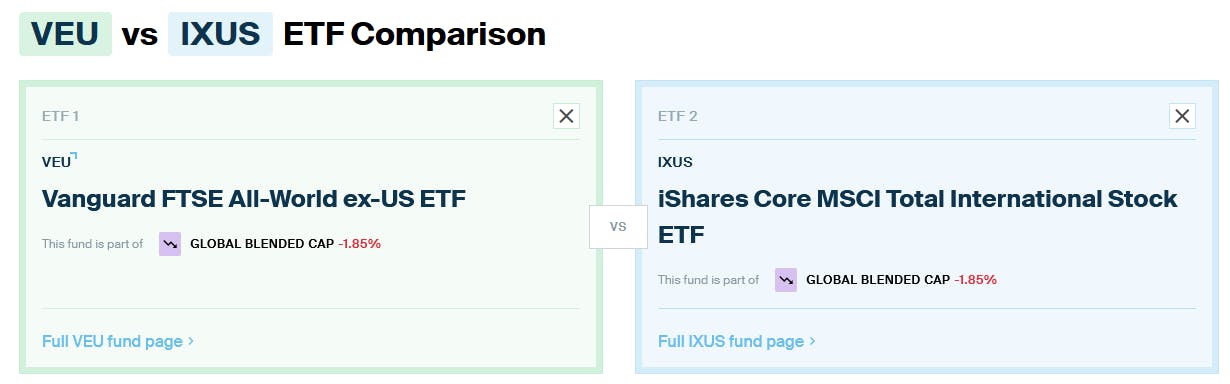
Today, we're comparing two of the most affordable options in this space: the Vanguard FTSE All-World ex-US ETF
Like what you're reading?
Stay in the loop — get the latest ETF insights: trends, analysis, and expert picks.
VEU vs IXUS: Total cost of ownership
Both VEU and IXUS are designed with low fees in mind, a hallmark of Vanguard's offerings and iShares' "Core" lineup. Each sports an expense ratio of just 0.07%, which translates to $7 per $10,000 invested annually.
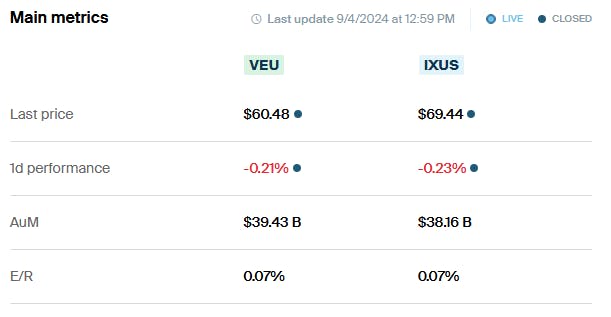
Looking at liquidity, implicit costs reflected in the bid-ask spread are also minimal for both ETFs. VEU
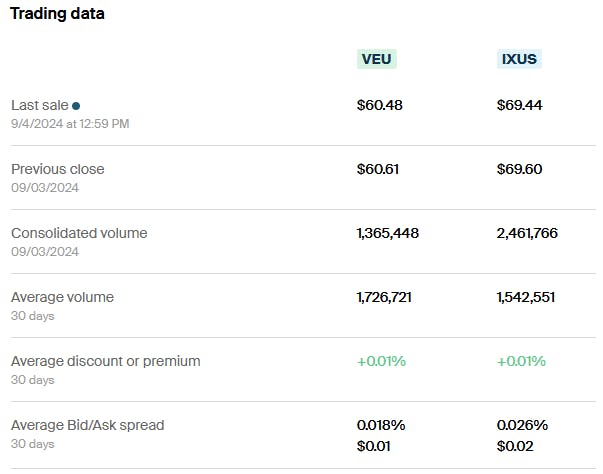
When you tally up the costs, VEU just edges out IXUS in terms of overall affordability, but the difference is so minor it's hardly a deciding factor unless you're dealing with a significantly large investment. This round, I'd say it's effectively a tie in terms of total cost of ownership.
VEU vs IXUS: Methodology and holdings
Both VEU
VEU follows the FTSE All-World ex US Index, encompassing around 3,333 equities but is limited to large and mid-cap stocks. In contrast, IXUS tracks the MSCI ACWI ex USA IMI Index, which includes a broader range with 4,323 holdings, capturing more mid and small-cap stocks.
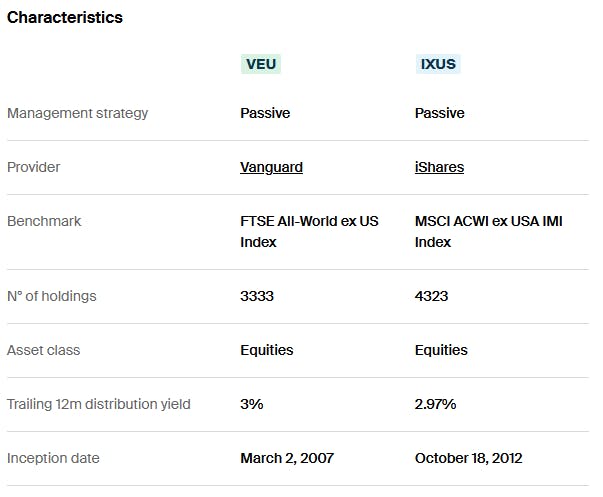
Despite these differences, the market cap-weighted nature of both indexes results in very similar country distributions, sector allocations, and top holdings in terms of both concentration and composition.
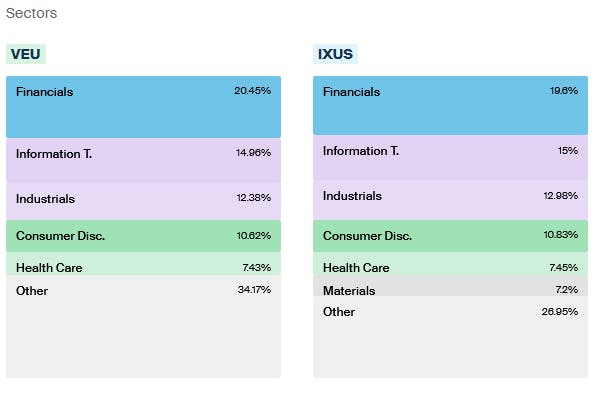
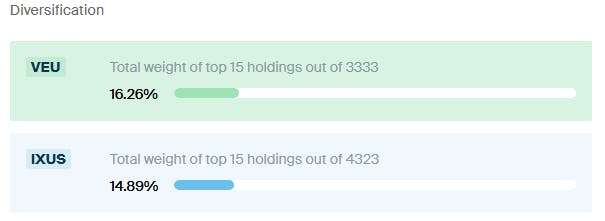
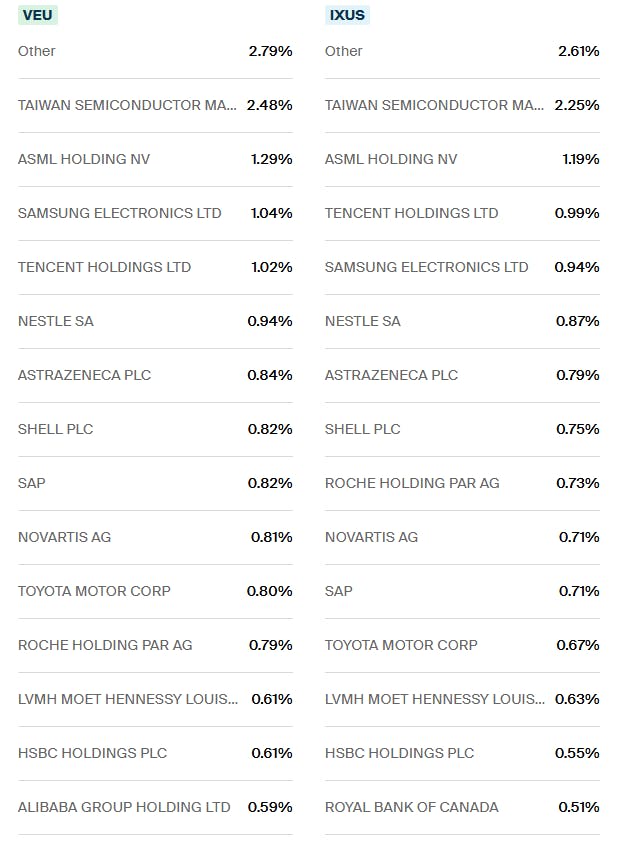
The decision between the two might just come down to a preference for the scope of market cap exposure: VEU for those content with large and mid-caps, and IXUS for investors seeking a more comprehensive range including smaller companies.
Moreover, their overall similarity but use of differing benchmarks makes them excellent candidates for tax-loss harvesting against one another.
VEU vs IXUS: Risk and return
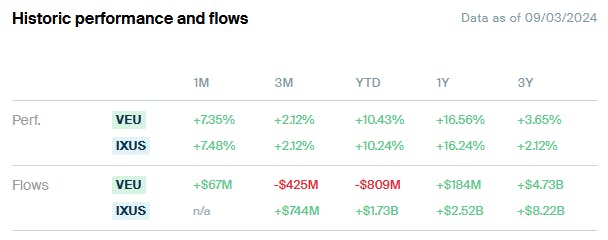
As anticipated from their similar portfolio compositions, the performance of VEU and IXUS over the last several years has been nearly identical, although VEU has seen net outflows year to date, while IXUS has attracted more investment.
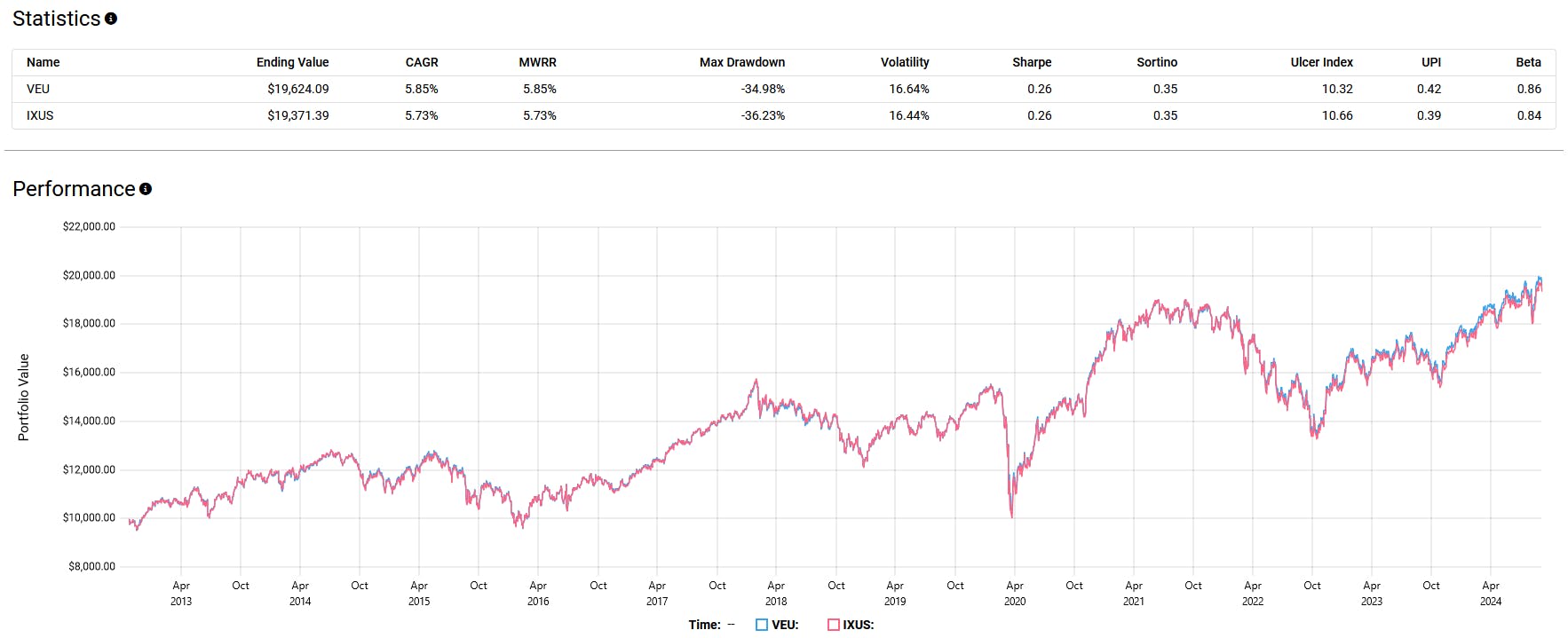
From October 2012 to the present, VEU has slightly outperformed IXUS in terms of total return but experienced slightly higher volatility. However, the difference in risk-adjusted returns between the two is statistically insignificant.
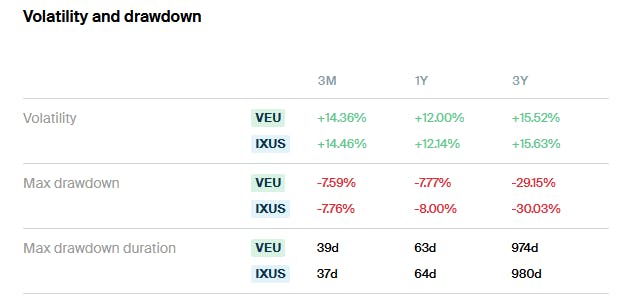
Risk-wise, both ETFs share roughly the same holdings and country weightings, which means their volatility and potential drawdowns are quite similar.
Verdict? Both VEU
Please note this article is for information purposes only and does not in any way constitute investment advice. It is essential that you seek advice from a registered financial professional prior to making any investment decision.
Segments
See all
Mentioned ETFs
Further reading
Latest ETF News
See all ETF newsCould Water ETFs Be the Next AI Bottleneck Trade?

What is a Boomer Candy ETF?

ETF Comparison: NEOS Nasdaq-100 High Income ETF (QQQI) Versus Goldman Sachs Nasdaq-100 Premium Income ETF (GPIQ)





 Advantages of ETFs over Mutual Funds1/6
Lower Costs
In this guide, we'll explore the advantages of ETFs over mutual funds, giving you valuable insights into why ETFs have gained significant popularity among investors like yourself.
Leveraged ETFs: Unlocking the Potential for Amplified Returns1/6
Understanding Leveraged ETFs
Explore leveraged ETFs: potential for amplified returns & risks. 5 ETFs to consider across equities, commodities & fixed income.
What is a Leveraged ETF?1/6
Introducing Leveraged and Inverse ETFs
In this guide, we'll dive into the world of leveraged ETFs, exploring their definition, mechanics, potential risks, and rewards.
Recent educational content

ETF Trends
ETF Industry KPIs September 8, 2026
This week’s KPI data overview highlights key metrics and trends shaping the ETF landscape.

ETF Trends
ETF Industry KPIs August 31, 2026
This week’s KPI data overview highlights key metrics and trends shaping the ETF landscape.
ETF Trends
ETF Industry KPIs August 24, 2026
This week’s KPI data overview highlights key metrics and trends shaping the ETF landscape.
What’sTheFund
What's the Fund | Ocean Park Diversified Income ETF (DUKZ)
James St Aubin, Chief Investment Officer at Ocean Park Asset Management, discuss the DUKZ ETF, exposing investors to the whole spectrum of asset classes in the fixed income markets, through their rules-based process.

Browse all educational columns



Active Trader Report: Use of Leveraged & Inverse ETFs Way Up
Direxion partnered with Compound Insights and Vanda to explore what’s driving the evolution of active trading — and how active traders are using leveraged and inverse funds across equities, single stocks, commodities, and volatility.