Global ETF Survey Is Live! 600+ ETF Professionals Weigh In. See Results →



ETF Comparison: Vanguard Mega Cap Growth ETF (MGK) Versus Invesco QQQ ETF (QQQ)
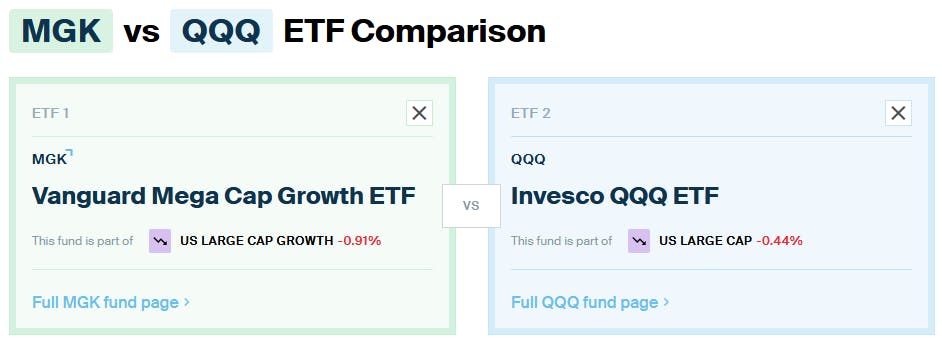
Two of the largest U.S. mega-cap growth ETFs face off in this week’s ETF comparison.


Keep up with what matters in ETFs
Get timely ETF insights, market trends, and top ideas straight to your inbox.
Your newsletter subscriptions with us are subject to ETF Central's Privacy Policy and Terms and Conditions.
Mega-cap stocks, particularly growth names from sectors like technology, consumer discretionary, and communication services, have been driving much of the market’s gains in recent years.
For investors looking to double down on this trend, the Invesco QQQ ETF
But fast forward to 2025, and QQQ is no longer the only game in town for targeting this segment of the U.S. market. A notable challenger is the Vanguard Mega Cap Growth ETF
This week, we’re putting QQQ and MGK head-to-head using the ETF Central comparison tool. Stick around to see how these two heavyweights stack up.
Like what you're reading?
Stay in the loop — get the latest ETF insights: trends, analysis, and expert picks.
MGK vs QQQ: Total cost of ownership
When it comes to fees, MGK
In comparison, QQQ
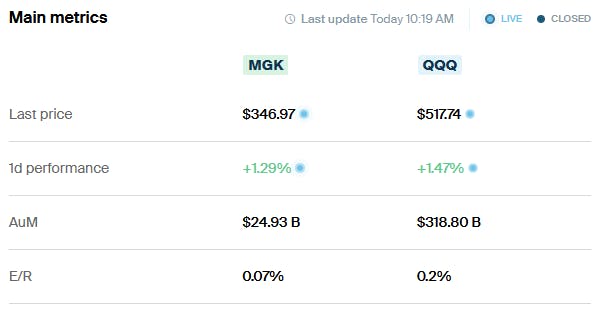
What about trading costs? Here, QQQ has the edge with a 30-day median bid-ask spread of just 0.005%, which is minuscule. MGK’s spread is 0.023%, roughly four times as wide, but still negligible in the grand scheme of things.
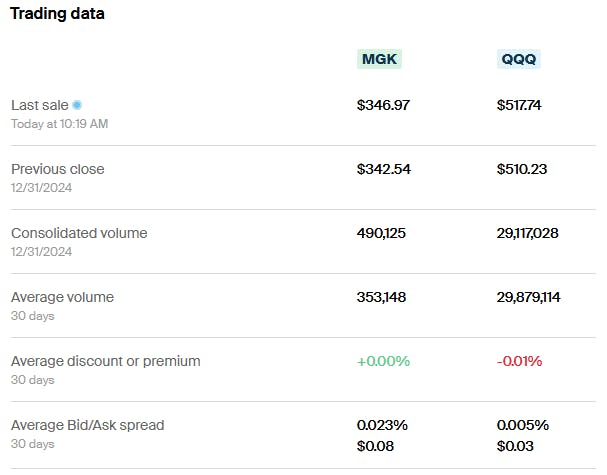
Verdict: Despite being more liquid, QQQ’s higher expense ratio makes it pricier overall. MGK is cheaper.
MGK vs QQQ: Methodology and holdings
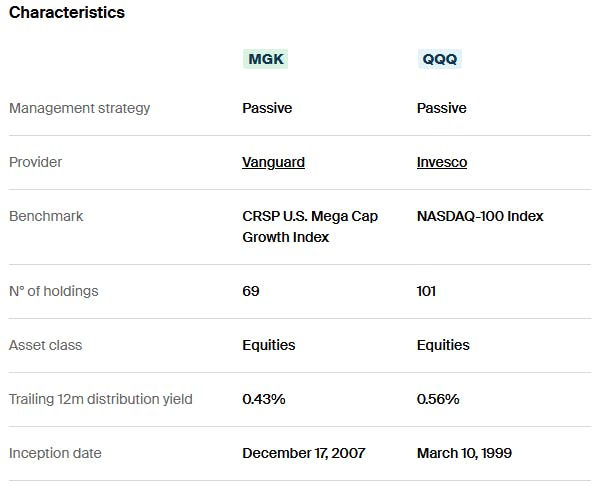
Both ETFs provide exposure to mega-cap growth stocks in the U.S. market, but their benchmarks differ significantly in approach.
Starting with QQQ, its methodology is straightforward. It tracks the Nasdaq-100 Index, which consists of the largest 100 Nasdaq-listed stocks, excluding financials, weighted by market cap. This structure provides a natural mega-cap tilt.
Now, QQQ
In contrast, MGK’s benchmark
Companies are screened based on several growth metrics, including historical and projected earnings per share (EPS) growth, sales per share growth, investment-to-assets ratios, and return on assets.
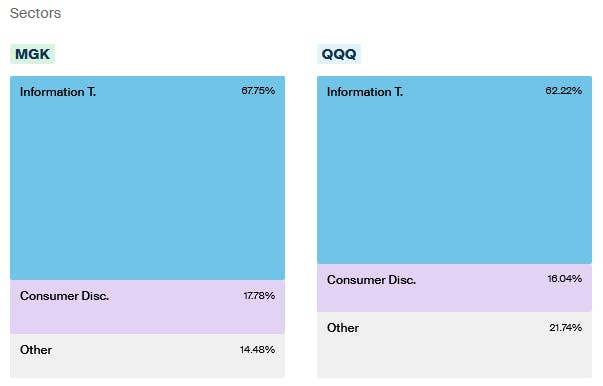
While the sector compositions of both ETFs are broadly similar—both heavily overweight technology followed by consumer discretionary stocks—MGK is more top-heavy.
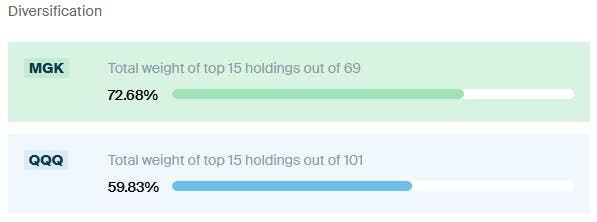
Its top 15 holdings (out of 69) account for 72.68% of the portfolio, compared to 59.83% for QQQ’s top 15 holdings (out of 101).
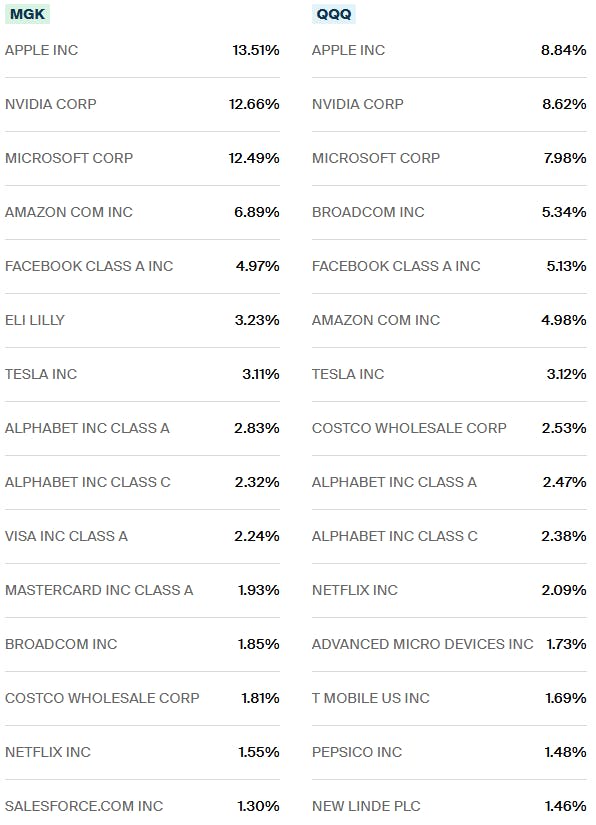
Both ETFs offer exposure to the “Magnificent Seven” stocks—Apple, Nvidia, Microsoft, Meta, Tesla, Amazon, and both Alphabet share classes. However, MGK
Verdict: While both ETFs are strong options, MGK edges ahead with its economically sound index criteria and inclusion of financials, offering a more comprehensive approach to mega-cap growth investing.
MGK vs QQQ: Risk and return
In the short term, MGK
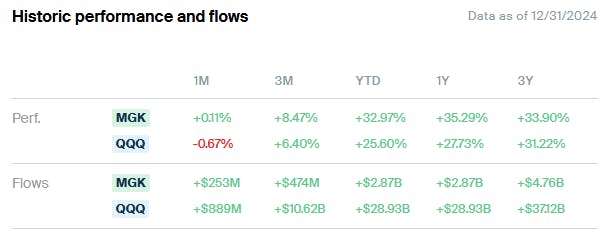
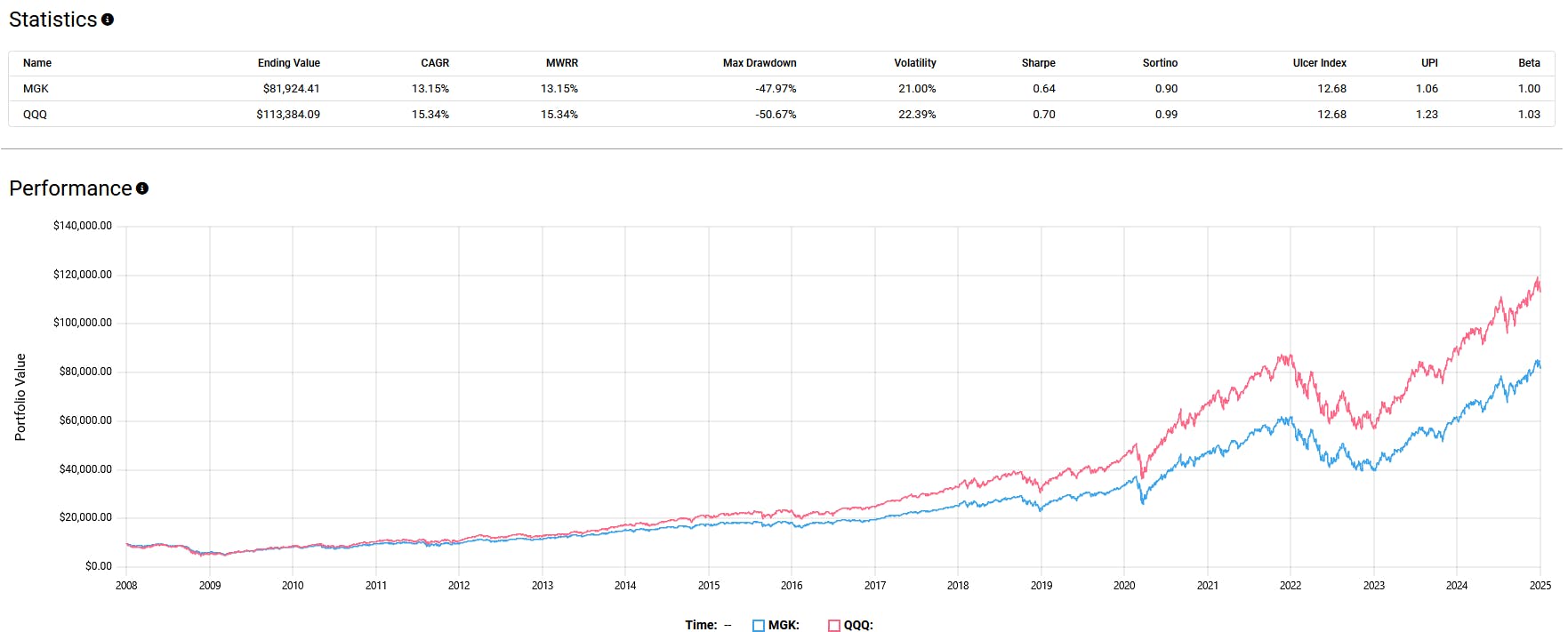
Over the long term, QQQ reclaims the edge. A backtest from December 27, 2007, to January 2, 2025, shows QQQ delivering a compound annual growth rate (CAGR) of 15.35%, compared to 13.15% for MGK.
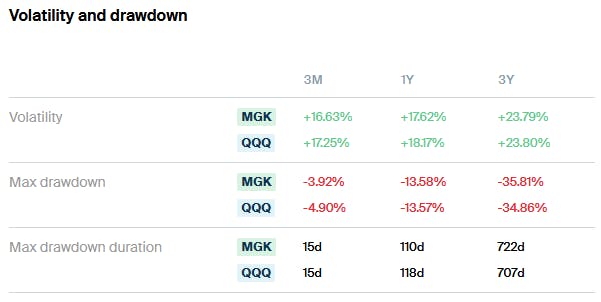
From a risk perspective, both ETFs exhibit similar levels of volatility over three- and one-year periods, with comparable drawdown depths and lengths, making their risk profiles largely equivalent.
Verdict: Despite MGK’s recent outperformance, QQQ’s longer track record, higher inflows, and superior long-term returns make it the winner in this category.
This article is for informational purposes only and does not in any way constitute investment advice. The author may express their own opinions, which may not represent the opinions of ETF Central or its affiliated partners. It is essential that you seek advice from a registered financial professional prior to making any investment decisions.
Latest ETF News
See all ETF newsBeyond Big Tech: The Increasing Specialization of AI ETFs

There's an ETF for That? Humanoid Robotics and Physical AI

How Some ETF Issuers Use Their Own Funds for Cash Management

These Public-Private ETFs Invest in Polymarket and Anduril

There's an ETF for That? Frontier Markets



 Advantages of ETFs over Mutual Funds1/6
Lower Costs
In this guide, we'll explore the advantages of ETFs over mutual funds, giving you valuable insights into why ETFs have gained significant popularity among investors like yourself.
Leveraged ETFs: Unlocking the Potential for Amplified Returns1/6
Understanding Leveraged ETFs
Explore leveraged ETFs: potential for amplified returns & risks. 5 ETFs to consider across equities, commodities & fixed income.
What is a Leveraged ETF?1/6
Introducing Leveraged and Inverse ETFs
In this guide, we'll dive into the world of leveraged ETFs, exploring their definition, mechanics, potential risks, and rewards.
Recent educational content

First Look ETF
First Look ETF: Income, International, and Cash Flow ETFs
In this season 6 episode of First Look ETF, Stephanie Stanton @etfguide examines the latest ETF marketplace trends with NYSE and guests.


ETF Trends
ETF Industry KPIs October 5, 2026
This week’s KPI data overview highlights key metrics and trends shaping the ETF landscape.

ETF Trends
ETF Industry KPIs September 28, 2026
This week’s KPI data overview highlights key metrics and trends shaping the ETF landscape.
ETF Trends
ETF Industry KPIs September 22, 2026
This week’s KPI data overview highlights key metrics and trends shaping the ETF landscape.