Global ETF Survey Is Live! 600+ ETF Professionals Weigh In. See Results →



ETF Comparison: Vanguard High Dividend Yield ETF (VYM) Versus Schwab U.S. Dividend Equity ETF (SCHD)
Two of the most popular low-cost dividend ETFs go head-to-head in this week’s ETF comparison.


Keep up with what matters in ETFs
Get timely ETF insights, market trends, and top ideas straight to your inbox.
Your newsletter subscriptions with us are subject to ETF Central's Privacy Policy and Terms and Conditions.
There’s more than one way to structure a dividend yield ETF, and two of the most popular competitors in this space—measured by assets under management (AUM)—are the Vanguard High Dividend Yield ETF
Both ETFs are low-cost, well-diversified, and backed by major asset managers—Vanguard and Schwab, respectively. But which one comes out on top for investors looking for dividend income and total return?
Here’s our assessment, using data from the ETF Central comparison tool.
Global ETF Survey 2026 is Live!
With 1,790 new products launched by July 2026, choosing is harder than ever. Our Global ETF Survey 2026, built on 620 professional investors and allocators, shows how active, fixed income, options-based and thematic ETFs are reshaping fund selection.
SCHD vs VYM: Total Cost of Ownership
It’s a tie when it comes to expense ratios. Both SCHD and VYM charge 0.06%, meaning investors pay just $6 per year on a $10,000 investment.
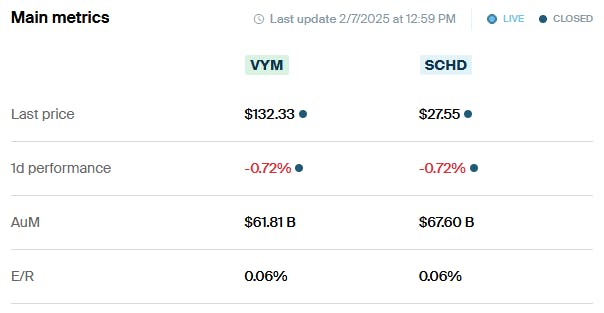
But what about implicit costs, like trading spreads? Both funds remain extremely liquid, with low 30-day median bid-ask spreads. VYM comes in at 0.024%, while SCHD is slightly higher at 0.036%.
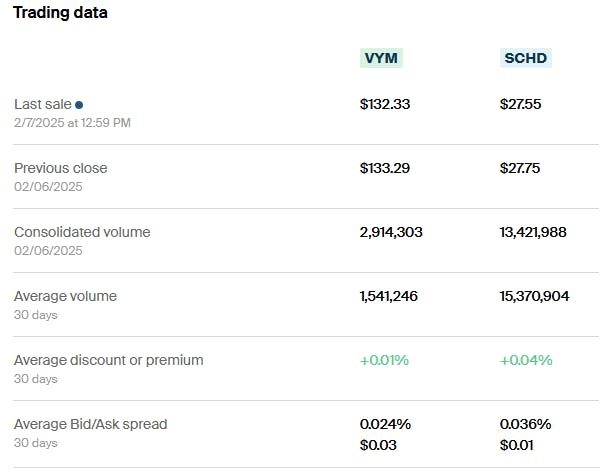
Verdict: VYM wins this by the slimmest of margins, but only because I don’t want to call it a tie. For all intents and purposes, these two ETFs are virtually identical in total costs.
SCHD vs VYM: Methodology and Holdings
Both SCHD and VYM track dividend-paying stocks, but they use very different methodologies for selecting and weighting their holdings.
VYM follows a simple, yield-based approach. It tracks the FTSE High Dividend Yield Index, which screens for stocks with a dividend yield above the 55th percentile within its selection universe.
The remaining stocks are then weighted by market capitalization, meaning larger companies have a bigger influence on the fund. This makes VYM a straightforward high-yield fund without additional quality filters.
SCHD, on the other hand, is far more selective. It tracks the Dow Jones U.S. Dividend 100 Index. To qualify, stocks must have paid dividends for at least 10 consecutive years and are then evaluated based on a composite score that includes cash flow to total debt, return on equity, dividend yield, and five-year dividend growth rate.
The top 100 highest-scoring stocks are selected and weighted by market cap, but with an individual stock cap of 4% and a sector cap of 25%. The fund is reconstituted annually, meaning it fully reselects and adjusts holdings once per year based on updated data.
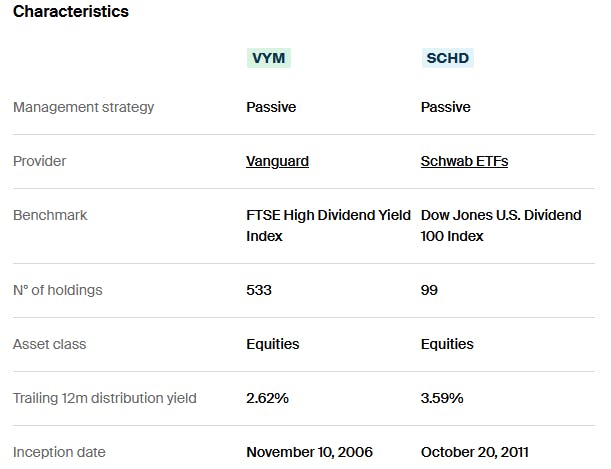
The differences in methodology create clear distinctions between the two funds. VYM is more diversified, holding over 500 stocks, while SCHD is more concentrated, with just 99 holdings. SCHD, however, offers a higher 12-month trailing yield of 3.59% compared to VYM’s 2.62%.
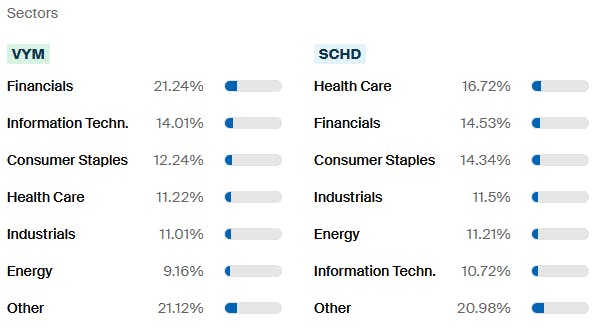
Sector allocations also differ, with SCHD evenly weighting healthcare, financials, and consumer staples, while VYM tilts more toward financials, tech, and consumer staples.
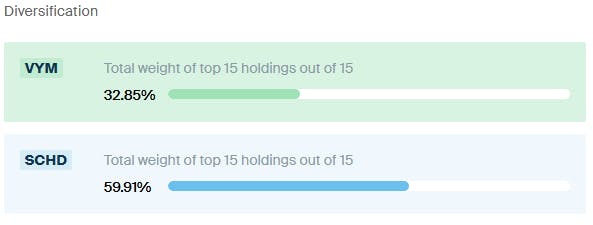
SCHD is also far more top-heavy, with its top 15 holdings accounting for 59.91% of the portfolio, compared to 32.85% for VYM.
Another notable distinction is portfolio turnover. SCHD has a turnover rate of 29%, meaning nearly a third of the fund is reallocated each year. VYM, in contrast, has a much lower turnover of 13%. While this is not a concern for ETFs due to in-kind creation and redemption mechanisms, it does indicate that SCHD’s portfolio composition changes more frequently.
Factor regression analysis shows that both ETFs have statistically significant exposure to value (HML) and quality in the form of profitability (RMW) and investment (CMA). VYM has a stronger value tilt, while SCHD leans more toward quality factors.

Verdict: Despite SCHD’s higher turnover and more concentrated portfolio, I prefer its more robust screening process. VYM is very one-dimensional in its approach, checking only for yield without additional quality controls.
SCHD vs VYM: Risk and Return
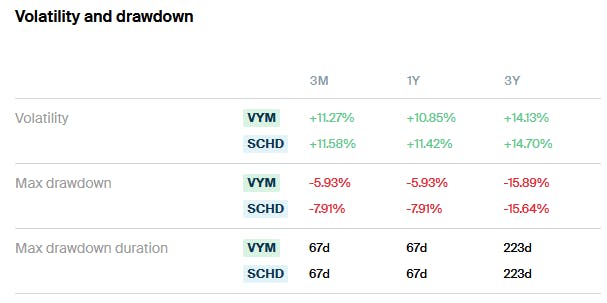
Short-term performance data shows VYM outperforming SCHD over the past one- and three-year periods. However, despite this, SCHD saw significantly higher net inflows, suggesting investors are still favoring its strategy for the long run.
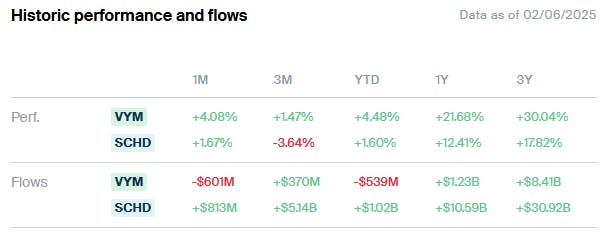
In terms of risk, both ETFs had similar volatility and maximum drawdowns over this same short-term period. Neither was meaningfully riskier than the other, making them relatively equal on a near-term risk basis.
However, if we extend the backtest beyond three years, the story changes. From October 20, 2011, to February 6, 2025, SCHD delivered a compound annual growth rate (CAGR) of 12.92%, while VYM trailed slightly at 12.33%.
SCHD achieved this outperformance with similar volatility but slightly lower drawdowns, resulting in a better risk-adjusted return. Over this period, SCHD posted a Sharpe ratio of 0.78 versus VYM’s 0.75, indicating that SCHD provided more return per unit of risk taken.
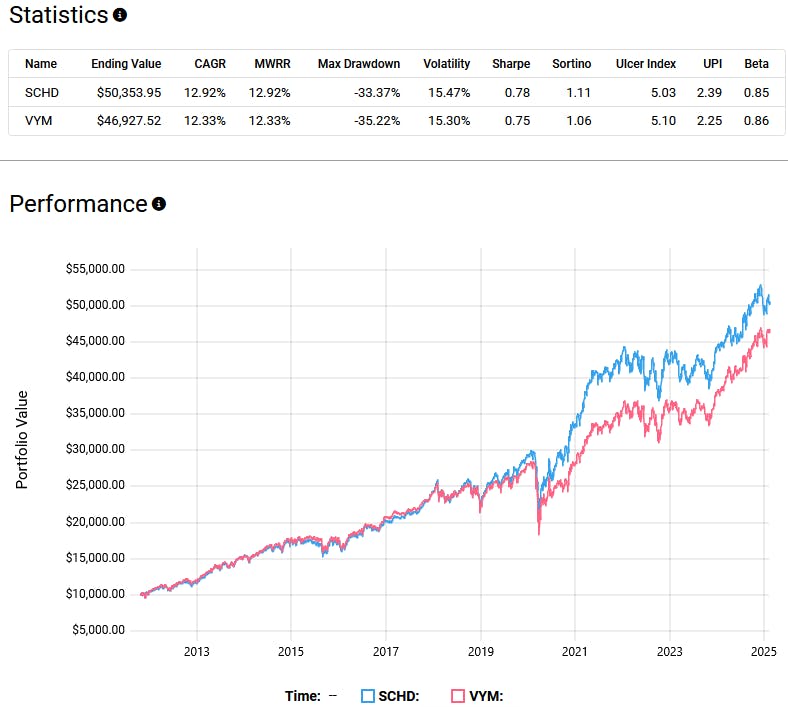
Verdict: Over the long term, SCHD has beaten VYM on both total and risk-adjusted returns. Given its superior index methodology and similar expense ratio, I expect this outperformance to continue.
This article is for informational purposes only and does not in any way constitute investment advice. The author may express their own opinions, which may not represent the opinions of ETF Central or its affiliated partners. It is essential that you seek advice from a registered financial professional prior to making any investment decisions.
Latest ETF News
See all ETF newsBeyond Big Tech: The Increasing Specialization of AI ETFs

There's an ETF for That? Humanoid Robotics and Physical AI

How Some ETF Issuers Use Their Own Funds for Cash Management

These Public-Private ETFs Invest in Polymarket and Anduril

There's an ETF for That? Frontier Markets



 Advantages of ETFs over Mutual Funds1/6
Lower Costs
In this guide, we'll explore the advantages of ETFs over mutual funds, giving you valuable insights into why ETFs have gained significant popularity among investors like yourself.
Leveraged ETFs: Unlocking the Potential for Amplified Returns1/6
Understanding Leveraged ETFs
Explore leveraged ETFs: potential for amplified returns & risks. 5 ETFs to consider across equities, commodities & fixed income.
What is a Leveraged ETF?1/6
Introducing Leveraged and Inverse ETFs
In this guide, we'll dive into the world of leveraged ETFs, exploring their definition, mechanics, potential risks, and rewards.
Recent educational content

First Look ETF
First Look ETF: Income, International, and Cash Flow ETFs
In this season 6 episode of First Look ETF, Stephanie Stanton @etfguide examines the latest ETF marketplace trends with NYSE and guests.


ETF Trends
ETF Industry KPIs October 5, 2026
This week’s KPI data overview highlights key metrics and trends shaping the ETF landscape.

ETF Trends
ETF Industry KPIs September 28, 2026
This week’s KPI data overview highlights key metrics and trends shaping the ETF landscape.
ETF Trends
ETF Industry KPIs September 22, 2026
This week’s KPI data overview highlights key metrics and trends shaping the ETF landscape.