Open Now: The Global ETF Survey Take the Survey →



ETF Comparison: Vanguard International Dividend Appreciation ETF (VIGI) Versus Vanguard International High Dividend Yield ETF (VYMI)
Here’s how this low-cost international dividend duo from Vanguard stack up head-to-head.

Keep up with what matters in ETFs
Get timely ETF insights, market trends, and top ideas straight to your inbox.
Your newsletter subscriptions with us are subject to ETF Central's Privacy Policy and Terms and Conditions.
As a result of renewed Trump tariffs and open threats to fire Federal Reserve Chairman Jerome Powell, investor confidence in U.S. equities has taken a hit. Many are rotating into international markets, particularly European equities, as a way to diversify away from U.S.-centric risk.
But if you’re looking for exposure to non-U.S. stocks, you don’t have to settle for plain-vanilla, market cap–weighted ETFs anymore. There’s no shortage of options offering more targeted exposure, especially when it comes to dividend strategies.
Two of the most popular in this category are the Vanguard International High Dividend Yield ETF
Here’s how they compare, using the latest data from the ETF Central comparison tool.

The ETF Industry Is Evolving Fast
From AI infrastructure to active strategies, the ETF landscape is shifting. Share your perspective in the 7th Annual Global ETF Survey and get exclusive early access to the final report.
VIGI vs VYMI: Cost of Ownership
As you’d expect from Vanguard, both VIGI and VYMI are relatively affordable. That said, they’re not quite as cheap as broad market cap–weighted ETFs, which can go as low as 0.03–0.06% these days.
VIGI
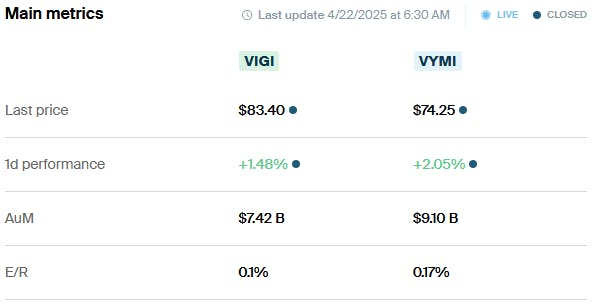
On the trading side, implicit costs are modest for both. VIGI has an average 30-day median bid-ask spread of 0.102%, while VYMI
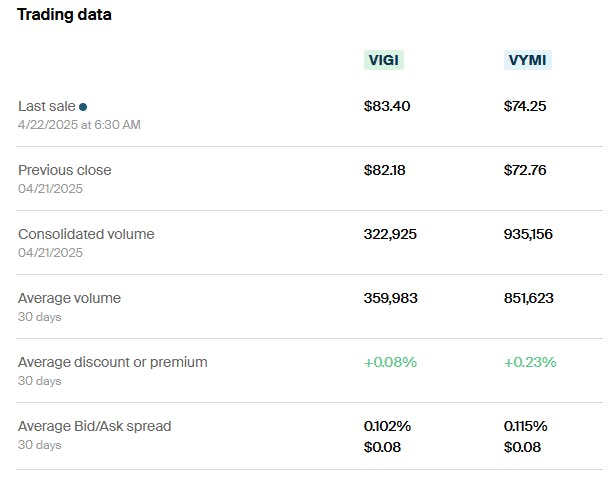
That’s not unexpected given that international stocks are generally less liquid than domestic ones, and that reduced liquidity carries over to the ETFs that hold them.
Verdict: Add it all up, and VIGI is the cheaper ETF to trade and own.
VIGI vs VYMI: Methodology and Holdings
This is where the two ETFs sharply diverge, both in how they select their holdings and what ends up in the portfolio.
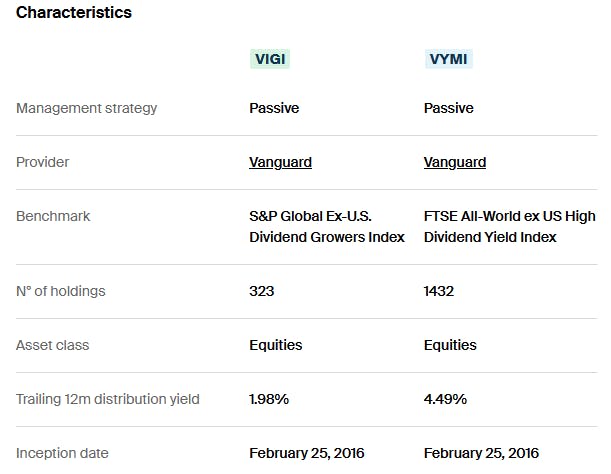
Starting with VIGI, it tracks the S&P Global Ex-U.S. Dividend Growers Index. The fund pulls from developed and emerging markets, screening for companies that have grown their dividends for at least seven consecutive years. REITs are excluded. After that, it ranks the remaining stocks by yield and removes the top 25% to avoid potential yield traps. What’s left is market cap weighted, with individual positions capped at 4%.
VYMI takes a more straightforward approach. It tracks the FTSE All-World ex U.S. High Dividend Yield Index, which selects the top 50% of stocks in its universe based on forecasted 12-month yield, again excluding REITs. Those picks are then market cap weighted without additional screening. It’s a pure high-yield screen, simple and mechanical.
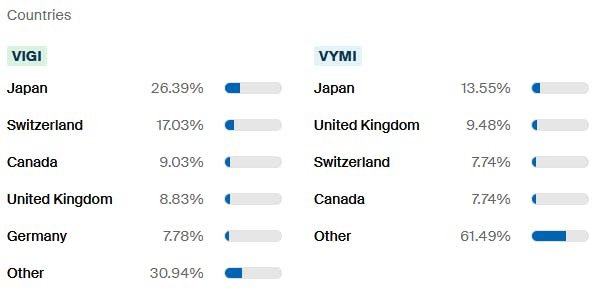
As a result, VYMI clearly delivers the higher yield—4.49% versus VIGI’s 1.98%. Looking at geographic exposure, both funds have Japan as their largest country weight, but VIGI allocates nearly double the weight there. Switzerland and Canada are also notable in VIGI’s top allocations.
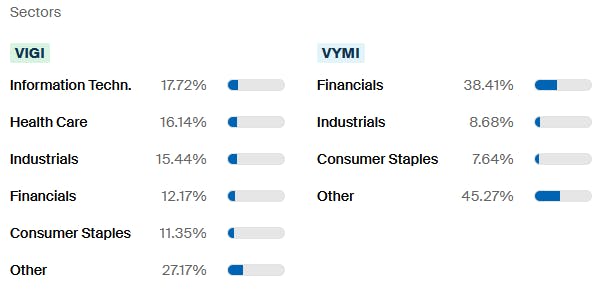
Sector-wise, VYMI
VIGI is also significantly more concentrated. It holds 323 stocks compared to 1,432 in VYMI. The top 15 holdings in VIGI

Verdict: This really comes down to whether you prefer dividend growth or high yield. Personally, I lean toward VIGI—the 324 holdings are more than sufficient, and its sector balance feels more stable. But if yield is your top priority, VYMI delivers more of it while still offering broad diversification.
VIGI vs VYMI: Risk and Return
Over the short term, whether you’re looking at the past three years, one year, or just year-to-date. VYMI has soundly outperformed VIGI and has also attracted significantly more investor inflows. The higher yield has made it a more appealing option in recent market conditions.
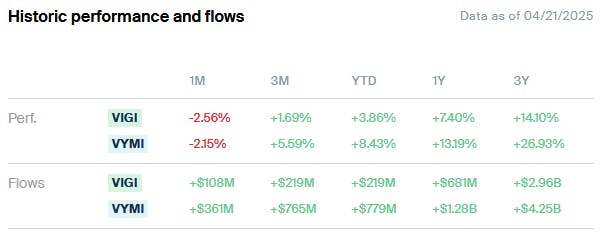
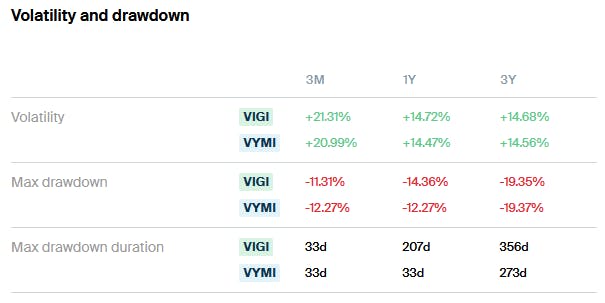
From a risk perspective, both ETFs have shown similar volatility profiles over these same timeframes. Their three-year, one-year, and year-to-date volatility levels and maximum drawdowns were comparable. However, VYMI’s drawdowns tended to be shorter in length, with faster recoveries, suggesting a more responsive rebound when markets corrected.
Looking at the full backtest from March 2, 2016, through April 21, 2025, VYMI also came out ahead in total return, posting a compound annual growth rate (CAGR) of 7.7% versus 6.4% for VIGI. But after adjusting for risk, the performance gap narrows considerably, with a Sharpe ratio of 0.41 for VIGI versus 0.42 for VYMI.
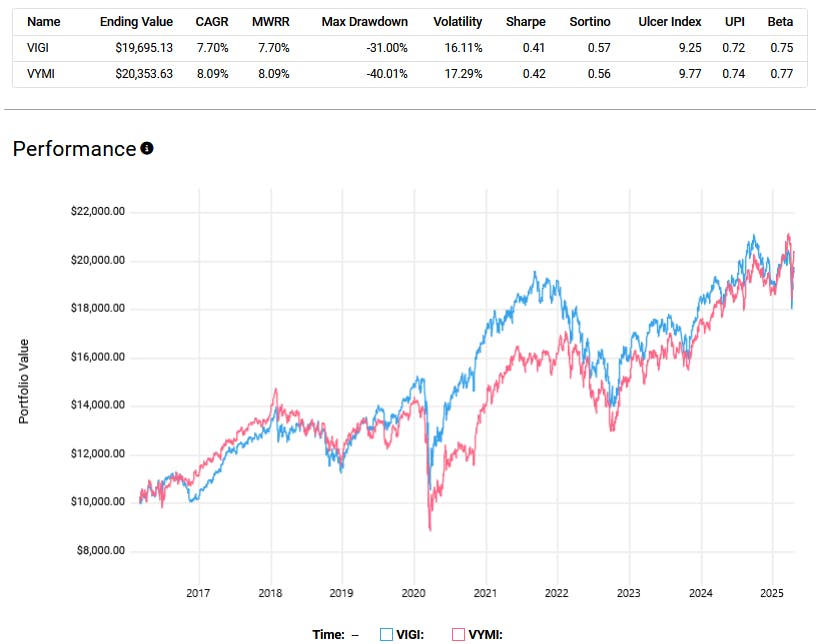
Verdict: VYMI takes the win overall. It has outperformed across most timeframes and continues to benefit from stronger exposure to the value factor, which has supported international equities lately. VIGI, by contrast, leans more toward the quality factor, making it a solid alternative for those who prefer stability—but in this matchup, VYMI has the edge.
This article is for informational purposes only and does not in any way constitute investment advice. The author may express their own opinions, which may not represent the opinions of ETF Central or its affiliated partners. It is essential that you seek advice from a registered financial professional prior to making any investment decisions.
Segments
See all
Mentioned ETFs
Further reading
Latest ETF News
See all ETF newsHow Investors can Maximize Tax Efficiency with Income ETFs

Trump Accounts: Here's Which ETFs You Can Invest In

The Two Best Types of Fixed-Income ETFs For Managing Cash

ETF Comparison: Roundhill Generative AI & Technology ETF Versus iShares A.I. Innovation and Tech Active ETF




 Advantages of ETFs over Mutual Funds1/6
Lower Costs
In this guide, we'll explore the advantages of ETFs over mutual funds, giving you valuable insights into why ETFs have gained significant popularity among investors like yourself.
Leveraged ETFs: Unlocking the Potential for Amplified Returns1/6
Understanding Leveraged ETFs
Explore leveraged ETFs: potential for amplified returns & risks. 5 ETFs to consider across equities, commodities & fixed income.
What is a Leveraged ETF?1/6
Introducing Leveraged and Inverse ETFs
In this guide, we'll dive into the world of leveraged ETFs, exploring their definition, mechanics, potential risks, and rewards.
Recent educational content

ETF Trends
ETF Industry KPIs July 20, 2026
This week’s KPI data overview highlights key metrics and trends shaping the ETF landscape.

ETF Trends
ETF Industry KPIs July 13, 2026
This week’s KPI data overview highlights key metrics and trends shaping the ETF landscape.

First Look ETF
First Look ETF: Cash Deployment, Bond, and Hedged ETFs
In this season 6 episode of First Look ETF, Stephanie Stanton examines the latest ETF marketplace trends with NYSE and guests.

ETF Trends
ETF Industry KPIs July 6, 2026
This week’s KPI data overview highlights key metrics and trends shaping the ETF landscape.
Browse all educational columns



Expert-Built ETF Portfolios, All in One Place
Don’t start from scratch. Discover ready-made ETF portfolios built by professionals to match different goals, timelines, and market views. Use them as inspiration or as a starting point for your own allocation.