Open Now: The Global ETF Survey Take the Survey →



ETF Comparison: VanEck Semiconductor ETF (SMH) Versus iShares Semiconductor ETF (SOXX)
The two largest semiconductor ETFs by AUM, SMH and SOXX, go head-to-head in this week’s ETF comparison.

Keep up with what matters in ETFs
Get timely ETF insights, market trends, and top ideas straight to your inbox.
Your newsletter subscriptions with us are subject to ETF Central's Privacy Policy and Terms and Conditions.
Semiconductors are the unsung heroes of modern technology, powering everything from smartphones, laptops, and cars to cutting-edge applications like artificial intelligence, quantum computing, and space exploration. Their importance in everyday life and innovation is hard to overstate.
Despite their broad application, the semiconductor industry is dominated by a handful of key players. Companies like Taiwan Semiconductor Manufacturing Company, ASML NV, Nvidia, AMD, and Broadcom are some of the biggest names driving advancements in this space.
For investors, ETFs offer a simple and efficient way to gain exposure to this sector. With a single ticker, you can invest in a diverse portfolio of semiconductor companies in a liquid and cost-effective manner.
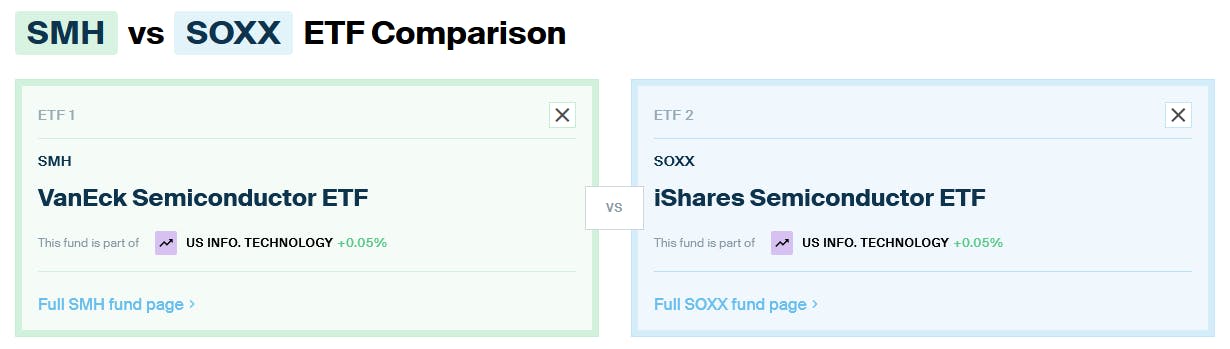
Today, we’ll put two of the largest semiconductor ETFs by assets under management—VanEck Semiconductor ETF
Like what you're reading?
Stay in the loop — get the latest ETF insights: trends, analysis, and expert picks.
SMH vs SOXX: Total cost of ownership
Both ETFs charge an identical expense ratio of 0.35%, which works out to $35 annually for every $10,000 invested. This is fairly typical for industry-specific ETFs.
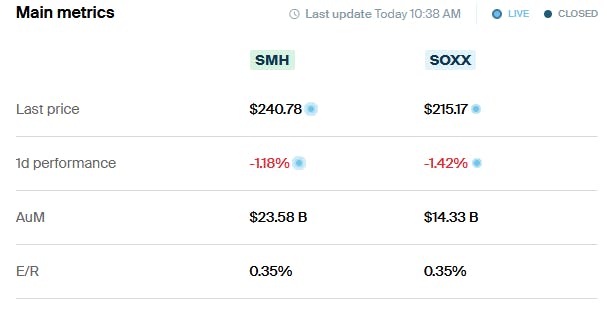
However, total cost of ownership isn’t just about the expense ratio. It also includes the implicit cost of trading, such as the bid-ask spread. On this front, both ETFs perform well, with 30-day average bid-ask spreads of 0.025% for SMH
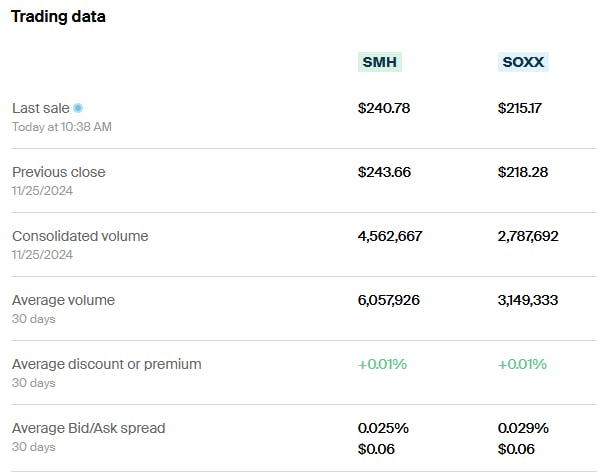
Verdict: It’s a tie when it comes to total cost of ownership. Both ETFs are competitively priced are, highly liquid, and have options chains.
SMH vs SOXX: Methodology and holdings
The main difference between these ETFs lies in their methodologies, determined by their benchmark indexes.
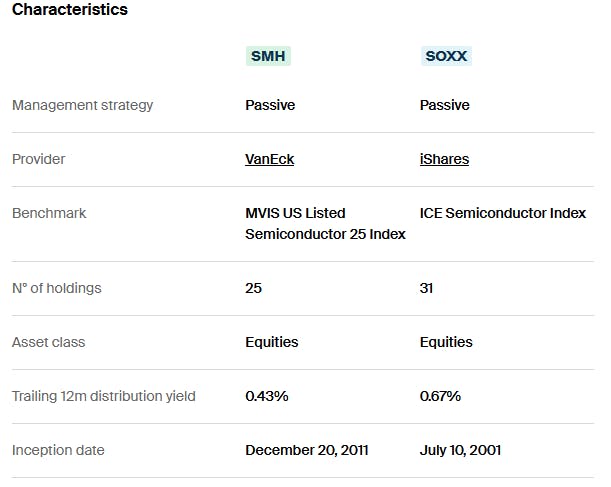
SMH
SOXX
The difference? Both ETFs are fairly top-heavy, but SMH is significantly more concentrated. The top 15 holdings make up 89.36% of SMH, compared to 78.87% of SOXX.

Nvidia, for example, currently represents 22.21% of SMH’s portfolio, exceeding the 20% cap due to a recent run-up between rebalances. In SOXX, Nvidia accounts for a more reasonable 9.4%.
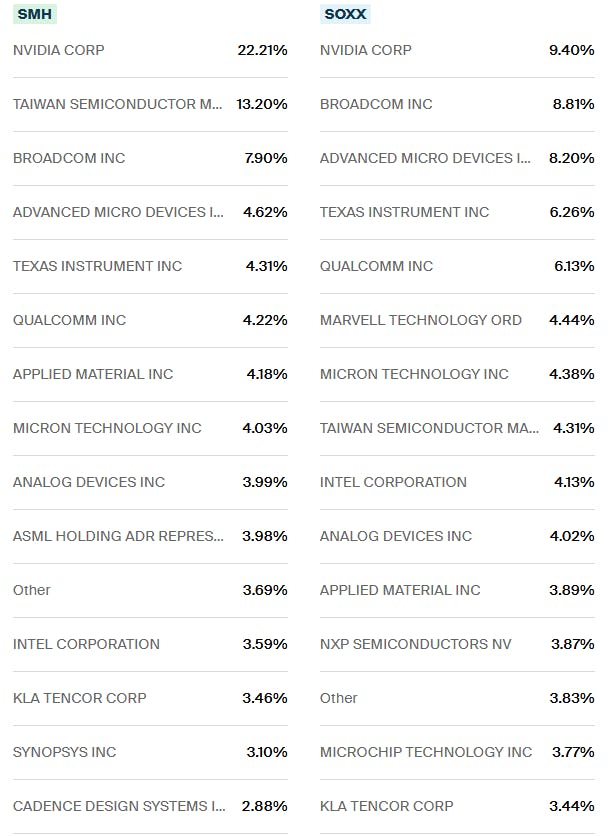
Verdict: SMH’s concentration at the top is a concern, as a 20% cap is quite liberal in my view. While SOXX is also weighted toward the big players, its composition is much more balanced, which I find preferable for diversification.
SMH vs SOXX: Risk and return
One upside of SMH’s concentration and its liberal 20% cap is that it has allowed Nvidia’s stellar performance to run relatively unchecked within the ETF. In contrast, SOXX’s methodology imposes stricter constraints on individual holdings, capping Nvidia at a lower weight.
Unsurprisingly, SMH
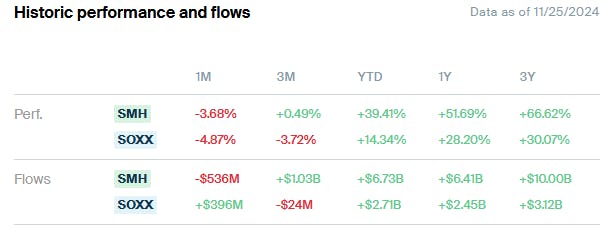
Even on a longer-term backtest from July 13, 2001, to November 25, 2024, SMH comes out ahead with a compound annual growth rate (CAGR) of 12.22% versus SOXX’s 10.78%. SMH also wins on a risk-adjusted basis, achieving a Sharpe ratio of 0.47 compared to SOXX’s 0.43.
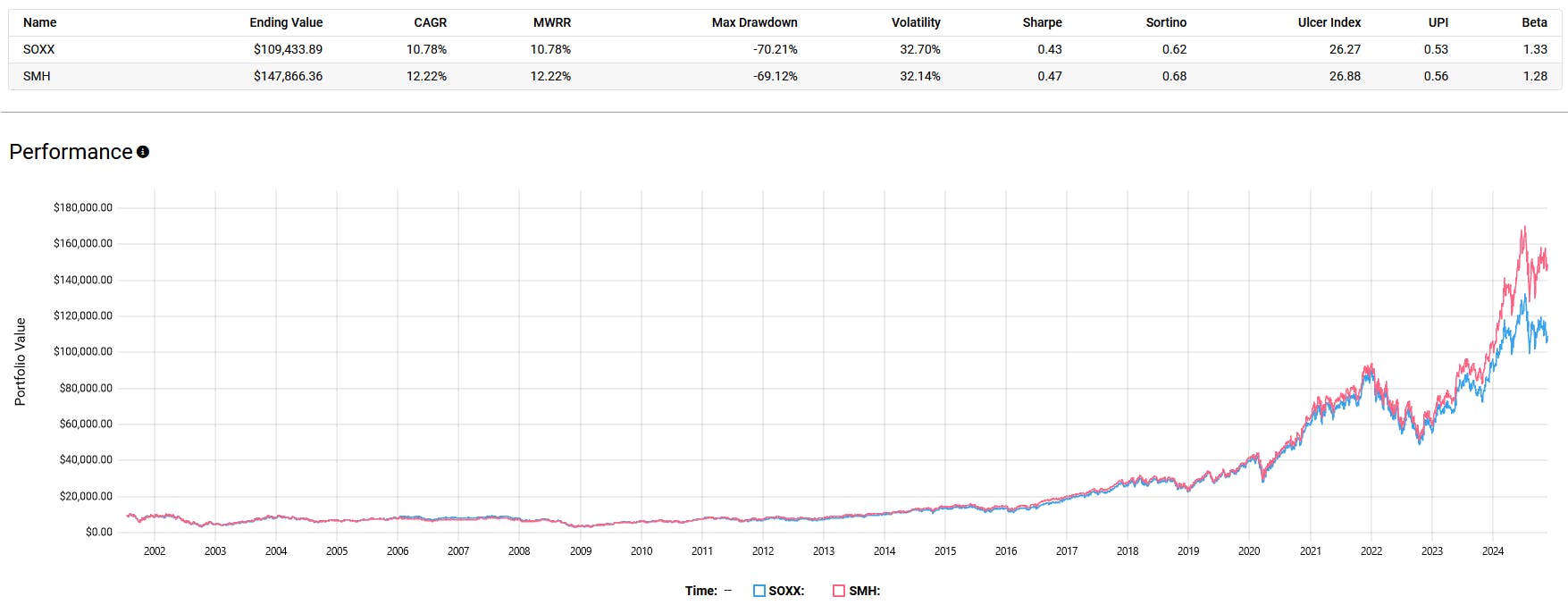
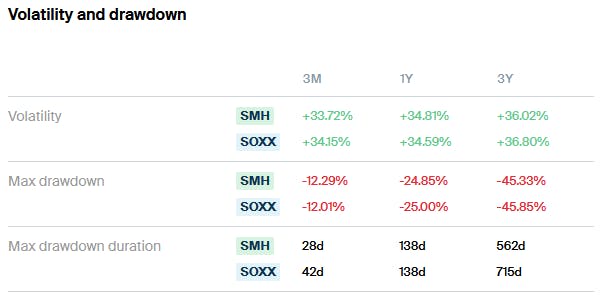
Interestingly, SOXX has been more volatile than SMH, despite SMH’s higher concentration. SOXX shows a higher three-year standard deviation and longer maximum drawdown duration, although the depth of the drawdowns was similar for both ETFs.
Verdict: SMH
This article is for informational purposes only and does not in any way constitute investment advice. The author may express their own opinions, which may not represent the opinions of ETF Central or its affiliated partners. It is essential that you seek advice from a registered financial professional prior to making any investment decisions.
Topics
See all
Segments
See all
Mentioned ETFs
Latest ETF News
See all ETF newsHow Investors can Maximize Tax Efficiency with Income ETFs

Trump Accounts: Here's Which ETFs You Can Invest In

The Two Best Types of Fixed-Income ETFs For Managing Cash

ETF Comparison: Roundhill Generative AI & Technology ETF Versus iShares A.I. Innovation and Tech Active ETF




 Advantages of ETFs over Mutual Funds1/6
Lower Costs
In this guide, we'll explore the advantages of ETFs over mutual funds, giving you valuable insights into why ETFs have gained significant popularity among investors like yourself.
Leveraged ETFs: Unlocking the Potential for Amplified Returns1/6
Understanding Leveraged ETFs
Explore leveraged ETFs: potential for amplified returns & risks. 5 ETFs to consider across equities, commodities & fixed income.
What is a Leveraged ETF?1/6
Introducing Leveraged and Inverse ETFs
In this guide, we'll dive into the world of leveraged ETFs, exploring their definition, mechanics, potential risks, and rewards.
Recent educational content

ETF Trends
ETF Industry KPIs July 20, 2026
This week’s KPI data overview highlights key metrics and trends shaping the ETF landscape.

ETF Trends
ETF Industry KPIs July 13, 2026
This week’s KPI data overview highlights key metrics and trends shaping the ETF landscape.
First Look ETF
First Look ETF: Cash Deployment, Bond, and Hedged ETFs
In this season 6 episode of First Look ETF, Stephanie Stanton examines the latest ETF marketplace trends with NYSE and guests.

ETF Trends
ETF Industry KPIs July 6, 2026
This week’s KPI data overview highlights key metrics and trends shaping the ETF landscape.
Browse all educational columns



Expert-Built ETF Portfolios, All in One Place
Don’t start from scratch. Discover ready-made ETF portfolios built by professionals to match different goals, timelines, and market views. Use them as inspiration or as a starting point for your own allocation.