From idea to ETF portfolio in minutes. Build yours now →



ETF Comparison: VanEck Oil Services ETF (OIH) Versus VanEck Oil Refiners ETF (CRAK)
Two NYSE-listed oil industry ETFs from VanEck go head-to-head in this week’s ETF comparison.

Keep up with what matters in ETFs
Get timely ETF insights, market trends, and top ideas straight to your inbox.
Your newsletter subscriptions with us are subject to ETF Central's Privacy Policy and Terms and Conditions.
One of the most common mistakes new energy investors make is treating the sector as a monolith. There’s a persistent assumption that energy ETFs move in a simple, linear relationship with oil prices. In reality, oil prices are only one input.
Equity performance in the energy space is also shaped by capital spending cycles, regulatory environments, geopolitical risk, refining margins, transportation constraints, and where a company sits in the energy value chain.
That last point matters more than most investors realize. The oil industry is not a single business. Broadly speaking, it breaks down into upstream companies focused on exploration and production, midstream firms that transport and store hydrocarbons, and downstream operators that refine crude into usable products like gasoline, diesel, and jet fuel.
There is also a fourth segment that often gets overlooked: oil services. These are the companies that supply the drilling, engineering, equipment, and technical expertise that upstream producers rely on to bring new supply online.
Oil services firms are often among the most sensitive to geopolitical developments. When expectations rise for new drilling activity or infrastructure rebuilds, investors tend to anticipate a surge in capital expenditures, which flows directly to service providers. The recent U.S. military action in Venezuela is a good example of this dynamic in action.
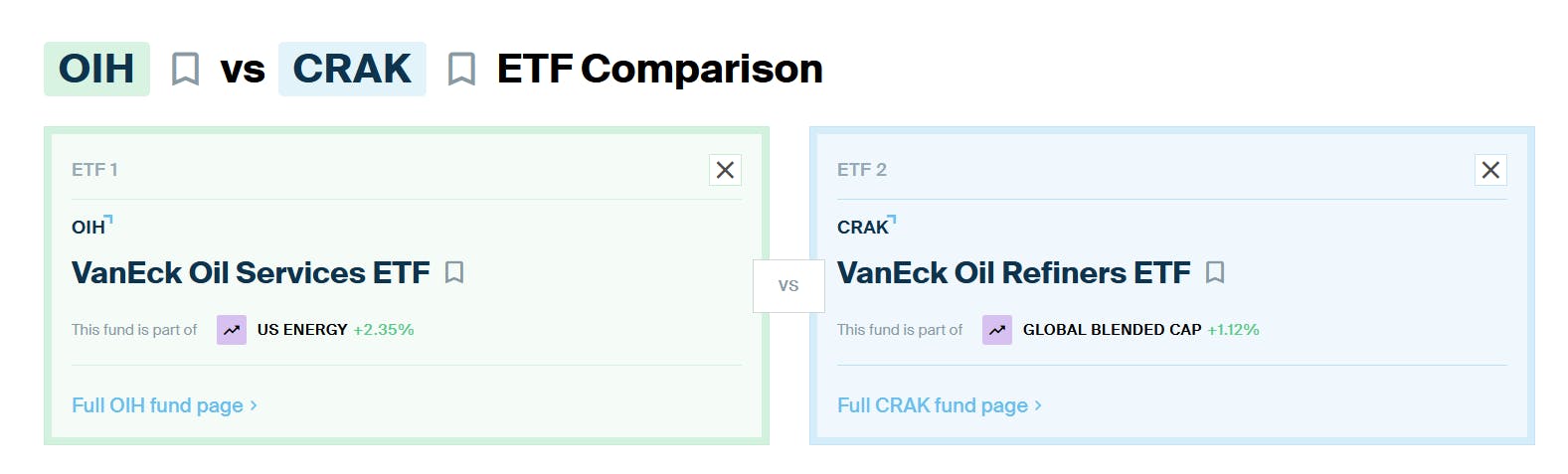
With that context in mind, this week’s ETF comparison looks at two energy ETFs that tend to be overshadowed by broader energy funds dominated by mega-cap producers. Using data from ETF Central’s comparison tool, we’re pitting the VanEck Oil Services ETF (OIH) against the VanEck Oil Refiners ETF (CRAK).
Global ETF Survey 2026 is Live!
With 1,790 new products launched by July 2026, choosing is harder than ever. Our Global ETF Survey 2026, built on 620 professional investors and allocators, shows how active, fixed income, options-based and thematic ETFs are reshaping fund selection.
OIH vs. CRAK: Total Cost of Ownership
Sector ETFs are almost always more expensive than broad-market ETFs, and the more specific the exposure, the higher the cost tends to be. Both of these funds reflect that reality.
OIH is the cheaper option on headline fees, with a 0.35% expense ratio. CRAK is meaningfully more expensive, carrying a 0.62% net expense ratio. That figure already reflects a fee waiver and expense reimbursement that reduced its costs from a much higher 0.85% gross expense ratio.
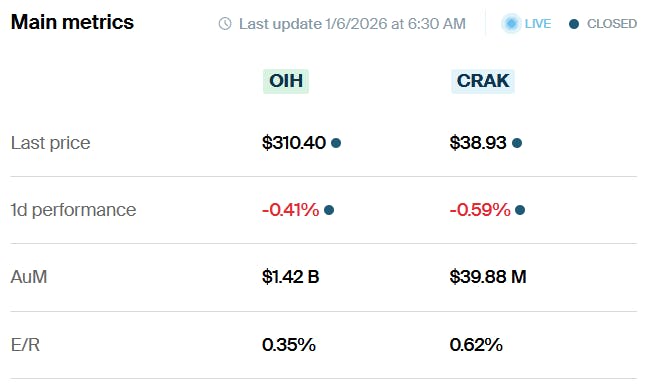
Fees, however, are only part of the story. Liquidity matters, particularly when sector ETFs are used for tactical positioning. On that front, OIH has a clear edge. Its 30-day average bid-ask spread is just 0.079%, compared with 0.46% for CRAK.
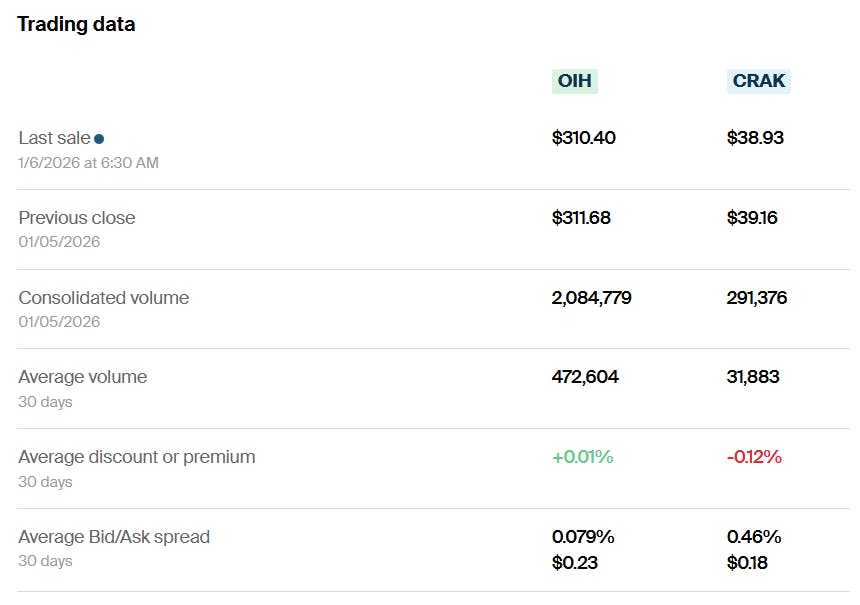
Verdict: When you combine expense ratios with trading costs, OIH is decisively cheaper to own and easier to trade. For investors who value flexibility and lower friction, it wins this round.
OIH vs. CRAK: Methodology and Exposure
Both ETFs are passive benchmark-tracking products, but their underlying exposure to the energy sector differs dramatically.
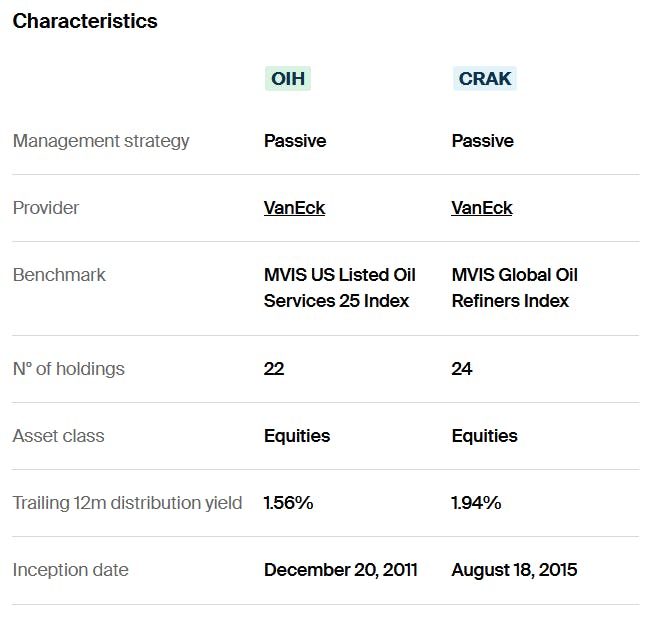
OIH tracks the MVIS U.S. Listed Oil Services 25 Index. It holds U.S.-listed companies that provide drilling, engineering, equipment, and related services to upstream producers. While often described as a pure services play, the index also captures some oilfield equipment exposure, making it a leveraged bet on upstream capital spending.
CRAK, by contrast, is a downstream-focused ETF. It tracks the MVIS Global Oil Refiners Index, which consists of companies that purchase crude oil and refine it into finished petroleum products. The investment thesis here revolves around refining margins and supply-demand imbalances for end products, rather than the price of crude itself.
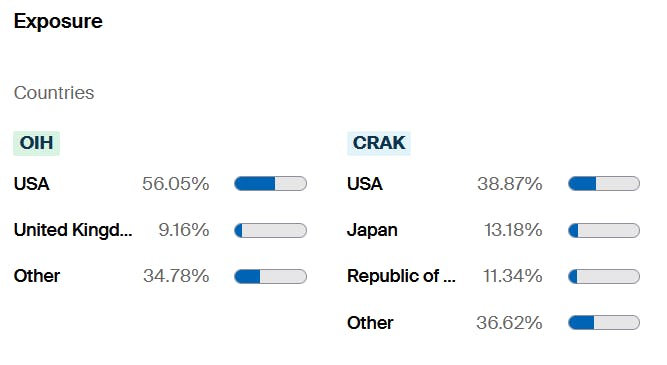
Geographically, OIH is far more U.S.-centric, with roughly 56% of assets tied to U.S. equities. CRAK is much more globally diversified, with significant exposure to Japan and additional allocations across India, South Korea, Poland, Finland, and other markets.
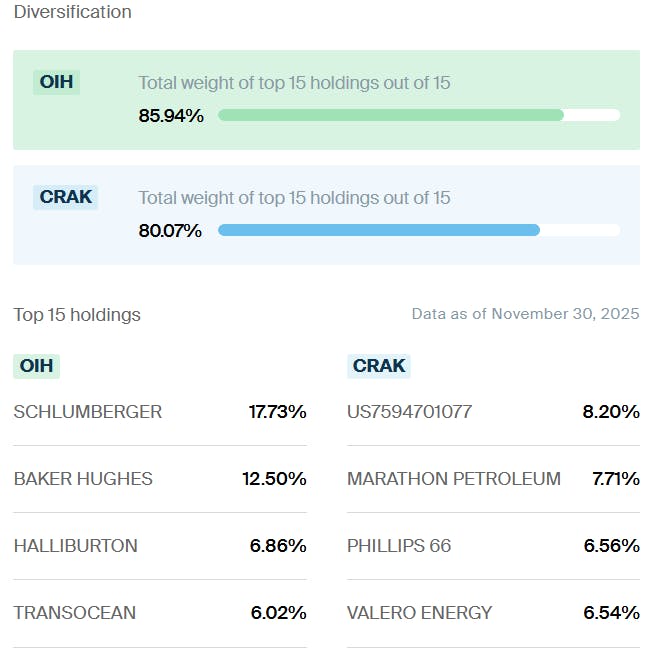
Both ETFs are highly concentrated. The top five holdings account for 85.94% of OIH and 80.07% of CRAK. OIH is dominated by the three largest oil services firms: Schlumberger, Baker Hughes, and Halliburton. CRAK’s top holdings are more varied, led by Reliance Industries, followed by Phillips 66, Valero Energy, and Marathon Petroleum.
Verdict: The choice depends on the thesis. OIH is the tool for expressing a view on upstream capital spending and drilling activity. CRAK is better suited for investors betting on refining margins and downstream capacity utilization. In the context of Venezuela-related headlines, either could make sense. CRAK captures the infrastructure needed to process additional supply, while OIH reflects expectations for increased services demand. On timeliness alone, it’s a tie.
OIH vs. CRAK: Risk and Return
Both ETFs have delivered strong returns in recent years, but history shows that these segments are highly cyclical. Energy services and refining are among the most volatile corners of the sector. Investors seeking stability within energy are usually better served by midstream companies with long-term contractual cash flows.
Leadership between OIH and CRAK has rotated. Over the past five years, OIH has outperformed CRAK. Over the last three years and one year, that relationship has flipped. Interestingly, OIH has experienced meaningful net outflows over these periods, while CRAK’s flows have been more balanced.
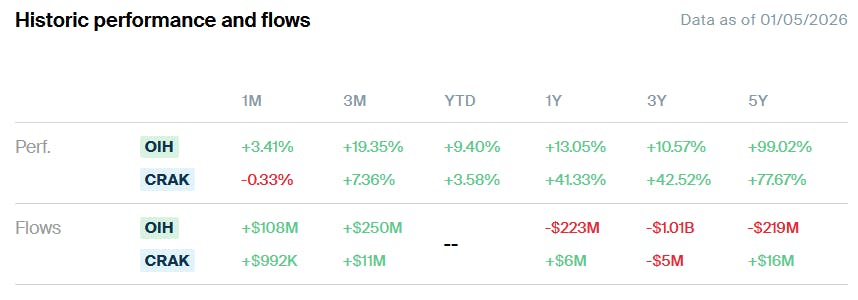
Risk metrics highlight a clear difference. Volatility is high for both ETFs, but OIH is consistently riskier, with higher standard deviation across five-, three-, and one-year periods. Its maximum drawdowns have also been deeper and longer lasting.

The reason is structural. Oil services companies live and die by upstream capital spending, which itself is highly sensitive to oil prices and producer sentiment. Refiners, while still cyclical, benefit from margin dynamics and product demand that can sometimes buffer crude price swings.
A longer-term backtest from August 19, 2015, through January 5, 2026, underscores this distinction. Over roughly 10.4 years, CRAK delivered a cumulative return of 164.81%, or an annualized return of 9.83%. OIH, by contrast, posted a cumulative loss of 36.8%, translating to an annualized decline of 4.32%. It has been a punishing decade for oil services investors.

Verdict: CRAK takes the win on a risk-adjusted, long-term basis. While OIH may benefit from improving valuations and renewed capital spending, CRAK has demonstrated greater durability across market cycles, making it a more balanced way to access this corner of the energy sector.
Please note this article is for information purposes only and does not in any way constitute investment advice. It is essential that you seek advice from a registered financial professional prior to making any investment decision.
Segments
See all
Mentioned ETFs
Further reading

Latest ETF News
See all ETF newsBeyond Big Tech: The Increasing Specialization of AI ETFs

There's an ETF for That? Humanoid Robotics and Physical AI

How Some ETF Issuers Use Their Own Funds for Cash Management

These Public-Private ETFs Invest in Polymarket and Anduril

There's an ETF for That? Frontier Markets



 Advantages of ETFs over Mutual Funds1/6
Lower Costs
In this guide, we'll explore the advantages of ETFs over mutual funds, giving you valuable insights into why ETFs have gained significant popularity among investors like yourself.
Leveraged ETFs: Unlocking the Potential for Amplified Returns1/6
Understanding Leveraged ETFs
Explore leveraged ETFs: potential for amplified returns & risks. 5 ETFs to consider across equities, commodities & fixed income.
What is a Leveraged ETF?1/6
Introducing Leveraged and Inverse ETFs
In this guide, we'll dive into the world of leveraged ETFs, exploring their definition, mechanics, potential risks, and rewards.
Recent educational content

First Look ETF
First Look ETF: Income, International, and Cash Flow ETFs
In this season 6 episode of First Look ETF, Stephanie Stanton @etfguide examines the latest ETF marketplace trends with NYSE and guests.


ETF Trends
ETF Industry KPIs October 5, 2026
This week’s KPI data overview highlights key metrics and trends shaping the ETF landscape.

ETF Trends
ETF Industry KPIs September 28, 2026
This week’s KPI data overview highlights key metrics and trends shaping the ETF landscape.
ETF Trends
ETF Industry KPIs September 22, 2026
This week’s KPI data overview highlights key metrics and trends shaping the ETF landscape.
Browse all educational columns



ETFs’ Next Act: From Access to Selection
With 1,790 new products launched by July 2026, choosing is harder than ever. Our Global ETF Survey 2026, built on 620 professional investors and allocators, shows how active, fixed income, options-based and thematic ETFs are reshaping fund selection.