Global ETF Survey Is Live! 600+ ETF Professionals Weigh In. See Results →



ETF Comparison: VanEck Gold Miners ETF (GDX) Versus VanEck Junior Gold Miners ETF (GDXJ)
Same ETF issuer and industry, vastly different underlying holdings and risk profiles.

Keep up with what matters in ETFs
Get timely ETF insights, market trends, and top ideas straight to your inbox.
Your newsletter subscriptions with us are subject to ETF Central's Privacy Policy and Terms and Conditions.
Gold prices have been on a strong run through most of 2025, with momentum carrying into 2026 so far. What has drawn even more attention, however, is the performance of gold miners. In many cases, miner stock appreciation has outpaced the metal itself!
Gold miners act as a form of operational leverage to spot gold prices. This is because mining costs tend to be relatively fixed in the short term. When gold prices rise sharply, revenue increases immediately, while many costs do not. That expansion in margins can translate into disproportionately higher earnings, stronger free cash flow, and in some cases, higher dividends or accelerated expansion plans.
The relationship is not perfect. These are still equities, which means they carry equity market risk, company-specific risk, geopolitical exposure, and operational uncertainty. Gold miners can also underperform during broader market selloffs, even when gold prices hold up. Still, as a category, gold miner ETFs were among the strongest performers in 2025, and that strength has extended into 2026.
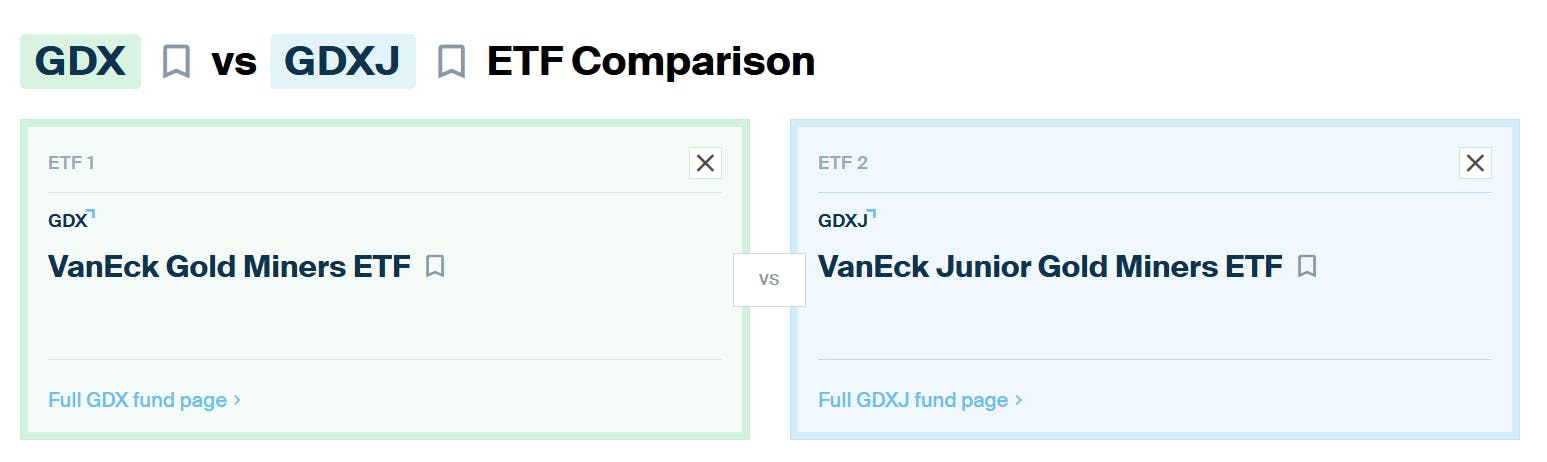
With that backdrop, this ETF comparison puts two of the largest and most widely used gold miner ETFs head to head: the VanEck Gold Miners ETF
Global ETF Survey 2026 is Live!
With 1,790 new products launched by July 2026, choosing is harder than ever. Our Global ETF Survey 2026, built on 620 professional investors and allocators, shows how active, fixed income, options-based and thematic ETFs are reshaping fund selection.
GDX versus GDXJ: Total Cost of Ownership
On headline expense ratios, the two ETFs are tied. Both charge a 0.51% expense ratio, which translates to an annual fee drag of $51 on a $10,000 investment. That level is higher than broad sector ETFs, but it is typical for industry-specific and niche exposure funds.
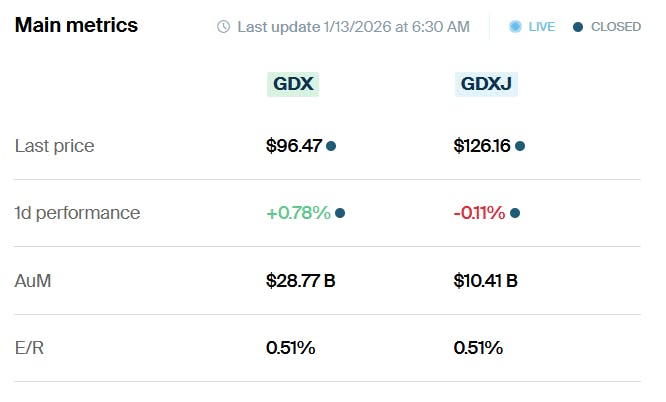
The difference shows up in trading costs. GDX
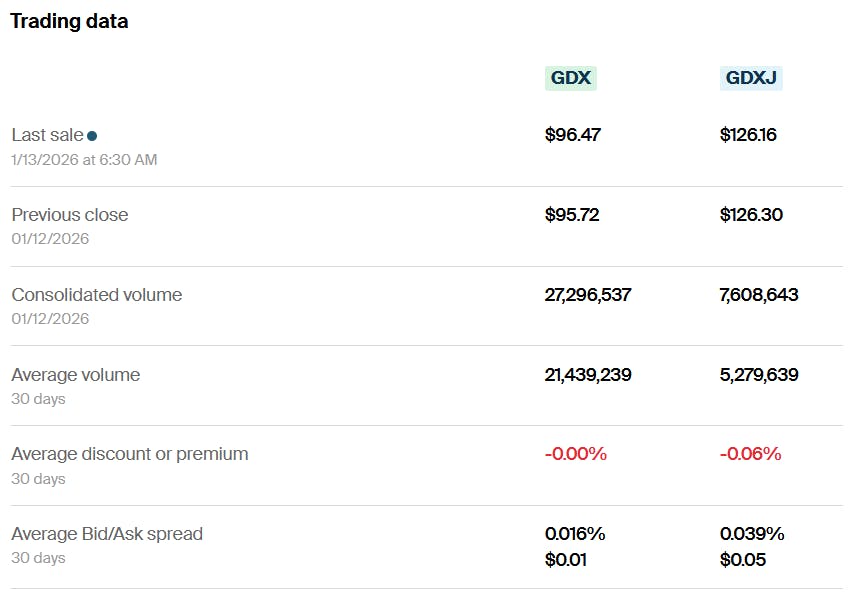
Verdict: When expense ratios and bid-ask spreads are considered together, GDX narrowly comes out ahead in total cost. For long-term buy-and-hold investors, the difference is minimal, but for active traders, GDX has a clear advantage.
GDX versus GDXJ: Methodology and Holdings
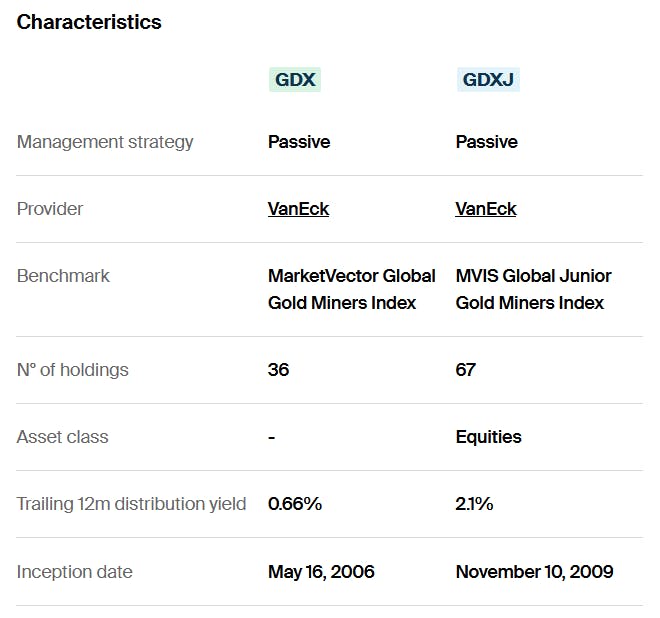
Despite similar names, these ETFs target very different parts of the gold mining industry. This results in a disparate basket of holdings and sensitivity to gold prices.
GDX
GDXJ
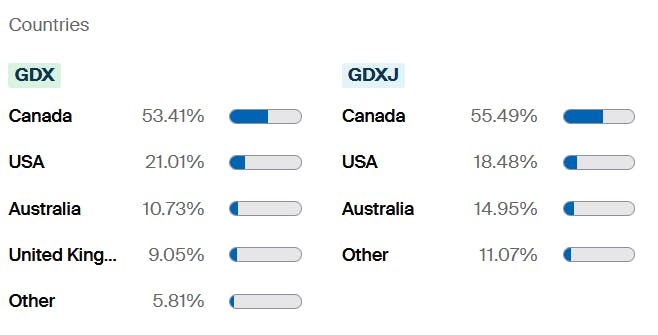
Geographically, both ETFs are Canada-heavy, with more than half of assets tied to Canadian-listed miners. That is not surprising given Canada’s role as a global hub for mining companies. Both also have exposure to the U.S. and Australia. It is worth noting that many Canadian miners are dual listed.
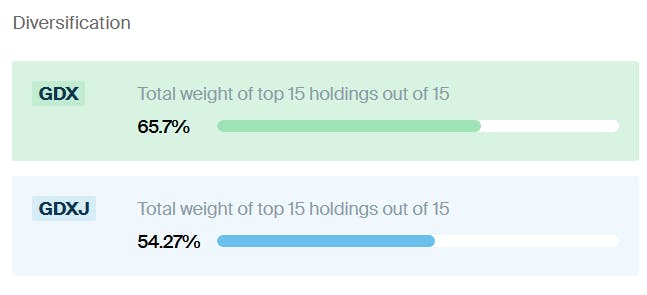
Concentration is another key difference. The top 15 holdings account for 65.7% of GDX
GDX offers broad exposure to the full spectrum of the gold mining industry. Holdings include large producers such as Agnico Eagle Mines, Newmont, and Barrick, alongside streaming and royalty companies like Franco-Nevada and Wheaton Precious Metals.
GDXJ leans much further into smaller operators. Junior miners may still be scaling production, expanding reserves, or even operating without meaningful output. Many are capital-intensive and speculative, relying on exploration success to justify valuations. The fund still holds established names such as Pan American Silver, Equinox Gold, Alamos Gold, and Royal Gold, but still skews small-mid cap.
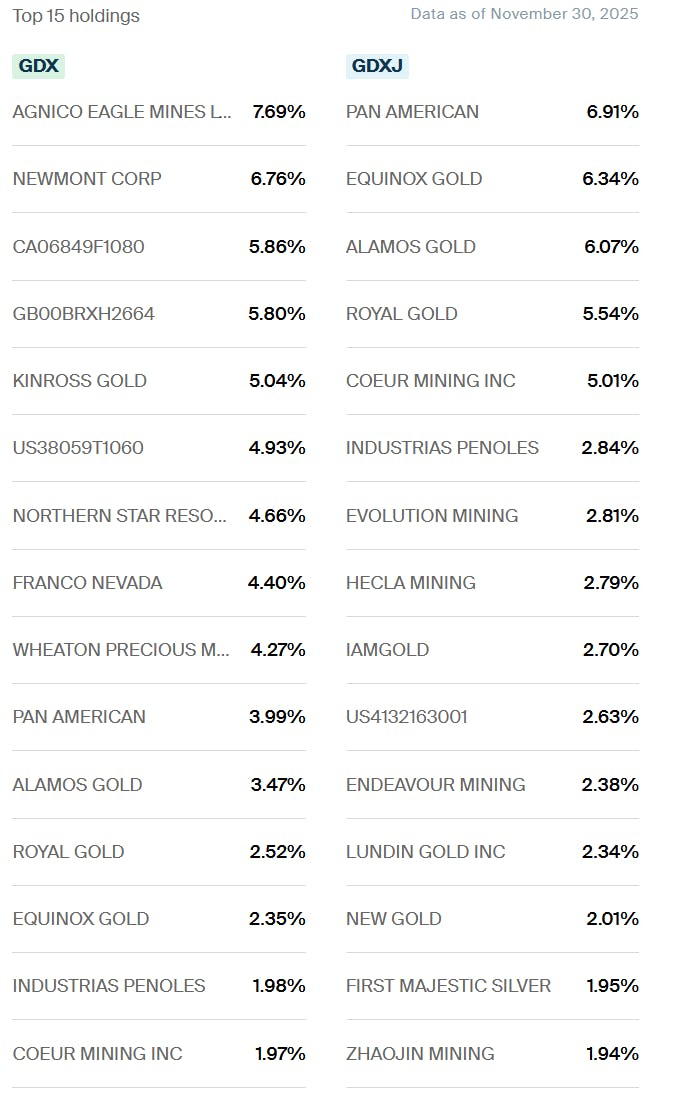
Verdict: GDX works well as a broad, leveraged play on gold prices. GDXJ offers more torque, but that leverage cuts both ways. I think for the average investor, GDX is the easier option to understand once they become familiar with spot gold ETFs.
GDX versus GDXJ: Risk and Return
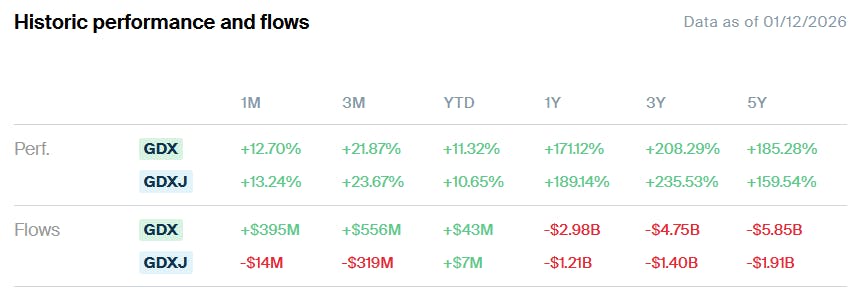
Both ETFs have delivered strong returns in recent years. Over the past five years, GDX
Despite this performance, both ETFs have experienced sustained net outflows over the past several years, with GDX seeing larger redemptions. Investor behavior has not fully matched performance!
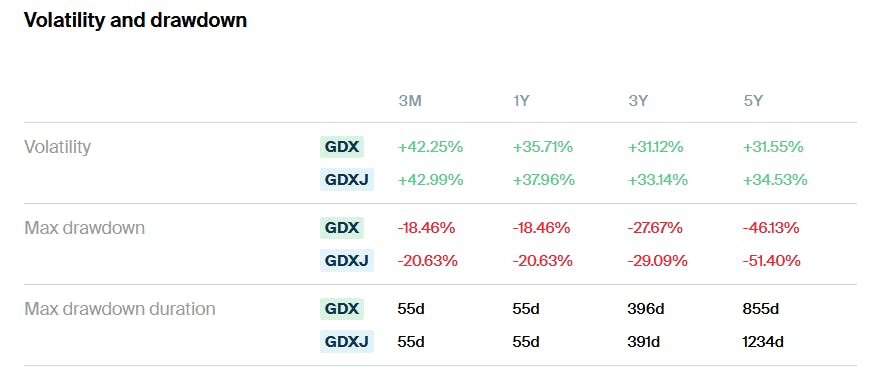
Volatility is where the differences become more pronounced. Both funds are volatile, but GDXJ consistently exhibits higher volatility due to its exposure to smaller and less established companies.
Over the last five years, GDX experienced a maximum drawdown of 46.13%, while GDXJ fell 51.40%. More importantly, GDX’s drawdown lasted 855 days, compared with 1,234 days for GDXJ.
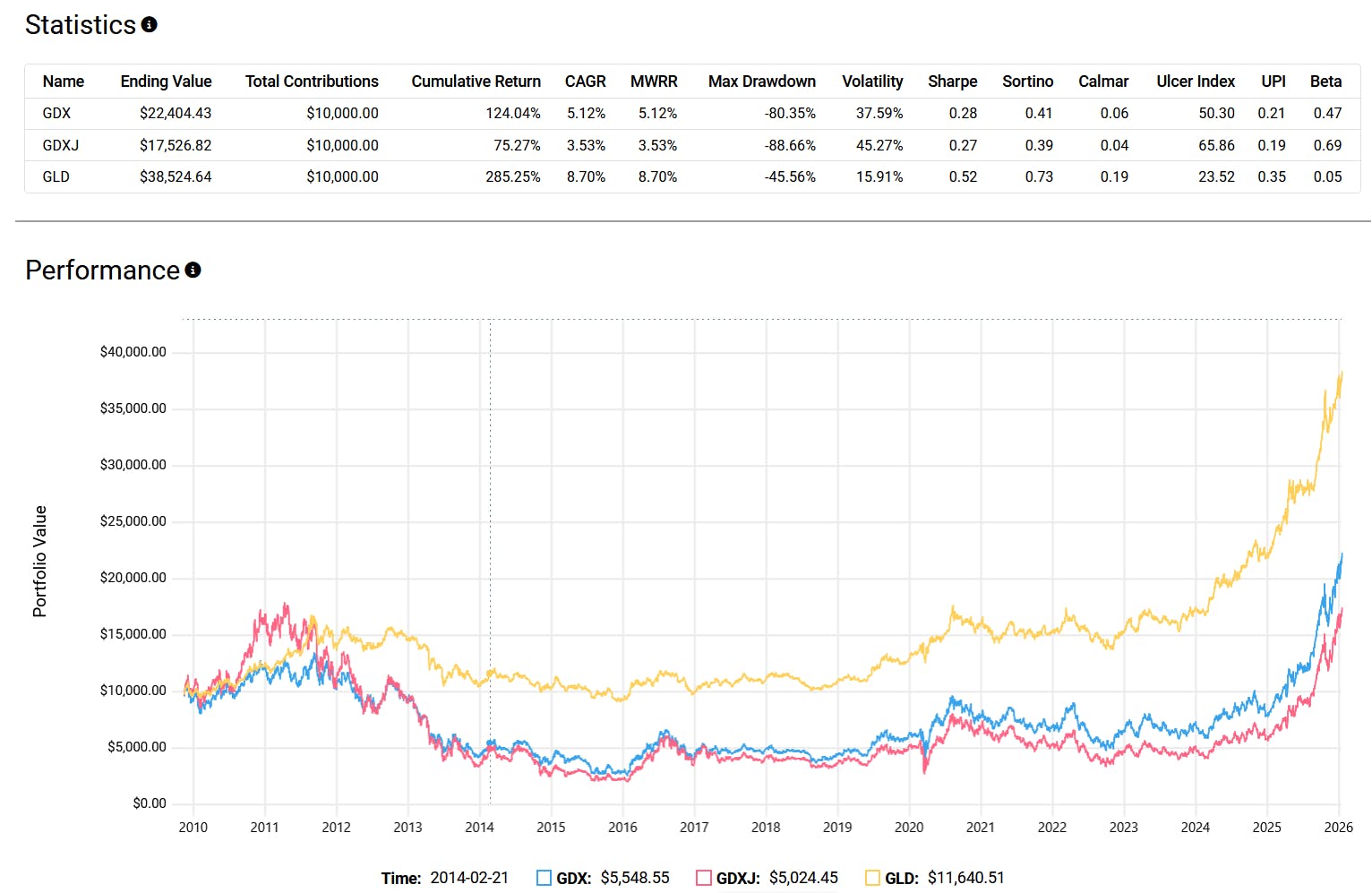
Over a longer horizon, from November 2009 through January 2026, both ETFs have underperformed spot gold. GDX delivered an annualized return of 5.11%, GDXJ returned 3.53%, while spot gold ETFs returned roughly 8.7%.
That gap highlights the downside of operational leverage during flat or declining gold cycles. Losses compound more quickly, and recovery requires larger subsequent gains.
Junior miners also face additional risks beyond price volatility. These include financing risk, project delays, reserve uncertainty, and geopolitical risk such as expropriation or unfavorable regulatory changes in resource-heavy regions.
Verdict: From a risk and return standpoint, GDX remains the more balanced option. It benefits from stronger balance sheets, better access to capital, and more diversified business models. GDXJ can amplify gains in strong bull markets for gold, but it also magnifies losses and drawdowns. For most investors, GDX is the easier entry point when expressing a bullish view on gold.
Please note this article is for information purposes only and does not in any way constitute investment advice. It is essential that you seek advice from a registered financial professional prior to making any investment decision.
Mentioned ETFs
Further reading

Latest ETF News
See all ETF news
Beyond TLT: Treasury ETFs For the Long Duration Trade

MoneyShow Chart of the Day 9/30/26: Are Hyperscalers the New "Sovereigns?"


Which Fixed-Income ETFs Benefit from Rising Interest Rates?




 Advantages of ETFs over Mutual Funds1/6
Lower Costs
In this guide, we'll explore the advantages of ETFs over mutual funds, giving you valuable insights into why ETFs have gained significant popularity among investors like yourself.
Leveraged ETFs: Unlocking the Potential for Amplified Returns1/6
Understanding Leveraged ETFs
Explore leveraged ETFs: potential for amplified returns & risks. 5 ETFs to consider across equities, commodities & fixed income.
What is a Leveraged ETF?1/6
Introducing Leveraged and Inverse ETFs
In this guide, we'll dive into the world of leveraged ETFs, exploring their definition, mechanics, potential risks, and rewards.
Recent educational content

First Look ETF
First Look ETF: Income, International, and Cash Flow ETFs
In this season 6 episode of First Look ETF, Stephanie Stanton @etfguide examines the latest ETF marketplace trends with NYSE and guests.


ETF Trends
ETF Industry KPIs October 5, 2026
This week’s KPI data overview highlights key metrics and trends shaping the ETF landscape.

ETF Trends
ETF Industry KPIs September 28, 2026
This week’s KPI data overview highlights key metrics and trends shaping the ETF landscape.
ETF Trends
ETF Industry KPIs September 22, 2026
This week’s KPI data overview highlights key metrics and trends shaping the ETF landscape.