Turn ETF ideas into real portfolios. Try the builder now →



ETF Comparison: Technology Select Sector SPDR Fund (XLK) Versus iShares Expanded Tech Sector ETF (IGM)
State Street SPDR’s flagship technology sector ETF goes head-to-head with a dark horse candidate from BlackRock iShares in this week’s ETF comparison.

Keep up with what matters in ETFs
Get timely ETF insights, market trends, and top ideas straight to your inbox.
Your newsletter subscriptions with us are subject to ETF Central's Privacy Policy and Terms and Conditions.
The S&P 500 index already allocates over 30% to technology stocks, and the Nasdaq-100 pushes that figure to nearly 50%. But if you’re looking to double down on a bullish view of the tech sector—despite alarmingly high valuations—a technology sector ETF could be your play.
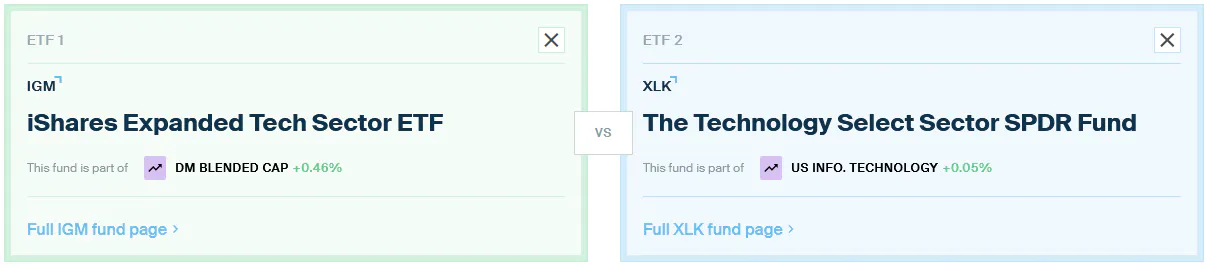
This week, we’re using data from the ETF Central comparison tool to put the reigning champion, the Technology Select Sector SPDR Fund
Get data on 14,000+ ETFs
Access Trackinsight's reliable and comprehensive data with 500M+ points on 14,000+ ETFs.
XLK vs IGM: Total cost of ownership
State Street recently reduced expense ratios across all 11 Select Sector SPDR ETFs, lowering XLK’s expense ratio to 0.09%, down from its previous 0.1%. Meanwhile, IGM
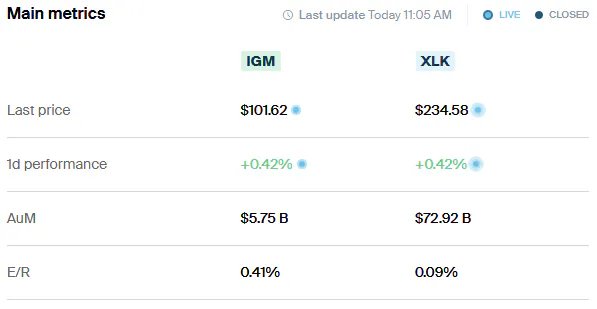
XLK also wins on implicit trading costs. The Select Sector SPDR suite is highly liquid, thanks to its exclusive focus on S&P 500 stocks within specific sectors. XLK’s 30-day median bid-ask spread is just 0.007%. While IGM isn’t far behind at 0.035%, it’s still noticeably higher.
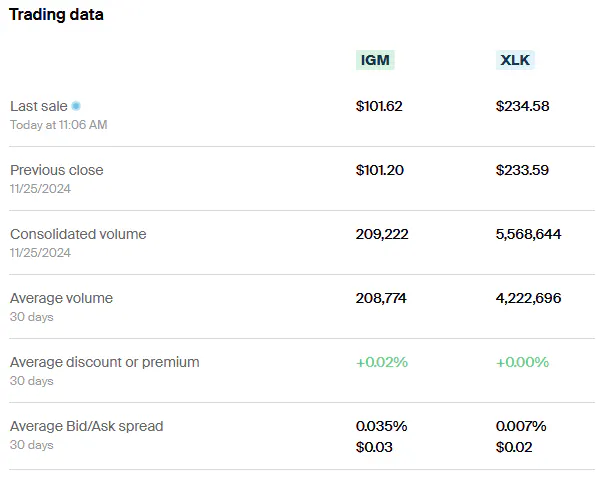
Verdict: XLK takes a clean sweep on total cost of ownership. Its lower expense ratio and superior liquidity make it the more cost-effective choice.
XLK vs IGM: Methodology and holdings
Both ETFs are passive, tracking indexes that appear to focus on technology stocks. However, a closer look under the hood reveals some significant differences in their approaches.
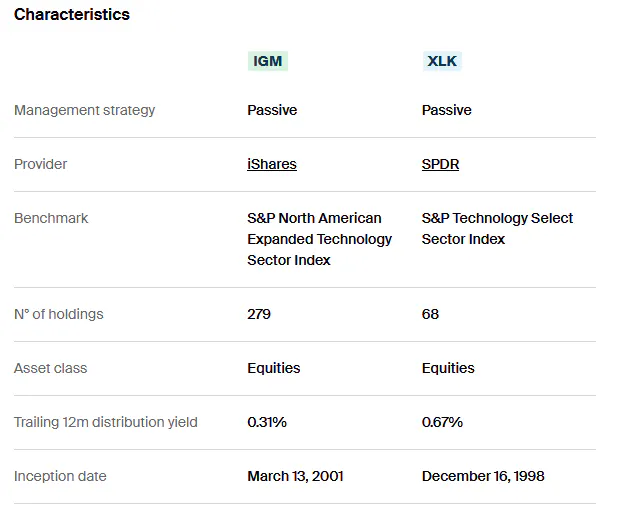
XLK
This means it holds big names like Apple, Nvidia, and Microsoft, but excludes companies like Alphabet (Google) and Meta, which fall under the communications sector, and Amazon or Tesla, which are classified as consumer discretionary.
IGM
The end result is that IGM is far more diversified, with 279 holdings compared to just 68 in XLK. This also makes IGM less concentrated at the top. Its top 15 holdings account for 63.16% of the ETF, compared to 73.62% for XLK.
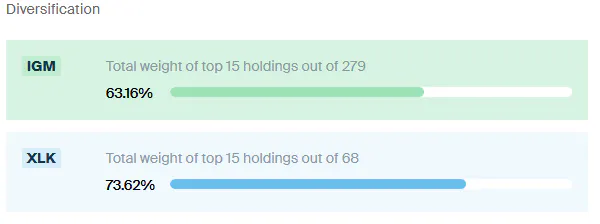
Moreover, XLK’s top three holdings—Apple, Nvidia, and Microsoft—currently make up nearly 43% of the ETF’s weight. In contrast, the top three in IGM—Nvidia, Meta, and Apple—combine for less than 30%.
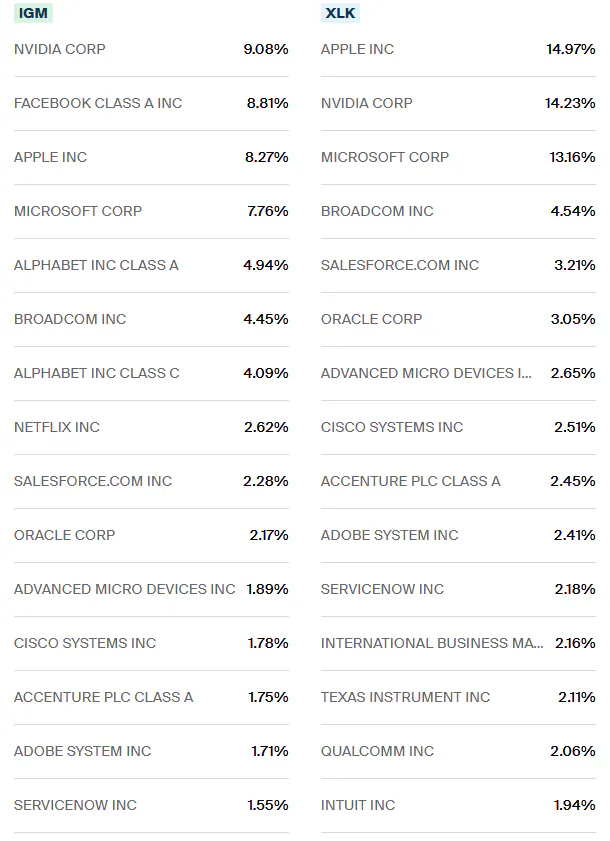
Verdict: XLK’s narrower focus creates higher concentration, while IGM offers broader diversification by incorporating communication stocks alongside traditional tech. Personally, I prefer the latter.
XLK vs IGM: Risk and return
Both ETFs deliver strong returns, reflecting the tech sector’s outperformance, but there are some important nuances to consider.
In the short term, XLK
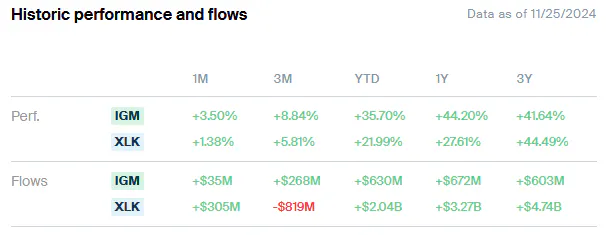
Over the long term, from March 19, 2001, to November 25, 2024, IGM edges out XLK with an annualized return of 11.33% versus 11.02%. However, XLK comes out ahead on a risk-adjusted basis, with a Sharpe ratio of 0.49 compared to IGM’s 0.47, likely due to the focus on solely S&P 500 large-caps.
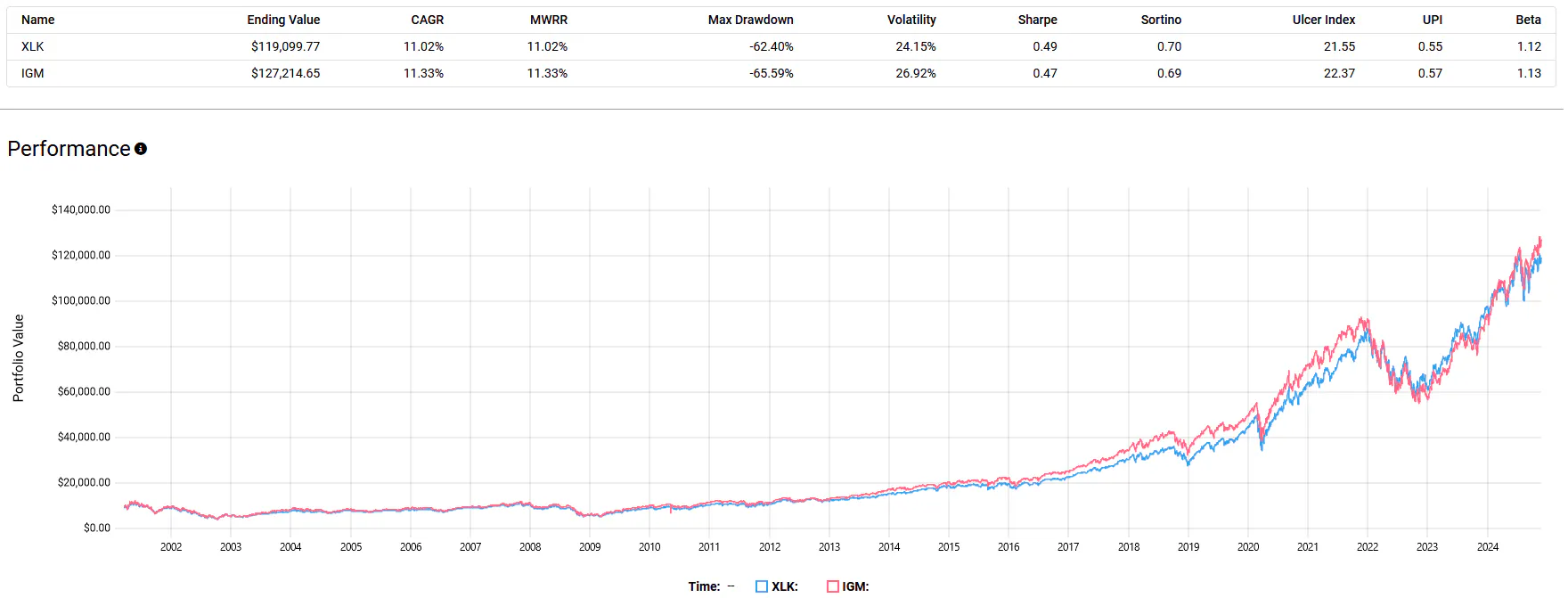
When it comes to risk, both ETFs exhibit nearly identical historical standard deviations, indicating similar levels of volatility. However, IGM
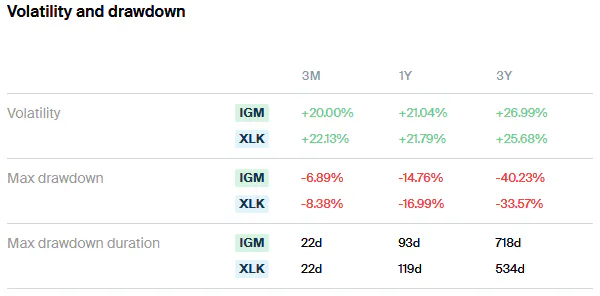
Verdict: This round goes to IGM for its slightly better long-term performance, even if it lags XLK on a risk-adjusted basis. While the diversification hasn’t provided a tangible risk advantage, IGM’s overall returns still give it the edge in this category.
This article is for informational purposes only and does not in any way constitute investment advice. The author may express their own opinions, which may not represent the opinions of ETF Central or its affiliated partners. It is essential that you seek advice from a registered financial professional prior to making any investment decisions.
Latest ETF News
See all ETF newsThere's an ETF for That? Humanoid Robotics and Physical AI

How Some ETF Issuers Use Their Own Funds for Cash Management

These Public-Private ETFs Invest in Polymarket and Anduril

There's an ETF for That? Frontier Markets




 Advantages of ETFs over Mutual Funds1/6
Lower Costs
In this guide, we'll explore the advantages of ETFs over mutual funds, giving you valuable insights into why ETFs have gained significant popularity among investors like yourself.
Leveraged ETFs: Unlocking the Potential for Amplified Returns1/6
Understanding Leveraged ETFs
Explore leveraged ETFs: potential for amplified returns & risks. 5 ETFs to consider across equities, commodities & fixed income.
What is a Leveraged ETF?1/6
Introducing Leveraged and Inverse ETFs
In this guide, we'll dive into the world of leveraged ETFs, exploring their definition, mechanics, potential risks, and rewards.
Recent educational content

ETF Trends
ETF Industry KPIs October 5, 2026
This week’s KPI data overview highlights key metrics and trends shaping the ETF landscape.

ETF Trends
ETF Industry KPIs September 28, 2026
This week’s KPI data overview highlights key metrics and trends shaping the ETF landscape.
ETF Trends
ETF Industry KPIs September 22, 2026
This week’s KPI data overview highlights key metrics and trends shaping the ETF landscape.

First Look ETF
First Look ETF: Income, Corporate Arbitrage, and Growth and Value Investing
First Look ETF September 2026: iCapital, Mast Investments and North Square unpack new ETFs targeting monthly income, merger arbitrage and complementary growth and value exposure.

Browse all educational columns



Have you tried our ETF Compare tool?
Compare ETFs like a pro. Analyze fees, performance, exposure & holdings side-by-side.