Create, analyze, optimize your ETF portfolio. Start now →



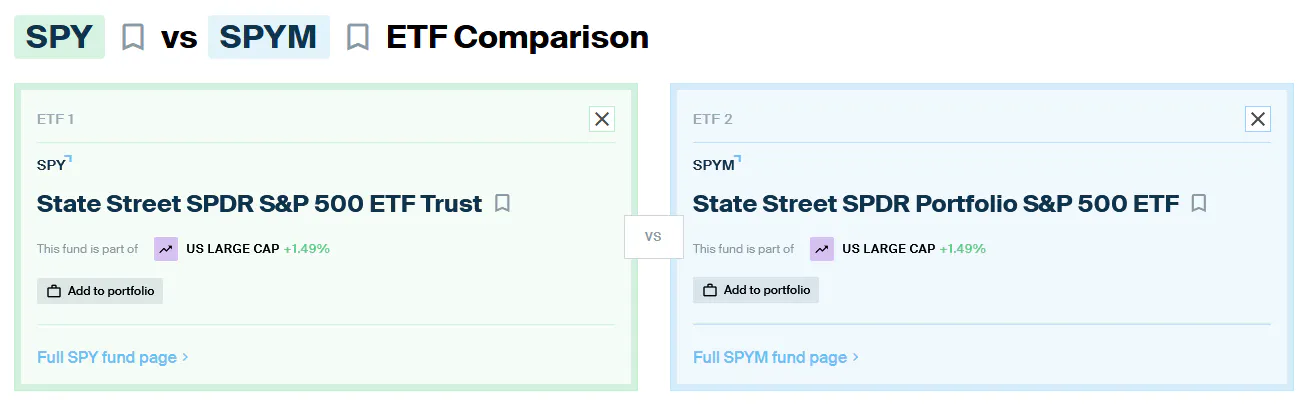
ETF Comparison: State Street SPDR S&P 500 ETF Trust (SPY) Versus State Street SPDR Portfolio S&P 500 ETF (SPYM)
Two of the largest and most liquid S&P 500 ETFs go head-to-head in this week’s ETF comparison.


Keep up with what matters in ETFs
Get timely ETF insights, market trends, and top ideas straight to your inbox.
Your newsletter subscriptions with us are subject to ETF Central's Privacy Policy and Terms and Conditions.
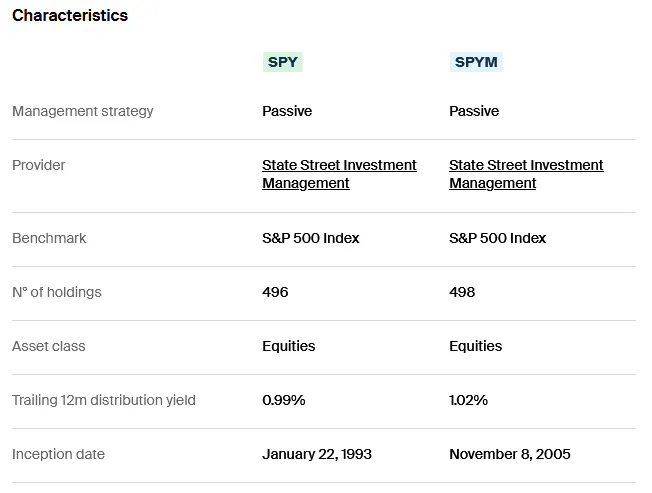
The S&P 500 Index is inseparable from the history of the U.S. ETF industry. That history began on January 22, 1993, with the launch of the State Street SPDR S&P 500 ETF Trust
Later, State Street introduced a cheaper alternative. Originally launched as SPLG on November 8, 2005, it’s now called the State Street SPDR Portfolio S&P 500 ETF
At first glance, the two funds appear nearly identical. Both track the same S&P 500 Index and hold essentially the same portfolio of large-cap U.S. stocks. The real differences lie behind the scenes.
SPY and SPYM use different structures, which affects everything from securities lending and portfolio management to how each fund handles certain operational mechanics. Here's how SPY and SPYM fare head-to-head, using data from the ETF Central Comparison tool.
Like what you're reading?
Stay in the loop — get the latest ETF insights: trends, analysis, and expert picks.
SPY vs. SPYM: Total Cost of Ownership
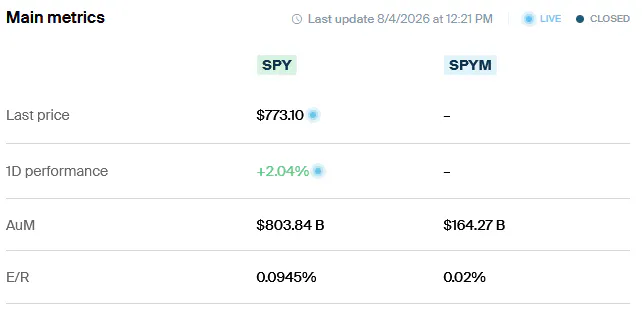
The biggest differentiator between these two ETFs is cost. SPY charges a 0.0945% expense ratio. That's hardly expensive in absolute terms, but it is more than three times the cost of comparable S&P 500 ETFs from Vanguard and BlackRock iShares. SPYM, on the other hand, charges just a 0.02% expense ratio, making it the lowest-cost S&P 500 index ETF currently available in the U.S. market.
On a $10,000 investment, that's approximately $2 per year in annual fee drag versus $9.45 for SPY. While the dollar difference is modest, it compounds over decades of investing.
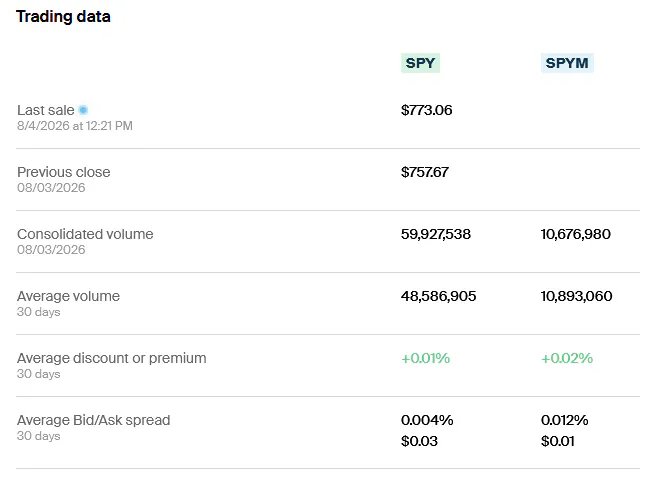
Transaction costs are also worth considering, although they're essentially a non-issue for either fund. SPY's immense trading volume helps produce an exceptionally tight 30-day average bid-ask spread of just 0.004%. SPYM is technically wider at 0.012%, but we're really splitting hairs. Both funds trade with excellent liquidity, meaning investors can generally enter and exit positions with minimal friction.
Verdict: SPYM is the clear winner on total cost of ownership. That said, existing SPY shareholders shouldn't necessarily rush to switch. For investors holding large unrealized capital gains, the tax bill from selling SPY could outweigh the modest savings from SPYM's lower expense ratio.
SPY vs. SPYM: Methodology and Exposure
In terms of investment exposure, there isn't much separating these two ETFs. Both are passive funds designed to track the S&P 500 Index. As a result, investors should expect nearly identical sector allocations, country exposure, and long-term performance.
Technology remains the dominant sector, and because both funds are market capitalization-weighted, the largest holdings account for a significant portion of total assets.
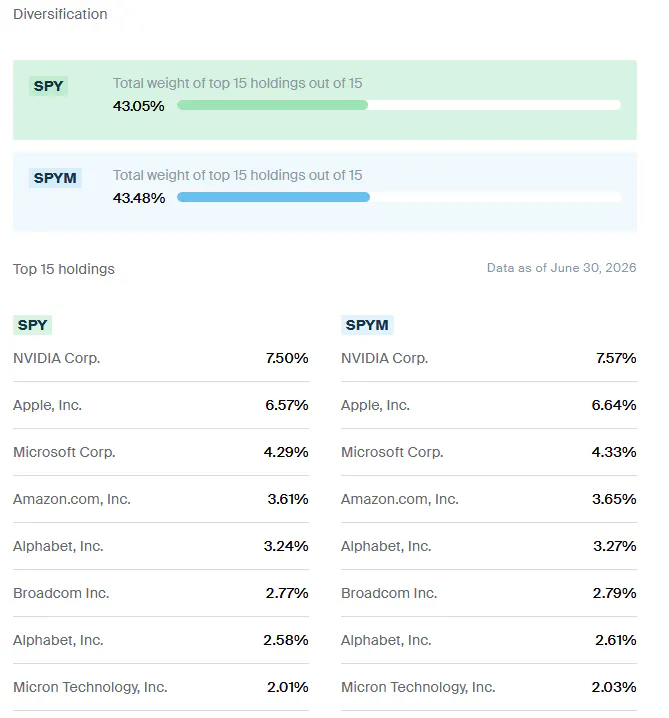
The meaningful differences lie behind the scenes. SPY is structured as a unit investment trust (UIT), a legal structure dating back to the earliest days of the ETF industry. While innovative when it launched in 1993, the UIT format comes with several quirks that more modern ETFs have largely moved beyond.
Because of its trust structure, SPY cannot reinvest dividends received from its holdings between quarterly distribution dates, resulting in a small amount of cash drag. It must also fully replicate the S&P 500 Index rather than using representative sampling, and it cannot lend its securities.
There's also one particularly unusual feature. Like other unit investment trusts, SPY cannot exist indefinitely. The trust is currently scheduled to terminate on the earlier of January 22, 2118, or 20 years after the death of the last survivor of 11 individuals named in the trust agreement. In practice, this is unlikely to affect today's investors, but it remains one of the more curious legal footnotes.
SPYM, by contrast, is about as plain vanilla as a modern ETF gets. Structured as an open-end fund, it can reinvest dividends immediately, has the flexibility to use representative sampling if appropriate, may engage in securities lending, and avoids the structural limitations associated with the older UIT format.
Verdict: SPYM gets the edge overall. None of SPY's UIT quirks are severe enough to justify selling the fund on their own, particularly for investors sitting on large, unrealized capital gains. However, for new money, SPYM's modern ETF structure eliminates several small structural inefficiencies.
SPY vs. SPYM: Risk and Return
This comparison is largely an exercise in splitting hairs, but it does demonstrate that even small differences in expense ratios and fund mechanics can compound over time.
Since its launch, SPYM has maintained a slight performance edge over SPY. That's hardly surprising given the combination of its lower expense ratio and the elimination of the modest cash drag associated with SPY's unit investment trust structure. Individually, neither advantage is particularly meaningful. Over years and decades, however, they add up.
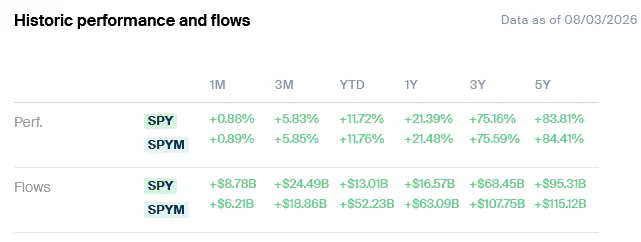
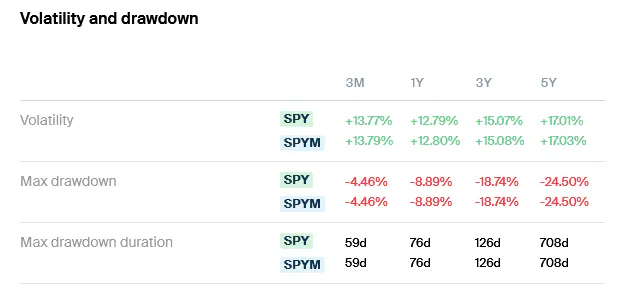
Interestingly, SPY's inability to immediately reinvest dividends has also resulted in marginally lower volatility over the same periods. Holding a small amount of cash naturally dampens portfolio fluctuations, although the effect has been extremely modest. That said, maximum drawdown depth and length between the two funds have likewise been nearly identical.
That being said, one area where SPY continues to dominate is options trading. It remains one of the most actively traded securities in the world, with an exceptionally deep options market featuring enormous open interest, hundreds of available strike prices, daily zero-days-to-expiration (0DTE) contracts, and expirations extending years into the future.
Verdict: SPYM gets another narrow win. Investors receive essentially identical market exposure while benefiting from slightly higher long-term returns, courtesy of its lower fees and more efficient fund structure. The differences are incremental rather than transformative, but when choosing between two nearly identical products, incremental advantages are worth having.
Please note that this article reflects the author’s personal views and does not represent the opinions of the publication or its affiliates. It is for informational purposes only and does not constitute investment advice. It is essential to seek guidance from a registered financial professional before making any investment decisions.

Latest ETF News
See all ETF newsETF Comparison: NEOS Russell 2000 High Income ETF (IWMI) Versus Global X Russell 2000 Covered Call ETF (RYLD)




 Advantages of ETFs over Mutual Funds1/6
Lower Costs
In this guide, we'll explore the advantages of ETFs over mutual funds, giving you valuable insights into why ETFs have gained significant popularity among investors like yourself.
Leveraged ETFs: Unlocking the Potential for Amplified Returns1/6
Understanding Leveraged ETFs
Explore leveraged ETFs: potential for amplified returns & risks. 5 ETFs to consider across equities, commodities & fixed income.
What is a Leveraged ETF?1/6
Introducing Leveraged and Inverse ETFs
In this guide, we'll dive into the world of leveraged ETFs, exploring their definition, mechanics, potential risks, and rewards.
Recent educational content

ETF Trends
ETF Industry KPIs September 28, 2026
This week’s KPI data overview highlights key metrics and trends shaping the ETF landscape.

ETF Trends
ETF Industry KPIs September 22, 2026
This week’s KPI data overview highlights key metrics and trends shaping the ETF landscape.
First Look ETF
First Look ETF: Income, Corporate Arbitrage, and Growth and Value Investing
First Look ETF September 2026: iCapital, Mast Investments and North Square unpack new ETFs targeting monthly income, merger arbitrage and complementary growth and value exposure.

ETF Trends
ETF Industry KPIs September 14, 2026
This week’s KPI data overview highlights key metrics and trends shaping the ETF landscape.
Browse all educational columns



Have you tried our ETF Compare tool?
Compare ETFs like a pro. Analyze fees, performance, exposure & holdings side-by-side.