Ready-made ETF portfolios built for real investor needs. Explore now →



ETF Comparison: State Street Energy Select Sector SPDR ETF (XLE) Versus State Street SPDR S&P Oil & Gas Exploration & Production ETF (XOP)
Two of the largest NYSE-listed energy sector ETFs from State Street go head-to-head in this week’s ETF comparison analysis.

Keep up with what matters in ETFs
Get timely ETF insights, market trends, and top ideas straight to your inbox.
Your newsletter subscriptions with us are subject to ETF Central's Privacy Policy and Terms and Conditions.
Just a few days into 2026, energy ETFs are already seeing high volatility. Two names leading that move are the State Street Energy Select Sector SPDR ETF
Both are large, liquid, and well-established funds, and both have picked up momentum alongside rising geopolitical risk and a rebound in energy sentiment.
This makes it a good time to remind newer energy investors of a basic rule: never take an ETF’s name at face value. You always need to dig into the index methodology. If you don’t, the exposure you end up owning may look very different from what you thought you were buying.
XLE versus XOP is a textbook example. Despite coming from the same issuer and targeting the same broad sector, these two ETFs are built very differently. Depending on the macro thesis you’re trying to express, one may be a good fit while the other may miss the mark entirely.
In today’s analysis, we break down the key differences to know using the latest data from ETF Central’s comparison tool.
Global ETF Survey 2026 is Live!
With 1,790 new products launched by July 2026, choosing is harder than ever. Our Global ETF Survey 2026, built on 620 professional investors and allocators, shows how active, fixed income, options-based and thematic ETFs are reshaping fund selection.
XLE vs. XOP: Total Cost of Ownership
I’ve said this before, and it still holds. The more specific an ETF becomes, the more expensive it usually is. Even within the same sector, costs can vary meaningfully.
XLE’s expense ratio sits at just 0.08%, making it one of the cheapest ways to access U.S. energy equities. XOP is pricier at 0.35%. That’s higher than XLE, but fairly standard for a subsector ETF that goes deeper into a specific slice of the energy industry.
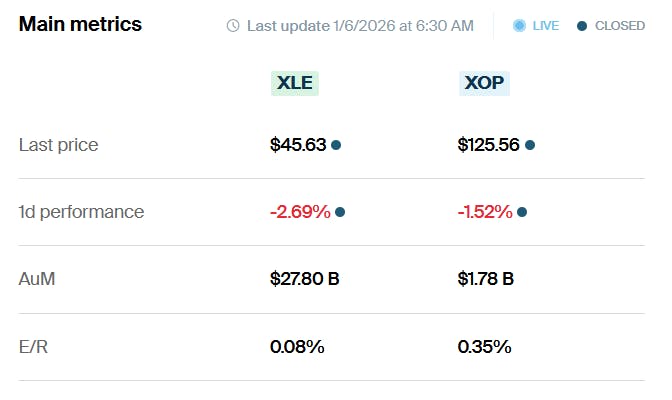
Expense ratios aren’t the only cost investors face, especially if they’re trading tactically. Bid-ask spreads matter when getting in and out of positions. Here again, XLE has the edge. Its 30-day average bid-ask spread is just 0.022%. XOP’s spread is still tight at 0.025%, but marginally worse.
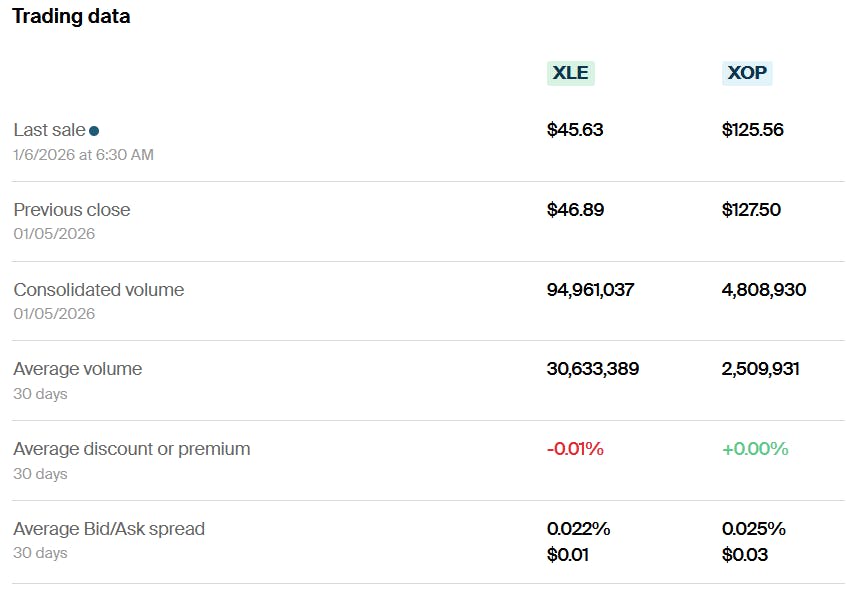
Verdict: When you combine expense ratios and trading costs, XLE is cheaper than XOP for both long-term buy-and-hold investors and short-term tactical traders.
XLE vs. XOP: Methodology and Exposure
This is where the real differences emerge. Both XLE and XOP are passive ETFs tracking S&P indices, but the construction rules lead to very different exposures and sensitivities to macro news.
XLE tracks the Energy Select Sector Index. It holds the 22 energy companies within the S&P 500 and weights them by market capitalization. Because constituents must be in the S&P 500, the ETF naturally skews toward large-cap companies with established profitability, liquidity, and balance sheet strength.
XOP tracks the S&P Oil & Gas Exploration & Production Select Industry Index. It goes a level deeper than sector exposure, focusing on companies involved in oil and gas exploration, production, refining, and marketing. While upstream names dominate, it isn’t a pure-play E&P ETF. What it notably excludes is midstream exposure. There are no pipelines or MLPs here.
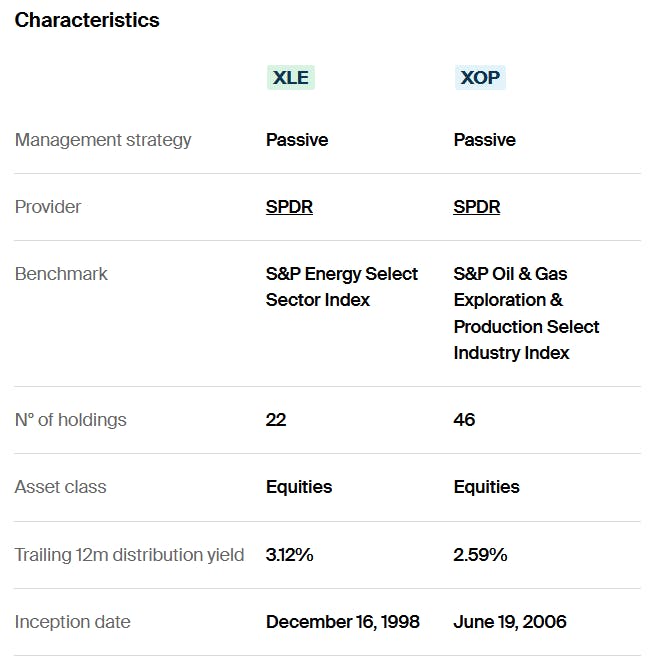
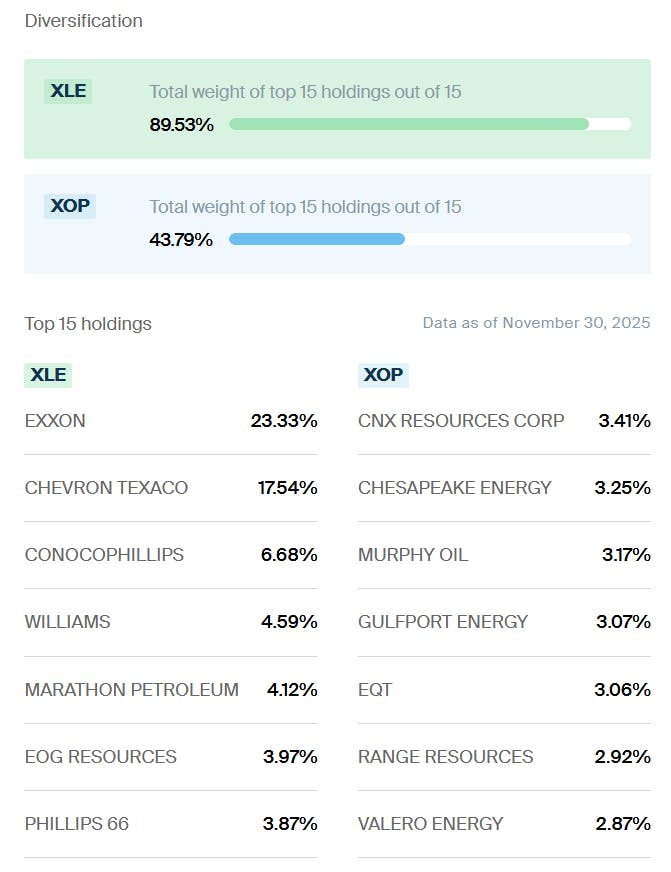
XLE is far more top-heavy in terms of composition. The top 15 holdings make up 89.53% of XLE, compared with just 43.79% for XOP. That difference is entirely due to the weighting methodology. In XLE, Exxon Mobil accounts for 23.33% of the fund, Chevron for 17.54%, and ConocoPhillips for 6.68%. Market-cap weighting in a narrow sector tends to produce this result.
XOP, by contrast, uses an equal-weight methodology. At each rebalance, companies receive roughly the same weight regardless of size. This creates a built-in buy-low, sell-high effect, but it can also cap momentum when a small number of winners start to pull away from the pack. As a result, XOP’s top holdings tend to be whichever companies have outperformed since the last rebalance.
Verdict: For long-term investors, I still prefer XLE. In energy, the size effect matters. Supermajors benefit from capital discipline, fortified balance sheets, and deal-making leverage. Recent events in Venezuela highlight this. Exxon Mobil and Chevron, XLE’s two largest holdings, already have existing interests in the region and significant lobbying power, positioning them to benefit disproportionately from political outcomes. XOP’s scattered exposure makes it less effective for expressing that kind of targeted thesis.
XLE vs. XOP: Risk and Return
Energy equities have had a solid run in recent years, particularly coming off the extreme stress of March 2020, when oil prices briefly went negative during the onset of COVID-19.
Over the past five years, XLE has meaningfully outperformed XOP. That leadership has also held over the past three-year and one-year periods. Despite this performance, both ETFs have experienced notable net outflows. Over five years, approximately $9.46 billion left XLE, while XOP saw outflows of about $3.45 billion. Energy has been out of favor, with investor attention focused elsewhere, particularly on AI.
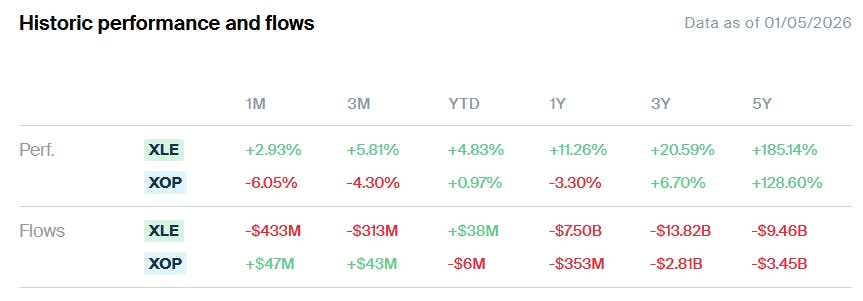
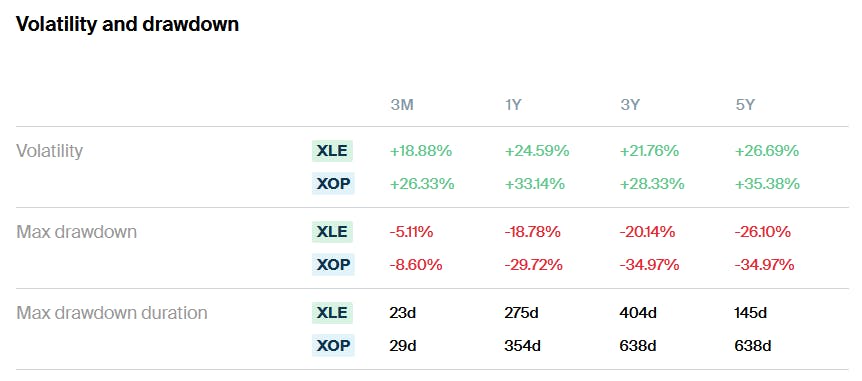
From a risk perspective, XLE has been consistently less volatile. Its standard deviation has been lower than XOP’s over five-, three-, and one-year periods. XOP’s equal-weight approach reduces single-stock concentration but increases exposure to cyclical small- and mid-cap energy companies. These firms often have weaker balance sheets and less capital discipline. XOP has experienced larger peak-to-trough losses and longer recovery periods than XLE across multiple time frames.
A longer backtest tells a similar story. From June 22, 2006, to January 5, 2026, a period of roughly 19.5 years, XLE delivered a cumulative return of 220.36%, or an annualized return of 6.14%. XOP, over the same period, returned just 21.04% cumulatively, or 0.98% annualized.
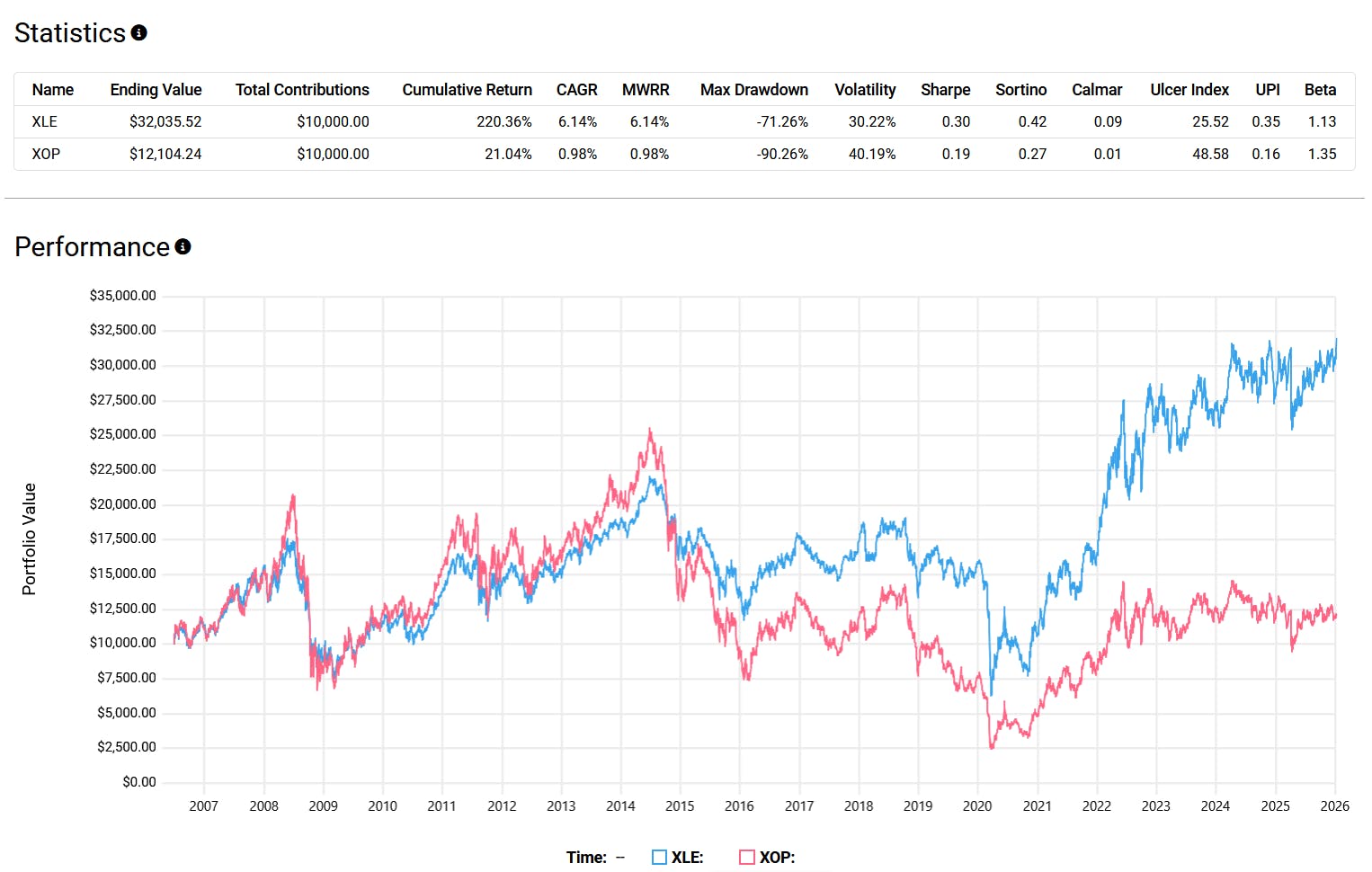
I think this gap reflects how the ETFs rebalance. XOP’s equal-weight structure repeatedly trims winners and reallocates toward laggards. In a sector ultimately dominated by a handful of global giants, that has historically meant selling the companies that mattered most and buying those that never scaled.
Verdict: From a risk-and-return perspective, XLE has been the superior choice. While XOP can make sense for short-term, high-beta bets on smaller producers, XLE’s concentration in supermajors has historically worked in investors’ favor. For core energy exposure, the evidence still points to XLE.
Please note this article is for information purposes only and does not in any way constitute investment advice. It is essential that you seek advice from a registered financial professional prior to making any investment decision.

Latest ETF News
See all ETF newsBeyond Big Tech: The Increasing Specialization of AI ETFs

There's an ETF for That? Humanoid Robotics and Physical AI

How Some ETF Issuers Use Their Own Funds for Cash Management

These Public-Private ETFs Invest in Polymarket and Anduril

There's an ETF for That? Frontier Markets



 Advantages of ETFs over Mutual Funds1/6
Lower Costs
In this guide, we'll explore the advantages of ETFs over mutual funds, giving you valuable insights into why ETFs have gained significant popularity among investors like yourself.
Leveraged ETFs: Unlocking the Potential for Amplified Returns1/6
Understanding Leveraged ETFs
Explore leveraged ETFs: potential for amplified returns & risks. 5 ETFs to consider across equities, commodities & fixed income.
What is a Leveraged ETF?1/6
Introducing Leveraged and Inverse ETFs
In this guide, we'll dive into the world of leveraged ETFs, exploring their definition, mechanics, potential risks, and rewards.
Recent educational content

First Look ETF
First Look ETF: Income, International, and Cash Flow ETFs
In this season 6 episode of First Look ETF, Stephanie Stanton @etfguide examines the latest ETF marketplace trends with NYSE and guests.


ETF Trends
ETF Industry KPIs October 5, 2026
This week’s KPI data overview highlights key metrics and trends shaping the ETF landscape.

ETF Trends
ETF Industry KPIs September 28, 2026
This week’s KPI data overview highlights key metrics and trends shaping the ETF landscape.
ETF Trends
ETF Industry KPIs September 22, 2026
This week’s KPI data overview highlights key metrics and trends shaping the ETF landscape.