Open Now: The Global ETF Survey Take the Survey →



ETF Comparison: SPDR Portfolio S&P 500 Growth ETF (SPYG) Versus SPDR Portfolio S&P 500 Value ETF (SPYV)
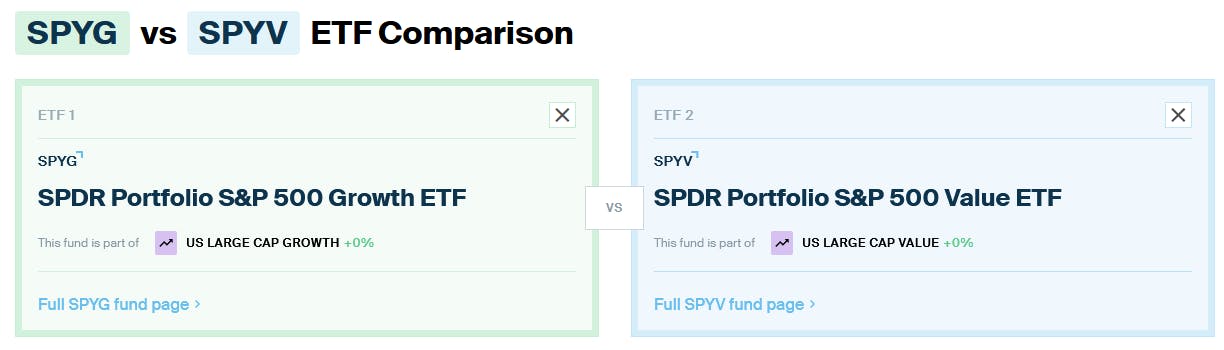
The growth and value components of the S&P 500 go head-to-head in this week’s ETF comparison.


Keep up with what matters in ETFs
Get timely ETF insights, market trends, and top ideas straight to your inbox.
Your newsletter subscriptions with us are subject to ETF Central's Privacy Policy and Terms and Conditions.
The S&P 500 is categorized as a large blend benchmark, meaning it is market-cap weighted—which emphasizes larger companies—and blend indicates that it holds both growth and value stocks.
However, index providers have created more specialized benchmarks that decompose the S&P 500 into distinct growth and value segments. ETF issuers have then licensed these benchmarks, leading to the creation of funds that track each investment style separately.
Among the most popular of these are the SPDR Portfolio S&P 500 Growth ETF
Like what you're reading?
Stay in the loop — get the latest ETF insights: trends, analysis, and expert picks.
SPYG vs. SPYV: Total Cost of Ownership
Both SPYG
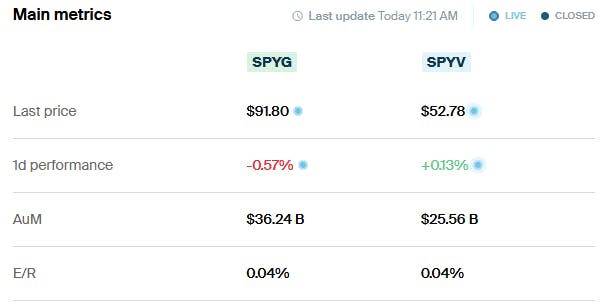
On paper, it’s a tie—each carries an expense ratio of just 0.04%, meaning a $10,000 investment costs only $4 in annual fees.
Looking at implicit costs, both ETFs have minimal bid-ask spreads: 0.012% for SPYG and 0.021% for SPYV. While SPYG is slightly tighter, the difference is so small that it’s not a real concern for most investors.
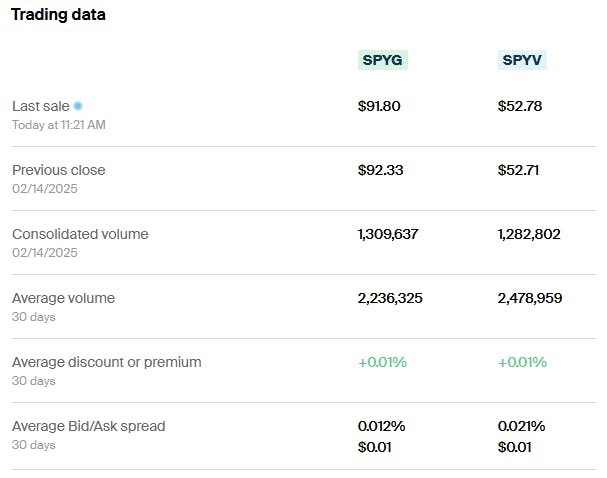
Verdict: SPYG takes this by a very slim margin, but in the grand scheme of things, I’d consider this a tie.
SPYG vs. SPYV: Methodology & Holdings
Both SPYG and SPYV target different styles within the S&P 500 Index, but they use the same screening criteria—just applied to opposite ends of the spectrum.
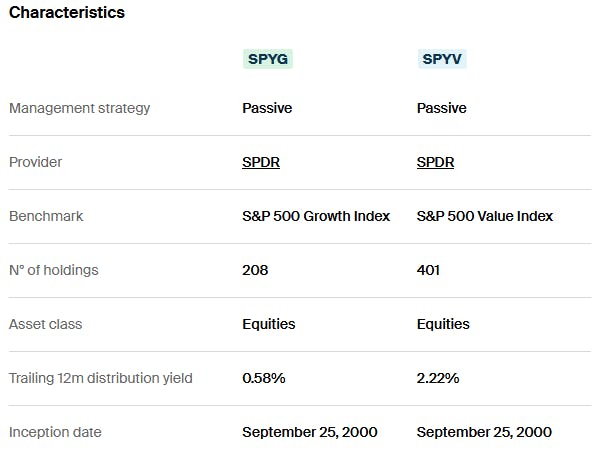
Each ETF selects stocks based on:
- Book value to price ratio
- Earnings to price ratio
- Sales to price ratio
SPYG
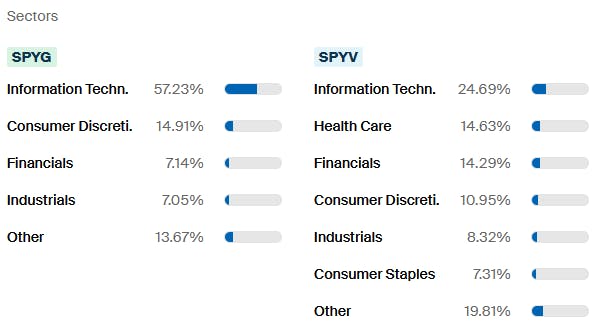
This methodology results in very different sector weightings. SPYG is heavily tilted toward information technology, while SPYV still has decent tech exposure but is more balanced across healthcare and financials as well.
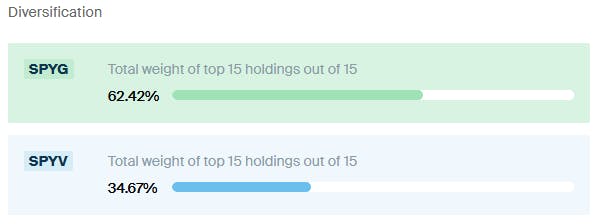
The higher concentration in mega-cap tech stocks also makes SPYG much more top-heavy. Its top 15 holdings make up 52.43% of the portfolio, compared to just 34.67% for SPYV.
One notable aspect of these ETFs is their level of overlap, despite targeting opposite styles. SPYG and SPYV share 107 holdings, meaning 51.4% of SPYG’s 208 stocks are also found in SPYV, while 26.9% of SPYV’s 402 holdings appear in SPYG.
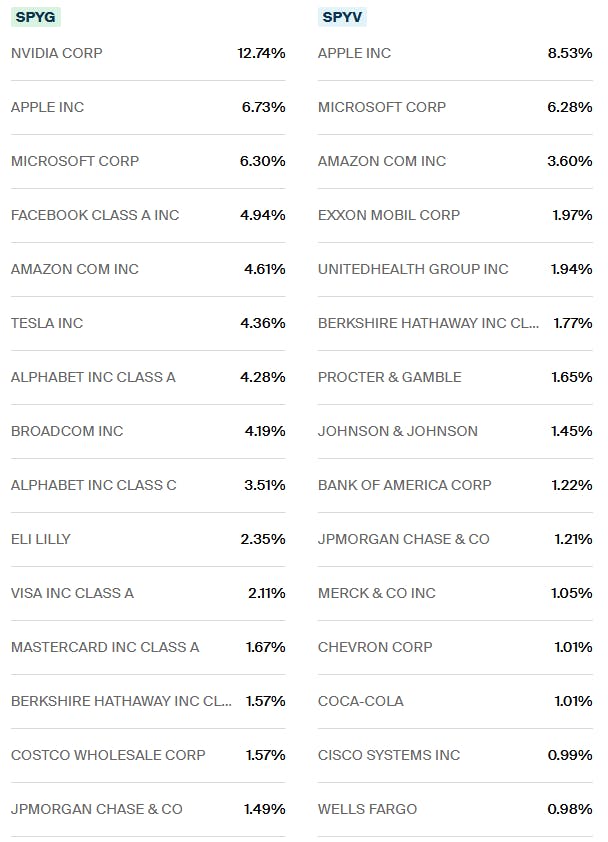
This happens because both indices use the same fundamental screening criteria, and some companies naturally straddle the line between growth and value. As a result, certain stocks meet the inclusion rules for both ETFs, leading to a higher-than-expected overlap between the two.
Verdict: SPYV
SPYG vs. SPYV: Risk & Return
Unsurprisingly, the outperformance of mega-cap tech stocks has given the growth-focused SPYG the edge in the short term.
Over the past one- and three-year periods, SPYG has delivered higher annualized returns along with significantly greater net inflows, as investors have continued piling into high-growth names.
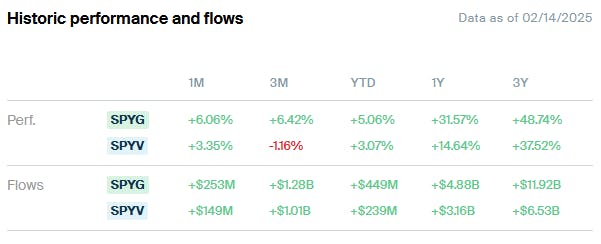
From a risk perspective, SPYG has also been far more volatile over the same time frame. It has seen higher drawdowns, greater volatility, and longer recovery periods, reflecting the inherent risk of chasing growth-heavy allocations.
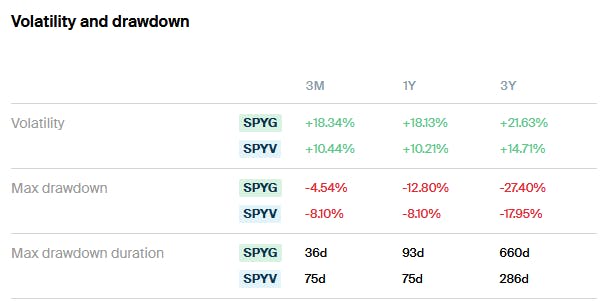
However, over the long run, SPYV
We see this in action looking at returns from October 2, 2000, to February 14, 2025. Through the dot-com crash and the 2008 financial crisis, value stocks outpaced growth until growth caught up during the COVID-era tech boom of the last few years.
Over this period, SPYG
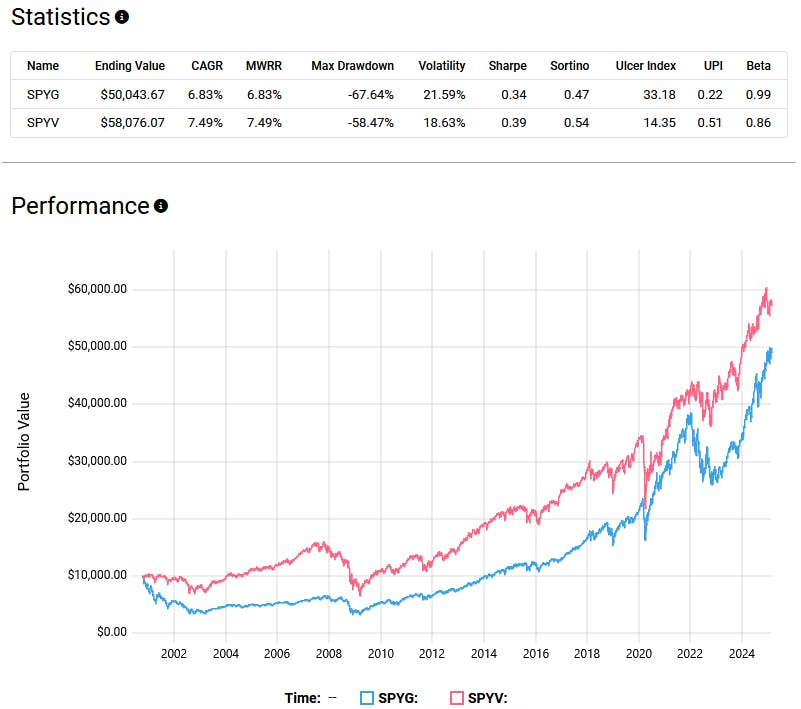
Verdict: I trust the value factor and believe that even at this point in the cycle, SPYV’s focus on value presents better long-term, risk-adjusted return potential.
This article is for informational purposes only and does not in any way constitute investment advice. The author may express their own opinions, which may not represent the opinions of ETF Central or its affiliated partners. It is essential that you seek advice from a registered financial professional prior to making any investment decisions.
Latest ETF News
See all ETF newsAvoid S&P 500 Concentration Risk with These Two ETFs

How Investors can Maximize Tax Efficiency with Income ETFs

Trump Accounts: Here's Which ETFs You Can Invest In

The Two Best Types of Fixed-Income ETFs For Managing Cash




 Advantages of ETFs over Mutual Funds1/6
Lower Costs
In this guide, we'll explore the advantages of ETFs over mutual funds, giving you valuable insights into why ETFs have gained significant popularity among investors like yourself.
Leveraged ETFs: Unlocking the Potential for Amplified Returns1/6
Understanding Leveraged ETFs
Explore leveraged ETFs: potential for amplified returns & risks. 5 ETFs to consider across equities, commodities & fixed income.
What is a Leveraged ETF?1/6
Introducing Leveraged and Inverse ETFs
In this guide, we'll dive into the world of leveraged ETFs, exploring their definition, mechanics, potential risks, and rewards.
Recent educational content

ETF Trends
ETF Industry KPIs July 20, 2026
This week’s KPI data overview highlights key metrics and trends shaping the ETF landscape.

ETF Trends
ETF Industry KPIs July 13, 2026
This week’s KPI data overview highlights key metrics and trends shaping the ETF landscape.

First Look ETF
First Look ETF: Cash Deployment, Bond, and Hedged ETFs
In this season 6 episode of First Look ETF, Stephanie Stanton examines the latest ETF marketplace trends with NYSE and guests.

ETF Trends
ETF Industry KPIs July 6, 2026
This week’s KPI data overview highlights key metrics and trends shaping the ETF landscape.
Browse all educational columns



Build and Analyze Your ETF Portfolio Like a Pro
Create your own ETF portfolio in minutes and instantly see allocations, exposures, performance, and risk. Visualize diversification across asset classes, regions, and sectors. Stress-test ideas, compare benchmarks, and refine your strategy with professional-grade analytics.