Ready-made ETF portfolios built for real investor needs. Explore now →



ETF Comparison: SPDR S&P 500 ETF Trust (SPY) Versus Invesco S&P 500 Equal Weight ETF (RSP)
Investors can track the S&P 500 index stocks via market-cap-weighted ETFs like SPY or equal-weighted ETFs like RSP. Here's how they compare.


Keep up with what matters in ETFs
Get timely ETF insights, market trends, and top ideas straight to your inbox.
Your newsletter subscriptions with us are subject to ETF Central's Privacy Policy and Terms and Conditions.
Most broad market indices, including the S&P 500, are typically market-cap weighted. This means that companies with higher market values have a greater impact on the index's performance. Practically, this approach tends to favor large, dominant companies, particularly in booming sectors like technology.
However, this method isn't without its criticisms. Some investors are concerned about the concentration risk associated with top-heavy indices where a few mega-caps hold sway. Others critique market-cap weighting as a crude momentum proxy, effectively buying more of a stock as its price increases and less as it declines.
Despite these concerns, the efficiency and cost-effectiveness of market-cap-weighted indices are undeniable. The S&P 500 has proven notoriously difficult to outperform, and ETFs that track it offer low-cost exposure to a broad market.
Today, we're comparing two different approaches to tracking the same index: the SPDR S&P 500 ETF Trust
Get data on 14,000+ ETFs
Access Trackinsight's reliable and comprehensive data with 500M+ points on 14,000+ ETFs.
SPY vs RSP: Total cost of ownership
When it comes to total cost of ownership, SPY clearly leads. With an expense ratio of just 0.0945%, it's significantly more affordable than RSP, which charges 0.2%.
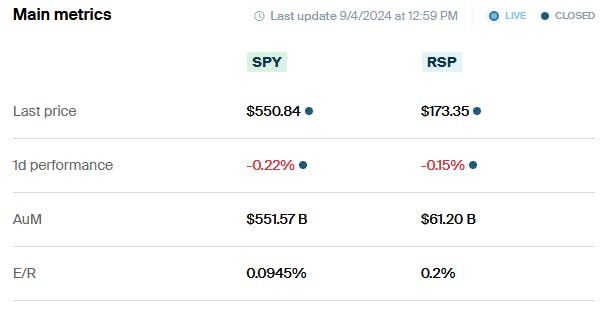
This higher fee for RSP can be attributed to its utilization of a more specialized index and the increased transaction costs associated with the frequent rebalancing necessary for maintaining equal weights.
In terms of trading costs, SPY also takes the lead due to its status as one of the largest and most liquid ETFs in the market, boasting a remarkably low 30-day median bid-ask spread of just 0.003%. While RSP's spread of 0.009% is still low, it doesn't quite match SPY's efficiency in this area.
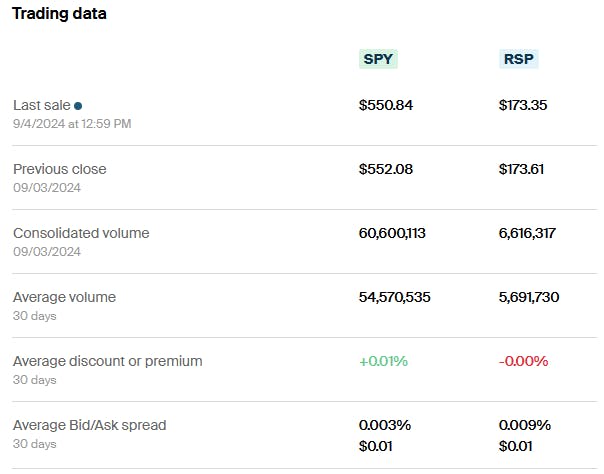
Combining these factors, SPY emerges as the more cost-effective choice overall. However, it's worth noting that even SPY's low fees are outdone by certain S&P 500 ETFs from Vanguard and iShares, which have expense ratios as low as 0.03%.
SPY vs RSP: Methodology and holdings
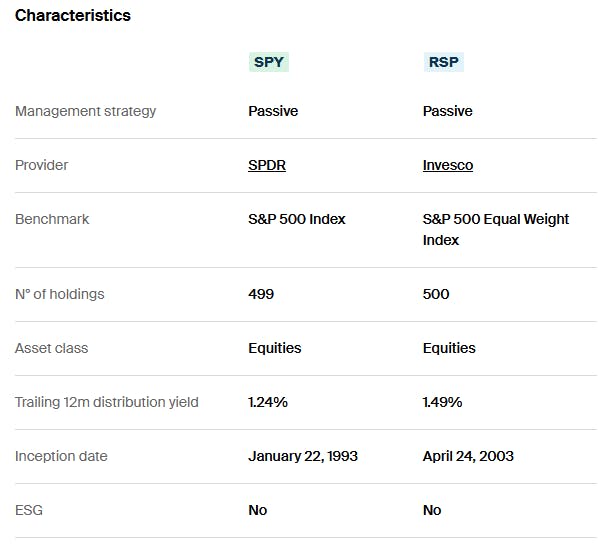
The benchmark index is the critical point of divergence between SPY and RSP. Although both ETFs hold the same stocks, the methods they use for weighting these stocks are fundamentally different.
SPY
RSP
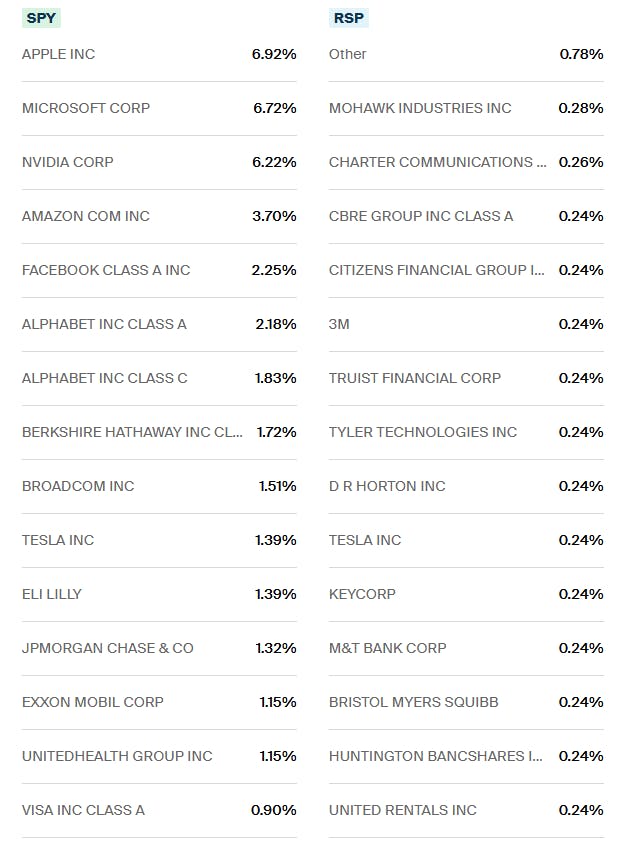
This equal weighting scheme results in marked differences in sector exposure. SPY has a significant overweight in the information technology sector due to the high market cap of companies within that sector. In contrast, RSP offers a more balanced sector distribution, with greater emphasis on industrials and financials and a comparatively modest tech presence.
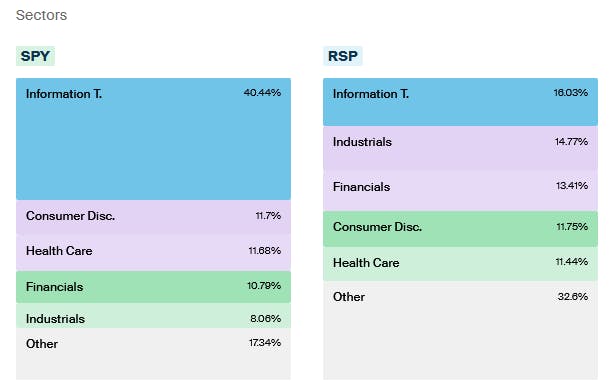
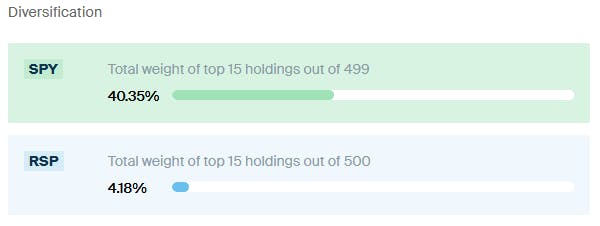
RSP is also much less top-heavy. Its top 10 holdings constitute only 4.18% of the ETF, compared to SPY's 40.35%, making RSP a potentially more appealing option for those seeking broader exposure across mid-caps alongside large and mega-caps.
SPY vs RSP: Risk and return
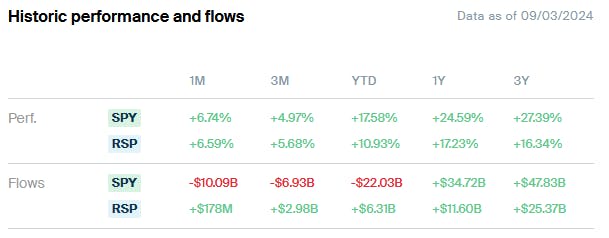
In recent years, SPY
Despite this performance, SPY has experienced net outflows year to date, while RSP has seen steady growth. This trend may indicate a shift among some investors towards diversifying away from mega-caps.
Looking at a longer time frame, from April 2003 to the present, RSP has actually outperformed SPY despite its higher turnover and expense ratio, with a compound annual growth rate (CAGR) of 11.06% compared to SPY's 10.82%.
However, RSP exhibits a lower risk-adjusted return, with a Sharpe ratio of 0.45 versus SPY's 0.47. RSP's overweight to mid-caps introduces a size factor, which can boost returns but also increases risk.
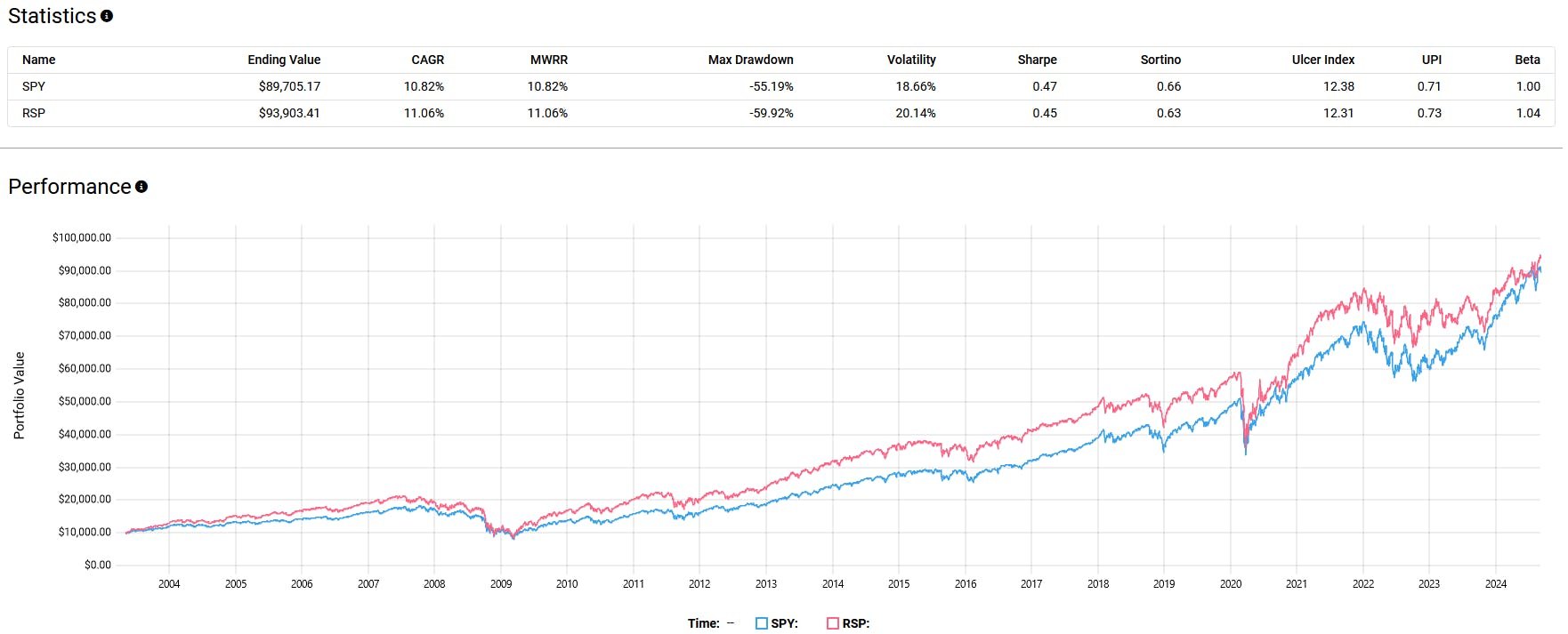
As for risk metrics, both ETFs exhibit similar historical volatility, but RSP has endured deeper and longer drawdowns. This might be attributed to its equal weighting approach, which can lead to higher exposure to sectors and stocks that are more volatile or less established compared to the large-cap dominated SPY.
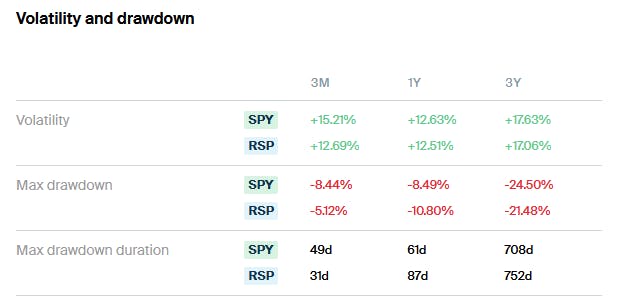
I have mixed feelings about these ETFs. SPY remains a supreme trading tool due to its unmatched liquidity and options market, making it ideal for tactical plays. However, its concentration in mega-caps and sector biases, particularly towards technology, can be concerning.
On the other hand, RSP offers a historically effective way to capture the S&P 500's constituents in a more balanced manner. Yet, the higher turnover and expense ratio of RSP might dampen its appeal somewhat, making it less suitable for those looking for a cost-efficient core holding.
Please note this article is for information purposes only and does not in any way constitute investment advice. It is essential that you seek advice from a registered financial professional prior to making any investment decision.
Latest ETF News
See all ETF newsCould Water ETFs Be the Next AI Bottleneck Trade?

What is a Boomer Candy ETF?

ETF Comparison: NEOS Nasdaq-100 High Income ETF (QQQI) Versus Goldman Sachs Nasdaq-100 Premium Income ETF (GPIQ)





 Advantages of ETFs over Mutual Funds1/6
Lower Costs
In this guide, we'll explore the advantages of ETFs over mutual funds, giving you valuable insights into why ETFs have gained significant popularity among investors like yourself.
Leveraged ETFs: Unlocking the Potential for Amplified Returns1/6
Understanding Leveraged ETFs
Explore leveraged ETFs: potential for amplified returns & risks. 5 ETFs to consider across equities, commodities & fixed income.
What is a Leveraged ETF?1/6
Introducing Leveraged and Inverse ETFs
In this guide, we'll dive into the world of leveraged ETFs, exploring their definition, mechanics, potential risks, and rewards.
Recent educational content

ETF Trends
ETF Industry KPIs September 8, 2026
This week’s KPI data overview highlights key metrics and trends shaping the ETF landscape.

ETF Trends
ETF Industry KPIs August 31, 2026
This week’s KPI data overview highlights key metrics and trends shaping the ETF landscape.
ETF Trends
ETF Industry KPIs August 24, 2026
This week’s KPI data overview highlights key metrics and trends shaping the ETF landscape.

What’sTheFund
What's the Fund | Ocean Park Diversified Income ETF (DUKZ)
James St Aubin, Chief Investment Officer at Ocean Park Asset Management, discuss the DUKZ ETF, exposing investors to the whole spectrum of asset classes in the fixed income markets, through their rules-based process.

Browse all educational columns



Have you tried our ETF Compare tool?
Compare ETFs like a pro. Analyze fees, performance, exposure & holdings side-by-side.