Keep tabs on your favorite ETFs with a personalized weekly tracker. Create a Watchlist now →



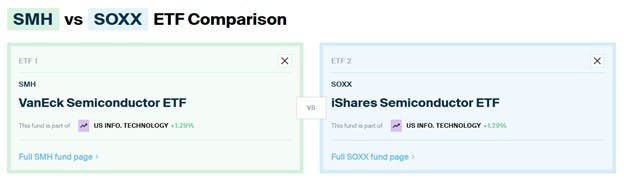
ETF Comparison: VanEck Semiconductor ETF (SMH) Versus iShares Semiconductor ETF (SOXX)
The two largest U.S.-listed semiconductor ETFs go head-to-head with data from the ETF Central ETF comparison tool.

Keep up with what matters in ETFs
Get timely ETF insights, market trends, and top ideas straight to your inbox.
Your newsletter subscriptions with us are subject to ETF Central's Privacy Policy and Terms and Conditions.
The hottest (but also one of the most expensive) industries right now is semiconductors—the companies designing and manufacturing the tiny chips that power your phones, computers, cars, and yes, even artificial intelligence (AI).
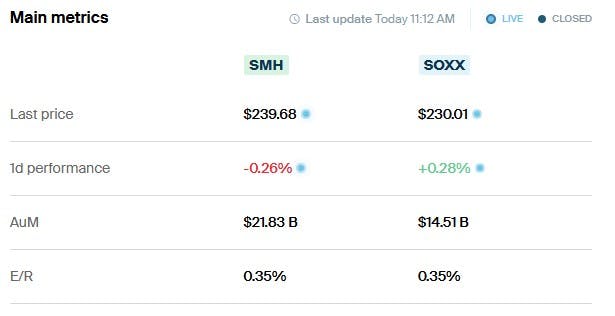
In this ETF segment, there are two titans that investors tend to gravitate to: the VanEck Semiconductor ETF (SMH) and iShares Semiconductor ETF (SOXX), boasting $21.83 billion and $14.51 billion in AUM respectively.
Now, both are fine ETFs, but not many investors know the precise minute differences between them, and this can lead to some analysis paralysis. Fortunately, I'm here to help you out today, along with data from the ETF Central comparison tool. Stick around for more!
Global ETF Survey 2026 is Live!
With 1,790 new products launched by July 2026, choosing is harder than ever. Our Global ETF Survey 2026, built on 620 professional investors and allocators, shows how active, fixed income, options-based and thematic ETFs are reshaping fund selection.
SMH vs SOXX: Total Cost of Ownership
Both ETFs are equivalent in expense ratios—0.35%, or around $35 in fees annually for a $10,000 investment.
However, as you know, the cost of investing in ETFs also involves dealing with the bid-ask spread when you buy and sell. The narrower the spread, the better.
Both SMH and SOXX excel here thanks to their high volume, AUM, and liquid underlying holdings. SMH has a 0.015% 30-day average bid-ask spread, while SOXX has a 0.022% spread. These differences are too minute to matter significantly.
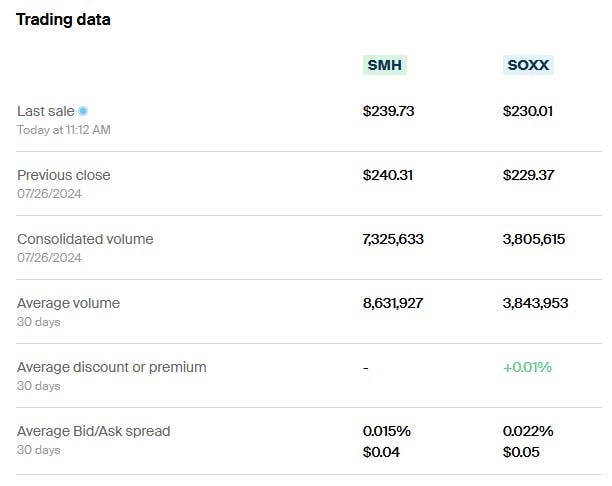
So, it's a clear tie here. Both ETFs are affordable, industry-specific options with excellent liquidity.
SMH vs SOXX: Methodology and Holdings
Both ETFs track the same industry but via different indexes. Before we get into the differences, note that both are tax-efficient with 0.43% and 0.64% trailing 12-month distribution yields for SMH and SOXX, respectively.
SMH uses the MVIS U.S. Listed Semiconductor 25 Index, which tracks the performance of the 25 largest and most liquid U.S. exchange-listed companies. This index requires constituents to generate 50% of their revenues from semiconductors and caps individual company weights at 20% at each quarterly rebalance. The index is reconstituted semi-annually in March and September.
On the other hand, SOXX uses the modified float-adjusted market capitalization-weighted ICE Semiconductor Index, tracking the 30 largest U.S.-listed semiconductor companies, making it slightly broader in scope.

In terms of top 15 holdings, both ETFs have very similar portfolios with common holdings including Nvidia, Broadcom, Qualcomm, AMD, Micron, Lam Research, Taiwan Semiconductor Manufacturing, Intel, and Texas Instruments.
However, the weighting and rankings differ significantly. You'll notice SMH is much more concentrated —Nvidia has crept up to 23.25% weight and TSM to 12.29%, whereas Nvidia is the largest in SOXX but only at 10.29%.
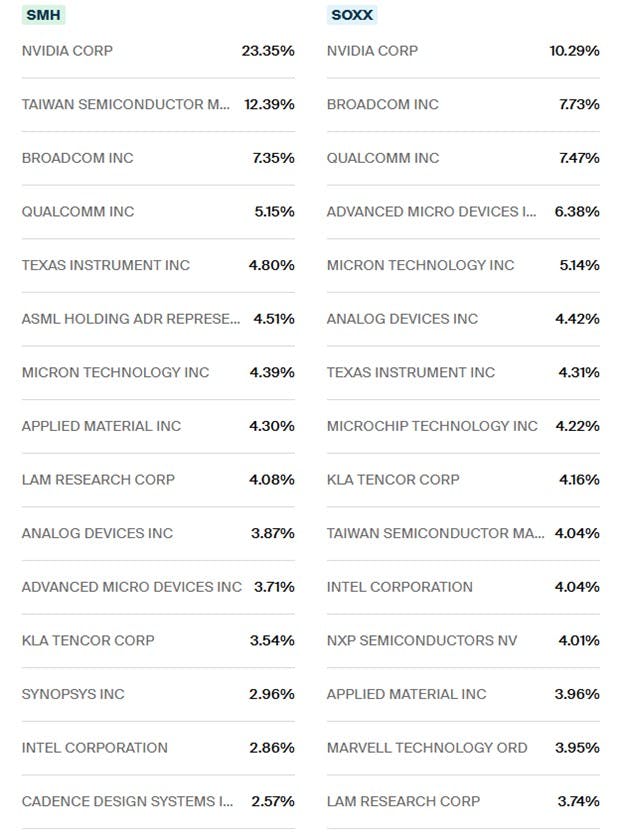
Both ETFs are top-heavy, although SMH is noticeably more so, with the top 15 holdings accounting for 89.84% of the weight, compared to 77.86% for SOXX.
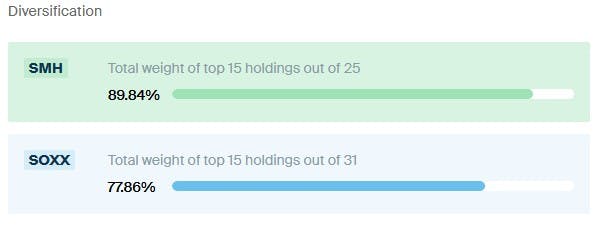
Personally, I prefer SOXX. While you may have missed out slightly on Nvidia's run-up, I would not want a single stock to be 20% or more of my industry-specific ETF—this takes on too much single-stock risk. If you want that much Nvidia exposure, just buy Nvidia.
SMH vs SOXX: Risk and Return
Both ETFs have dramatically outperformed both the broad market and tech sector thanks to the AI boom, but remember, this performance is not predictive of future returns and has been accompanied by high volatility.
Over the last three years, one year, and year-to-date, SMH has strongly outperformed SOXX. This can be attributed to SMH's ability to overweight Nvidia up to 20% of its portfolio. SMH has also attracted much higher inflows, with investors pouring in $8.89 billion over three years and $5.24 billion year-to-date—more than twice as much as SOXX in both periods.
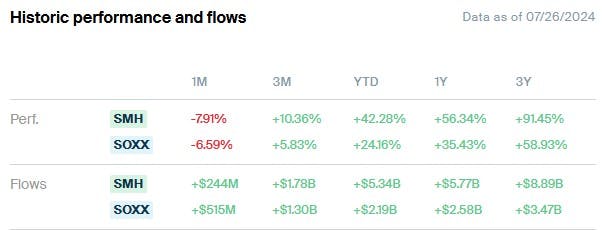
You might think this outperformance came at the cost of greater risk, but historical volatility reveals this isn't the case. SMH had comparable standard deviation to SOXX and similar maximum drawdown depth and length. Nvidia's strong performance has really carried SMH.
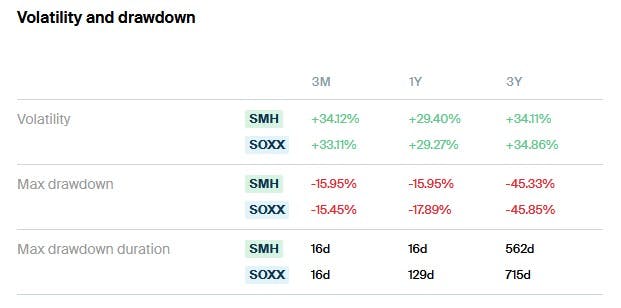
Is this a reason to pick SMH? Personally, I would not, simply because I don't think overweighting Nvidia at 20% is a compensated risk. It worked great in a bull market but will likely hurt you in a bear market. I feel more comfortable with the exposure SOXX provides, which is still significant but more balanced.
Please note this article is for information purposes only and does not in any way constitute investment advice. It is essential that you seek advice from a registered financial professional prior to making any investment decision.


Latest ETF News
See all ETF newsThere's an ETF for That? Humanoid Robotics and Physical AI

How Some ETF Issuers Use Their Own Funds for Cash Management

These Public-Private ETFs Invest in Polymarket and Anduril

There's an ETF for That? Frontier Markets




 Advantages of ETFs over Mutual Funds1/6
Lower Costs
In this guide, we'll explore the advantages of ETFs over mutual funds, giving you valuable insights into why ETFs have gained significant popularity among investors like yourself.
Leveraged ETFs: Unlocking the Potential for Amplified Returns1/6
Understanding Leveraged ETFs
Explore leveraged ETFs: potential for amplified returns & risks. 5 ETFs to consider across equities, commodities & fixed income.
What is a Leveraged ETF?1/6
Introducing Leveraged and Inverse ETFs
In this guide, we'll dive into the world of leveraged ETFs, exploring their definition, mechanics, potential risks, and rewards.
Recent educational content

First Look ETF
First Look ETF: Income, International, and Cash Flow ETFs
In this season 6 episode of First Look ETF, Stephanie Stanton @etfguide examines the latest ETF marketplace trends with NYSE and guests.


ETF Trends
ETF Industry KPIs October 5, 2026
This week’s KPI data overview highlights key metrics and trends shaping the ETF landscape.

ETF Trends
ETF Industry KPIs September 28, 2026
This week’s KPI data overview highlights key metrics and trends shaping the ETF landscape.
ETF Trends
ETF Industry KPIs September 22, 2026
This week’s KPI data overview highlights key metrics and trends shaping the ETF landscape.
Browse all educational columns



ETFs’ Next Act: From Access to Selection
With 1,790 new products launched by July 2026, choosing is harder than ever. Our Global ETF Survey 2026, built on 620 professional investors and allocators, shows how active, fixed income, options-based and thematic ETFs are reshaping fund selection.