Ready-made ETF portfolios built for real investor needs. Explore now →



ETF Comparison: Schwab U.S. REIT ETF (SCHH) Versus Vanguard Real Estate ETF (VNQ)
Here's how these two popular and affordable ETF options for real estate exposure stack up.


Keep up with what matters in ETFs
Get timely ETF insights, market trends, and top ideas straight to your inbox.
Your newsletter subscriptions with us are subject to ETF Central's Privacy Policy and Terms and Conditions.
If you're looking to generate income from real property but don't have the down payment or the time to manage a rental, Real Estate Investment Trusts (REITs) offer a viable alternative.
These are companies that own, operate, or finance income-generating real estate across a range of industries, including residential, commercial, healthcare, and industrial properties.
As with most assets, using an ETF to invest in REITs can provide far better diversification compared to owning individual securities.
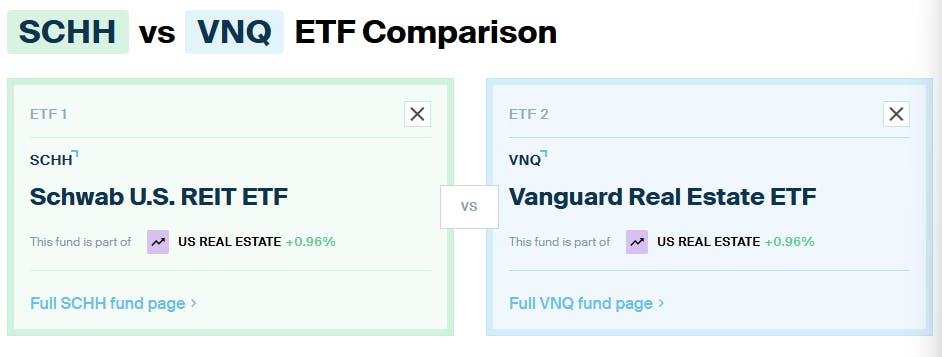
With numerous options available, today we'll analyze two of the best ones listed on the NYSE: the Schwab U.S. REIT ETF
Global ETF Survey 2026 is Live!
With 1,790 new products launched by July 2026, choosing is harder than ever. Our Global ETF Survey 2026, built on 620 professional investors and allocators, shows how active, fixed income, options-based and thematic ETFs are reshaping fund selection.
SCHH vs VNQ: total cost of ownership
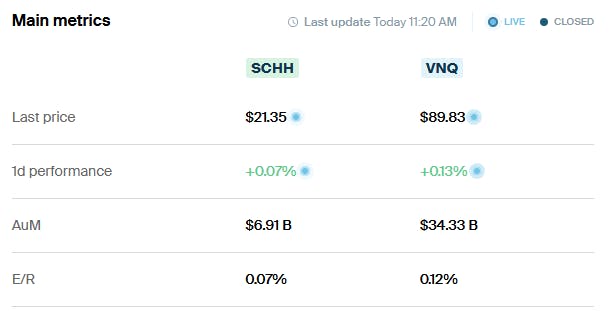
Both ETFs are known for their low-cost structures, primarily due to their passive index-tracking methodologies.
VNQ
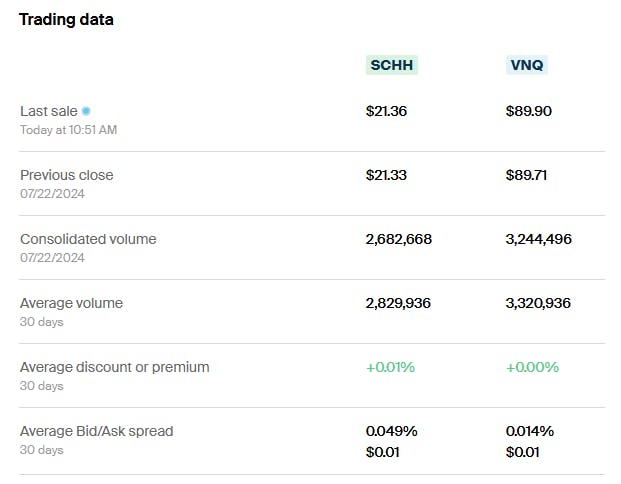
However, expense ratios aren't the only costs to consider. The bid-ask spread is another important factor, especially if you plan on trading the ETF frequently.
The bid-ask spread represents the difference between the highest price a buyer is willing to pay and the lowest price a seller is willing to accept. A wider spread can increase your costs when entering or exiting a position.
SCHH vs VNQ: methodology and holdings
VNQ
Notably, VNQ's top holding is actually a mutual fund—the Vanguard Real Estate II Index Fund Institutional Plus Shares (VRTPX). Vanguard employs this strategy to achieve better index tracking and ensure liquidity, which is a distinctive feature of VNQ.
In addition to its core REIT holdings, VNQ's portfolio is broader, with 155 holdings compared to SCHH's 118. This broader scope includes real estate equities that are not strictly REITs.
Examples of these non-REIT holdings include companies like Zillow Group, CBRE Group, and Compass Inc. These companies are involved in real estate services, brokerage, and technology, providing a more diversified exposure to the real estate sector.
On the other hand, SCHH
This focus on REITs means that SCHH provides more targeted exposure to companies that own, operate, or finance income-producing real estate. In other words, you're getting more core real estate exposure as opposed to periphery support.
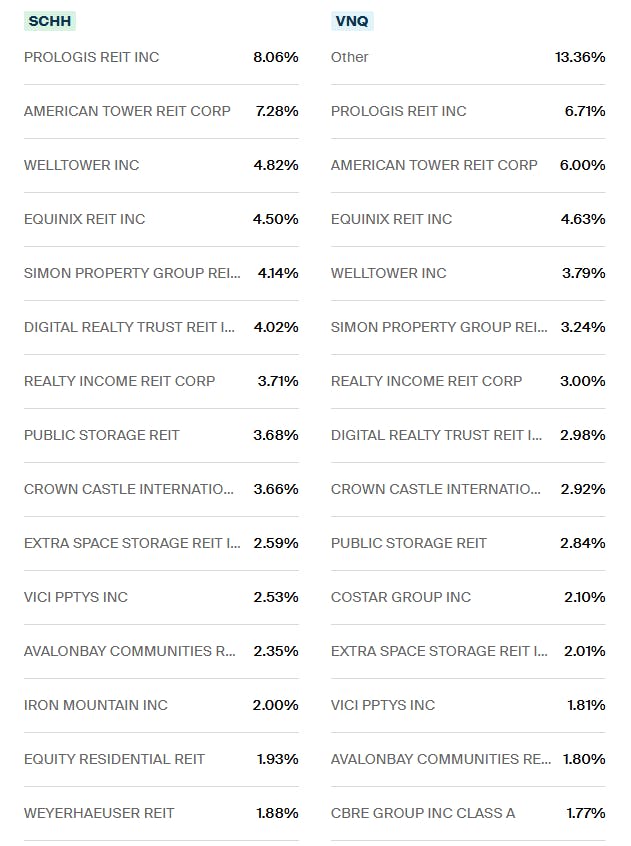
Now, which ETF is better depends on your investment objectives. If you prefer a pure-play REIT exposure as an alternative asset class, SCHH
Conversely, if you're looking for broader real estate sector exposure, including companies involved in real estate services and technology, VNQ
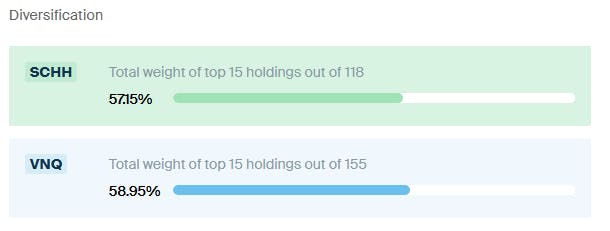
Finally, both ETFs are fairly top-heavy, with over half of their portfolio weighted in the top 15 holdings. To me, this makes them better for a satellite as opposed to a core holding.
SCHH vs VNQ: risk and return
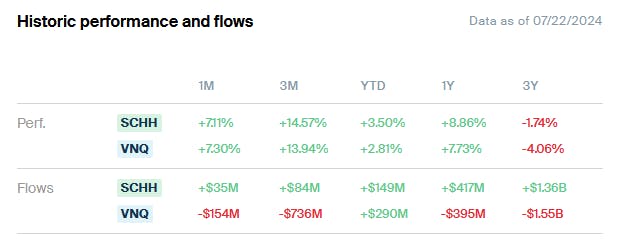
As always, it's important to remember that past returns don't predict future performance, but they can provide insights into how two ETFs with similar strategies and objectives have fared historically. This can help you assess their suitability for your risk appetite.
When comparing the SCHH and VNQ, we see that over the three and one-year periods, SCHH has outperformed VNQ. Additionally, SCHH has garnered greater net inflows, indicating its popularity among investors.
Regarding volatility, both ETFs exhibit similar historical standard deviations and drawdowns. It's important to note how steep and prolonged these drawdowns can be. This sector can experience significant fluctuations, which is something investors need to be prepared for.
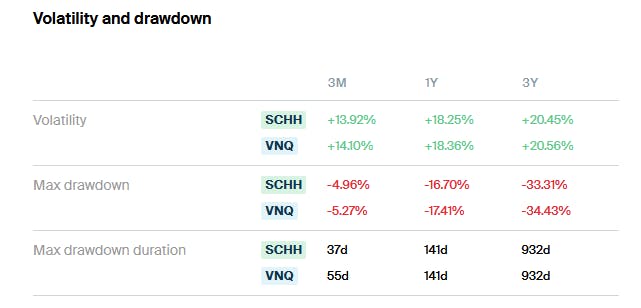
In terms of risk and return, this part of the comparison is a toss-up. The difference in performance between SCHH and VNQ is not substantial enough to be a decisive factor.
Both ETFs offer similar risk profiles and return potential, making them suitable candidates for tax loss harvesting. You can feel comfortable switching between these two ETFs without significantly altering your investment risk or expected returns.
Please note this article is for information purposes only and does not in any way constitute investment advice. It is essential that you seek advice from a registered financial professional prior to making any investment decision.

Latest ETF News
See all ETF newsBeyond Big Tech: The Increasing Specialization of AI ETFs

There's an ETF for That? Humanoid Robotics and Physical AI

How Some ETF Issuers Use Their Own Funds for Cash Management

These Public-Private ETFs Invest in Polymarket and Anduril

There's an ETF for That? Frontier Markets



 Advantages of ETFs over Mutual Funds1/6
Lower Costs
In this guide, we'll explore the advantages of ETFs over mutual funds, giving you valuable insights into why ETFs have gained significant popularity among investors like yourself.
Leveraged ETFs: Unlocking the Potential for Amplified Returns1/6
Understanding Leveraged ETFs
Explore leveraged ETFs: potential for amplified returns & risks. 5 ETFs to consider across equities, commodities & fixed income.
What is a Leveraged ETF?1/6
Introducing Leveraged and Inverse ETFs
In this guide, we'll dive into the world of leveraged ETFs, exploring their definition, mechanics, potential risks, and rewards.
Recent educational content

First Look ETF
First Look ETF: Income, International, and Cash Flow ETFs
In this season 6 episode of First Look ETF, Stephanie Stanton @etfguide examines the latest ETF marketplace trends with NYSE and guests.


ETF Trends
ETF Industry KPIs October 5, 2026
This week’s KPI data overview highlights key metrics and trends shaping the ETF landscape.

ETF Trends
ETF Industry KPIs September 28, 2026
This week’s KPI data overview highlights key metrics and trends shaping the ETF landscape.
ETF Trends
ETF Industry KPIs September 22, 2026
This week’s KPI data overview highlights key metrics and trends shaping the ETF landscape.