Keep tabs on your favorite ETFs with a personalized weekly tracker. Create a Watchlist now →



ETF Comparison: Schwab U.S. Large-Cap Growth ETF (SCHG) Versus Schwab U.S. Large-Cap Value ETF (SCHV)
Both ETFs are broadly diversified and have low fees, but which one comes out on top?


Keep up with what matters in ETFs
Get timely ETF insights, market trends, and top ideas straight to your inbox.
Your newsletter subscriptions with us are subject to ETF Central's Privacy Policy and Terms and Conditions.
Virtually all of the major ETF providers—including Vanguard, iShares, SPDR, and Invesco—offer competing ETFs that allow investors to take sides in the age-old value versus growth debate.
Schwab is no exception. The firm offers two broadly diversified and low-cost ETFs, the Schwab U.S. Large-Cap Growth ETF
Here’s how SCHG and SCHV stack up head-to-head, based on data from the ETF Central comparison tool.
Global ETF Survey 2026 is Live!
With 1,790 new products launched by July 2026, choosing is harder than ever. Our Global ETF Survey 2026, built on 620 professional investors and allocators, shows how active, fixed income, options-based and thematic ETFs are reshaping fund selection.
SCHG vs SCHV: Total cost of ownership
Both the Schwab U.S. Large-Cap Growth ETF
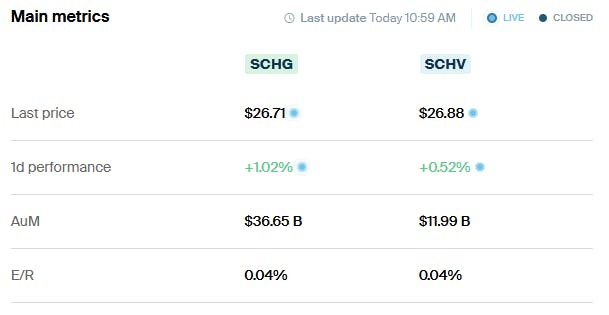
Indirect costs are also minimal. SCHG has a 0.038% 30-day average bid-ask spread, while SCHV is slightly higher at 0.044%, but the difference is inconsequential for most investors.
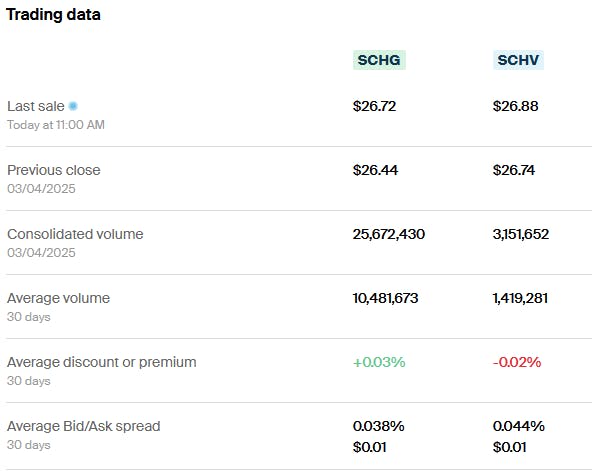
Verdict: It’s a tie. Both ETFs are highly affordable to trade and own long-term.
SCHG vs SCHV: Methodology and holdings
This is where the differences between the Schwab U.S. Large-Cap Growth ETF
Both funds track different style components of the same parent index, the Dow Jones U.S. Large-Cap Total Stock Market Index. SCHG follows the Dow Jones U.S. Large-Cap Growth Total Stock Market Index, while SCHV tracks the Dow Jones U.S. Large-Cap Value Total Stock Market Index.
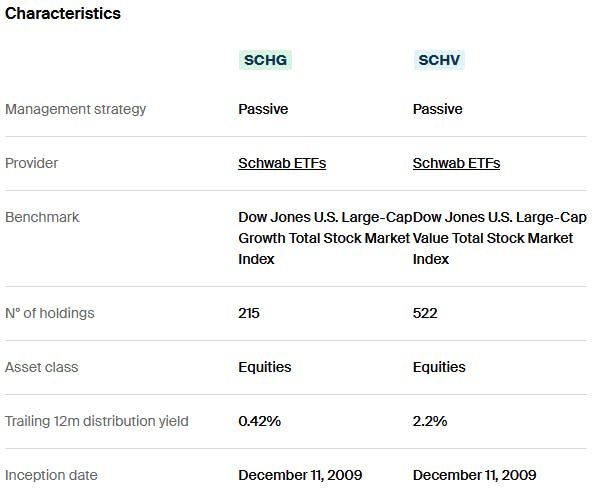
These indices use six factor criteria to select their holdings, including the projected price-to-earnings (P/E) ratio, projected earnings growth, price-to-book (P/B) ratio, dividend yield, trailing revenue growth, and earnings growth.
From here, SCHG targets stocks scoring on the growth side of these factors, while SCHV selects stocks that rank on the value-heavy side.
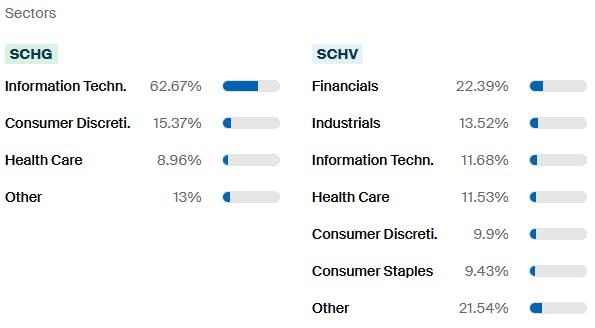
In practice, this leads to very different sector allocations. SCHG is heavily weighted toward technology, with consumer discretionary as a distant second. SCHV, on the other hand, is more balanced between financials, industrials, and healthcare.
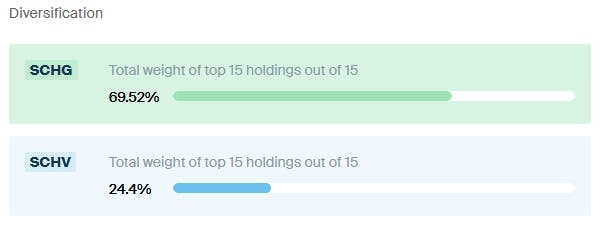
SCHG is also very top-heavy, reflecting the dominance of large-cap tech stocks. Its top 15 holdings account for 69.52% of the ETF, whereas SCHV’s top 15 only make up 24.4% of its portfolio.
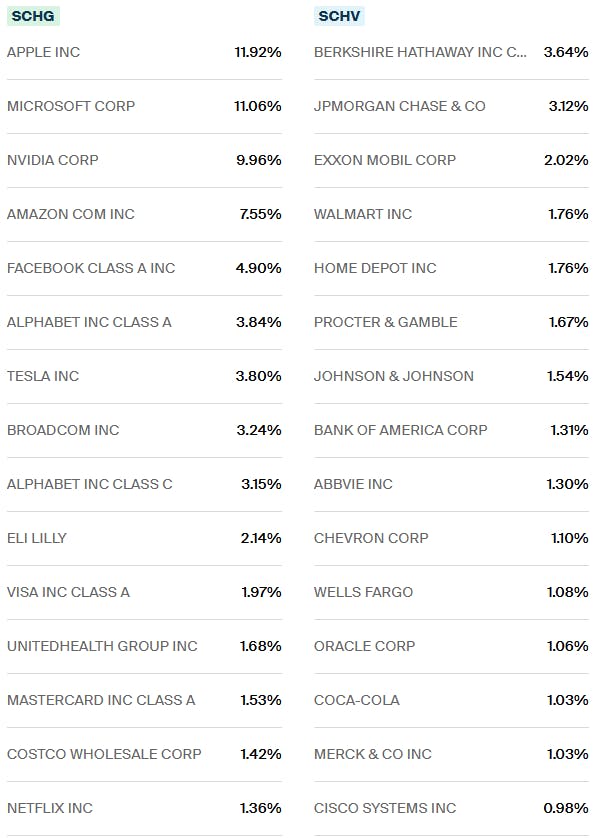
Unsurprisingly, SCHG is dominated by the “Magnificent Seven”: Microsoft, Apple, Nvidia, Amazon, Meta Platforms, Alphabet, and Tesla are all top holdings, with Microsoft and Apple alone accounting for over 22% of the ETF.
In contrast, SCHV has a more traditional, “boomer” portfolio, featuring Berkshire Hathaway, JPMorgan Chase, Exxon Mobil, Walmart, Home Depot, Procter & Gamble, and Johnson & Johnson among its top ranks.
Verdict: Your mileage may vary (YMMV) here. My preference leans toward SCHV, as I’m more bullish on value stocks for the long term. However, if you want to double down on growth, SCHG hits all the big names.
SCHG vs SCHV: Risk and return
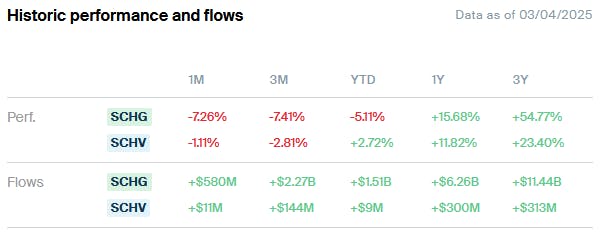
In the short term, SCHG has outperformed SCHV handily, which isn’t surprising given the tech surge in recent years. SCHG has beaten SCHV over the three-year and one-year trailing periods, but year-to-date in 2025, SCHG is struggling.
The Trump administration’s tariffs have hit growth stocks hard, while value stocks have held their ground. Despite the recent downturn, SCHG remains far more popular, attracting billions in inflows compared to the millions going into SCHV.
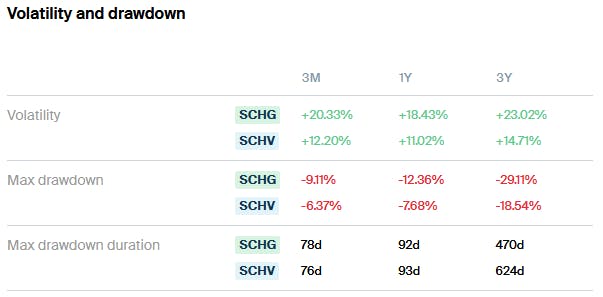
On the risk side, SCHG has also been more volatile, with higher standard deviations over the three-year, one-year, and year-to-date periods. The ETF has experienced deeper and more prolonged drawdowns, which is par for the course with growth investing. Investors should expect greater swings and more significant losses during market downturns if they choose SCHG.
Looking at the long-term performance, a backtest from December 11, 2009, to March 4, 2025, shows SCHG delivering a compound annual growth rate (CAGR) of 15.98%, significantly outpacing SCHV’s 10.73% CAGR. SCHG also had better risk-adjusted returns, with a Sharpe ratio of 0.8 compared to SCHV’s 0.63.
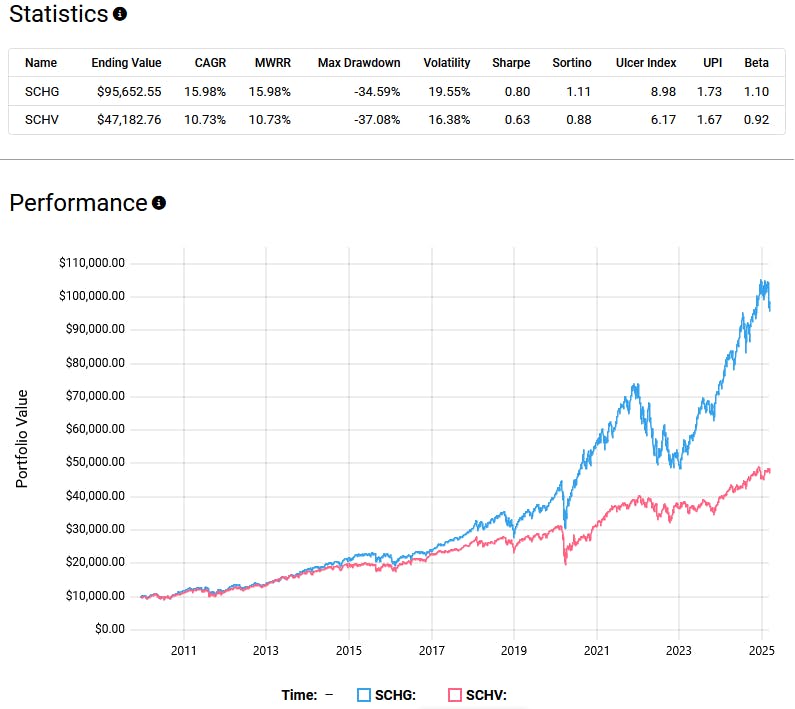
Verdict: As a value investor, it’s painful to admit, but SCHG wins clearly on this basis. A decade of falling interest rates and tech outperformance has given it significant tailwinds, leaving value strategies like SCHV in the dust.
This article is for informational purposes only and does not in any way constitute investment advice. The author may express their own opinions, which may not represent the opinions of ETF Central or its affiliated partners. It is essential that you seek advice from a registered financial professional prior to making any investment decisions.


Latest ETF News
See all ETF newsBeyond Big Tech: The Increasing Specialization of AI ETFs

There's an ETF for That? Humanoid Robotics and Physical AI

How Some ETF Issuers Use Their Own Funds for Cash Management

These Public-Private ETFs Invest in Polymarket and Anduril

There's an ETF for That? Frontier Markets



 Advantages of ETFs over Mutual Funds1/6
Lower Costs
In this guide, we'll explore the advantages of ETFs over mutual funds, giving you valuable insights into why ETFs have gained significant popularity among investors like yourself.
Leveraged ETFs: Unlocking the Potential for Amplified Returns1/6
Understanding Leveraged ETFs
Explore leveraged ETFs: potential for amplified returns & risks. 5 ETFs to consider across equities, commodities & fixed income.
What is a Leveraged ETF?1/6
Introducing Leveraged and Inverse ETFs
In this guide, we'll dive into the world of leveraged ETFs, exploring their definition, mechanics, potential risks, and rewards.
Recent educational content

First Look ETF
First Look ETF: Income, International, and Cash Flow ETFs
In this season 6 episode of First Look ETF, Stephanie Stanton @etfguide examines the latest ETF marketplace trends with NYSE and guests.


ETF Trends
ETF Industry KPIs October 5, 2026
This week’s KPI data overview highlights key metrics and trends shaping the ETF landscape.

ETF Trends
ETF Industry KPIs September 28, 2026
This week’s KPI data overview highlights key metrics and trends shaping the ETF landscape.
ETF Trends
ETF Industry KPIs September 22, 2026
This week’s KPI data overview highlights key metrics and trends shaping the ETF landscape.