Explore professionally built ETF model portfolios. Discover now →



ETF Comparison: Schwab US Dividend Equity ETF (SCHD) Versus WisdomTree U.S. Quality Dividend Growth Fund (DGRW)
Two of the top multi-factor dividend index ETFs go head-to-head in this week’s ETF comparison.

Keep up with what matters in ETFs
Get timely ETF insights, market trends, and top ideas straight to your inbox.
Your newsletter subscriptions with us are subject to ETF Central's Privacy Policy and Terms and Conditions.
There’s more than one way to structure a dividend ETF. Most funds lean into either yield, dividend growth, or quality, but some go a step further and combine multiple factors into a single strategy.
When done right, the result is a more well-rounded portfolio that captures different sources of return and helps smooth out the rough edges of any one factor.
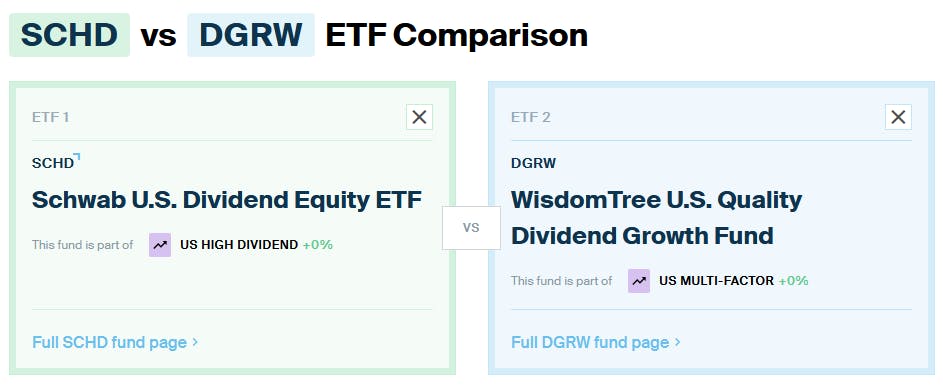
That’s exactly what you get with the Schwab US Dividend Equity ETF
But which one wins out when you put them head-to-head? Here’s how the data shakes out in today’s dividend showdown, using the ETF Central comparison tool.
Like what you're reading?
Stay in the loop — get the latest ETF insights: trends, analysis, and expert picks.
SCHD vs DGRW: Total Cost of Ownership
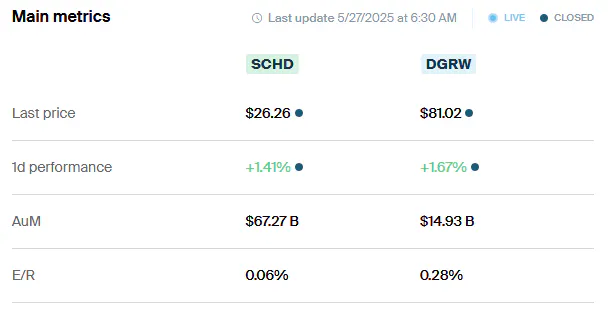
SCHD comes in with an ultra-low 0.06% expense ratio, one of the cheapest in the entire dividend ETF universe. DGRW, while still reasonable, charges 0.28%, more than four times as much. On a $10,000 investment, that's the difference between paying $6 a year versus $28.
But management fees aren’t the only cost to consider. When trading ETFs, you also pay an embedded cost via the bid-ask spread, which is the difference between what buyers will pay and what sellers will accept. Here, SCHD and DGRW are nearly identical. SCHD has an average 30-day bid-ask spread of 0.038%, while DGRW sits at 0.037%.
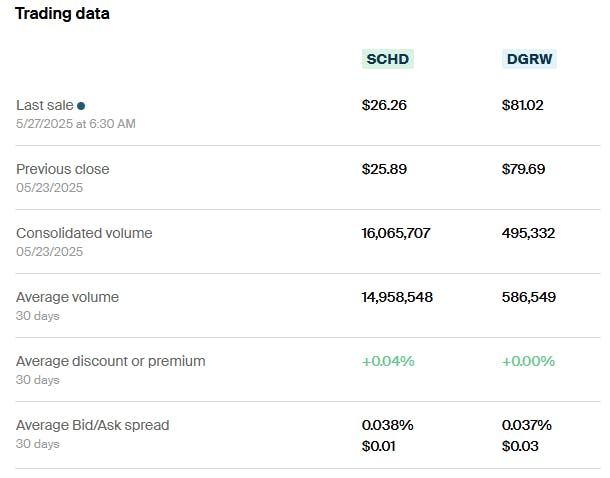
Verdict: Put it all together, and SCHD is cheaper by a mile. DGRW isn’t expensive by any stretch, but it does cost more than many of its peers.
SCHD vs DGRW: Methodology and Holdings
Fees don’t define an ETF. What really matters is how it’s built. Always pop the hood and examine the index methodology and selection rules. That’s where the real story lies.
Right away, there’s a key difference in how these two ETFs approach income. SCHD sports a trailing 12-month yield of 4.02%, while DGRW offers just 1.62%. That’s not a bug; it’s a feature, baked into how each fund is constructed.
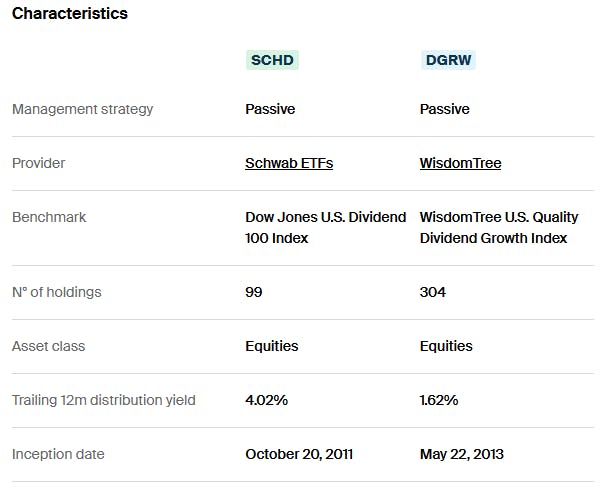
SCHD tracks the Dow Jones U.S. Dividend 100 Index. It starts by filtering for stocks with at least 10 consecutive years of dividend payments—not increases, just uninterrupted distributions.
From there, it scores companies based on four factors: free cash flow to total debt, return on equity, dividend yield, and five-year dividend growth rate. The top 100 are selected and market cap weighted, with quarterly rebalancing and annual reconstitution.
DGRW, by contrast, follows the WisdomTree U.S. Quality Dividend Growth Index. It pulls from a larger universe of dividend-paying stocks and selects the top 300 based on forward-looking earnings growth estimates (for growth) and three-year averages of return on equity and return on assets (for quality).
Final weights are based on the company’s projected share of aggregate dividends in the coming year, not yield. That’s a subtle but important difference. It’s also worth clearing up a misconception: DGRW is not a dividend growth ETF in the traditional sense. It’s a growth-oriented ETF that screens for quality within a dividend-paying universe.
Both are concentrated. SCHD’s top 15 names make up 58.94% of assets, while DGRW’s top 15 sit at 46.07%. From a sector perspective, SCHD leans more toward large-cap value stocks—think energy, consumer staples, healthcare, and industrials. DGRW, meanwhile, mirrors the broad market more closely, with a heavier tilt toward tech and growth.

You’ll see it in the holdings: SCHD is top-heavy with names like ConocoPhillips, Coca-Cola, Lockheed Martin, Verizon, and Altria. DGRW features Microsoft, Apple, Exxon Mobil, Procter & Gamble, and even Nvidia.
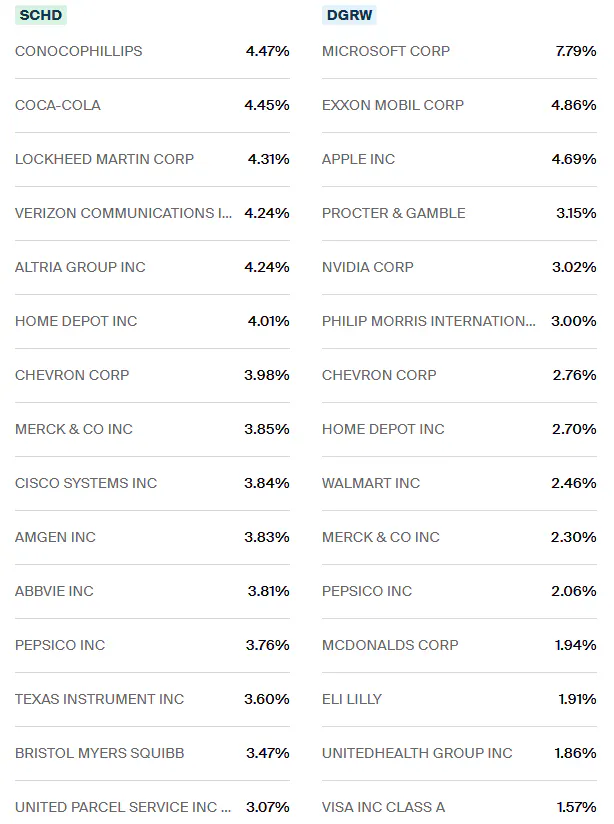
Verdict: SCHD is a classic large-cap value ETF with a focus on income and financial strength. DGRW is more of a large-cap quality growth fund dressed in dividend clothing. Which one fits better depends on whether you want yield today or capital appreciation tomorrow.
SCHD vs DGRW: Risk and Return
Over the short term, DGRW has outpaced SCHD with stronger 1- and 3-year trailing returns. Despite that, SCHD continues to rake in more investor inflows, likely due to a mix of brand loyalty, higher yield, and perceived simplicity.
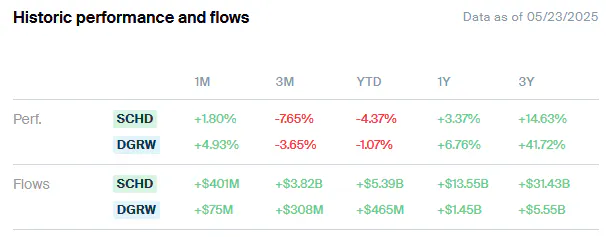
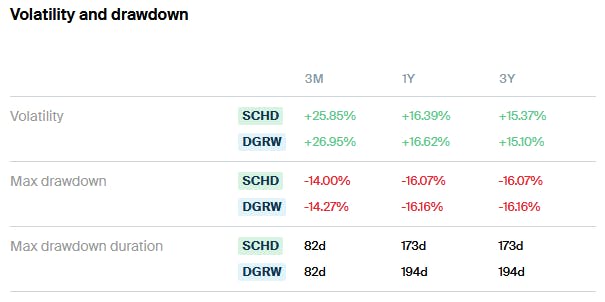
In terms of risk, both ETFs have exhibited very similar volatility profiles and comparable max drawdown depth and duration over the same short-term periods. Neither one has shown materially better downside protection in recent corrections.
But when you zoom out to a longer timeframe (2013-05-22 to 2025-05-23), DGRW pulls ahead meaningfully. It has delivered a 12.43% CAGR compared to SCHD’s 10.63%, with superior risk-adjusted returns. DGRW’s Sharpe ratio clocks in at 0.72 versus 0.61 for SCHD, suggesting that investors have been rewarded not just with higher returns, but also more return per unit of risk.
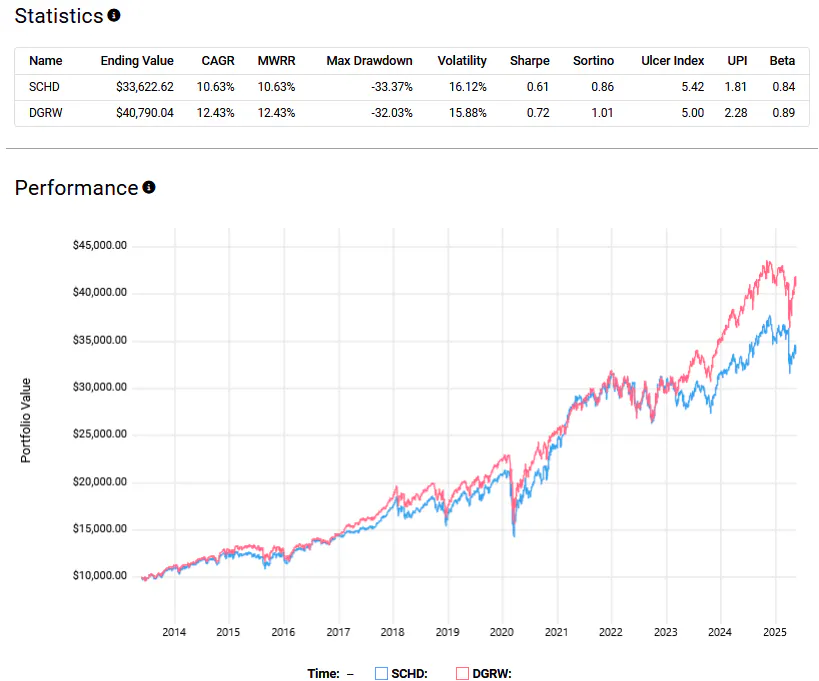
Verdict: Historically, DGRW has been the better total return vehicle with stronger risk-adjusted results. SCHD still shines for yield and cost, but DGRW edges it out for total return-driven investors willing to accept a lower starting yield.
Please note that this article reflects the author’s personal views and does not represent the opinions of the publication or its affiliates. It is for informational purposes only and does not constitute investment advice. It is essential to seek guidance from a registered financial professional before making any investment decisions.
Segments
See all
Mentioned ETFs
Further reading
Latest ETF News
See all ETF newsThese Public-Private ETFs Invest in Polymarket and Anduril

There's an ETF for That? Frontier Markets

10-Year Treasury Yield Hits 5%: Which Bond ETFs Offer the Most Direct Exposure?

ETF comparison: NEOS S&P 500 High Income ETF (SPYI) Versus Goldman Sachs S&P 500 Premium Income ETF (GPIX)




 Advantages of ETFs over Mutual Funds1/6
Lower Costs
In this guide, we'll explore the advantages of ETFs over mutual funds, giving you valuable insights into why ETFs have gained significant popularity among investors like yourself.
Leveraged ETFs: Unlocking the Potential for Amplified Returns1/6
Understanding Leveraged ETFs
Explore leveraged ETFs: potential for amplified returns & risks. 5 ETFs to consider across equities, commodities & fixed income.
What is a Leveraged ETF?1/6
Introducing Leveraged and Inverse ETFs
In this guide, we'll dive into the world of leveraged ETFs, exploring their definition, mechanics, potential risks, and rewards.
Recent educational content

ETF Trends
ETF Industry KPIs September 28, 2026
This week’s KPI data overview highlights key metrics and trends shaping the ETF landscape.

ETF Trends
ETF Industry KPIs September 22, 2026
This week’s KPI data overview highlights key metrics and trends shaping the ETF landscape.

First Look ETF
First Look ETF: Income, Corporate Arbitrage, and Growth and Value Investing
First Look ETF September 2026: iCapital, Mast Investments and North Square unpack new ETFs targeting monthly income, merger arbitrage and complementary growth and value exposure.

ETF Trends
ETF Industry KPIs September 14, 2026
This week’s KPI data overview highlights key metrics and trends shaping the ETF landscape.
Browse all educational columns



Have you tried our ETF Compare tool?
Compare ETFs like a pro. Analyze fees, performance, exposure & holdings side-by-side.