Open Now: The Global ETF Survey Take the Survey →



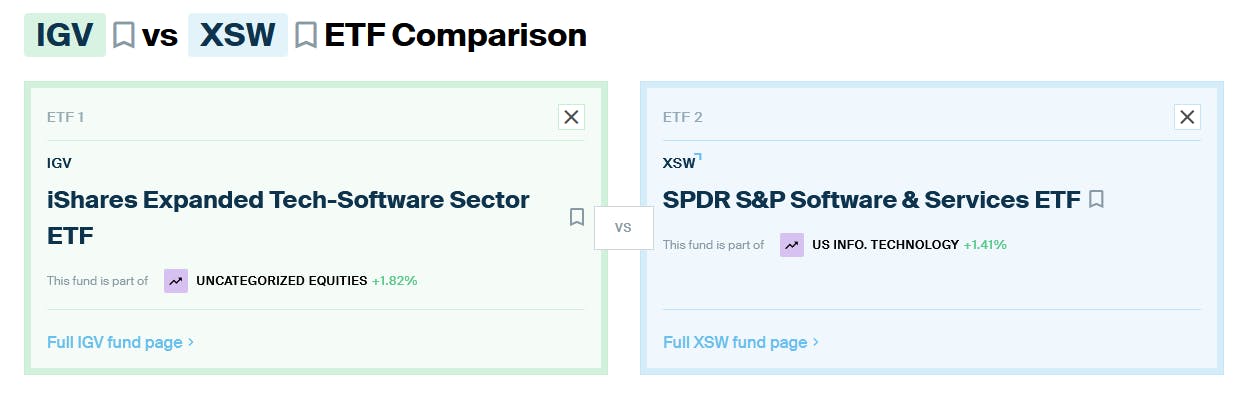
ETF Comparison: iShares Expanded Tech-Software Sector ETF (IGV) Versus SPDR S&P Software & Services ETF (XSW)
Software ETFs have seen increased inflows and volatility thanks to investor fears about AI disruption.

Keep up with what matters in ETFs
Get timely ETF insights, market trends, and top ideas straight to your inbox.
Your newsletter subscriptions with us are subject to ETF Central's Privacy Policy and Terms and Conditions.
Lately, I have been seeing comparisons on social media that frame Bitcoin as a proxy for the software industry, often by overlaying its price chart with that of the iShares Expanded Tech-Software Sector ETF
The argument is that over the past year and a half, Bitcoin has behaved less like digital gold and more like a leveraged technology trade. Correlation data over shorter windows does lend some support to that view.
That comparison still feels strained. Bitcoin and software equities are fundamentally different assets. Bitcoin has a fixed supply schedule and no cash flows, making it inherently deflationary by design.
Software companies, by contrast, are operating businesses with revenues, margins, and competitive dynamics that can change quickly. Treating the two as interchangeable expressions of the same theme risks oversimplifying both.
What appears to be driving renewed interest in software ETFs such as IGV is a more specific concern. Investors are increasingly focused on how artificial intelligence could disrupt software-as-a-service business models.
The bear case is that AI-driven tools could compress pricing power, reduce switching costs, and weaken the durability of subscription-based revenue streams. That debate is still in its early stages, but ETF flows suggest investors are actively repositioning, and price volatility across the software space has picked up.
IGV remains the most recognizable vehicle for accessing software equities, but it is not the only option. A less concentrated alternative is the SPDR S&P Software & Services ETF
Get data on 14,000+ ETFs
Access Trackinsight's reliable and comprehensive data with 500M+ points on 14,000+ ETFs.
IGV vs. XSW: Total Cost of Ownership
Industry-focused ETFs tend to be more expensive than broad sector funds. While sector ETFs can charge as little as 0.08%, the industry standard for more targeted exposure is closer to 0.35%. That higher cost reflects narrower mandates and smaller asset bases, and it is part of the trade-off.
XSW sits right at that industry norm with an expense ratio of 0.35%. IGV is slightly more expensive at 0.39%, a difference of four basis points. On fees alone, XSW has a modest edge.
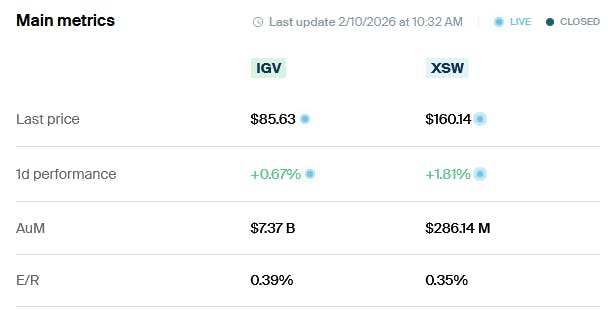
Costs, however, are not limited to the expense ratio. For investors using these ETFs tactically rather than as long-term holdings, the bid-ask spread becomes an important consideration. On that front, IGV is more liquid. Its 30-day average bid-ask spread is about 0.02%, compared with 0.123% for XSW.
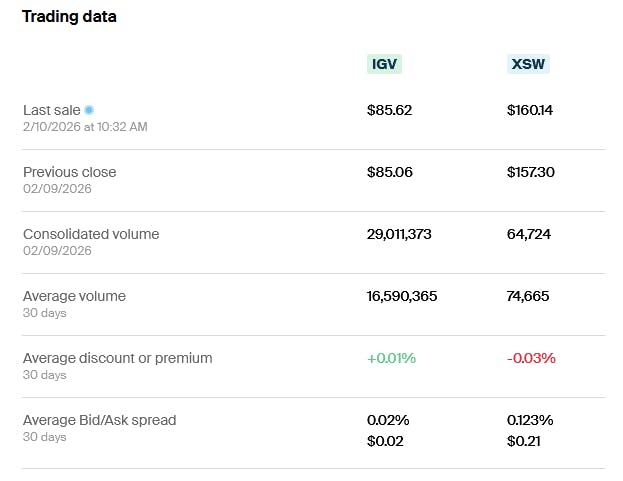
Verdict: For long-term investors who plan to buy and hold, XSW is marginally cheaper based on expense ratio alone. For shorter-term trades where positions are entered and exited more frequently, IGV’s tighter spread makes it the lower-cost option in practice.
IGV vs XSW: Methodology and Holdings
Both ETFs target the software industry and both are passive, tracking rules-based indexes. Beyond that shared objective, their construction differs in ways that materially affect concentration, exposure, and use case.
IGV tracks the S&P North American Expanded Technology Software Index. The “expanded” label matters. A strict GICS technology classification would miss several companies whose core business is software but are formally classified under other sectors, such as communication services or consumer discretionary. IGV broadens the universe to capture those names. Its North American scope also allows for limited exposure to Canadian software companies.
XSW takes a different approach. It tracks the S&P Software and Services Select Industry Index and uses an equal-weighted methodology. State Street applies equal weighting across its industry ETFs to reduce top-heavy concentration and increase representation of small- and mid-cap companies.
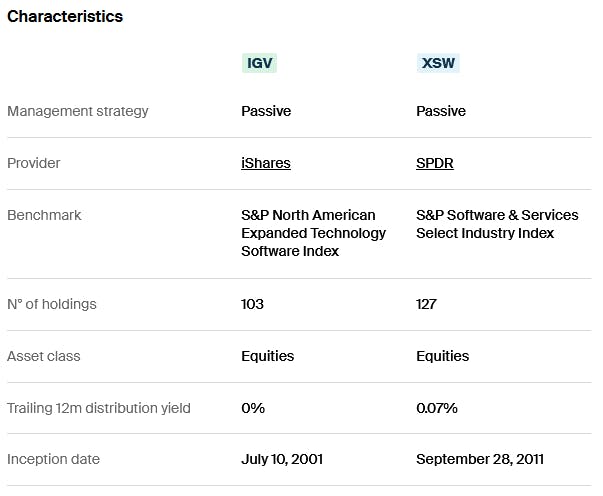
The impact is substantial. The top 15 holdings in IGV account for 72.82% of the portfolio. In XSW, the top 15 holdings make up just 12.19% of assets, with individual positions typically capped near 1%.
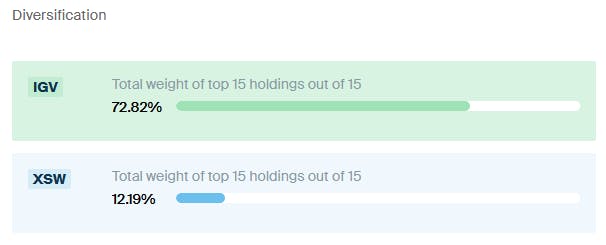
That difference shows up clearly in the holdings. IGV is dominated by mega-cap software firms such as Microsoft, Palantir, Oracle, Salesforce, and Intuit. XSW, by contrast, reflects whatever has performed well between rebalance dates. The current lineup is more eclectic and skews toward higher-volatility names, including companies such as Hut 8, Zoom Communications, Core Scientific, and TeraWulf.
Verdict: I think XSW is the more compelling option for a tactical software tilt today. Investors adding software exposure on top of an existing core equity allocation are likely already heavily exposed to mega-cap technology through market-cap-weighted funds. XSW minimizes that overlap and offers a purer expression of relative performance within the software industry.
IGV vs XSW: Risk and Return
Despite periodic setbacks, the software sector has delivered strong long-term performance. Which ETF an investor chose, however, has made a meaningful difference in outcomes.
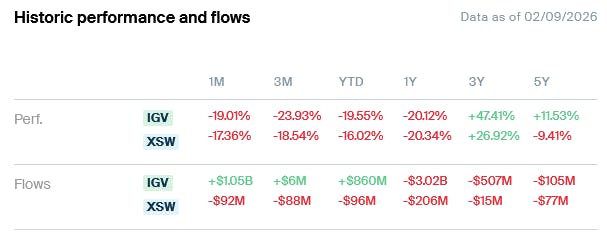
Over the trailing five- and three-year periods, IGV has significantly outperformed XSW. Over five years, IGV delivered an annualized return of 11.53%, while XSW posted a 9.41% loss. Over three years, the gap remained wide, with IGV returning 47.41% compared with 26.92% for XSW.
Notably, both ETFs experienced net outflows over much of this period, suggesting that investors had already been rotating away from software exposure well before the current AI-driven narrative took hold.
However, more recently, flows have shifted. Year to date, IGV has attracted roughly $860 million in net inflows, more than offsetting its longer-term outflows. That reversal points to renewed investor confidence and expectations of a rebound in large-cap software. XSW has not seen the same magnitude of renewed interest.
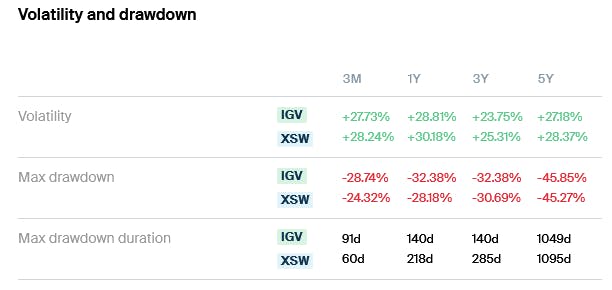
Risk metrics tell a more nuanced story. XSW’s equal-weight structure, with its heavier tilt toward small- and mid-cap stocks, has resulted in higher annualized volatility across the one-, three-, and five-year periods. At the same time, drawdowns have generally been shallower, even if they have lasted longer.
That pattern likely reflects the mechanics of equal weighting. Regular rebalancing systematically trims winners and adds to laggards, which can dampen prolonged losses and introduce a rebalancing effect that stabilizes downside risk over time.
Looking further back helps put the trade-offs into context. Over a 14.37-year period from September 29, 2011 to February 9, 2026, IGV outperformed XSW with an annualized return of 15.74% versus 14.51%. Volatility was similar across both ETFs, resulting in a higher risk-adjusted return for IGV, with a Sharpe ratio of 0.67 compared with 0.63 for XSW.
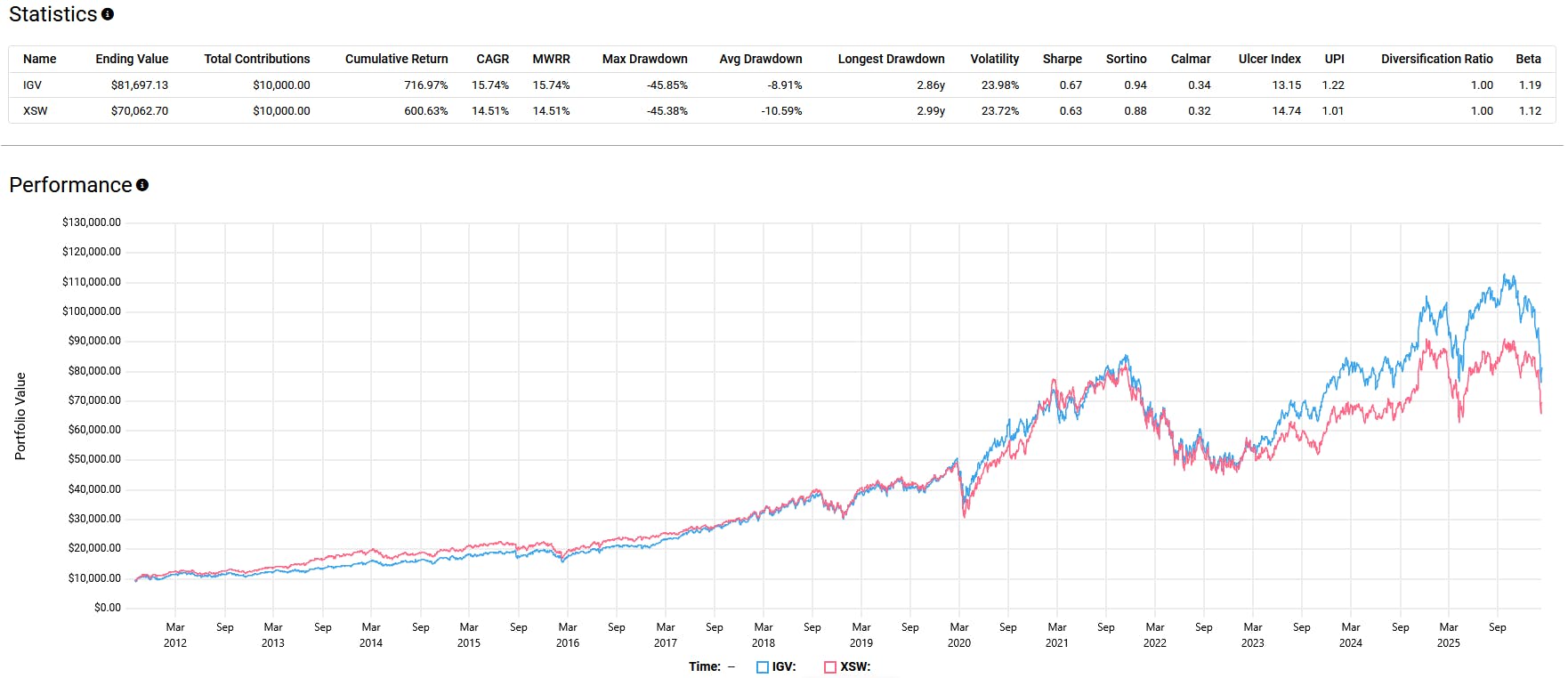
Verdict: IGV comes out ahead. Its market-cap-weighted structure has delivered stronger long-term returns with comparable volatility, leading to superior risk-adjusted performance. For investors prioritizing sustained exposure to large-cap software leaders, IGV has been the more effective vehicle over time.
Please note that this article reflects the author’s personal views and does not represent the opinions of the publication or its affiliates. It is for informational purposes only and does not constitute investment advice. It is essential to seek guidance from a registered financial professional before making any investment decisions.
Mentioned ETFs
Latest ETF News
See all ETF newsTrump Accounts: Here's Which ETFs You Can Invest In

The Two Best Types of Fixed-Income ETFs For Managing Cash

ETF Comparison: Roundhill Generative AI & Technology ETF Versus iShares A.I. Innovation and Tech Active ETF

Crypto Income ETFs: Futures, Options, or Staking?




 Advantages of ETFs over Mutual Funds1/6
Lower Costs
In this guide, we'll explore the advantages of ETFs over mutual funds, giving you valuable insights into why ETFs have gained significant popularity among investors like yourself.
Leveraged ETFs: Unlocking the Potential for Amplified Returns1/6
Understanding Leveraged ETFs
Explore leveraged ETFs: potential for amplified returns & risks. 5 ETFs to consider across equities, commodities & fixed income.
What is a Leveraged ETF?1/6
Introducing Leveraged and Inverse ETFs
In this guide, we'll dive into the world of leveraged ETFs, exploring their definition, mechanics, potential risks, and rewards.
Recent educational content

ETF Trends
ETF Industry KPIs July 20, 2026
This week’s KPI data overview highlights key metrics and trends shaping the ETF landscape.

ETF Trends
ETF Industry KPIs July 13, 2026
This week’s KPI data overview highlights key metrics and trends shaping the ETF landscape.

First Look ETF
First Look ETF: Cash Deployment, Bond, and Hedged ETFs
In this season 6 episode of First Look ETF, Stephanie Stanton examines the latest ETF marketplace trends with NYSE and guests.

ETF Trends
ETF Industry KPIs July 6, 2026
This week’s KPI data overview highlights key metrics and trends shaping the ETF landscape.
Browse all educational columns



The ETF Industry Is Evolving Fast
From AI infrastructure to active strategies, the ETF landscape is shifting. Share your perspective in the 7th Annual Global ETF Survey and get exclusive early access to the final report.