Create, analyze, optimize your ETF portfolio. Start now →



ETF Comparison: Invesco S&P 500 Low Volatility ETF (SPLV) Versus iShares MSCI USA Min Vol Factor ETF (USMV)
Both of these ETFs can help you stay invested while removing some risk, but they work in very different ways.

Keep up with what matters in ETFs
Get timely ETF insights, market trends, and top ideas straight to your inbox.
Your newsletter subscriptions with us are subject to ETF Central's Privacy Policy and Terms and Conditions.
With Donald Trump’s second term in full swing, there’s been no shortage of volatility-inducing events. From threatening tariffs on longstanding trade partners like Canada to pressuring Ukraine to sign a peace deal with Russia, investors can expect market turmoil in the weeks, months, and years to come.
If you’re looking to de-risk your portfolio, there’s no need to rotate into fixed income or use complex options-based hedging strategies. You can remain invested in equities while enjoying a smoother ride by considering low-volatility ETFs like the Invesco S&P 500 Low Volatility ETF
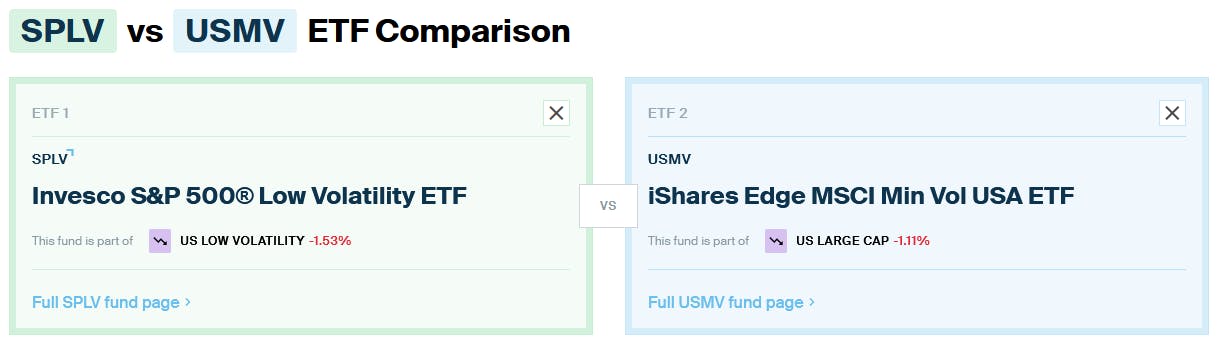
Both ETFs offer the potential to stay invested while aiming for lower downside risk, but they operate very differently despite their similar-sounding names. Here’s how SPLV and USMV compare head-to-head, with data from the ETF Central Comparison Tool.
Like what you're reading?
Stay in the loop — get the latest ETF insights: trends, analysis, and expert picks.
SPLV vs. USMV: Total Cost of Ownership
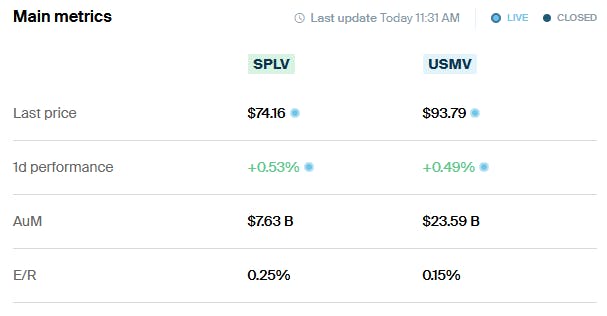
SPLV charges 0.25%, while USMV costs 0.15%, translating to $25 versus $15 annually on a $10,000 investment. On fees alone, USMV comes out ahead.
When it comes to implicit costs, both ETFs have the same 0.015% 30-day average bid-ask spread, making this aspect a tie.
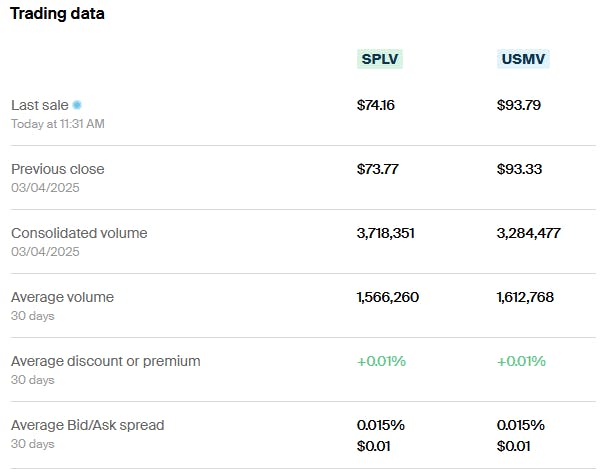
Verdict: Considering both expense ratios and trading costs, USMV is the lower-cost buy-and-hold option.
SPLV vs. USMV: Methodology and Holdings
Both SPLV and USMV aim to reduce volatility, but they go about it in diametrically different ways using competing indexes.
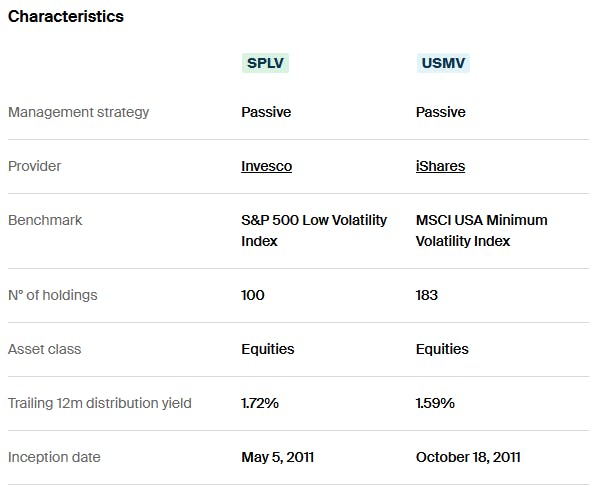
SPLV tracks the S&P 500® Low Volatility Index, which follows a straightforward approach. Every quarter, the fund reconstitutes and rebalances, selecting the 100 securities from the S&P 500® with the lowest realized volatility over the past 12 months. This method directly targets low-volatility stocks, leading to a static basket of defensive names.
In contrast, USMV tracks the MSCI USA Minimum Volatility Index, which uses a quantitative framework to build a portfolio that is, in the aggregate, less volatile. Instead of simply picking low-volatility stocks, USMV considers the correlations between holdings, aiming to construct a portfolio where the combination of stocks offers reduced overall volatility.
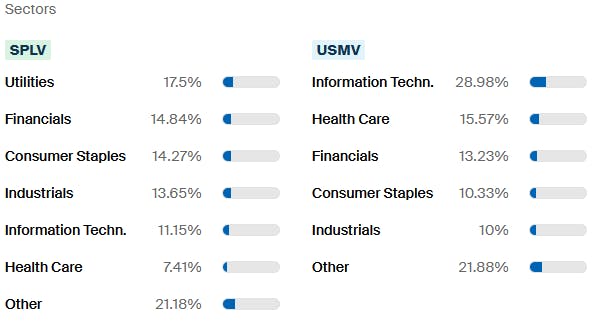
In practice, this leads to notable differences in sector composition. SPLV tends to be overweight in defensive sectors like utilities, consumer staples, and healthcare, with the first two sectors often underrepresented in market-cap-weighted indexes.
USMV, on the other hand, takes a more sector-neutral approach, maintaining sector weights that closely align with the broad market. This means USMV still has the usual overweights to tech, financials, and healthcare, making it less of a departure from the overall market.
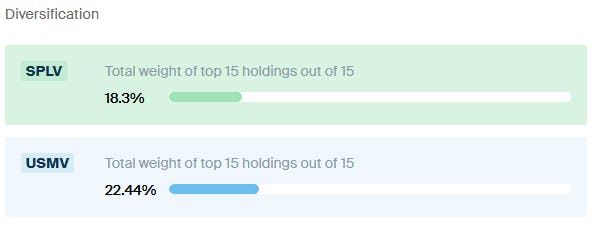
Neither ETF is top-heavy. While USMV has more holdings than SPLV, the top 15 holdings of each account for 22.44% and 18.3% of their portfolios, respectively.
Both ETFs hold what investors traditionally consider defensive stocks, such as Berkshire Hathaway, Republic Services, Waste Management, Colgate-Palmolive, Procter & Gamble, and Walmart.
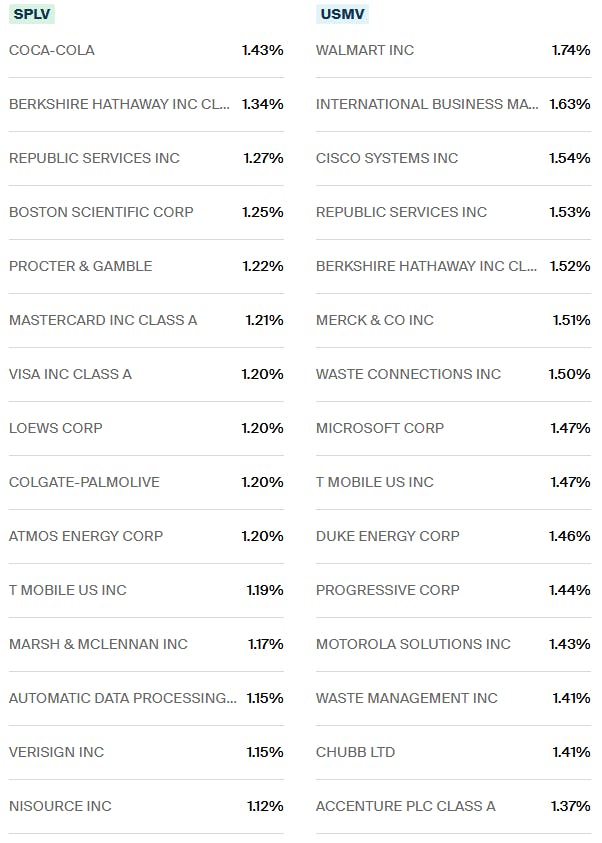
Verdict: I prefer USMV here. The more diversified approach and sector-neutral strategy ensure that any deviations from the broad market are due to individual security selection, not sector concentration bets.
SPLV vs. USMV: Risk and Return
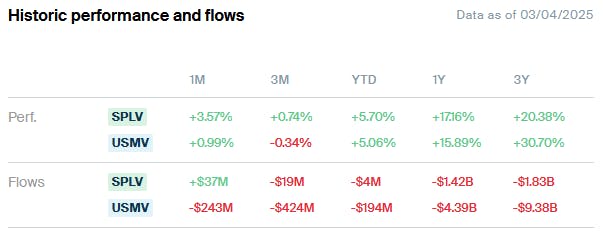
In the short term, it’s a wash between SPLV and USMV. On a three-year trailing basis, USMV outperformed, but over the one-year and year-to-date periods, SPLV has pulled ahead.
Despite these differences, both ETFs saw sustained net outflows, indicating that risk-seeking investors remain disinterested in low-volatility strategies amid bullish market sentiment.
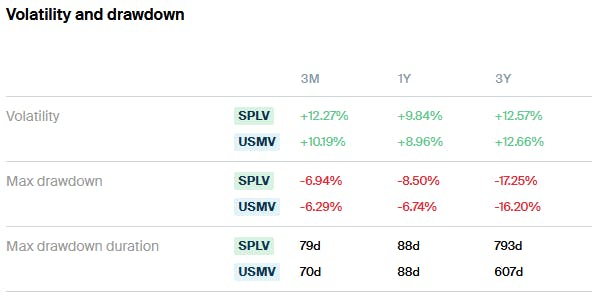
On the risk front, USMV has maintained a slight edge, showing lower volatility across the same periods. It also delivered a shallower max drawdown with a shorter duration, helping investors weather market swings with less turbulence.
Looking at the long-term performance from October 20, 2011, to March 4, 2025, USMV has outperformed SPLV with a compound annual growth rate (CAGR) of 12.53% compared to SPLV’s 11.06% CAGR.
USMV also experienced a smaller max drawdown of 33.10% versus SPLV’s 36.25% and offered better risk-adjusted returns, with a Sharpe ratio of 0.83 compared to SPLV’s 0.70.
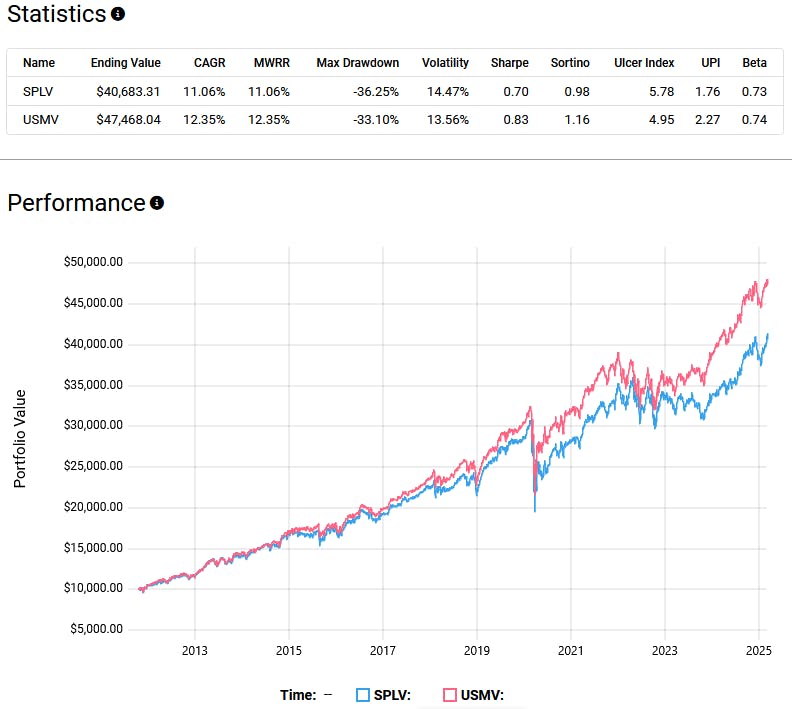
Verdict: USMV wins here. It has navigated the past decade, including the March 2020 COVID crash and the 2022 bear market, with better total returns and superior risk-adjusted performance.
This article is for informational purposes only and does not in any way constitute investment advice. The author may express their own opinions, which may not represent the opinions of ETF Central or its affiliated partners. It is essential that you seek advice from a registered financial professional prior to making any investment decisions.
Latest ETF News
See all ETF newsETF comparison: NEOS S&P 500 High Income ETF (SPYI) Versus Goldman Sachs S&P 500 Premium Income ETF (GPIX)

There’s an ETF for That? Investing Like University Endowments

Could Water ETFs Be the Next AI Bottleneck Trade?

What is a Boomer Candy ETF?




 Advantages of ETFs over Mutual Funds1/6
Lower Costs
In this guide, we'll explore the advantages of ETFs over mutual funds, giving you valuable insights into why ETFs have gained significant popularity among investors like yourself.
Leveraged ETFs: Unlocking the Potential for Amplified Returns1/6
Understanding Leveraged ETFs
Explore leveraged ETFs: potential for amplified returns & risks. 5 ETFs to consider across equities, commodities & fixed income.
What is a Leveraged ETF?1/6
Introducing Leveraged and Inverse ETFs
In this guide, we'll dive into the world of leveraged ETFs, exploring their definition, mechanics, potential risks, and rewards.
Recent educational content

ETF Trends
ETF Industry KPIs September 14, 2026
This week’s KPI data overview highlights key metrics and trends shaping the ETF landscape.

ETF Trends
ETF Industry KPIs September 8, 2026
This week’s KPI data overview highlights key metrics and trends shaping the ETF landscape.
ETF Trends
ETF Industry KPIs August 31, 2026
This week’s KPI data overview highlights key metrics and trends shaping the ETF landscape.
ETF Trends
ETF Industry KPIs August 24, 2026
This week’s KPI data overview highlights key metrics and trends shaping the ETF landscape.
Browse all educational columns



Build and Analyze Your ETF Portfolio Like a Pro
Create your own ETF portfolio in minutes and instantly see allocations, exposures, performance, and risk. Visualize diversification across asset classes, regions, and sectors. Stress-test ideas, compare benchmarks, and refine your strategy with professional-grade analytics.