Open Now: The Global ETF Survey Take the Survey →



ETF Comparison: Invesco S&P 500 Low Volatility ETF Versus THOR Equal Weight Low Volatility ETF (THLV)
Both ETFs provide exposure to large-cap U.S. equities while attempting to lower volatility, but achieve that using different index methodologies.

Keep up with what matters in ETFs
Get timely ETF insights, market trends, and top ideas straight to your inbox.
Your newsletter subscriptions with us are subject to ETF Central's Privacy Policy and Terms and Conditions.
There’s more than one way to structure a low-volatility equity strategy, but few are as well-known as the Invesco S&P 500 Low Volatility ETF
Still, size alone doesn’t mean SPLV should be the default choice for investors seeking a smoother equity ride. Smaller, boutique issuers have built thoughtful alternatives that deserve a look.
One of the most notable is the THOR Equal Weight Low Volatility ETF
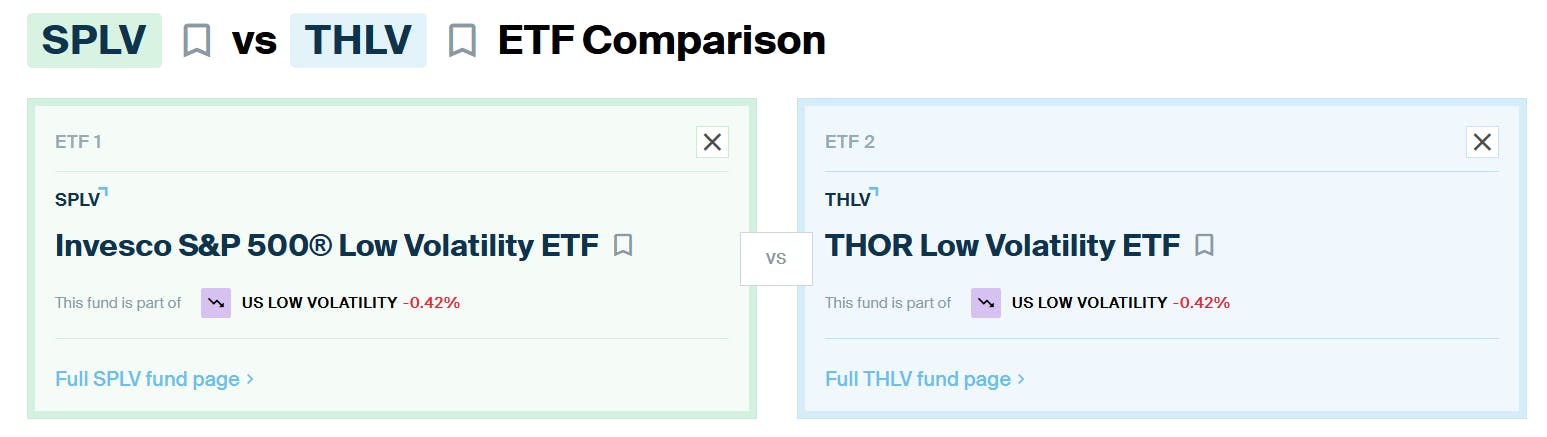
So how do these two competing low-volatility ETFs—one a large, established product and the other a boutique strategy—stack up? Here’s how they compare using data from ETF Central’s comparison tool.
The ETF Industry Is Evolving Fast
From AI infrastructure to active strategies, the ETF landscape is shifting. Share your perspective in the 7th Annual Global ETF Survey and get exclusive early access to the final report.
SPLV vs. THLV: Total Cost of Ownership
It’s tough to beat the largest ETF issuers on headline fees. Scale lets firms like Invesco spread fixed costs across billions in assets and even run certain strategies as loss leaders to defend market share. SPLV benefits from that scale. It charges a 0.25% expense ratio, well below THLV’s 0.64%.
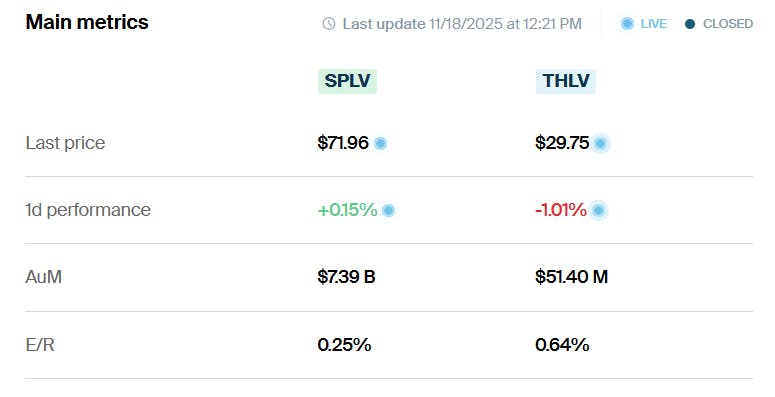
Cost isn’t only about the headline fee. Spreads matter too, especially if you trade more frequently. SPLV’s 30-day median bid-ask spread sits at 0.016%, reflecting deep liquidity. THLV’s spread is 0.109%, understandable for a boutique product but still meaningfully wider. Long-term buy-and-hold investors may not feel that difference as much, but it’s part of the total cost picture.
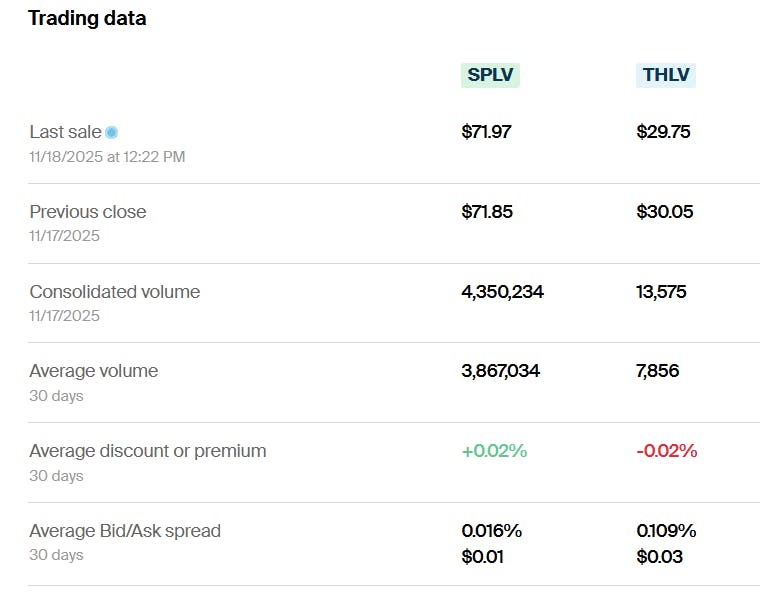
Verdict: Combining fees and spreads, SPLV emerges as the more cost-effective and liquid option.
SPLV vs. THLV: Methodology and Exposure
Both ETFs target lower-volatility U.S. equity exposure, but they arrive there using very different index construction rules.
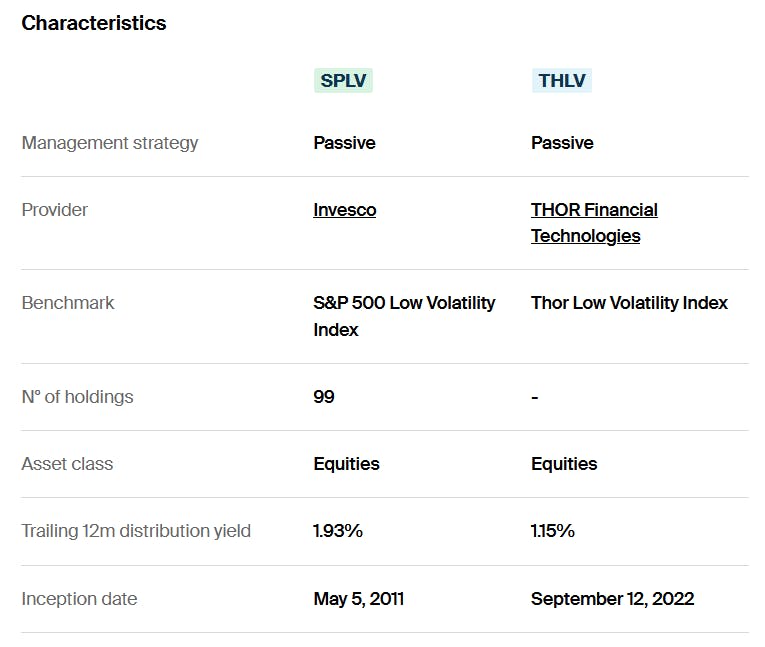
SPLV tracks the S&P 500 Low Volatility Index. It selects the 100 stocks in the S&P 500 with the lowest trailing one-year standard deviation and weights them by inverse volatility. Lower-volatility stocks receive larger weights. The index reconstitutes quarterly, which can lead to meaningful turnover as volatility profiles shift.
THLV takes a different path. It tracks the THOR U.S. Sector Low Volatility Index, which allocates across the SPDR sector ETFs except consumer discretionary. Rather than screening individual stocks, the index uses a quantitative model to evaluate sector-level conditions and applies a weekly risk-on or risk-off tilt. It’s essentially a sector-based trend-following approach that assumes leadership and volatility conditions rotate and should be managed at the portfolio level.
The end result is a notable divergence in exposures. SPLV’s backward-looking screen produces heavy allocation to traditional defensive sectors like utilities and consumer staples. THLV is more balanced because it rotates across sectors rather than concentrating in historical low-volatility pockets.
Verdict: I prefer THLV’s approach because it focuses on portfolio-level risk management rather than relying entirely on trailing volatility. Its methodology accounts for changing market regimes instead of extrapolating past stability into the future.
SPLV vs. THLV: Risk and Return
With a shared inception date of September 12, 2022, the performance history is still short. Even so, the data captures two useful stress periods: the back half of the 2022 bear market and the April 2024 tariff-driven correction.
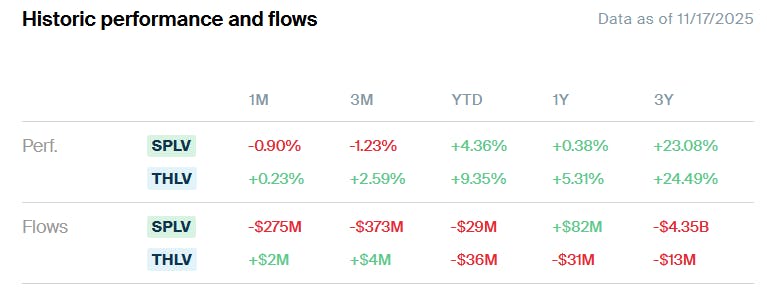
Across the three-year, one-year, and year-to-date windows, THLV has delivered higher total returns than SPLV. Both ETFs have seen recent outflows, which isn’t surprising in a strong equity market where investors tend to shift away from defensive or low-volatility products.
Risk results over the same horizon are mixed. SPLV has posted higher volatility, while THLV has experienced deeper peak-to-trough drawdowns. The depth of those drawdowns varies depending on the window you examine, so neither fund consistently dominates the other on downside behavior.
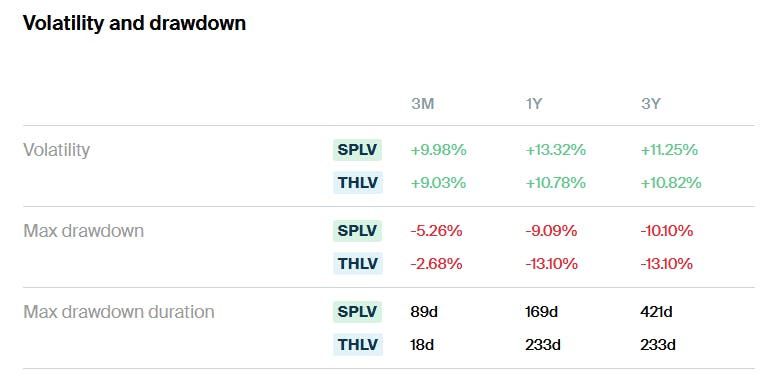
The aggregate backtest covering 3.18 years (2022-09-13 to 2025-11-17) helps fill the gaps. THLV outperformed with an 8.24% compound annual growth rate versus 6.26% for SPLV. It also produced a better overall risk-adjusted profile.
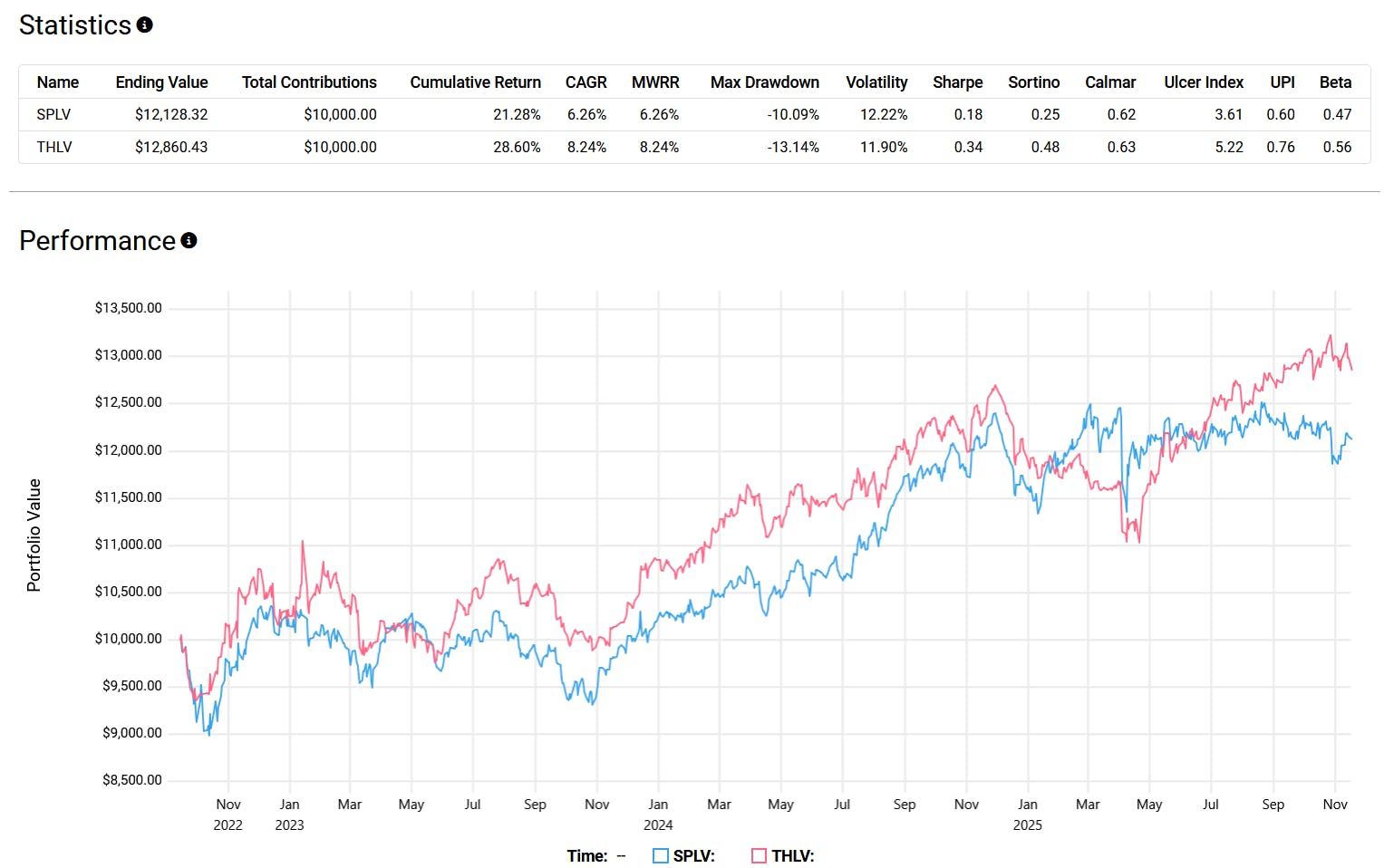
THLV’s volatility was lower over the full period, and its Sharpe and Sortino ratios were higher. Although its maximum drawdown was steeper, the fund still edged out SPLV on a drawdown-adjusted basis, measured through the Calmar ratio.
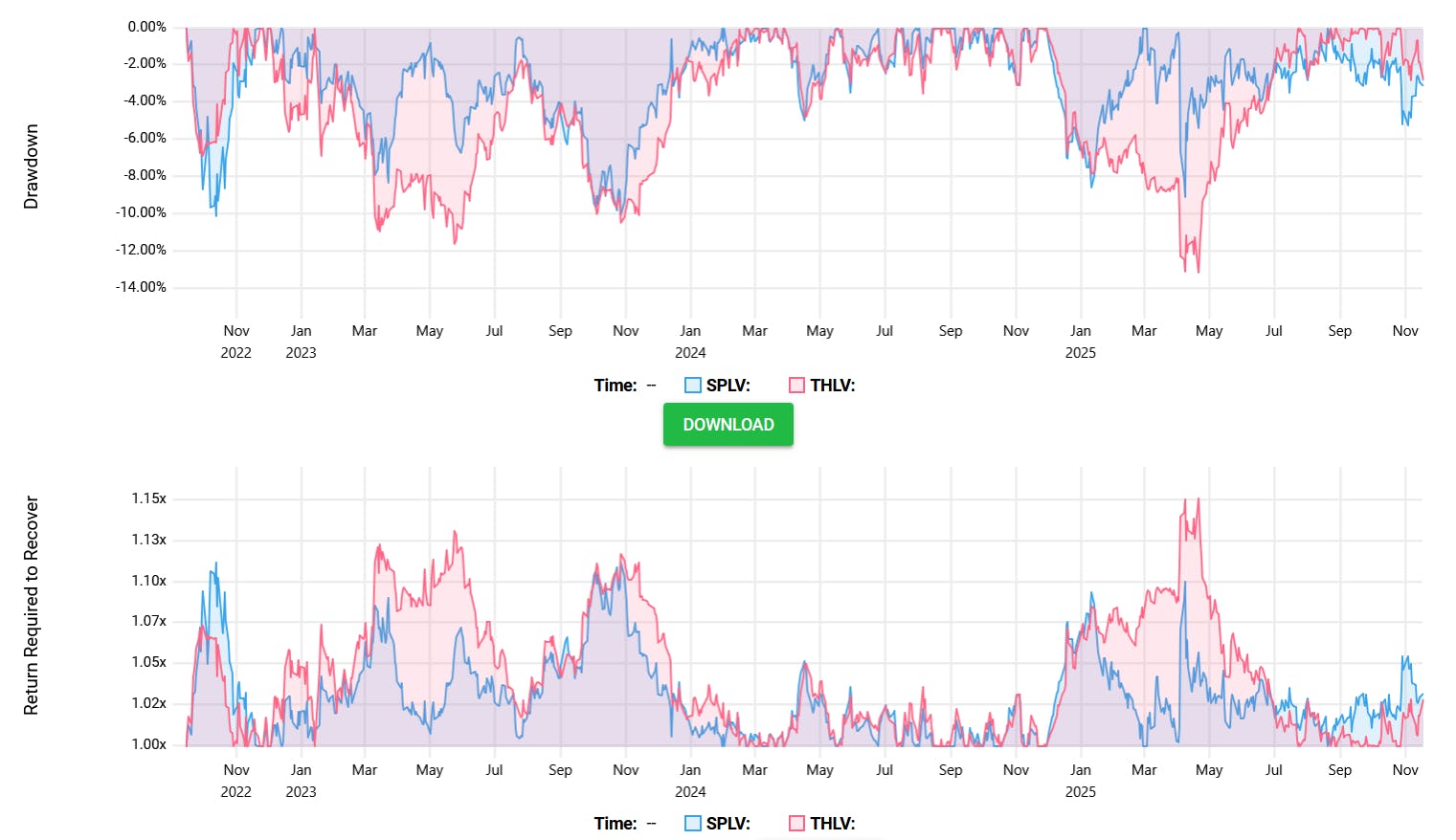
Verdict: THLV comes out ahead on total return and risk-adjusted efficiency, even with the occasional deeper dip. Looking forward, I personally prefer strategies that account for changing market regimes and manage risk at the portfolio level rather than relying solely on backward-looking volatility screens.
Please note this article is for information purposes only and does not in any way constitute investment advice. It is essential that you seek advice from a registered financial professional prior to making any investment decision.
Latest ETF News
See all ETF newsHow Investors can Maximize Tax Efficiency with Income ETFs

Trump Accounts: Here's Which ETFs You Can Invest In

The Two Best Types of Fixed-Income ETFs For Managing Cash

ETF Comparison: Roundhill Generative AI & Technology ETF Versus iShares A.I. Innovation and Tech Active ETF




 Advantages of ETFs over Mutual Funds1/6
Lower Costs
In this guide, we'll explore the advantages of ETFs over mutual funds, giving you valuable insights into why ETFs have gained significant popularity among investors like yourself.
Leveraged ETFs: Unlocking the Potential for Amplified Returns1/6
Understanding Leveraged ETFs
Explore leveraged ETFs: potential for amplified returns & risks. 5 ETFs to consider across equities, commodities & fixed income.
What is a Leveraged ETF?1/6
Introducing Leveraged and Inverse ETFs
In this guide, we'll dive into the world of leveraged ETFs, exploring their definition, mechanics, potential risks, and rewards.
Recent educational content

ETF Trends
ETF Industry KPIs July 20, 2026
This week’s KPI data overview highlights key metrics and trends shaping the ETF landscape.

ETF Trends
ETF Industry KPIs July 13, 2026
This week’s KPI data overview highlights key metrics and trends shaping the ETF landscape.
First Look ETF
First Look ETF: Cash Deployment, Bond, and Hedged ETFs
In this season 6 episode of First Look ETF, Stephanie Stanton examines the latest ETF marketplace trends with NYSE and guests.

ETF Trends
ETF Industry KPIs July 6, 2026
This week’s KPI data overview highlights key metrics and trends shaping the ETF landscape.
Browse all educational columns



Expert-Built ETF Portfolios, All in One Place
Don’t start from scratch. Discover ready-made ETF portfolios built by professionals to match different goals, timelines, and market views. Use them as inspiration or as a starting point for your own allocation.