Create, analyze, optimize your ETF portfolio. Start now →



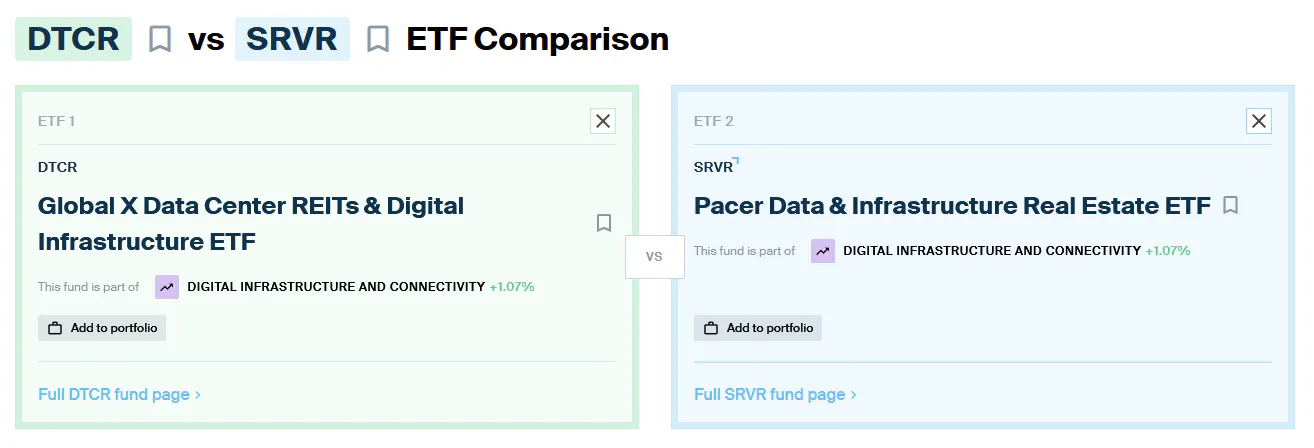
ETF Comparison: Global X Data Center REITs & Digital Infrastructure ETF (DTCR) Versus Pacer Data & Infrastructure Real Estate ETF (SRVR)
Both of these competing thematic ETFs provide landlord-like, tollbooth exposure to the real assets driving AI infrastructure development.

Keep up with what matters in ETFs
Get timely ETF insights, market trends, and top ideas straight to your inbox.
Your newsletter subscriptions with us are subject to ETF Central's Privacy Policy and Terms and Conditions.
Data centers have been everywhere in the headlines lately. The themes driving that attention go beyond just artificial intelligence (AI) demand.
Power is becoming a real constraint, with growing electrification needs putting strain on grids and raising the possibility of regulatory pushback, whether through higher costs or requirements for on-site generation. There’s also a social angle. Many of these developments are being built in less urban areas, where local resistance to large-scale infrastructure projects could slow expansion.
Even with those risks, the growth trajectory is hard to ignore. While most investors gravitate toward chipmakers or software companies building large language models, there’s another way to play it. Real estate investment trusts (REITs) that own and lease out these facilities effectively operate like tollbooths, collecting rent from hyperscalers and cloud providers that need the infrastructure to run.
That exposure is now available in ETF form through a more targeted set of real estate strategies. Two of the more focused options are the Global X Data Center REITs & Digital Infrastructure ETF
Both go beyond broad real estate sector funds to zero in on digital infrastructure tied to AI and data demand. Using data from the ETF Central comparison tool, here’s how they stack up.
Like what you're reading?
Stay in the loop — get the latest ETF insights: trends, analysis, and expert picks.
DTCR vs. SRVR: Total Cost of Ownership
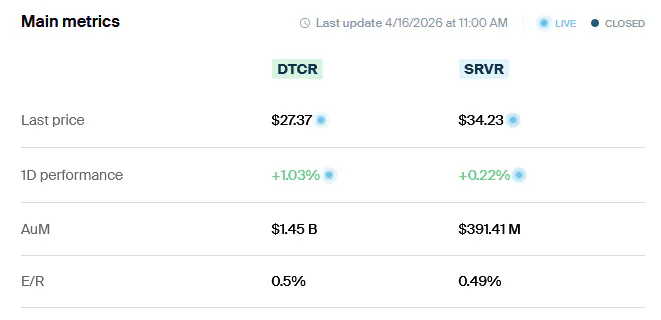
Thematic ETFs tend to come with higher price tags than broad market funds. DTCR charges a 0.50% expense ratio, while SRVR comes in one basis point lower at 0.49%. On a $10,000 investment, that works out to about $50 versus $49 per year. that’s a rounding error.
Expense ratios aren’t the only cost to consider, though. If you’re trading these ETFs more actively, the bid-ask spread also matters. Here, DTCR has a slight edge, with a 30-day average spread of 0.213% compared to 0.226% for SRVR. Again, the difference is marginal.
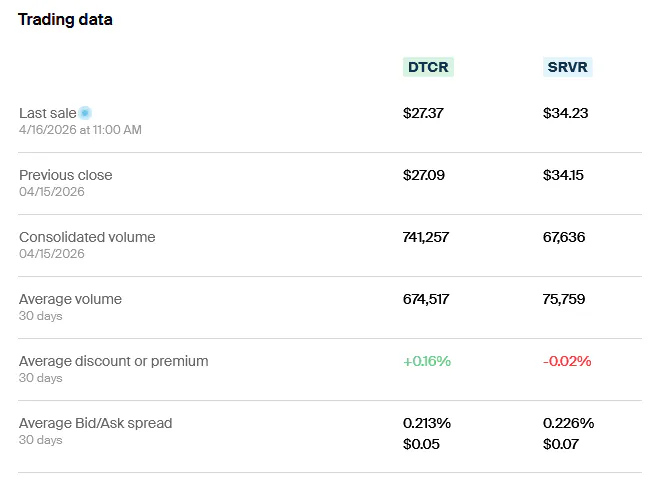
Verdict: Once you factor in both fees and trading costs, you’re basically splitting basis points. Total cost of ownership is effectively identical, so this one is a tie.
DTCR vs. SRVR: Methodology and Holdings
Both ETFs are passive index trackers, but the benchmarks they follow take very different approaches for security selection and weighting.
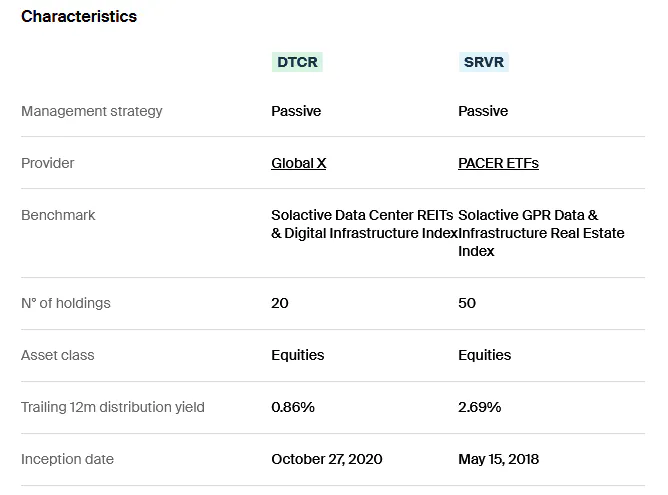
DTCR tracks the Solactive Data Center REITs & Digital Infrastructure Index. It’s a relatively concentrated portfolio of just 20 holdings, with a 0.86% trailing 12-month yield. The strategy goes beyond traditional real estate by including companies tied to the broader data center ecosystem. That means you’re not just getting landlords, but also exposure to semiconductor names that support the buildout.
SRVR, on the other hand, tracks the S&P Global Data & Infrastructure Real Estate Index, with a broader basket of about 50 holdings. It also offers a higher 2.69% 30-day SEC yield. The focus here is more squarely on real assets, with greater weight in real estate and some exposure to communications.
That difference shows up clearly in the portfolios. As expected, both ETFs have a heavy real estate focus, but DTCR is more heavily tilted toward U.S. companies and includes a meaningful allocation to technology names at over a quarter of its portfolio.
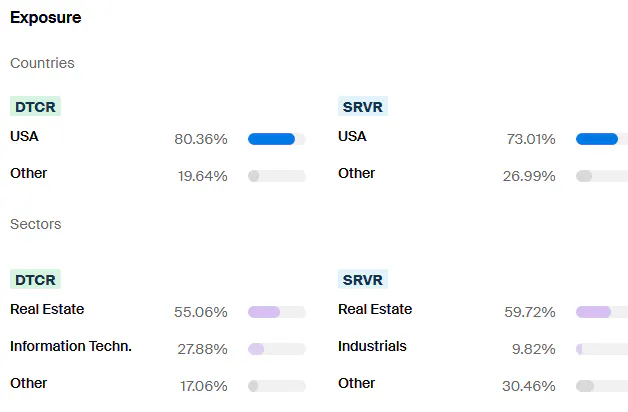
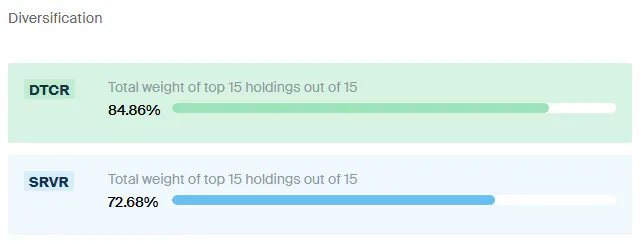
Both funds are top-heavy, but DTCR is more concentrated. Its top 15 holdings account for 84.86% of the portfolio, compared to 72.68% for SRVR.
There is overlap at the top, with Equinix, Digital Realty, American Tower, and Crown Castle featuring prominently in both. But dig into DTCR’s holdings and you’ll find companies like Micron, Intel, Taiwan Semiconductor, Broadcom, AMD, and Nvidia alongside the usual REIT suspects. SRVR stays closer to its lane, with a more global footprint, including names like China Tower.
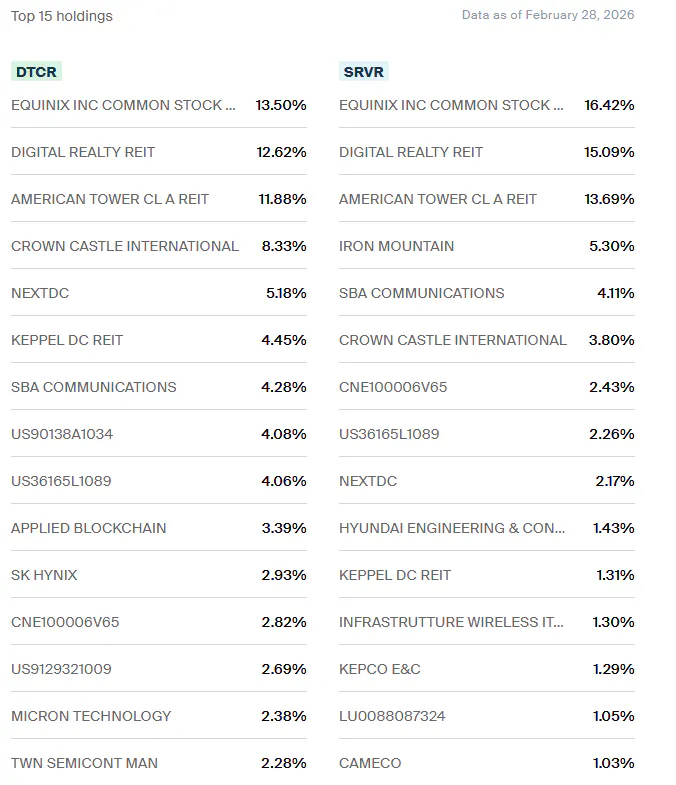
Verdict: SRVR stands out to me as the cleaner digital real estate play. You’re getting higher yield, broader diversification, and less overlap with mega-cap tech names that investors may already own elsewhere.
DTCR vs. SRVR: Risk and Return
Over the trailing five-, three-, and one-year periods, as well as year-to-date, DTCR has outperformed SRVR. By stepping outside of real estate and into technology, it has benefited from the strength in semiconductors and AI-related infrastructure, while REITs have faced pressure from higher rates.
That positioning has also made DTCR the more popular fund, with consistent net inflows over the same periods. SRVR, in contrast, has seen net outflows despite its larger and more established portfolio.
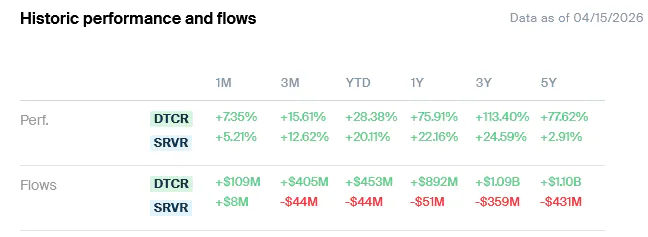
On the risk side, DTCR is more volatile across those same timeframes. That’s not surprising given its exposure to tech stocks, which tend to have sharper price swings.
However, when you look at drawdowns, SRVR has had its own issues. Peak-to-trough losses have, at times, been deeper and slower to recover, reflecting the more muted rebound profile of real estate compared to tech.
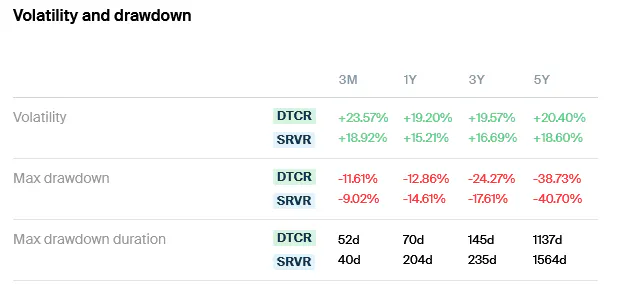
Verdict: Objectively, DTCR gets the edge here. Higher returns have come with higher volatility, but the payoff profile has been more favorable, especially in a macro environment where tech has led and real estate has lagged.
Please note that this article reflects the author’s personal views and does not represent the opinions of the publication or its affiliates. It is for informational purposes only and does not constitute investment advice. It is essential to seek guidance from a registered financial professional before making any investment decisions.
Mentioned ETFs
Further reading
Latest ETF News
See all ETF newsBeyond Big Tech: The Increasing Specialization of AI ETFs

There's an ETF for That? Humanoid Robotics and Physical AI

How Some ETF Issuers Use Their Own Funds for Cash Management

These Public-Private ETFs Invest in Polymarket and Anduril

There's an ETF for That? Frontier Markets



 Advantages of ETFs over Mutual Funds1/6
Lower Costs
In this guide, we'll explore the advantages of ETFs over mutual funds, giving you valuable insights into why ETFs have gained significant popularity among investors like yourself.
Leveraged ETFs: Unlocking the Potential for Amplified Returns1/6
Understanding Leveraged ETFs
Explore leveraged ETFs: potential for amplified returns & risks. 5 ETFs to consider across equities, commodities & fixed income.
What is a Leveraged ETF?1/6
Introducing Leveraged and Inverse ETFs
In this guide, we'll dive into the world of leveraged ETFs, exploring their definition, mechanics, potential risks, and rewards.
Recent educational content

First Look ETF
First Look ETF: Income, International, and Cash Flow ETFs
In this season 6 episode of First Look ETF, Stephanie Stanton @etfguide examines the latest ETF marketplace trends with NYSE and guests.


ETF Trends
ETF Industry KPIs October 5, 2026
This week’s KPI data overview highlights key metrics and trends shaping the ETF landscape.

ETF Trends
ETF Industry KPIs September 28, 2026
This week’s KPI data overview highlights key metrics and trends shaping the ETF landscape.
ETF Trends
ETF Industry KPIs September 22, 2026
This week’s KPI data overview highlights key metrics and trends shaping the ETF landscape.
Browse all educational columns



ETFs’ Next Act: From Access to Selection
With 1,790 new products launched by July 2026, choosing is harder than ever. Our Global ETF Survey 2026, built on 620 professional investors and allocators, shows how active, fixed income, options-based and thematic ETFs are reshaping fund selection.