Create, analyze, optimize your ETF portfolio. Start now →



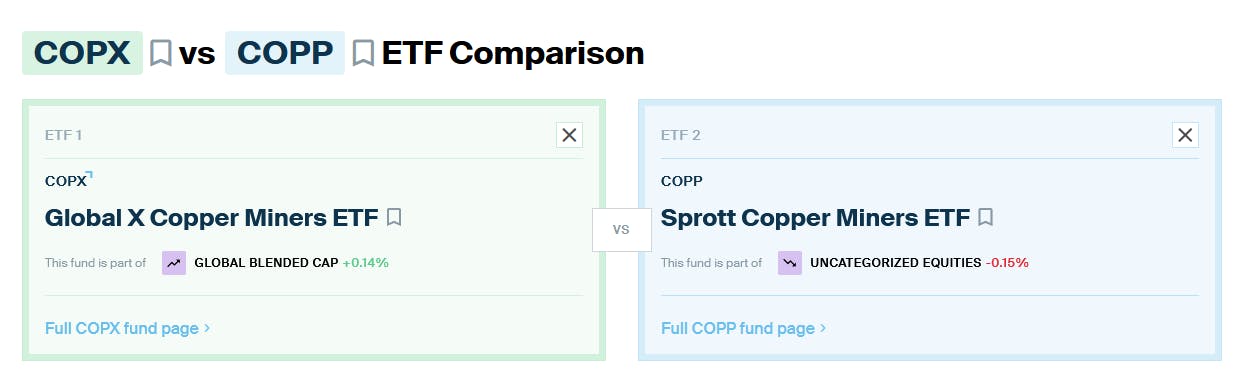
ETF Comparison: Global X Copper Miners ETF (COPX) Versus Sprott Copper Miners ETF (COPP)
Copper prices have taken center stage amidst a continuation of the “debasement trade” and electrification demands from AI infrastructure build-out.

Keep up with what matters in ETFs
Get timely ETF insights, market trends, and top ideas straight to your inbox.
Your newsletter subscriptions with us are subject to ETF Central's Privacy Policy and Terms and Conditions.
Base metals have begun to follow precious metals into the debasement trade as that theme carries into 2026. A softer U.S. dollar, combined with renewed speculative interest from overseas investors, particularly China, has pushed copper into the spotlight alongside gold and silver.
The difference is that copper is not a precious metal. It is primarily an industrial input with direct ties to real economic activity.
Copper sits at the center of electrification. It is a key component in power grids, electric vehicles, charging infrastructure, data centers, and renewable energy systems. The build-out of AI infrastructure has only intensified that demand, as high-performance computing requires dense electrical wiring and efficient heat dissipation.
At the same time, supply remains constrained. A large share of global copper production is concentrated in emerging market countries that are not always aligned with U.S. strategic interests, even as the U.S. has classified copper as a critical resource.
When spot copper prices move higher, mining equities often amplify those moves. That operating leverage comes from largely fixed costs at the mine level, which means incremental price gains can translate into outsized changes in cash flow and equity valuations.
As a result, inflows into copper miner ETFs can accelerate faster than flows into the physical metal itself. Against that backdrop, today’s comparison looks at two of the most widely used copper miner ETFs, the Global X Copper Miners ETF
Like what you're reading?
Stay in the loop — get the latest ETF insights: trends, analysis, and expert picks.
COPX vs. COPP: Total Cost of Ownership
As thematic products, neither of these ETFs is inexpensive. While broad sector ETFs can charge as little as 0.08%, copper is not a sector. It is a narrow subset of the materials space, and that specialization comes with higher costs. Both ETFs charge the same net expense ratio of 0.65%, which translates to roughly $65 per year on a $10,000 investment.
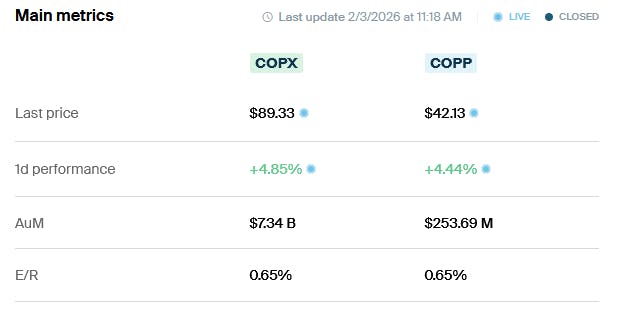
The expense ratio is not the only cost to consider. Trading costs matter as well, particularly the bid-ask spread, which reflects the difference between the price you can buy at and the price you can sell at. This is most relevant for short-term traders. On this front, COPX is meaningfully cheaper, with a 30-day average bid-ask spread of 0.053%. COPP is far less liquid, with a spread of 0.377%.
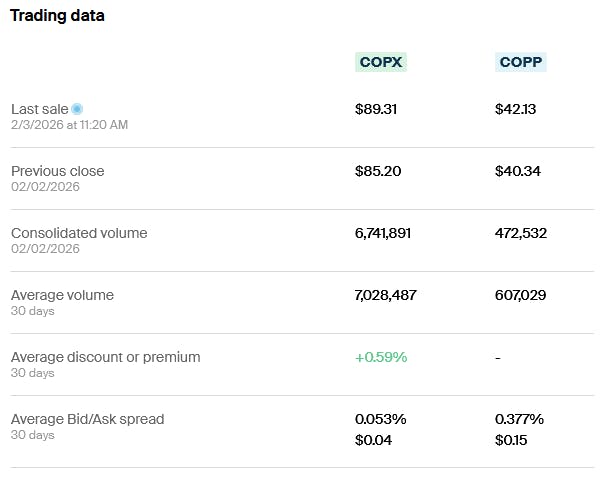
Verdict: When combining the expense ratio with average bid-ask spreads, COPX is the cheaper option for short-term trading. For long-term investors, the higher spread on COPP may be less relevant if positions are entered carefully and held over time.
COPX vs. COPP: Methodology and Holdings
Both ETFs are passive, but they track different indexes, which leads to meaningful differences in portfolio construction, concentration, and country exposure. There is overlap in holdings, but the way each fund expresses copper exposure is not the same.
COPX tracks the Selective Global Copper Miners Index. The result is a relatively concentrated portfolio of 35 holdings and an annualized yield of 2.28%. COPP follows a broader NASDAQ-sourced copper miners index with 174 holdings and a slightly lower yield of 2.05%.
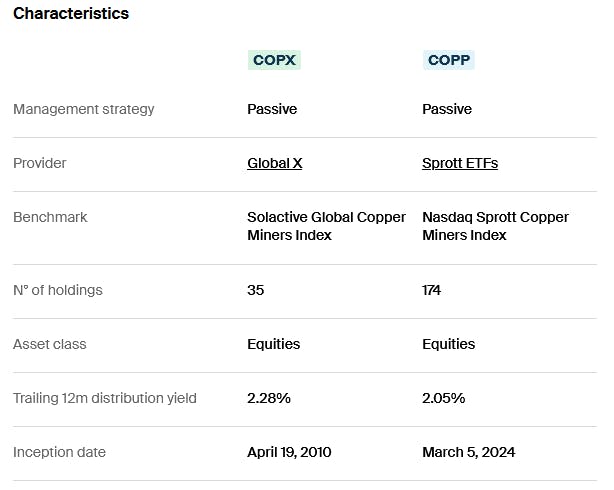
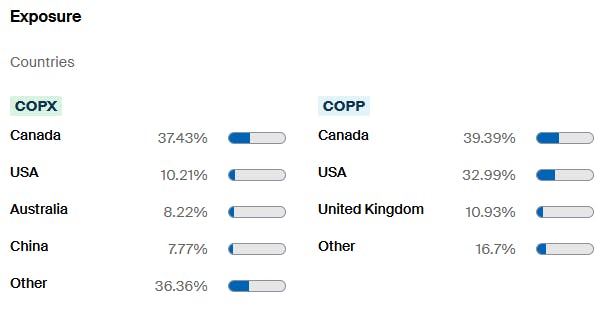
Country exposure is similar at the top level, with both ETFs allocating more than 37% of assets to Canadian equities. That reflects Canada’s role as a home base for large, publicly listed mining companies, even when underlying operations are global. COPP has higher exposure to U.S. and United Kingdom listings, while COPX leans more heavily toward Australia and China as secondary allocations.
Holdings across both ETFs will look familiar to most investors. There is shared exposure to companies such as Freeport-McMoRan, Southern Copper, and Teck, alongside a mix of foreign-listed miners, including Polish, Chinese, and U.K. names. In both cases, exposure skews toward large-cap producers rather than smaller, higher-risk developers.
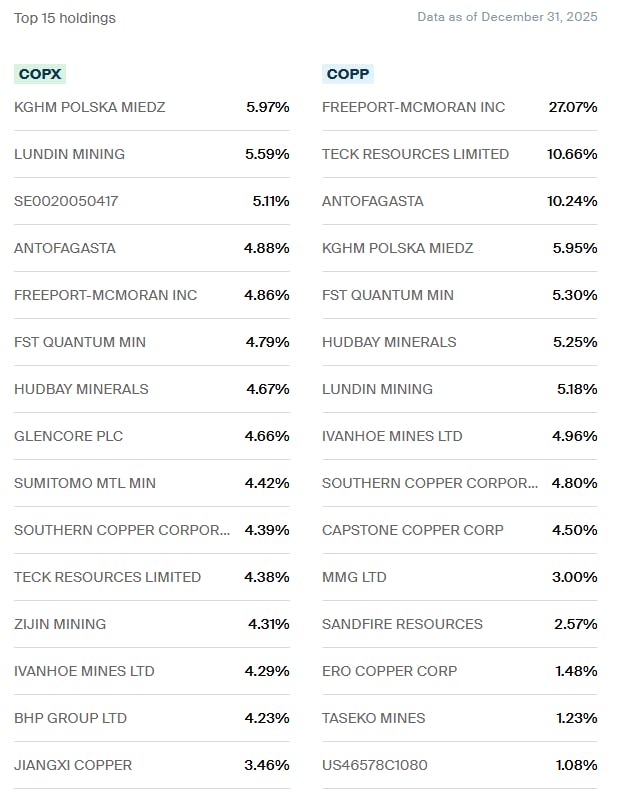
Verdict: COPX is my preferred option here. Despite having fewer holdings, its concentration is materially lower than COPP’s. If the goal is to express a bullish view on the copper industry as a whole rather than on a single producer, allocating roughly a quarter of a portfolio to one company, as COPP currently does, is a meaningful drawback.
COPX vs. COPP: Risk and Return
The shared performance history between these ETFs is limited. COPP only launched on March 5, 2024, while COPX dates back to April 19, 2010. That short overlap constrains longer-term comparisons, but recent data still offers some insight.
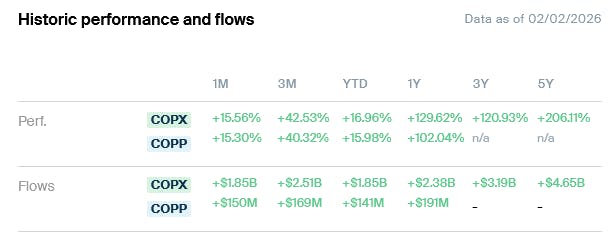
Across the trailing year, year to date, and the one- and three-month periods, both ETFs have posted strong gains. That is not surprising given the move in spot copper. However, COPX currently leads on absolute returns across those windows. It has also attracted meaningfully larger net inflows, running into the billions, compared with hundreds of millions for COPP.
Risk metrics tell a similar story. COPP has exhibited higher volatility than COPX over both the one- and three-year periods, with a wider dispersion of returns. It has also experienced a deeper maximum drawdown and a longer recovery period. The most likely driver is concentration. When a single holding represents a large share of the portfolio, performance tends to swing more sharply in both directions.
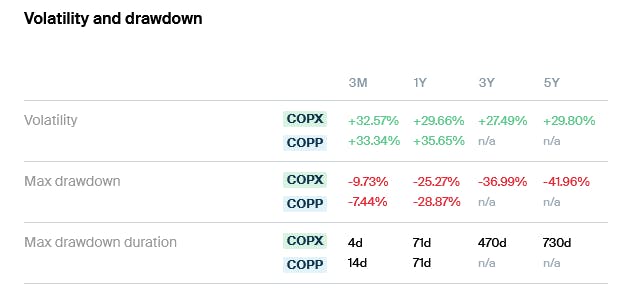
Verdict: COPX comes out ahead for me. It has delivered better historical returns with lower volatility, shallower drawdowns, and more diversified exposure within the copper mining space. For investors seeking broad copper miner exposure rather than a leveraged bet on a small number of producers, I think that balance matters.
Please note this article is for information purposes only and does not in any way constitute investment advice. It is essential that you seek advice from a registered financial professional prior to making any investment decision.

Latest ETF News
See all ETF newsWhat is a Boomer Candy ETF?

ETF Comparison: NEOS Nasdaq-100 High Income ETF (QQQI) Versus Goldman Sachs Nasdaq-100 Premium Income ETF (GPIQ)

Which Real Estate ETFs Pay the Highest Yields?





 Advantages of ETFs over Mutual Funds1/6
Lower Costs
In this guide, we'll explore the advantages of ETFs over mutual funds, giving you valuable insights into why ETFs have gained significant popularity among investors like yourself.
Leveraged ETFs: Unlocking the Potential for Amplified Returns1/6
Understanding Leveraged ETFs
Explore leveraged ETFs: potential for amplified returns & risks. 5 ETFs to consider across equities, commodities & fixed income.
What is a Leveraged ETF?1/6
Introducing Leveraged and Inverse ETFs
In this guide, we'll dive into the world of leveraged ETFs, exploring their definition, mechanics, potential risks, and rewards.
Recent educational content

ETF Trends
ETF Industry KPIs September 8, 2026
This week’s KPI data overview highlights key metrics and trends shaping the ETF landscape.

ETF Trends
ETF Industry KPIs August 31, 2026
This week’s KPI data overview highlights key metrics and trends shaping the ETF landscape.
ETF Trends
ETF Industry KPIs August 24, 2026
This week’s KPI data overview highlights key metrics and trends shaping the ETF landscape.
What’sTheFund
What's the Fund | Ocean Park Diversified Income ETF (DUKZ)
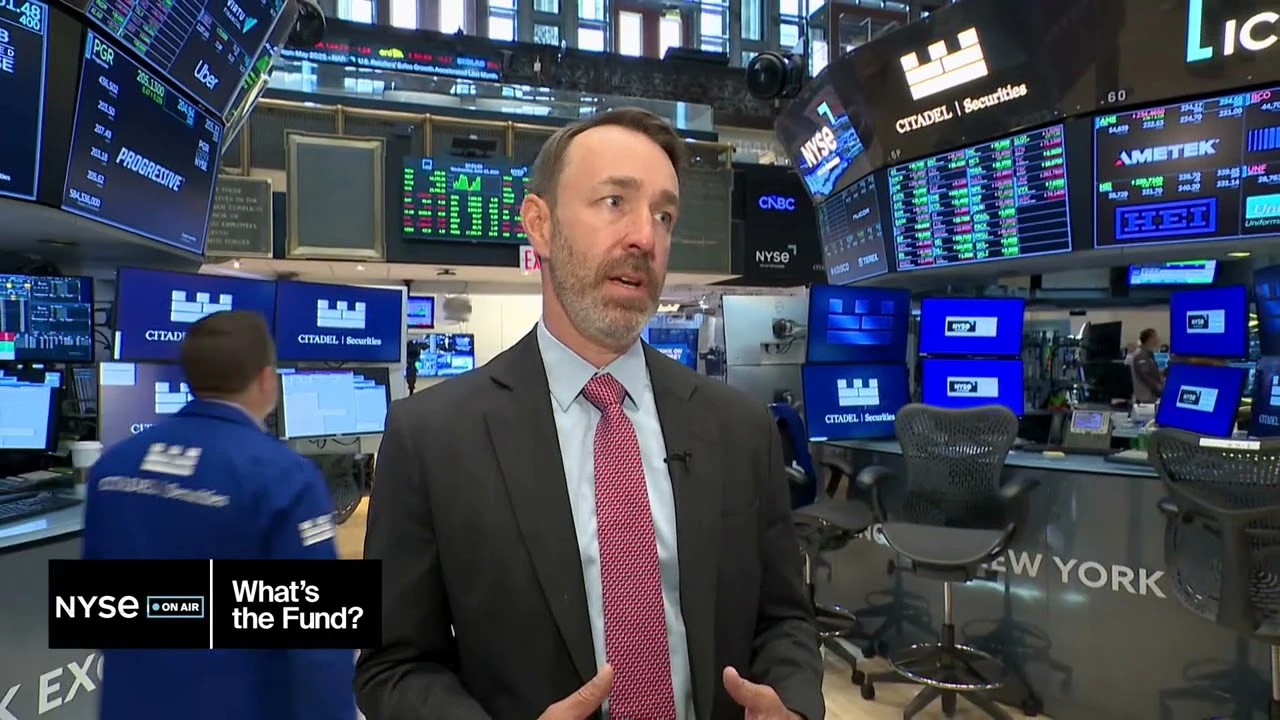
James St Aubin, Chief Investment Officer at Ocean Park Asset Management, discuss the DUKZ ETF, exposing investors to the whole spectrum of asset classes in the fixed income markets, through their rules-based process.

Browse all educational columns



Expert-Built ETF Portfolios, All in One Place
Don’t start from scratch. Discover ready-made ETF portfolios built by professionals to match different goals, timelines, and market views. Use them as inspiration or as a starting point for your own allocation.