Create, analyze, optimize your ETF portfolio. Start now →



ETF Comparison: Fundstrat Granny Shots US Large Cap ETF (GRNY) Versus ARK Innovation ETF (ARKK)
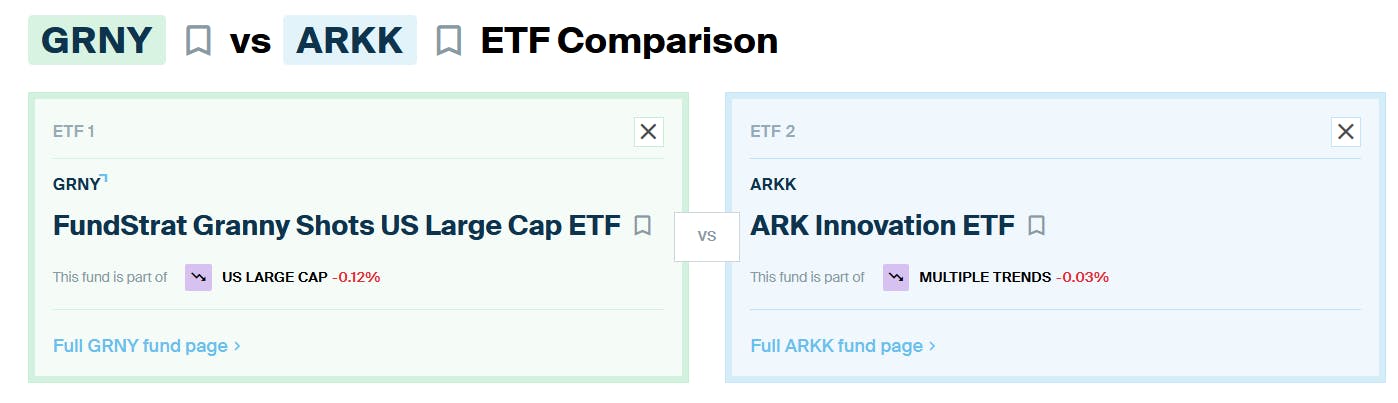
Tom Lee and Cathie Wood go head-to-head in this week’s active ETF comparison.


Keep up with what matters in ETFs
Get timely ETF insights, market trends, and top ideas straight to your inbox.
Your newsletter subscriptions with us are subject to ETF Central's Privacy Policy and Terms and Conditions.
Wall Street’s most famous bears have stayed quiet for most of 2025, aside from briefly waking during the April “tariff tantrum” sell-off to gloat. They were quickly beaten back into silence as every major index pushed to fresh all-time highs.
The bulls, however, are still very much active, and some have their own ETFs. Leading inflows and AUM growth right now are a pair of funds from Tom Lee and Cathie Wood.
Lee, known for his consistently bullish calls on U.S. equities, now runs the Fundstrat Granny Shots US Large Cap ETF
Both offer actively managed strategies, but they take very different approaches. Here’s how they compare, based on data from the ETF Central comparison tool.
Like what you're reading?
Stay in the loop — get the latest ETF insights: trends, analysis, and expert picks.
GRNY vs. ARKK: Total Cost of Ownership
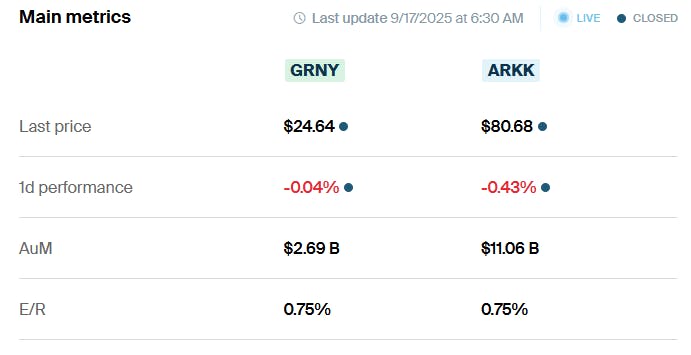
Both funds charge the same 0.75% expense ratio, which is on the higher side but has become the accepted standard for actively managed equity ETFs. This fee level is common among boutique managers converting mutual funds to ETFs or using white-label platforms. Put simply, investors pay about $75 annually for every $10,000 invested.
However, management fees aren’t the only cost of investing in ETFs. Trading also matters, since the gap between the bid and ask price—the spread—eats into returns. On this front, ARKK has the edge, with a 30-day median bid-ask spread of 0.019% compared with 0.046% for GRNY.
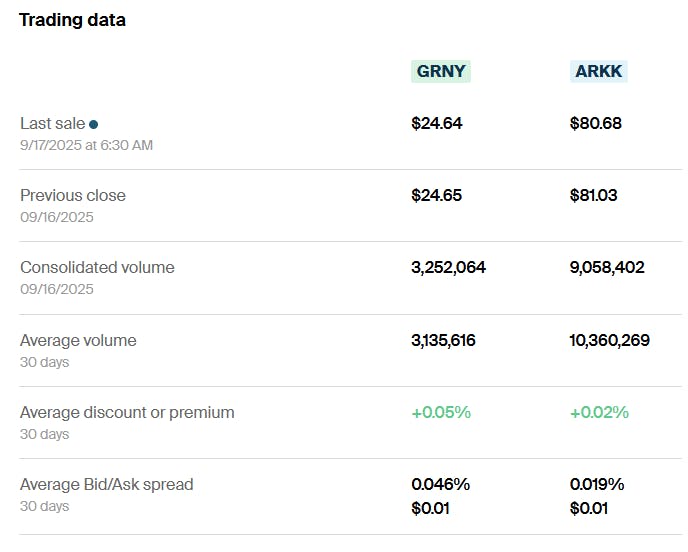
Verdict: When you combine expense ratios with spreads, ARKK comes out slightly cheaper to trade. But for buy-and-hold investors, the difference is negligible unless one of the funds decides to cut fees, which seems unlikely.
GRNY vs. ARKK: Methodology and Holdings
Neither fund follows an index with rigid, rules-based criteria. Both are actively managed in the truest sense, relying on discretionary stock picking by a lead manager supported by analyst teams, guided only by broad principles.
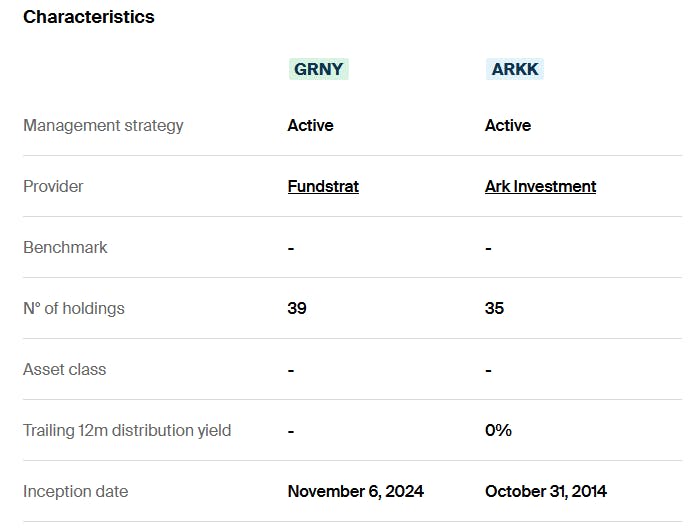
GRNY is built on Tom Lee’s “granny shot” philosophy, a basketball metaphor. In practice, the portfolio is divided into long-term and short-term themes that Fundstrat believes will outperform, with stock selection done from the bottom up within each bucket. While not marketed explicitly this way, the approach resembles a growth-at-a-reasonable-price (GARP) style, blending growth potential with some attention to valuations.
ARKK, in contrast, is less interested in established large caps and instead seeks out disruptive mid- and small-cap companies. Its portfolio spans themes such as intelligent devices, autonomous mobility, precision therapies, neural networks, next-gen cloud, digital wallets, digital assets, smart contracts, and genomics. This results in a very different composition than GRNY, with a heavier emphasis on speculative innovation.
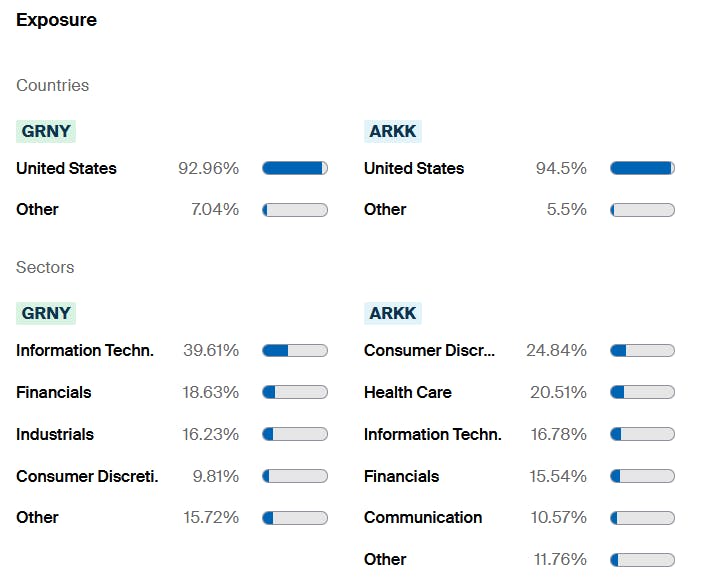
Both ETFs are U.S.-heavy, but sector exposure diverges. GRNY tilts toward technology, financials, and industrials with a blue-chip flavor. ARKK allocates more to consumer discretionary and healthcare in addition to technology, with greater granularity in emerging sub-sectors.
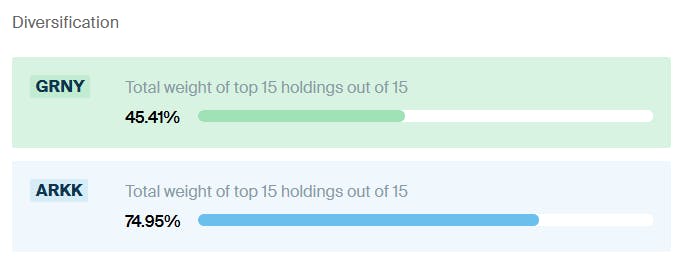
Portfolio concentration also differs. GRNY’s top 15 holdings make up 45.41% of assets, while ARKK’s top 15 account for 74.95%, reflecting Cathie Wood’s willingness to double down on her highest-conviction names, for better or worse.
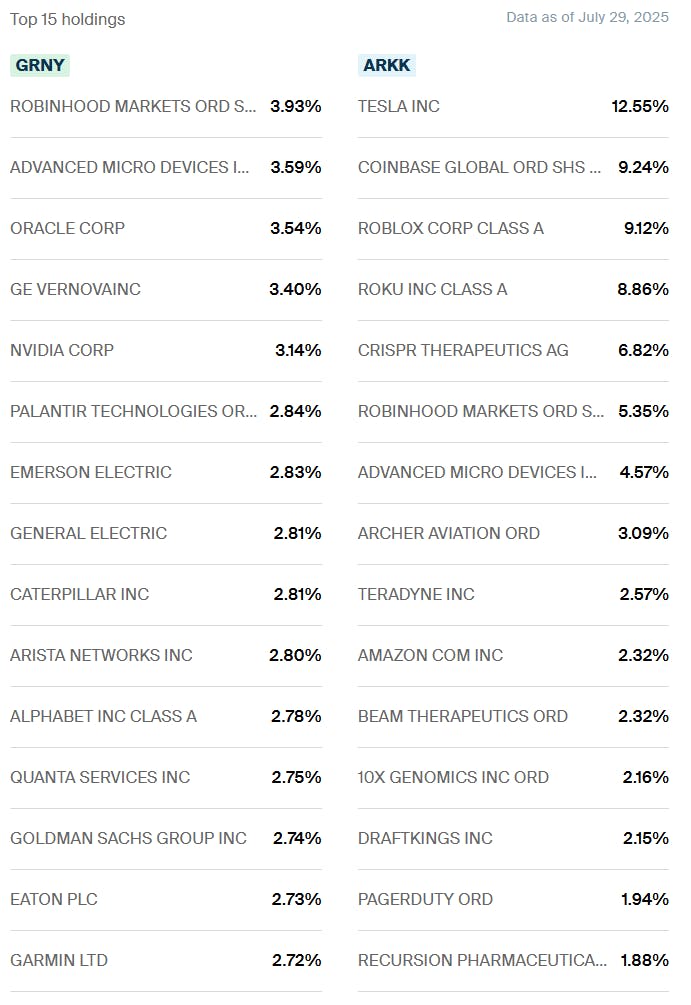
Looking at the end of July holdings, GRNY features many S&P 500 and Nasdaq 100 constituents, but without market-cap weighting, allowing smaller positions meaningful impact. ARKK holds some big names like Tesla and Coinbase, but it also includes far more speculative bets like CRISPR Therapeutics, 10x Genomics, and Archer Aviation. Many of these companies are pre-profit or even pre-revenue, making them true boom-or-bust plays.
Verdict: For investors new to active management, GRNY
GRNY vs. ARKK: Risk and Return
The data is limited by GRNY’s recent inception in November 2024, but we can still draw some early comparisons. Year to date, ARKK has strongly outperformed GRNY, which isn’t surprising given the resurgence of small-cap growth stocks and a broader risk-on sentiment.
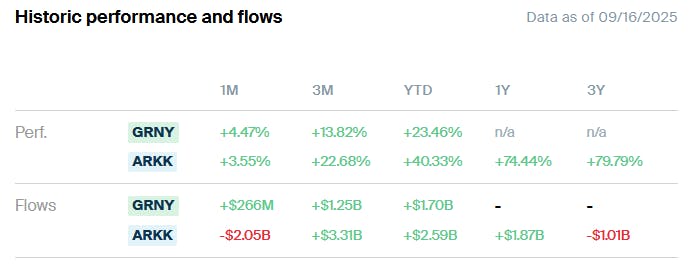
That said, GRNY has hardly been weak. It has managed to outperform both the Nasdaq 100 and the S&P 500 over the same stretch, which is notable for such a new entrant. Both funds have also seen net inflows in the billions, though measured as a percentage of assets under management, GRNY has grown faster.
On the risk side, ARKK
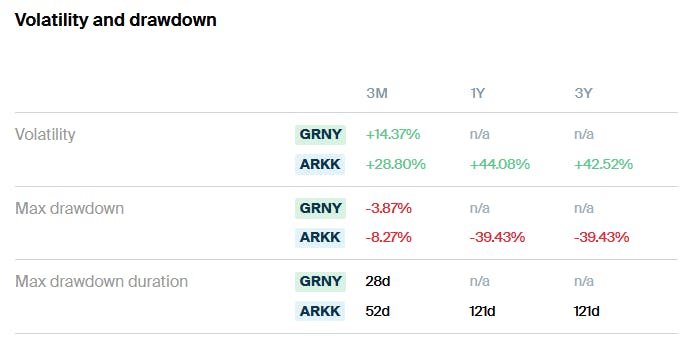
Verdict: ARKK is positioned to shine when risk appetite is high and innovation themes are in favor, but that comes with higher volatility and bigger drawdowns. GRNY offers a smoother ride with strong relative performance against major benchmarks, making it a more balanced choice for investors who want active management without embracing the full boom-or-bust profile of disruptive innovation.
Please note that this article reflects the author’s personal views and does not represent the opinions of the publication or its affiliates. It is for informational purposes only and does not constitute investment advice. It is essential to seek guidance from a registered financial professional before making any investment decisions.
Mentioned ETFs
Further reading


Latest ETF News
See all ETF newsETF comparison: NEOS S&P 500 High Income ETF (SPYI) Versus Goldman Sachs S&P 500 Premium Income ETF (GPIX)

There’s an ETF for That? Investing Like University Endowments

Could Water ETFs Be the Next AI Bottleneck Trade?

What is a Boomer Candy ETF?



 Advantages of ETFs over Mutual Funds1/6
Lower Costs
In this guide, we'll explore the advantages of ETFs over mutual funds, giving you valuable insights into why ETFs have gained significant popularity among investors like yourself.
Leveraged ETFs: Unlocking the Potential for Amplified Returns1/6
Understanding Leveraged ETFs
Explore leveraged ETFs: potential for amplified returns & risks. 5 ETFs to consider across equities, commodities & fixed income.
What is a Leveraged ETF?1/6
Introducing Leveraged and Inverse ETFs
In this guide, we'll dive into the world of leveraged ETFs, exploring their definition, mechanics, potential risks, and rewards.
Recent educational content

ETF Trends
ETF Industry KPIs September 14, 2026
This week’s KPI data overview highlights key metrics and trends shaping the ETF landscape.

ETF Trends
ETF Industry KPIs September 8, 2026
This week’s KPI data overview highlights key metrics and trends shaping the ETF landscape.
ETF Trends
ETF Industry KPIs August 31, 2026
This week’s KPI data overview highlights key metrics and trends shaping the ETF landscape.
ETF Trends
ETF Industry KPIs August 24, 2026
This week’s KPI data overview highlights key metrics and trends shaping the ETF landscape.
Browse all educational columns



Have you tried our ETF Compare tool?
Compare ETFs like a pro. Analyze fees, performance, exposure & holdings side-by-side.