Ready-made ETF portfolios built for real investor needs. Explore now →



ETF Comparison: Avantis U.S. Small Cap Value ETF (AVUV) Versus Dimensional US Small Cap Value ETF (DFSV)
Two of the most well-known and top performing small-cap value factor ETFs go head-to-head in this week’s ETF comparison.


Keep up with what matters in ETFs
Get timely ETF insights, market trends, and top ideas straight to your inbox.
Your newsletter subscriptions with us are subject to ETF Central's Privacy Policy and Terms and Conditions.
Factor investing has gained a lot of traction thanks to ETFs offering affordable and effective active management solutions.
Among the leaders in this space are Dimensional Fund Advisors and Avantis Investors, both renowned for their roots in Fama and French’s research and their expertise in small-cap value strategies.
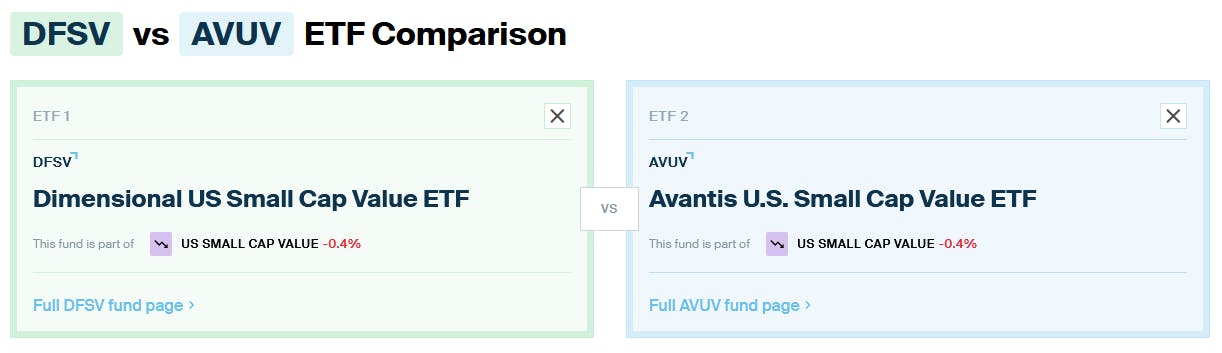
This week, we’re putting two of their leading offerings head-to-head: the Avantis U.S. Small Cap Value ETF
As usual, we’ll be using data from the ETF Central comparison tool to determine which NYSE-listed small-cap value ETF stands out as the better option.
Get data on 14,000+ ETFs
Access Trackinsight's reliable and comprehensive data with 500M+ points on 14,000+ ETFs.
AVUV vs DFSV: Total cost of ownership
Both AVUV and DFSV offer highly competitive pricing structures for active management, reflecting the broader trend of falling fees in the active ETF space.
AVUV charges an expense ratio of 0.25%, amounting to $25 annually per $10,000 invested, while DFSV is slightly pricier at 0.33%, or $33 annually per $10,000 invested.
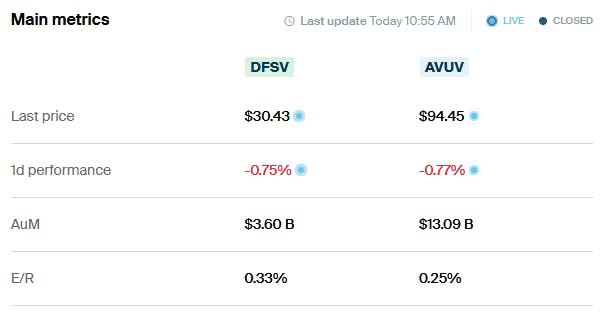
In terms of trading costs, both ETFs maintain good liquidity. AVUV features a slightly tighter bid-ask spread at 0.044%, compared to DFSV’s 0.055%.
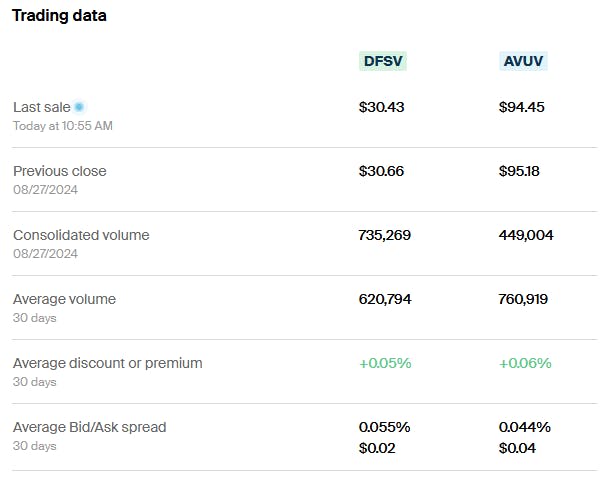
When considering both the expense ratios and the trading costs, AVUV edges out as the more cost-effective option, offering a slight advantage for cost-conscious investors.
AVUV vs DFSV: Methodology and holdings
Both AVUV and DFSV employ a rules-based, active management strategy that does not follow a conventional benchmark. Instead, each fund applies its own methodology to select stocks, focusing on the small-cap value segment of the market.
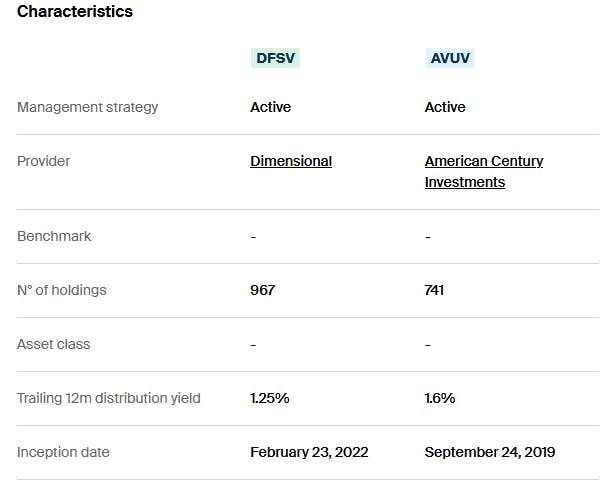
AVUV targets approximately 740 small-cap stocks, emphasizing those with higher profitability and value characteristics. The selection criteria involve metrics like adjusted book-to-price ratios for assessing value and adjusted cash from operations to book value ratios for profitability assessment.
Conversely, DFSV selects around 960 stocks based on their low price relative to book value for value assessment and evaluates profitability using earnings or profits relative to book value or assets. It also includes a momentum screen and defines its small cap focus as the lowest 10% of the total market capitalization or those smaller than the 1,000th largest U.S. company.
Both ETFs maintain a disciplined selling strategy, which is beneficial for active management as it allows for flexibility in adjusting holdings based on evolving market conditions, unlike index-based strategies that follow fixed reconstitution schedules.
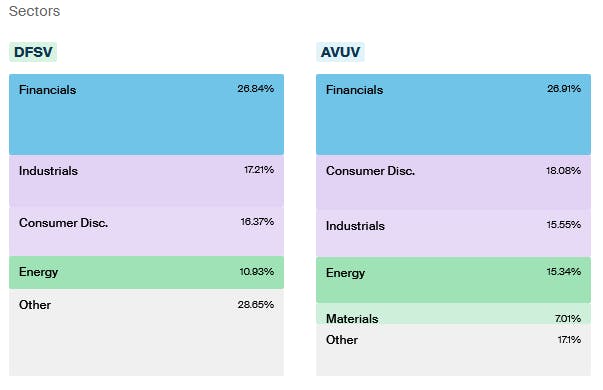
In terms of sector allocation, both ETFs predominantly invest in financials, consumer discretionary, and industrials, reflecting typical characteristics of small-cap value funds.
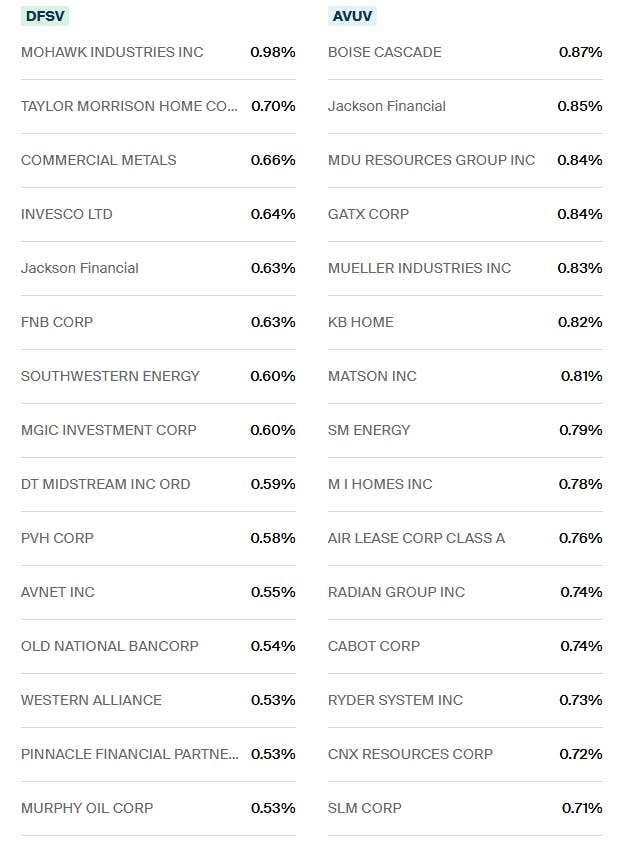
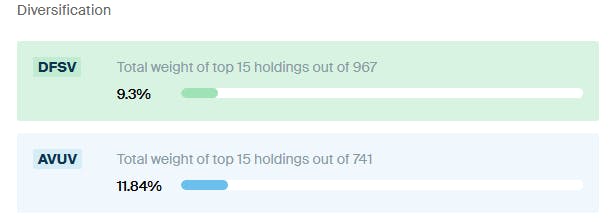
Portfolio composition is balanced, with the 15 largest holdings of DFSV accounting for 9.3% and AVUV 11.84% of their respective portfolios. They share 528 overlapping holdings as of the latest data.
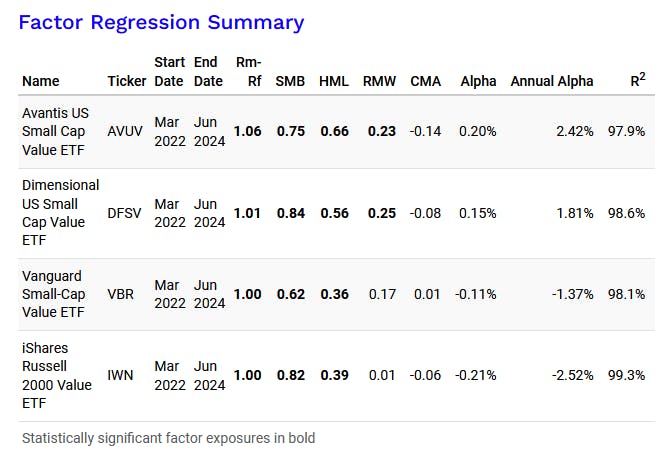
Factor analysis reveals that both ETFs robustly capture the small size (SMB), value (HML), and profitability (RMW) factors. AVUV shows a stronger tilt towards value, whereas DFSV emphasizes the size factor more prominently. This active factor management positions both ETFs favorably against their index-based peers which lack similar degrees of profitability emphasis.
AVUV vs DFSV: Risk and return
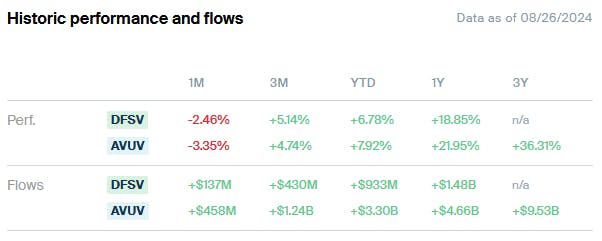
Both AVUV and DFSV have demonstrated impressive performance, albeit over a relatively short timeframe, with AVUV slightly outperforming DFSV in terms of trailing one-year and year-to-date returns.
However, it’s crucial to approach such short-term data cautiously, as these patterns may not necessarily predict long-term performance. Nonetheless, AVUV has attracted more investor interest, reflected in its higher net inflows.
Notably, both ETFs have significantly outperformed their index-based counterparts in terms of compound annual growth rate (CAGR) and Sharpe ratio. This success can largely be attributed to the inclusion of profitability screens in their investment strategies.
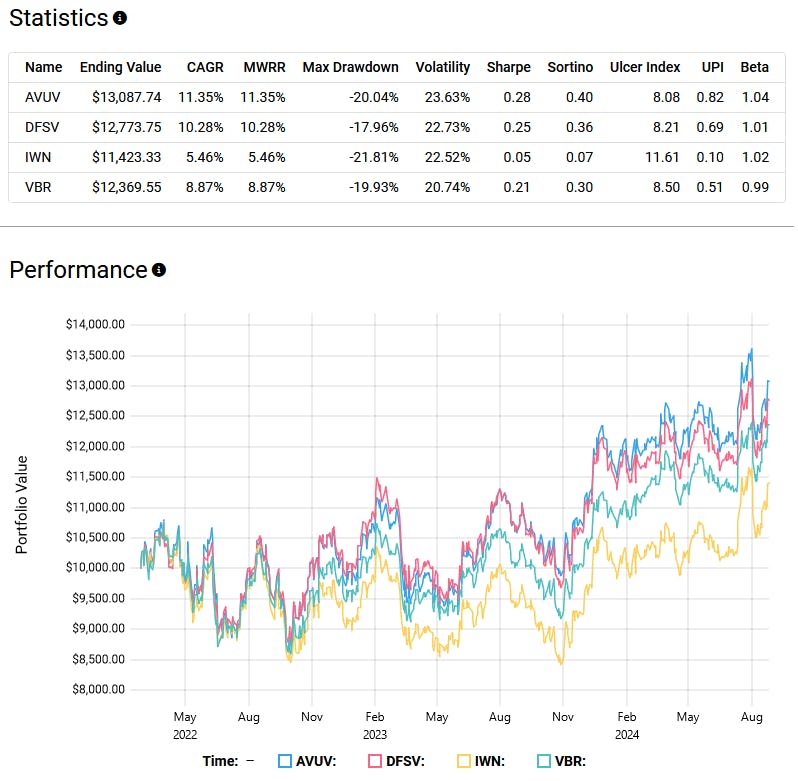
These screens help to filter out less financially robust companies, echoing the sentiment of Cliff Asness’s observation that in investing, “Size matters, if you control your junk."
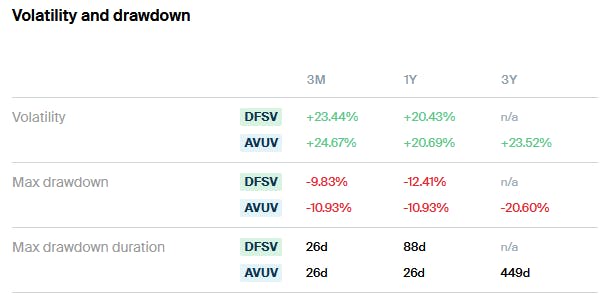
In terms of risk, both ETFs exhibit the typical volatility associated with small-cap value strategies. Over the past year, AVUV has experienced slightly less severe drawdowns in both duration and depth compared to DFSV, indicating a potentially lower risk profile during downturns.
Given their performances and strategic approaches, my recommendation would be to consider holding both ETFs. This strategy not only diversifies your investment across two adept managers, reducing manager-specific risk, but also guards against style drift, which can occur if a fund manager deviates from their stated investment strategy.
Please note this article is for information purposes only and does not in any way constitute investment advice. It is essential that you seek advice from a registered financial professional prior to making any investment decision.

Latest ETF News
See all ETF newsCould Water ETFs Be the Next AI Bottleneck Trade?

What is a Boomer Candy ETF?

ETF Comparison: NEOS Nasdaq-100 High Income ETF (QQQI) Versus Goldman Sachs Nasdaq-100 Premium Income ETF (GPIQ)





 Advantages of ETFs over Mutual Funds1/6
Lower Costs
In this guide, we'll explore the advantages of ETFs over mutual funds, giving you valuable insights into why ETFs have gained significant popularity among investors like yourself.
Leveraged ETFs: Unlocking the Potential for Amplified Returns1/6
Understanding Leveraged ETFs
Explore leveraged ETFs: potential for amplified returns & risks. 5 ETFs to consider across equities, commodities & fixed income.
What is a Leveraged ETF?1/6
Introducing Leveraged and Inverse ETFs
In this guide, we'll dive into the world of leveraged ETFs, exploring their definition, mechanics, potential risks, and rewards.
Recent educational content

ETF Trends
ETF Industry KPIs September 8, 2026
This week’s KPI data overview highlights key metrics and trends shaping the ETF landscape.

ETF Trends
ETF Industry KPIs August 31, 2026
This week’s KPI data overview highlights key metrics and trends shaping the ETF landscape.
ETF Trends
ETF Industry KPIs August 24, 2026
This week’s KPI data overview highlights key metrics and trends shaping the ETF landscape.
What’sTheFund
What's the Fund | Ocean Park Diversified Income ETF (DUKZ)
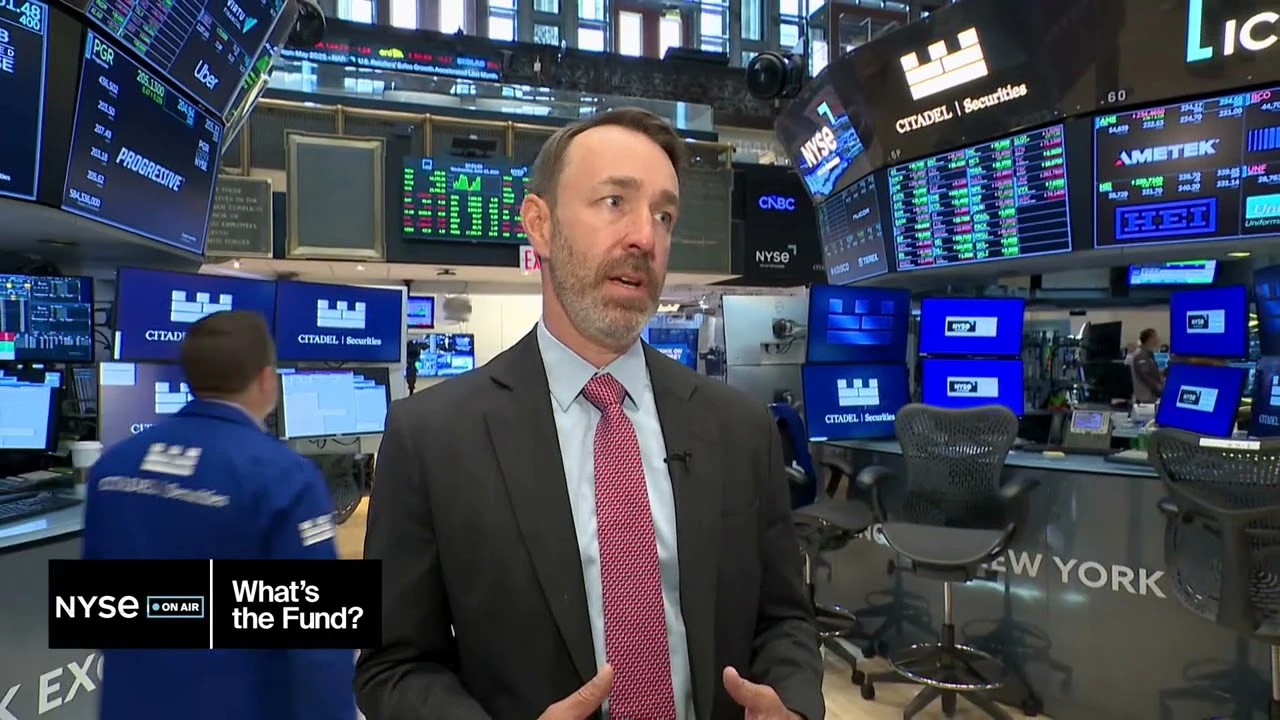
James St Aubin, Chief Investment Officer at Ocean Park Asset Management, discuss the DUKZ ETF, exposing investors to the whole spectrum of asset classes in the fixed income markets, through their rules-based process.

Browse all educational columns



Expert-Built ETF Portfolios, All in One Place
Don’t start from scratch. Discover ready-made ETF portfolios built by professionals to match different goals, timelines, and market views. Use them as inspiration or as a starting point for your own allocation.