Explore professionally built ETF model portfolios. Discover now →



ETF Comparison: ARK Innovation ETF (ARK) Versus iShares Exponential Technologies ETF (XT)
Passive index versus actively managed innovation ETFs go head to head in this week’s ETF comparison.

Keep up with what matters in ETFs
Get timely ETF insights, market trends, and top ideas straight to your inbox.
Your newsletter subscriptions with us are subject to ETF Central's Privacy Policy and Terms and Conditions.
There’s no shortage of ways to invest in disruptive technology. You can pick individual stocks, use a sector-based ETF, or invest in a thematic ETF focused on innovation.
The competition in this space is fierce, and returns can be a rollercoaster—spectacular during bull markets but devastating in downturns like 2022.
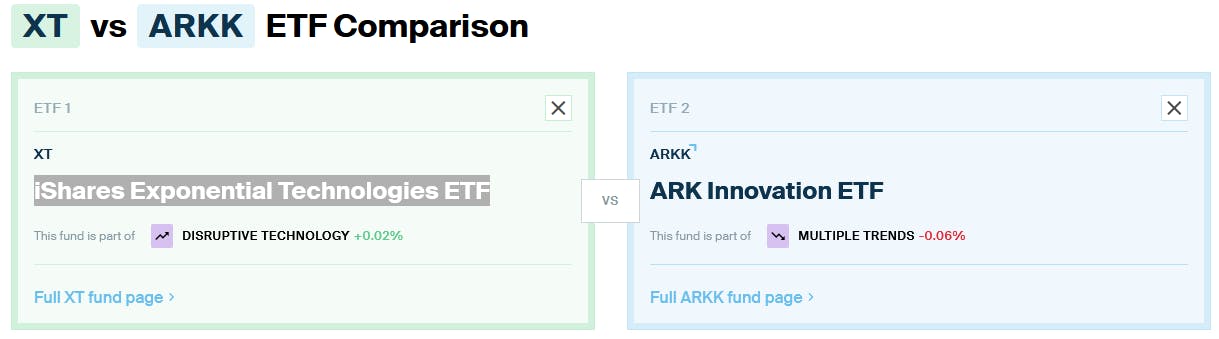
Today, we’re putting a passive innovation ETF, iShares Exponential Technologies ETF
Like what you're reading?
Stay in the loop — get the latest ETF insights: trends, analysis, and expert picks.
ARKK vs. XT: Total Cost of Ownership
It’s always an uphill battle for any actively managed ETF to compete with passive ETFs on fees, and this case is no different.
XT comes in with a 0.46% expense ratio, meaning an investor would pay $46 per year on a $10,000 investment. In contrast, ARKK charges 0.75%, or $75 annually for the same investment, making it notably more expensive.
Looking at implicit costs, ARKK is an extremely liquid ETF, with a 30-day median bid-ask spread of just 0.017%, meaning low trading friction. XT is less liquid, with a 0.05% spread, which is still relatively low but not as tight as ARKK’s.
Verdict: When you add up both the expense ratio and bid-ask spread, XT wins by a mile as the more affordable ETF.
ARKK vs. XT: Methodology and Holdings
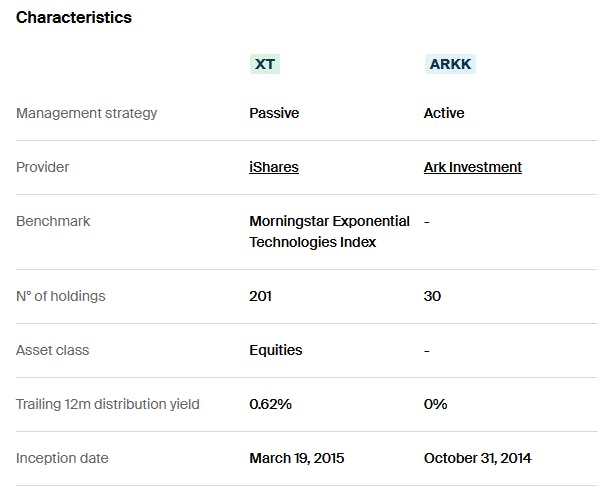
This is where the differences between both ETFs become night and day.
XT tracks the Morningstar Exponential Technologies Index, which is defined as “advances expected to create significantly positive non-linear economic benefits for the companies that produce or use them.”
Morningstar employs a team of 100 equity analysts who take a fundamental approach to identifying promising technologies across nine exponential tech themes: big data and analytics, nanotechnology, networks and computer systems, energy and environmental systems, medicine and neuroscience, robotics, 3D printing, bioinformatics, and financial services innovation.
Stocks eligible for inclusion are selected from the Morningstar Global Markets Index, assigned “exposure scores”, and ranked by equity research managers. Certain stocks scoring 2 are selected as thematic leaders, which boosts them to a “3” and an overweight allocation, resulting in a portfolio of 200 stocks.
This process isn’t quite traditional passive indexing—it functions more like a rules-based overlay on qualitative analyst insights.
ARKK, on the other hand, is old-fashioned active management. Investing in ARKK means putting full trust in Cathie Wood’s expertise in picking winners in “disruptive innovation.” Unlike XT, which has clear constraints, ARKK
It focuses on a few key themes, including intelligent devices, autonomous mobility, precision therapies, neural networks, next-gen cloud, digital wallets, digital assets, smart contracts, and multiomic technologies.
The differences between XT and ARKK are palpable. XT
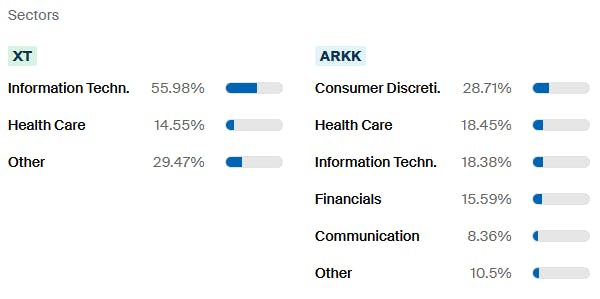
Sector-wise, XT is tech-heavy, with 55.98% of the portfolio in technology, whereas ARKK is actually fairly balanced between consumer discretionary, healthcare, tech, and financials.
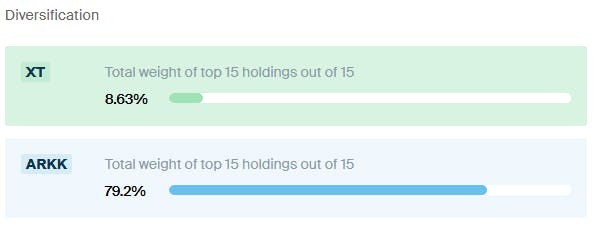
ARKK is also extremely top-heavy. Its top 15 holdings account for 79.2% of the fund, compared to just 8.63% in XT. Cathie Wood often takes a high-conviction approach with security selection and weighting, so this is to be expected.
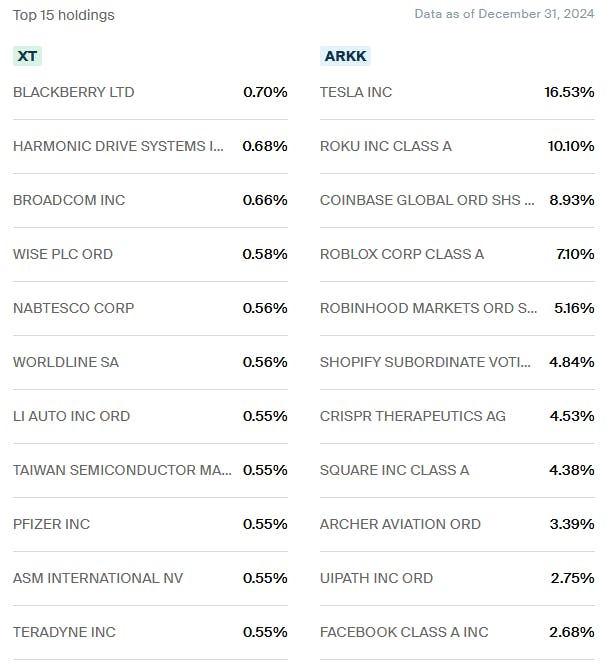
Single-stock risk is also far greater in ARKK—Tesla and Roku alone make up 16.53% and 10.10% of the portfolio, respectively, while XT’s top holding, BlackBerry, is just 0.7%.
Verdict: I respect Cathie Wood’s expertise in disruptive innovation and thematic investing, but XT provides more tech exposure in a less concentrated and more diversified manner.
ARKK vs. XT: Risk and Return
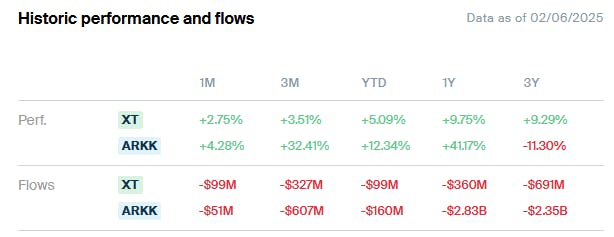
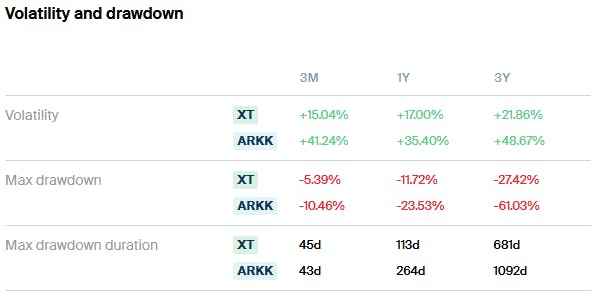
Over the past three years, XT has outperformed ARKK, but over the last one year, ARKK has massively outpaced XT as speculative tech stocks rebounded. Interestingly, both ETFs have seen net outflows, though ARKK’s redemptions have been significantly higher, suggesting some investors have lost confidence in its high-risk, high-reward strategy.
Risk data over this period shows that ARKK has been more than twice as volatile as XT, with much deeper and more prolonged drawdowns.
However, an extended backtest from March 24, 2015, to February 6, 2025, reveals that ARKK has the edge in total returns, delivering a 12.70% compound annual growth rate (CAGR) versus 10.59% for XT.
That said, ARKK achieved this outperformance by taking on far greater risk—experiencing a 90.96% peak drawdown compared to 34.40% for XT, alongside a 38.23% standard deviation versus 19.69% for XT.
Unsurprisingly, XT had the better risk-adjusted return, with a Sharpe ratio of 0.52 versus 0.46 for ARKK.
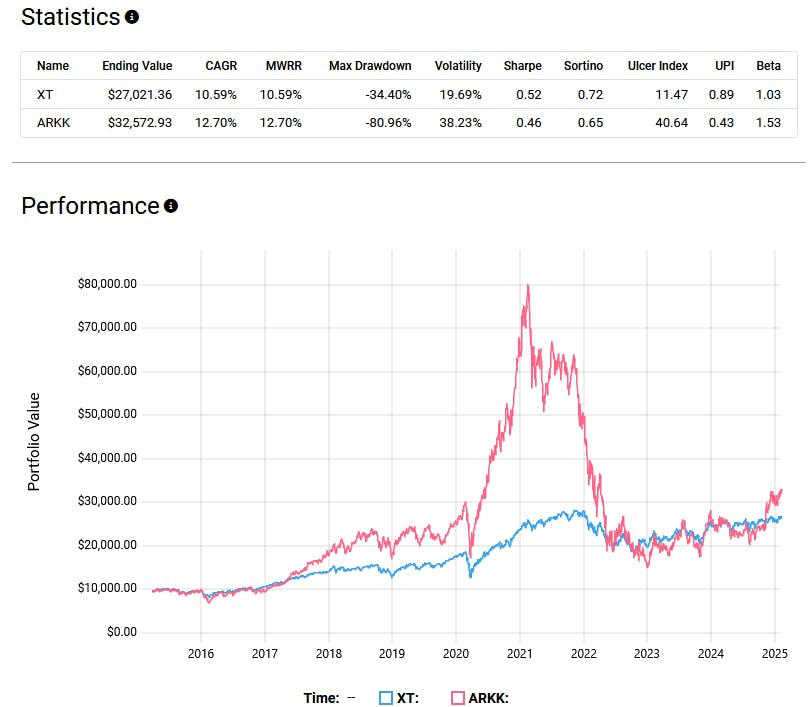
Verdict: ARKK may be appealing to high-risk investors looking to swing for the fences, but for the average investor, XT provides a far less volatile ride with a better balance of risk and reward.
This article is for informational purposes only and does not in any way constitute investment advice. The author may express their own opinions, which may not represent the opinions of ETF Central or its affiliated partners. It is essential that you seek advice from a registered financial professional prior to making any investment decisions.
Topics
See all
Mentioned ETFs
Latest ETF News
See all ETF newsETF comparison: NEOS S&P 500 High Income ETF (SPYI) Versus Goldman Sachs S&P 500 Premium Income ETF (GPIX)

There’s an ETF for That? Investing Like University Endowments

Could Water ETFs Be the Next AI Bottleneck Trade?

What is a Boomer Candy ETF?




 Advantages of ETFs over Mutual Funds1/6
Lower Costs
In this guide, we'll explore the advantages of ETFs over mutual funds, giving you valuable insights into why ETFs have gained significant popularity among investors like yourself.
Leveraged ETFs: Unlocking the Potential for Amplified Returns1/6
Understanding Leveraged ETFs
Explore leveraged ETFs: potential for amplified returns & risks. 5 ETFs to consider across equities, commodities & fixed income.
What is a Leveraged ETF?1/6
Introducing Leveraged and Inverse ETFs
In this guide, we'll dive into the world of leveraged ETFs, exploring their definition, mechanics, potential risks, and rewards.
Recent educational content
ETF Trends
ETF Industry KPIs September 14, 2026
This week’s KPI data overview highlights key metrics and trends shaping the ETF landscape.

ETF Trends
ETF Industry KPIs September 8, 2026
This week’s KPI data overview highlights key metrics and trends shaping the ETF landscape.
ETF Trends
ETF Industry KPIs August 31, 2026
This week’s KPI data overview highlights key metrics and trends shaping the ETF landscape.
ETF Trends
ETF Industry KPIs August 24, 2026
This week’s KPI data overview highlights key metrics and trends shaping the ETF landscape.
Browse all educational columns



Build and Analyze Your ETF Portfolio Like a Pro
Create your own ETF portfolio in minutes and instantly see allocations, exposures, performance, and risk. Visualize diversification across asset classes, regions, and sectors. Stress-test ideas, compare benchmarks, and refine your strategy with professional-grade analytics.