Create, analyze, optimize your ETF portfolio. Start now →



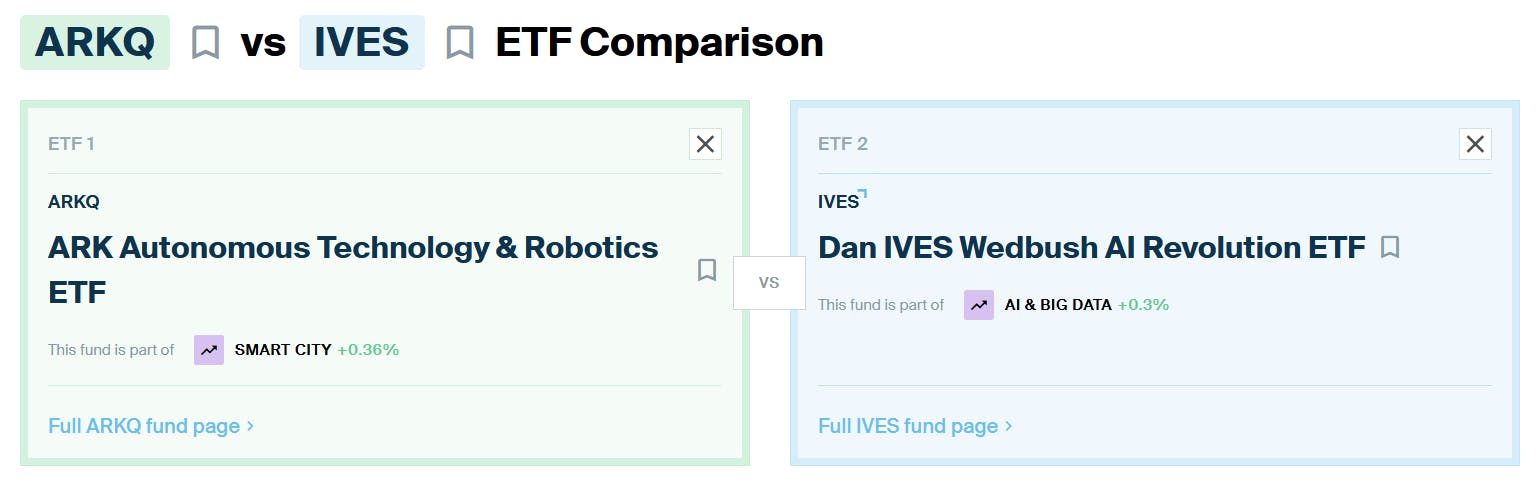
ETF Comparison: ARK Autonomous Technology & Robotics ETF (ARKQ) Versus Dan IVES Wedbush AI Revolution ETF (IVES)
Both ETFs are actively managed by well-known Wall Street bulls and target innovation, but achieve their exposure in very different ways.

Keep up with what matters in ETFs
Get timely ETF insights, market trends, and top ideas straight to your inbox.
Your newsletter subscriptions with us are subject to ETF Central's Privacy Policy and Terms and Conditions.
Cathie Wood remains the poster child for Wall Street’s love affair with innovation and tech moonshots. Her ARK Invest lineup has attracted billions in assets, despite a track record marked by extreme volatility.
In 2025’s bull market, the firm is once again drawing inflows and posting strong returns. For investors seeking AI exposure, the ARK Autonomous Technology & Robotics ETF
But ARKQ now faces serious competition - not just from cheaper, passively managed AI index ETFs, but also from a growing field of active contenders. Chief among them is the NYSE-listed Dan Ives Wedbush AI Revolution ETF
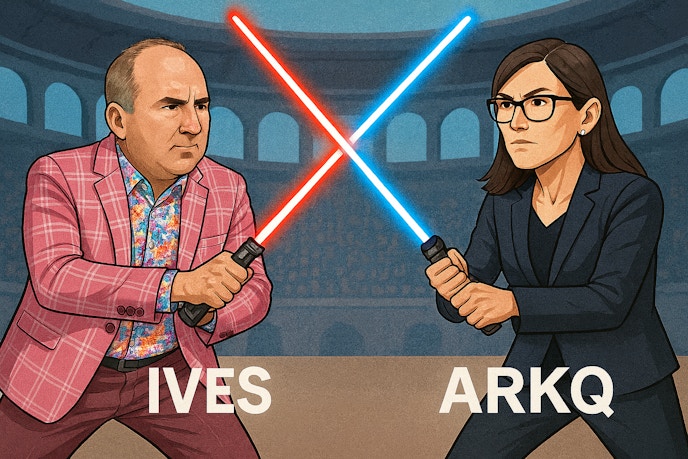
Ives, a longtime technology bull known for his bold calls and colorful suits, has become a regular fixture on CNBC and Bloomberg. Now, like other star analysts turned portfolio managers, he’s putting his innovation growth thesis to work in ETF form.
So how do ARKQ and IVES compare? Which one offers the better play on the AI megatrend? Here’s my breakdown based on data from the ETF Central screener.
Global ETF Survey 2026 is Live!
With 1,790 new products launched by July 2026, choosing is harder than ever. Our Global ETF Survey 2026, built on 620 professional investors and allocators, shows how active, fixed income, options-based and thematic ETFs are reshaping fund selection.
ARKQ vs IVES: Total Cost of Ownership
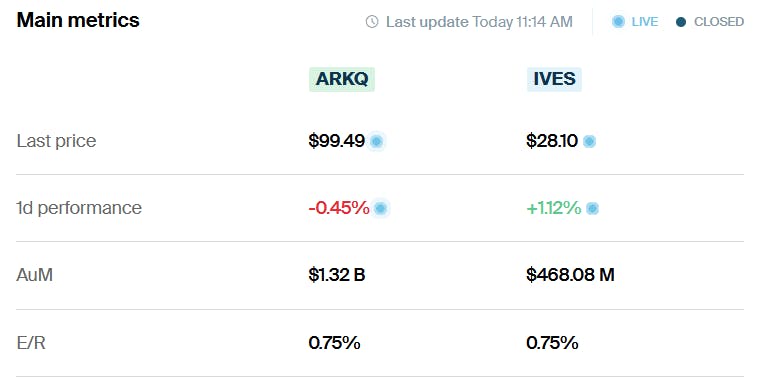
Neither ETF is cheap. Both ARKQ and IVES charge a 0.75% expense ratio, or $75 per $10,000 invested. That’s typical for actively managed funds with concentrated stock picks and high research overhead.
But the expense ratio isn’t the only cost. You also pay a spread when buying and selling. Here, IVES has a slight advantage, with a 30-day average bid-ask spread of 0.065% compared to ARKQ’s 0.075%.
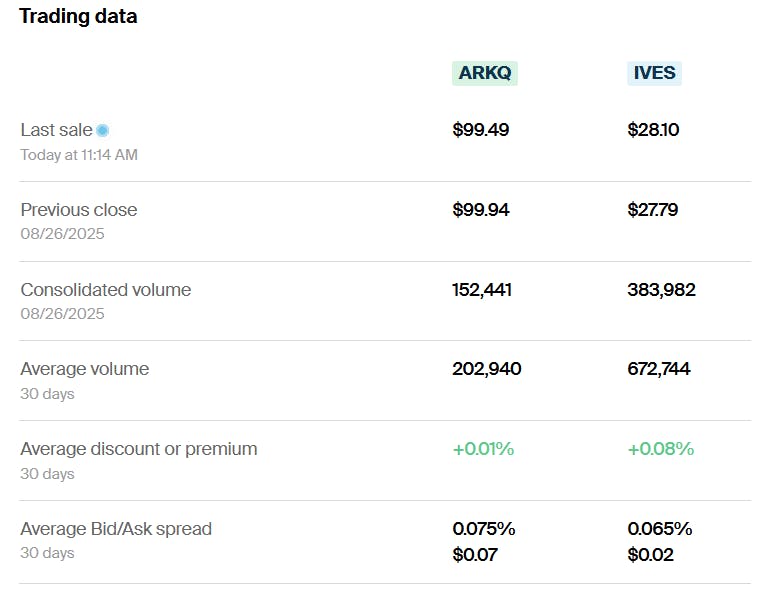
Verdict: Technically, IVES is a tad cheaper when combining expense ratio and spread. But with only a one basis point difference, the edge is negligible. I’m calling this one a tie.
ARKQ vs IVES: Methodology and Holdings
Both of these ETFs are actively managed, so there’s no index dictating what goes in or out. Portfolio construction is based entirely on Cathie Wood’s and Dan Ives’ respective research and that of their analyst teams.
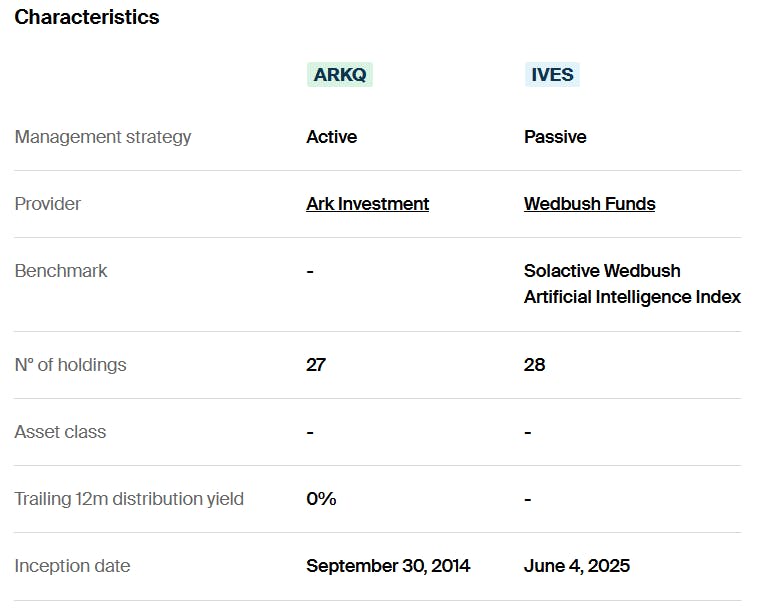
Despite launching just over two months ago, IVES has already attracted $468 million in assets under management. ARKQ, which launched in September 2014, sits at $1.32 billion. That early traction speaks to investor interest in Ives’ AI-centric approach.
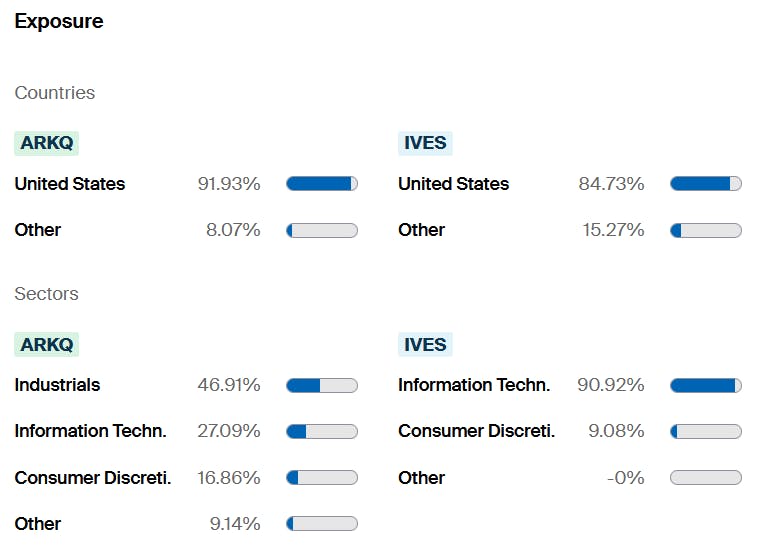
ARKQ is more U.S.-focused than IVES, but it isn’t as tech-heavy as the name might suggest. There’s significant exposure to industrials and consumer discretionary stocks, reflecting a broader definition of innovation. IVES is more tech-dense at nearly 90% of the portfolio with smaller allocations to consumer discretionary names that support the AI ecosystem.
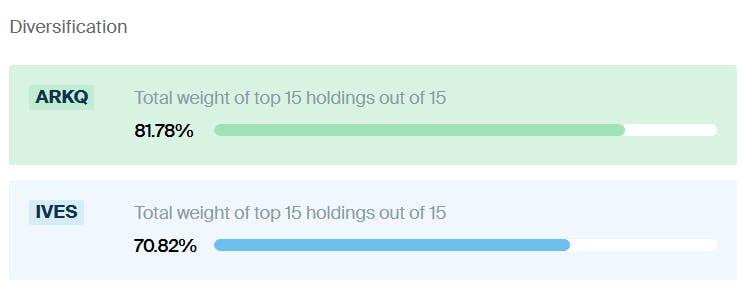
Both ETFs are highly concentrated. ARKQ holds 27 stocks and IVES 28. The top 15 holdings make up 81.78% of ARKQ’s portfolio versus 70.82% for IVES, so both are top-heavy, though IVES is slightly more diversified at the top.
The holdings differ meaningfully. ARKQ's top position is Tesla at 12.9%, followed by a mix of aerospace and defense contractors like Kratos Defense, Archer Aviation, and AeroVironment. Many of these are mid-cap growth names with unsteady or negative profitability. IVES, in contrast, is anchored by mega-cap names at the center of AI capex: Nvidia, TSMC, Microsoft, Meta Platforms, Amazon, Broadcom, Apple, and Alphabet all feature in its top holdings.
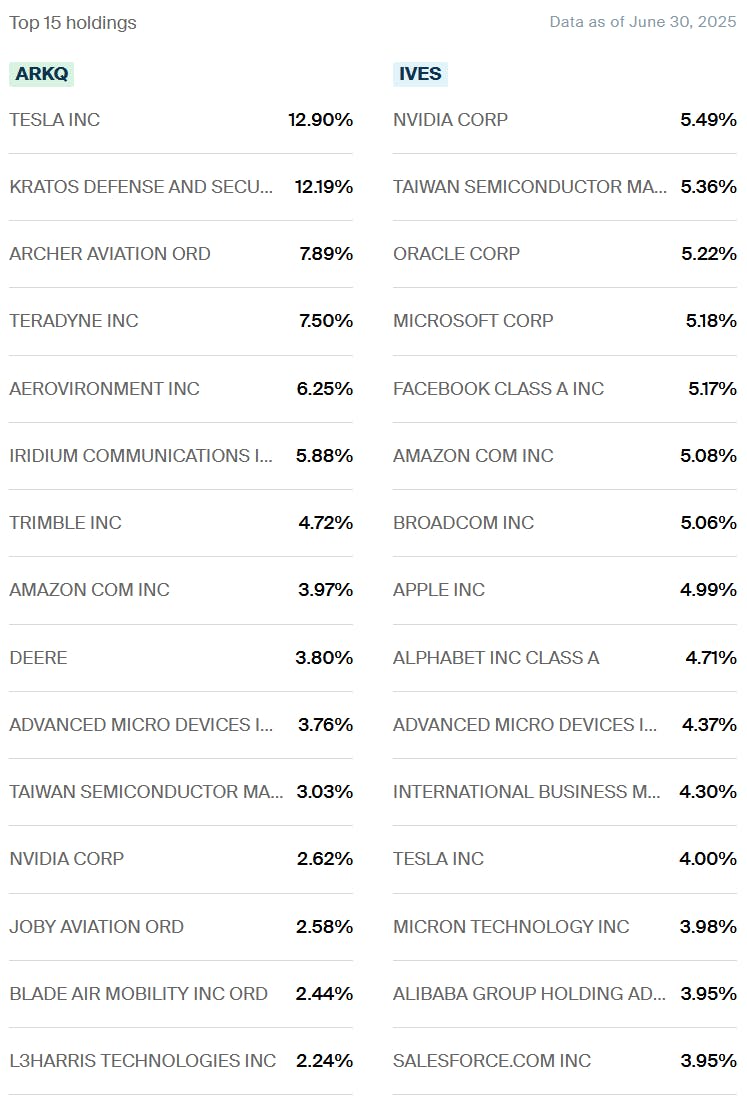
Verdict: At this stage in the cycle, I prefer IVES. Some of ARKQ’s top holdings, like Tesla, have sky-high valuations, and others like Kratos or Archer have weak or nonexistent earnings. IVES is making a direct bet on profitable AI infrastructure leaders that already dominate tech spending.
ARKQ vs IVES: Risk and Return
Since IVES only launched in June 2025, there isn’t enough historical data yet to evaluate its volatility or returns. That makes this section mostly a review of ARKQ, which, to its credit, has delivered strong performance recently.
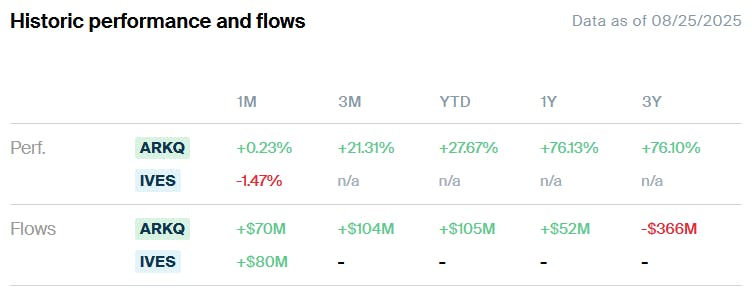
But that outperformance comes at a cost. ARKQ remains a high-risk ETF with elevated volatility over both the one- and three-year periods. Its worst drawdown stretched across 151 trading days, highlighting how tough the ride can be for investors during downturns.
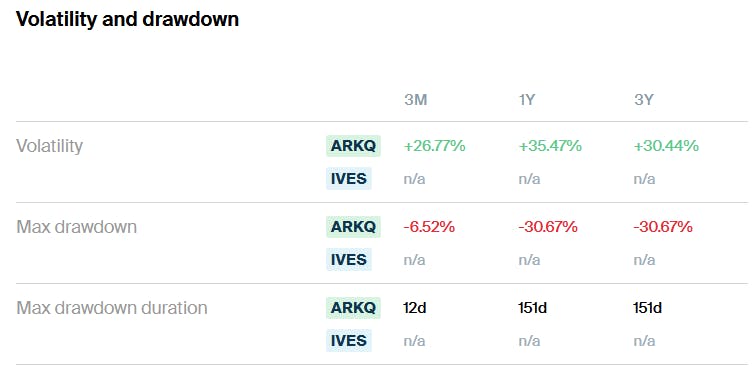
As for IVES, while we’ll need time to get actual numbers, the portfolio’s heavy overlap with the Nasdaq-100 suggests it will likely share many of the same characteristics: high beta, high growth, and sensitivity to interest rates. However, IVES is even more concentrated than the Nasdaq-100 and charges a 0.75% expense ratio, which could weigh on returns relative to a low-cost index tracker.
That said, if Dan Ives sticks to a concentrated portfolio of high-conviction, large-cap AI names, and if the macro environment turns supportive with potential rate cuts later this year, IVES could outperform traditional benchmarks despite its higher costs.
Verdict: Right now, ARKQ has the proven track record. But if you’re betting on a continued AI rally and want a pure-play approach with active conviction and a focus on profitable mega-caps, IVES may have more upside, especially in a lower-rate environment.
Please note that this article reflects the author’s personal views and does not represent the opinions of the publication or its affiliates. It is for informational purposes only and does not constitute investment advice. It is essential to seek guidance from a registered financial professional before making any investment decisions.
Mentioned ETFs
Further reading

Latest ETF News
See all ETF newsBeyond Big Tech: The Increasing Specialization of AI ETFs

There's an ETF for That? Humanoid Robotics and Physical AI

How Some ETF Issuers Use Their Own Funds for Cash Management

These Public-Private ETFs Invest in Polymarket and Anduril

There's an ETF for That? Frontier Markets



 Advantages of ETFs over Mutual Funds1/6
Lower Costs
In this guide, we'll explore the advantages of ETFs over mutual funds, giving you valuable insights into why ETFs have gained significant popularity among investors like yourself.
Leveraged ETFs: Unlocking the Potential for Amplified Returns1/6
Understanding Leveraged ETFs
Explore leveraged ETFs: potential for amplified returns & risks. 5 ETFs to consider across equities, commodities & fixed income.
What is a Leveraged ETF?1/6
Introducing Leveraged and Inverse ETFs
In this guide, we'll dive into the world of leveraged ETFs, exploring their definition, mechanics, potential risks, and rewards.
Recent educational content
First Look ETF
First Look ETF: Income, International, and Cash Flow ETFs
In this season 6 episode of First Look ETF, Stephanie Stanton @etfguide examines the latest ETF marketplace trends with NYSE and guests.


ETF Trends
ETF Industry KPIs October 5, 2026
This week’s KPI data overview highlights key metrics and trends shaping the ETF landscape.

ETF Trends
ETF Industry KPIs September 28, 2026
This week’s KPI data overview highlights key metrics and trends shaping the ETF landscape.
ETF Trends
ETF Industry KPIs September 22, 2026
This week’s KPI data overview highlights key metrics and trends shaping the ETF landscape.