Keep tabs on your favorite ETFs with a personalized weekly tracker. Create a Watchlist now →



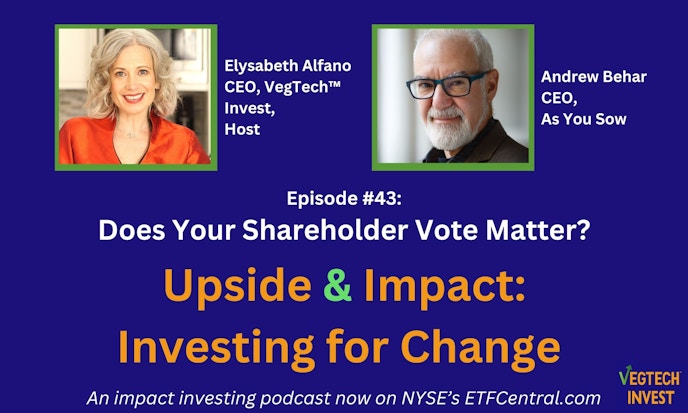
Ep. 43: The Power of Shareholder Advocacy - Andrew Behar of As You Sow
Investors can shape corporate accountability and tackle climate risks through shareholder engagement, promoting sustainability and systemic change.

Keep up with what matters in ETFs
Get timely ETF insights, market trends, and top ideas straight to your inbox.
Your newsletter subscriptions with us are subject to ETF Central's Privacy Policy and Terms and Conditions.
In a recent discussion on the VegTech™ Invest podcast, Upside & Impact: Investing for Change, Elysabeth Alfano, CEO of VegTech™ Invest and host, sat down with Andrew Behar, CEO of As You Sow, to explore the intersection of sustainability, corporate accountability, and shareholder influence. If you are interested in knowing how investors can drive meaningful change in corporate behavior, address climate risks, and use their dollars to promote justice across various sectors, read on!
Like what you're reading?
Stay in the loop — get the latest ETF insights: trends, analysis, and expert picks.
Shareholder Power: A Catalyst for Change
As You Sow’s mission is to empower shareholders to hold corporations accountable. "We help companies reduce material risk and discover new opportunities," said Behar. "By advocating for better business plans, we’re showing companies how they can outperform financially while meeting their environmental and social goals."
VegTech™ Invest has worked with As You Sow on engagements and also believe in the power of shareholder engagement for both upside and impact. Elysabeth shared the company’s commitment to shareholder engagement to advocate for certain climate positive initiatives such as reducing climate impact, reducing biodiversity loss, and having companies disclose their scope 1, 2 and 3 emissions. The VegTech™ Invest current Protein Diversification and Disclosures stakeholder engagement campaign encourages companies to advance their transition towards a plant-centric portfolio.
A highlight clip from the interview on the power on shareholder engagement.
The Financial Case for Sustainability
Despite ongoing political debates around ESG (Environmental, Social, and Governance) investing, the financial case for responsible corporate practices is compelling. Citing As You Sow’s 2022 research, Behar highlighted the correlation between diversity and financial performance. Companies with diverse workforces have achieved higher returns on equity and greater stock price appreciation.
Behar also illustrated how ESG-aware companies often outperform financially, largely due to their proactive approach to managing risks such as supply chain disruptions and climate volatility. Looking at ESG metrics is important to understanding the full risks of investing in companies. It looks at more than just revenue and financial metrics, and instead checks on other risk factors like work force diversity, environmental fines, lawsuits and more.
Tackling Climate Risks and Food System Challenges
While the food system is partly responsible for advancing climate change, it has also felt the effects of climate change. Climate risks, such as rising costs of raw materials like cotton and cacao, require immediate action, Behar emphasized. This is another reason VegTech™ Invest focuses on working towards a food system of diversified proteins. This includes plant-based proteins, cultivated meat, blended products, regenerative agriculture products and more. "Regenerative agriculture benefits farmers with higher yields, better soil health, and improved profitability," Behar noted, urging policymakers to prioritize such practices in the upcoming U.S. Farm Bill.
It is extremely important to connect climate change with the global food system. According to the UN Environmental Programme, 32% of global methane emissions stem from animal agriculture, making food system reform a pivotal aspect of combating climate change. "It’s not just a climate issue," Alfano remarked. "Our current food production systems are driving biodiversity loss, water scarcity, and public health crises."
Transparency and Accountability: The Road Ahead
The SEC’s recent rules requiring Scope 1 and Scope 2 emissions disclosures represent a step forward, though Behar argued that comprehensive Scope 3 data—accounting for most emissions—remains critical. Europe’s Corporate Sustainability Reporting Directive (CSRD), which mandates Scope 3 reporting, was highlighted as a model for the U.S. to emulate. Europe is leading the way for other countries to require similar disclosures and since most large multinational companies operate in Europe, they will soon be required to share their emissions data. This ultimately means more disclosures for US-based companies.
Behar expressed optimism about a shift toward a regenerative economy built on sustainability, justice, and long-term thinking. “Companies embracing these principles will thrive,” he said.
A Call to Action for Investors
Investors hold the power to shape corporate priorities through shareholder engagement. Tools like As You Sow’s Invest Your Values platform allows investors to evaluate mutual funds based on ESG criteria, empowering them to align their portfolios with their principles.
As Behar concluded, "Shareholders are uniquely positioned to influence corporate behavior. By advocating for sustainable and just practices, we’re not just reducing risk—we’re building a better future for everyone."
To dive deeper into this conversation, visit the VegTech™ Invest podcast page and listen to the full podcast here. Watch the full video here.
Elysabeth Alfano is the CEO of VegTech™ Invest, Advisor to the VegTech™ food innovation ETF. She is a consultant to C-Suite of multinational companies and speaks internationally on the intersection of investing, sustainability, and food systems transformation. Elysabeth is also the host of the podcast, Upside & Impact: Investing for Change. This article was co-written by the Fractional Associate Director of Comms & Research at VegTech™ Invest, Gwendolyn Brown.
Please note this article is for information purposes only and does not in any way constitute investment advice. It is essential that you seek advice from a registered financial professional prior to making any investment decision.
Segments
See all
No specific market segments were tagged
Mentioned ETFs
No specific ETFs were tagged
Further reading

Latest ETF News
See all ETF newsForm 4 Has 20 Transaction Codes. None Say "Section 351 ETF Swap"


Who Really Owns a White-Label ETF?


What If a Futures-Based ETF Never Had to Roll Again?
How Do You Build a Winning ETF Business?

Losers Of Q2 2026 REIT Earnings Season


Winners of Q2 2026 REIT Earnings Season


 Advantages of ETFs over Mutual Funds1/6
Lower Costs
In this guide, we'll explore the advantages of ETFs over mutual funds, giving you valuable insights into why ETFs have gained significant popularity among investors like yourself.
Leveraged ETFs: Unlocking the Potential for Amplified Returns1/6
Understanding Leveraged ETFs
Explore leveraged ETFs: potential for amplified returns & risks. 5 ETFs to consider across equities, commodities & fixed income.
What is a Leveraged ETF?1/6
Introducing Leveraged and Inverse ETFs
In this guide, we'll dive into the world of leveraged ETFs, exploring their definition, mechanics, potential risks, and rewards.
Recent educational content
ETF Trends
ETF Industry KPIs September 14, 2026
This week’s KPI data overview highlights key metrics and trends shaping the ETF landscape.

ETF Trends
ETF Industry KPIs September 8, 2026
This week’s KPI data overview highlights key metrics and trends shaping the ETF landscape.
ETF Trends
ETF Industry KPIs August 31, 2026
This week’s KPI data overview highlights key metrics and trends shaping the ETF landscape.
ETF Trends
ETF Industry KPIs August 24, 2026
This week’s KPI data overview highlights key metrics and trends shaping the ETF landscape.
Browse all educational columns



Build and Analyze Your ETF Portfolio Like a Pro
Create your own ETF portfolio in minutes and instantly see allocations, exposures, performance, and risk. Visualize diversification across asset classes, regions, and sectors. Stress-test ideas, compare benchmarks, and refine your strategy with professional-grade analytics.