Open Now: The Global ETF Survey Take the Survey →



DOJ’s Cannabis Rescheduling Proposal: What It Means for Investors
The recent proposal by the Department of Justice (DOJ) to reclassify cannabis from Schedule I to Schedule III of the Controlled Substances Act (CSA) has sparked considerable discussion among investors in the burgeoning cannabis sector. As regulatory winds shift, investors are preparing for the potential impacts on market dynamics, investment strategies, and the overall landscape of cannabis-related businesses.


Keep up with what matters in ETFs
Get timely ETF insights, market trends, and top ideas straight to your inbox.
Your newsletter subscriptions with us are subject to ETF Central's Privacy Policy and Terms and Conditions.
Regulatory Changes: A New Era for American Cannabis Companies
U.S. Multi-State Operators (MSOs)
The ETF Industry Is Evolving Fast
From AI infrastructure to active strategies, the ETF landscape is shifting. Share your perspective in the 7th Annual Global ETF Survey and get exclusive early access to the final report.
The potential uplisting of U.S. multi-state operators (MSOs) onto major exchanges is seen as a crucial milestone in the cannabis industry. This change would provide greater access to these companies for a broader range of investors, including institutions that have previously shied away due to legal and regulatory uncertainties. Rescheduling cannabis under the CSA would legitimize the operations of MSOs, making them more attractive to institutional investors. However, it would also introduce a new layer of scrutiny from the U.S. Food and Drug Administration (FDA), which could result in increased compliance costs and regulatory burdens. Investors should remain informed about the evolving regulatory environment, as future regulations could impact the operations and profitability of cannabis companies.
Market Volatility: Navigating Uncertainty in a Maturing Sector
The cannabis market has historically been marked by volatility, and the proposed rescheduling is likely to continue this trend. Uncertainty surrounding the implementation timelines, potential legal challenges, and market disruptions could lead to fluctuations in cannabis stock prices. While this volatility poses risks, it also presents opportunities for investors who are prepared to navigate the ups and downs of the market. As the sector matures and more institutional investors enter the space, we may see a stabilization in prices. However, investors should be prepared for continued volatility in the near term as the industry adjusts to new regulatory realities.
Access to Capital: A Gradual Improvement on the Horizon
Rescheduling cannabis to Schedule III could lead to improved access to traditional banking services and capital markets for cannabis companies. While this shift would likely ease some of the banking restrictions that have hindered the industry, it’s important to note that these improvements may not be immediate. Cannabis companies still face challenges in securing financing and accessing banking services. As the industry becomes more normalized and less stigmatized, institutional capital that has been sitting on the sidelines may finally enter the space. This influx of capital could fuel further growth and expansion in the sector, but investors should remain patient as these changes take effect.
Tax Relief Opportunities: Unlocking Shareholder Value
One of the most significant benefits of rescheduling for U.S. MSOs is the potential for tax relief under IRS Code Section 280E. Currently, state-compliant cannabis companies are unable to deduct ordinary business expenses, resulting in higher tax burdens. With rescheduling, these companies would be allowed to take these deductions, significantly improving cash flows and unlocking shareholder value. To put this into perspective, cannabis companies paid over $1.8 billion in excess taxes compared to non-cannabis businesses in 2022. This tax relief could provide a much-needed boost to profitability and reinvestment in the industry.
Broader Market Competition: A Double-Edged Sword
Rescheduling could attract new entrants to the cannabis market, increasing competition. Established pharmaceutical companies, biotech firms, and other businesses exploring the medical applications of cannabis may see rescheduling as an opportunity to enter the market. This influx of new players could intensify competition, particularly in the medical cannabis space. However, American-based tobacco, alcohol, and pharmaceutical companies still face limitations in deploying capital into the U.S. cannabis sector due to the risk of exchange delisting under current law. As a result, investment in the U.S. cannabis market has remained largely constrained to domestic companies, with international expansion offering alternative growth opportunities.
International Implications: A Ripple Effect Across Borders
The DOJ’s proposed rescheduling could have significant implications for international cannabis markets. Investors are closely monitoring global regulatory developments to assess how these changes in the U.S. might influence cross-border investments, partnerships, and market expansion strategies. Countries such as Canada, Germany, Australia, the United Kingdom, Mexico, and Spain are among those with varying regulations for medical cannabis use. The U.S. decision to reschedule could set a precedent that impacts international trade dynamics and the global cannabis market, offering new opportunities for investors with a global perspective.
Legal Uncertainties: Navigating the Federal-State Divide
Despite the potential rescheduling, cannabis remains illegal under federal law, creating ongoing legal uncertainties for investors. Legal challenges, enforcement actions, and shifting political landscapes could still disrupt investment plans and undermine investor confidence in the sector. While rescheduling represents progress, it does not eliminate the complex legal landscape that cannabis investors must navigate. It’s likely that individual state rights will continue to play a significant role in the cannabis industry’s development, and securing access to capital markets will remain a priority for investors and businesses alike.
Domino Effect: Steps Toward Normalization
Rescheduling cannabis from Schedule I to Schedule III would be a significant step toward normalizing the industry from an investment perspective. This move could trigger a series of regulatory and investment-related changes, including the potential passage of the SAFER Banking Act, which would provide “safe harbor” provisions for banks and SEC-regulated activities such as investment banking, custody, and stock exchanges. In the absence of dedicated legislation like the SAFER Banking Act, rescheduling could prompt the U.S. Treasury Department to update the FinCEN framework, providing necessary protections for financial institutions dealing with cannabis businesses.
Rescheduling Timeline:
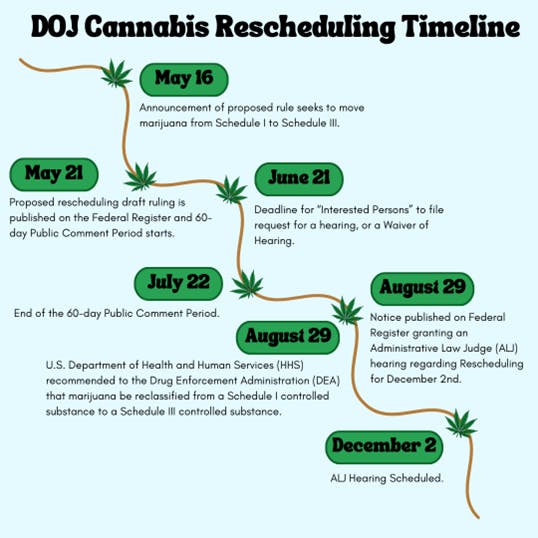
High Level Summary:
The potential rescheduling of cannabis to Schedule III could significantly impact the U.S. cannabis industry. It might improve access to capital and banking services, reduce tax burdens, and attract more institutional investors. However, this change could also increase regulatory scrutiny, leading to higher compliance costs and ongoing market volatility. Increased competition and international implications are likely as well. Despite these advances, legal uncertainties and the federal-state legal divide will continue to pose challenges. As the regulatory landscape continues to evolve, strategic planning, due diligence, and risk management will be essential for investors navigating the cannabis sector.
The opinions expressed in this publication are those of the authors and are subject to change. They do not purport to reflect the opinions or views of ETF Central or its members. ETF central does not guarantee the accuracy, completeness, or reliability of the information provided.
Segments
See all
Mentioned ETFs
No specific ETFs were tagged
Further reading
Latest ETF News
See all ETF newsShould You Avoid a Small ETF?




Why ETF Spreads Often Mislead Investors





 Advantages of ETFs over Mutual Funds1/6
Lower Costs
In this guide, we'll explore the advantages of ETFs over mutual funds, giving you valuable insights into why ETFs have gained significant popularity among investors like yourself.
Leveraged ETFs: Unlocking the Potential for Amplified Returns1/6
Understanding Leveraged ETFs
Explore leveraged ETFs: potential for amplified returns & risks. 5 ETFs to consider across equities, commodities & fixed income.
What is a Leveraged ETF?1/6
Introducing Leveraged and Inverse ETFs
In this guide, we'll dive into the world of leveraged ETFs, exploring their definition, mechanics, potential risks, and rewards.
Recent educational content

Asset TV
The ETF Show - New Autism-Impact ETF Launched
Defiance ETFs has launched the first ETF, $ASD, focused on the autism ecosystem, investing in companies that provide services, products, and research related to autism and neurodivergence.


ETF Trends
ETF Industry KPIs June 1, 2026
The ETF Industry saw 22 New Launches, 1 Ticker Change and 1 closure last week.

ETF Trends
ETF Industry KPIs May 20, 2026
The ETF Industry saw 44 New Launches, 3 Mutual Fund Conversions and 9 closures last week.

Asset TV
The ETF Show - Politics Becomes Investable Trade through ETFs
Dan Weiskopf, Senior Portfolio Manager at Tidal Financial Group spoke with the ETF Show about Subversive ETFs that help investors trade like politicians.
Browse all educational columns



Build and Analyze Your ETF Portfolio Like a Pro
Create your own ETF portfolio in minutes and instantly see allocations, exposures, performance, and risk. Visualize diversification across asset classes, regions, and sectors. Stress-test ideas, compare benchmarks, and refine your strategy with professional-grade analytics.