Explore professionally built ETF model portfolios. Discover now →



Do U.S. investors actually need foreign bond ETFs?
Most U.S. investors only hold U.S. bonds. Here’s the pros and cons of adding foreign issuers.


Keep up with what matters in ETFs
Get timely ETF insights, market trends, and top ideas straight to your inbox.
Your newsletter subscriptions with us are subject to ETF Central's Privacy Policy and Terms and Conditions.
Most U.S. investors heavily overweight domestic stocks in their portfolio. While U.S. stocks comprise around 55% of the world by market capitalization weight, some investors hold anywhere from 60 – 100% of their stock allocation in U.S. markets.
This approach is called a "home-country bias". While not the greatest for diversification, it does lower currency risk and boosts tax-efficiency. Thanks to low-cost index ETFs, more and more investors are diversifying into international equities.
The same cannot be said for fixed-income allocation. The average U.S. investor often holds a single aggregate U.S. bond market ETF like the Vanguard Total Bond Market ETF (BND) or the iShares Core U.S. Aggregate Bond ETF (AGG), or a U.S. government Treasury ETF like the iShares Core U.S. Treasury Bond ETF (GOVT).
The question is, why aren't U.S. investors diversifying their fixed-income allocations internationally? If holding global stocks is a good idea, then why not global bonds? Let's take a look at the pros and cons of investing internationally in bonds.
Like what you're reading?
Stay in the loop — get the latest ETF insights: trends, analysis, and expert picks.
The argument for U.S. bonds
Historically, the argument against global bonds centered around currency risk. Because global bonds do not trade in USD, fluctuations in currency pairs can add additional volatility. This is obviously undesirable for investors who hold fixed-income assets to dampen volatility.
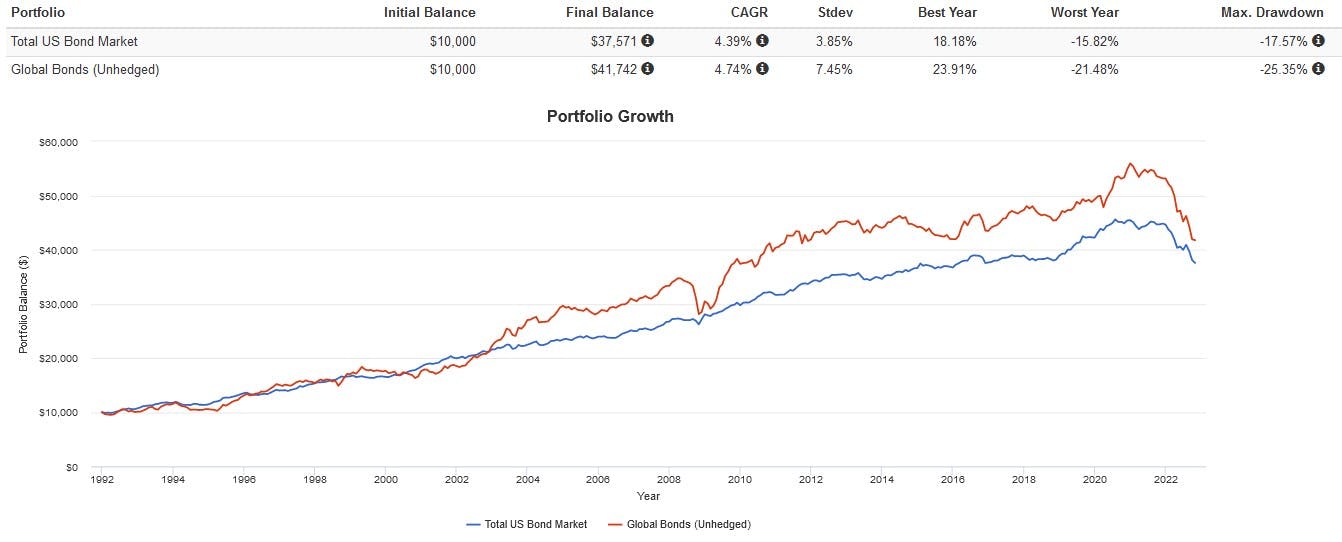
As seen below, from 1992 to the present non-currency hedged global ex-U.S. bonds returned slightly more than U.S. bonds, but with much higher volatility and drawdowns during market downturns:
There's also the perception that U.S. debt is as safe as it gets. This mainly pertains to Treasury bonds, which comprise the majority of U.S. aggregate bonds. The notion that "Uncle Sam makes good on his debts" is hard to dispel given the Federal Reserve's aggressive support of the bond market since 2008.
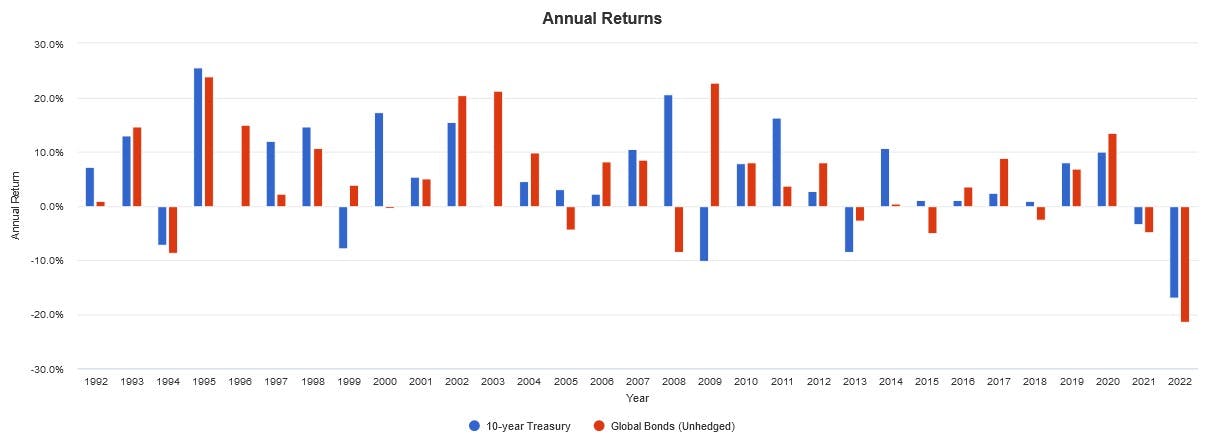
This is especially so when it comes to U.S. Treasury bonds. Few other countries have government-issued bonds with a similarly high credit rating, level of institutional adoption, and faith. During crashes like 2001 and 2008, U.S. government Treasurys had a "flight to safety" effect, as seen below:
The argument for international bonds
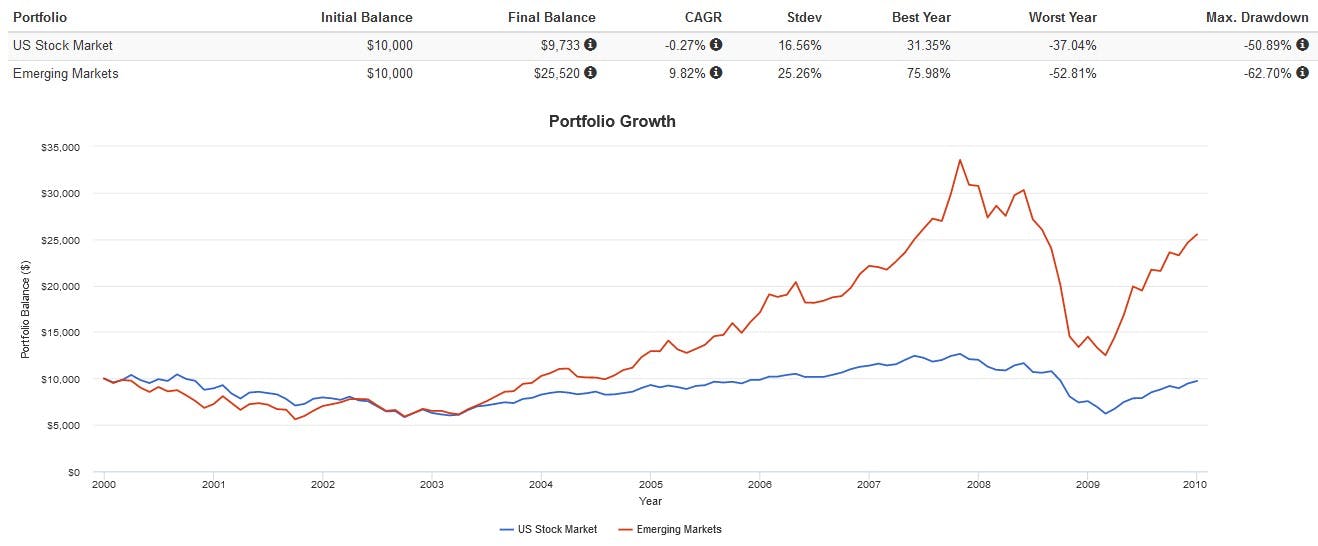
There have been times where the U.S. stock market experienced decades of flat returns. Case in point, from 2000 to 2009 ("the lost decade") the U.S. market returned an annualized 0.27%. During this time, emerging markets returned an annualized 9.82%. Global diversification would have been very beneficial during this period.
One can argue that the bond market is different, and that the comparatively high amounts of regulation in the U.S. and the political power it wields will ensure its fixed-income holdings remain the gold standard for the foreseeable future. I strongly disagree.
Without getting too political or historically inclined, its worth noting that every nation goes through periods of economic prosperity and decline. The recent economic turmoil in the U.K. that caused the near collapse of its government bonds, called gilts, underscores this possibility.
The U.S. is absolutely vulnerable to this type of risk. Possible scenarios include defaulting on its debt (as evidenced every time Congress votes to raise the debt ceiling), the failure of the Fed to support the bond market during a liquidity crisis, aggressive interest rate hikes, a civil war, currency crisis, etc.
If this occurs and the U.S. bond market collapses, U.S. investors will see immense losses in their portfolios. While contagion is a feature of today's globalized economy, a U.S. collapse would not necessarily see the bond markets of other developed nations go bust overnight.
In a whitepaper on the benefits of a global fixed income allocation, Vanguard noted that:
"Investors should keep in mind that to the extent that the events affecting bonds of other markets are different from those affecting bonds in their own local market, a global bond allocation can reduce a fixed income portfolio’s risk without necessarily decreasing its expected return."
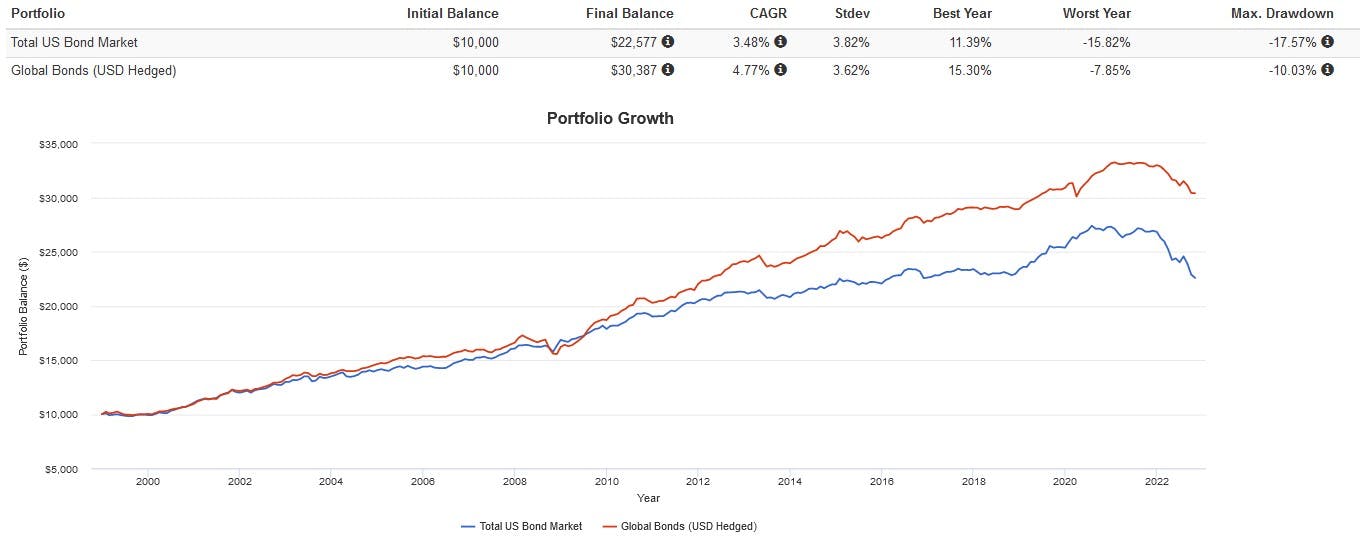
Moreover, most global bond ETFs are able to substantially lower their volatility via currency hedging. According to Vanguard, this has substantially improved the attractiveness of global bonds. As seen in the below backtest, with currency hedging in place, global bonds have actually outperformed U.S. bonds since 1999, incurring similar volatility and lower drawdowns:
Fees have also dropped too. Some global bond index ETFs charge expense ratios as low as 0.07%. With the economy of scale afforded by large fund managers like Blackrock, Invesco, State Street, and Vanguard, global bond funds have become extremely accessible and cost-effective.
The following ETFs offer exposure to global bonds. Clicking on them will take you to a page where you can view their strategy, holdings, and expense ratios.
- Vanguard Total World Bond ETF (BNDW)
- Vanguard Total International Bond ETF (BNDX)
- iShares International Treasury Bond ETF (IGOV)
- Invesco International Corporate Bond ETF (PCIB)
Please note this article is for information purposes only and does not constitute investment advice.
Latest ETF News
See all ETF newsThere's an ETF for That? Humanoid Robotics and Physical AI

How Some ETF Issuers Use Their Own Funds for Cash Management

These Public-Private ETFs Invest in Polymarket and Anduril

There's an ETF for That? Frontier Markets




 Advantages of ETFs over Mutual Funds1/6
Lower Costs
In this guide, we'll explore the advantages of ETFs over mutual funds, giving you valuable insights into why ETFs have gained significant popularity among investors like yourself.
Leveraged ETFs: Unlocking the Potential for Amplified Returns1/6
Understanding Leveraged ETFs
Explore leveraged ETFs: potential for amplified returns & risks. 5 ETFs to consider across equities, commodities & fixed income.
What is a Leveraged ETF?1/6
Introducing Leveraged and Inverse ETFs
In this guide, we'll dive into the world of leveraged ETFs, exploring their definition, mechanics, potential risks, and rewards.
Recent educational content

ETF Trends
ETF Industry KPIs October 5, 2026
This week’s KPI data overview highlights key metrics and trends shaping the ETF landscape.

ETF Trends
ETF Industry KPIs September 28, 2026
This week’s KPI data overview highlights key metrics and trends shaping the ETF landscape.
ETF Trends
ETF Industry KPIs September 22, 2026
This week’s KPI data overview highlights key metrics and trends shaping the ETF landscape.

First Look ETF
First Look ETF: Income, Corporate Arbitrage, and Growth and Value Investing
First Look ETF September 2026: iCapital, Mast Investments and North Square unpack new ETFs targeting monthly income, merger arbitrage and complementary growth and value exposure.

Browse all educational columns



ETFs’ Next Act: From Access to Selection
With 1,790 new products launched by July 2026, choosing is harder than ever. Our Global ETF Survey 2026, built on 620 professional investors and allocators, shows how active, fixed income, options-based and thematic ETFs are reshaping fund selection.