Keep tabs on your favorite ETFs with a personalized weekly tracker. Create a Watchlist now →



Direxion Global ETF Strategist Says Retail Is Missing Crypto's Bigger Story
Bilal Little says crypto's long-term story remains strong despite the AI frenzy.

Keep up with what matters in ETFs
Get timely ETF insights, market trends, and top ideas straight to your inbox.
Your newsletter subscriptions with us are subject to ETF Central's Privacy Policy and Terms and Conditions.
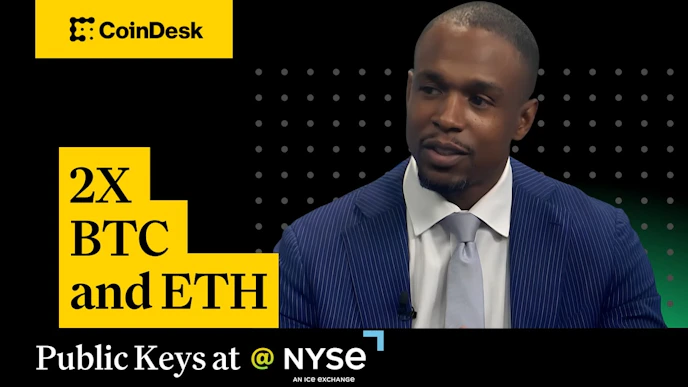
Direxion Global ETF Strategist Bilal Little joins CoinDesk’s Public Keys to explain why retail capital is chasing AI over crypto and why he thinks that's a mistake. Plus, the mechanics behind Direxion's 2X leveraged spot Bitcoin (BTCU) and Ethereum (EVMU) ETFs, and his take on Eric Balchunas's comparison of Bitcoin ETFs to gold's 22-year "triumph and pain" trajectory.
For a brief moment, Ethereum managed to do something unusual: attract more ETF inflows than Bitcoin. That shift sparked a broader conversation between Direxion Global ETF Strategist Bilal Little and host Jenn, not just about Ethereum, but about where crypto investing is headed, why retail investors behave the way they do, and why Direxion believes now is the right time to launch leveraged spot crypto ETFs.
Global ETF Survey 2026 is Live!
With 1,790 new products launched by July 2026, choosing is harder than ever. Our Global ETF Survey 2026, built on 620 professional investors and allocators, shows how active, fixed income, options-based and thematic ETFs are reshaping fund selection.
Ethereum's Inflows Tell a Bigger Story
Ethereum outperforming Bitcoin in ETF inflows may grab headlines, but Little argues the real story runs deeper than weekly fund flows.
He sees two forces at work. The first is institutional adoption, which continues to build beneath the surface. Little compared today's environment to 2022, when Ethereum appeared to stabilize before Bitcoin and began attracting early institutional interest. He believes a similar pattern is unfolding again.
The second force is investor flows. Institutional investors increasingly use ETFs as highly liquid vehicles for gaining crypto exposure, causing money to move back and forth between Bitcoin and Ethereum depending on market conditions.
Retail investors, however, are telling a different story. Instead of abandoning crypto entirely, many have simply shifted their attention, and their money, toward the booming artificial intelligence theme.
Retail Investors Still Love Chasing the Hype
Little believes retail investors often let headlines drive portfolio decisions more than valuation or long-term opportunity.
Today, AI dominates the conversation. Companies like SK Hynix and private-market names such as SpaceX have captured investor imagination, while media coverage continues reinforcing AI as the market's hottest trade. As a result, significant retail capital has rotated away from crypto.
That doesn't necessarily mean crypto's fundamentals have weakened.
Little argues that both Bitcoin and Ethereum continue to enjoy strong institutional support, improving technical setups, and an increasingly favorable regulatory backdrop. In his view, the investment thesis remains intact even if attention has temporarily shifted elsewhere.
Interestingly, he also sees a split within retail investors themselves. Long-term crypto believers continue buying during periods of weakness, treating current prices as opportunities rather than reasons to exit. The broader decline in flows, he suggests, reflects portfolio rotation and temporary risk reduction rather than a collapse in conviction.
Crypto Is Trading More Like a Risk Asset
One notable shift is how Bitcoin and Ethereum now behave in financial markets.
Historically, many investors viewed crypto primarily as a revolutionary technology or alternative financial system. Today, Little says both assets trade much more like traditional risk assets, moving alongside broader market sentiment.
That evolution helps explain why flows can fluctuate dramatically as investors rotate between sectors like AI, technology, and crypto depending on macroeconomic conditions.
Rather than signaling weakness, Little views this as a sign that crypto has become increasingly integrated into institutional portfolio construction.
Why Direxion Launched Leveraged Spot Crypto ETFs Now
Direxion recently introduced two new products: a 2X Leveraged Spot Bitcoin ETF and a 2X Leveraged Spot Ethereum ETF.
The timing wasn't accidental.
According to Little, crypto has spent several quarters trading within relatively tight ranges. While some investors may find sideways markets frustrating, Direxion sees them as attractive environments for active trading strategies.
The firm's goal is straightforward. Package institutional-grade exposure into an ETF wrapper that's easy for retail investors to access.
These funds aim to deliver twice the daily performance of the underlying spot asset. For traders with high conviction and correctly timed positions, that leverage can amplify gains through daily compounding.
Of course, leverage cuts both ways.
Little repeatedly emphasized that losses can compound just as quickly when markets move against investors, making these products better suited for closely monitored, short-term trades than buy-and-hold investing.
Why Not Just Use a Crypto Exchange?
If leverage already exists on crypto exchanges, why buy a leveraged ETF?
Little offered several practical reasons.
First, borrowing on margin can be expensive for retail investors.
Second, Direxion uses institutional derivatives, primarily swap agreements, to obtain roughly 200% exposure to the underlying asset. Replicating that structure independently would be difficult or impossible for most individual investors.
Finally, ETFs remove much of the operational complexity. Investors can trade them through traditional brokerage accounts with familiar market infrastructure, avoiding many of the extra steps involved with crypto exchanges and margin trading.
The trade-off remains clear. Simplicity and accessibility don't eliminate risk. Leveraged ETFs still require active monitoring because their daily reset and compounding characteristics can produce returns that differ significantly from simply doubling long-term crypto performance.
What's Next for ETF Innovation?
Looking ahead, Direxion isn't focused solely on crypto.
Little says product development begins with collaboration across portfolio managers, traders, and legal teams to identify areas where the firm believes it has a competitive advantage.
One major opportunity is income-oriented products, particularly while markets continue trading sideways.
Another growing area of demand involves risk-mitigating strategies. Investors remain uncertain about Federal Reserve policy, market volatility, and the broader economic outlook, creating interest in products that can help manage risk without abandoning market exposure altogether.
Little expects Direxion to continue expanding its lineup of income-focused ETFs while exploring additional structured investment solutions.
Are Bitcoin ETFs Following Gold's Playbook?
The conversation closed with an observation from Bloomberg ETF analyst Eric Balchunas, who suggested Bitcoin ETFs may follow the same long-term path as gold ETFs.
His argument is simple. Both wrap assets that generate no cash flow or income, leaving investor sentiment as the primary driver of demand. Gold ETFs surged to enormous popularity before enduring years of stagnation, only to regain momentum much later.
Little largely agrees.
Rather than focusing on short-term inflows, he points to the broader structural developments supporting crypto. Proposed legislation such as the Genius Act and Clarity Act, along with growing political support for digital assets, could provide a stronger legal framework for the industry.
He also pushes back against the idea that crypto lacks liquidity. Bitcoin, he notes, remains one of the world's most accessible assets, capable of being bought or sold around the clock in a matter of seconds.
For Little, temporary flow fluctuations don't change the bigger picture. Institutional adoption continues expanding, regulatory clarity appears to be improving, and crypto is becoming more deeply embedded within the financial system.
If that thesis plays out, today's ETF flow charts may end up looking like just another chapter in a much longer story.
Please note this article is for information purposes only and does not in any way constitute investment advice. It is essential that you seek advice from a registered financial professional prior to making any investment decision.


Latest ETF News
See all ETF news




Inside the XRP ETF Surge and the Traders Driving It


 Advantages of ETFs over Mutual Funds1/6
Lower Costs
In this guide, we'll explore the advantages of ETFs over mutual funds, giving you valuable insights into why ETFs have gained significant popularity among investors like yourself.
Leveraged ETFs: Unlocking the Potential for Amplified Returns1/6
Understanding Leveraged ETFs
Explore leveraged ETFs: potential for amplified returns & risks. 5 ETFs to consider across equities, commodities & fixed income.
What is a Leveraged ETF?1/6
Introducing Leveraged and Inverse ETFs
In this guide, we'll dive into the world of leveraged ETFs, exploring their definition, mechanics, potential risks, and rewards.
Recent educational content

First Look ETF
First Look ETF: Income, International, and Cash Flow ETFs
In this season 6 episode of First Look ETF, Stephanie Stanton @etfguide examines the latest ETF marketplace trends with NYSE and guests.


ETF Trends
ETF Industry KPIs October 5, 2026
This week’s KPI data overview highlights key metrics and trends shaping the ETF landscape.

ETF Trends
ETF Industry KPIs September 28, 2026
This week’s KPI data overview highlights key metrics and trends shaping the ETF landscape.
ETF Trends
ETF Industry KPIs September 22, 2026
This week’s KPI data overview highlights key metrics and trends shaping the ETF landscape.