Keep tabs on your favorite ETFs with a personalized weekly tracker. Create a Watchlist now →



Death, Taxes, and the Innovator Equity Defined Protection ETF
Innovator Equity Defined Protection ETF pushes the paradigm on buffer ETFs and the depth of loss protection they can provide to investors.


Keep up with what matters in ETFs
Get timely ETF insights, market trends, and top ideas straight to your inbox.
Your newsletter subscriptions with us are subject to ETF Central's Privacy Policy and Terms and Conditions.
Death and taxes are often considered the two certainties in life, but Innovator Capital Management is looking to add to this list with the recent launch of the Innovator Equity Defined Protection ETF (TJUL), which aims to provide a 100% downside buffer over a two-year period.
In this article we will highlight the value proposition and intended outcome of the ETF, explore the solution’s investment experience, and provide some noteworthy considerations for interested investors.
Like what you're reading?
Stay in the loop — get the latest ETF insights: trends, analysis, and expert picks.
Value Proposition & Intended Outcome
The Innovator Equity Defined Protection will utilize FLexible EXchange® Options on the SPDR® S&P 500® ETF Trust to fulfill its defined outcome strategy of providing a buffer against 100% of underlying ETF losses, while capping upside return at 16.62%, over a 2-year period.
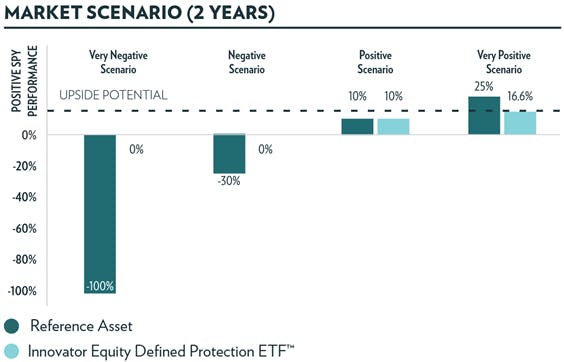
Source: Innovator ETFs
While the ‘100% loss protect’ aspect of the solution is eye-catching in nature, looking at the historical 2-year rolling return data of the S&P 500 Index provides clarity regarding the feasibility of the fund’s claim.

Source: Innovator ETFs
As observed from the chart, and generally understood by investors, losses do occur over a long investment period – but severe losses are very infrequent in nature and the returns of equity markets tend to be positively skewed in the long run. While the use of derivates to manage risk exposure will facilitate the strategy’s loss-protection objective, the relatively low frequency in which negative returns do occur over a rolling two-year period provides a baseline understanding of the solution’s ability to fulfill its 100% downside buffer. It is important to note, there is no guarantee the ETF will be successful in providing the sought-after protection.
The chart also highlights the other aspect of the solution’s offering – capping returns to 16.62%. As seen from the chart the average positive return of the index is 32%, which means that capping returns is potentially leaving money on the table. But let’s take an alternative perspective when considering the cap rate. TJUL’s stated focus is on a 2-year time frame. If investors were to instead invest their monies in a 2-year U.S. Treasury Instrument, what would they yield during said period? As seen in the following chart, approximately 5% in our prevailing interest rate environment, but would that vary depending on the time frame in question?

Against the backdrop of a market environment that currently has elevated interest rates and strong equity market performance, the value proposition of the ETF is its ability to provide a measure of safety, while also allowing for some equity-market upside participation. Though investors are knowingly giving up some returns, the knowledge of avoiding losses is a compelling notion.
Exploring the investment experience
While the ETF can be bought or sold at any point in time, the 2-year outcome period (i.e., July 18, 2023, to June 30, 2025) is very important as investors will need to hold the fund for the entirety of the outcome period established in order to achieve the expected returns. This is in line with the structure of the FLEX options used in order to achieve the desired outcome of 100% loss protection. So, what is the potential investment experience of the ETF over the 2-year period? The following charts provide a telling illustration.

Source: Innovator ETFs

Source: Innovator ETFs
As observed from the charts, there isn’t a ‘one-to-one’ correlation between the benchmark and the ETF, hence investors should not expect a return profile that mirrors the S&P 500 Index. Furthermore, when investors buy or sell the fund within the prescribed outcome period, it is evident that their return will vary, as buffer ETFs are built with the endpoint in mind.
Other noteworthy considerations
For investors that are still intrigued by the solution, there are some additional aspects of the ETF that should be held in consideration, namely:
The buffer is provided prior to taking into account annual Fund management fees, shareholder transaction fees and any extraordinary expenses incurred by the fund, and that such fees and expenses will have the effect of lowering the buffer.
The fund’s investments do not provide dividends, as such there is no income provided to investors.
Most importantly, and worth repeating, there is no guarantee that the fund will be successful in its attempt to provide protection through the buffer.
While the novelty of TJUL does make it a standout investment solution, investors should be aware of the pros and cons associated with the ETF and determine if its inclusion in their portfolio is appropriate.
Please note this article is for information purposes only and does not in any way constitute investment advice. It is essential that you seek advice from a registered financial professional prior to making any investment decision.

Latest ETF News
See all ETF newsCould Water ETFs Be the Next AI Bottleneck Trade?


What is a Boomer Candy ETF?

ETF Comparison: NEOS Nasdaq-100 High Income ETF (QQQI) Versus Goldman Sachs Nasdaq-100 Premium Income ETF (GPIQ)





 Advantages of ETFs over Mutual Funds1/6
Lower Costs
In this guide, we'll explore the advantages of ETFs over mutual funds, giving you valuable insights into why ETFs have gained significant popularity among investors like yourself.
Leveraged ETFs: Unlocking the Potential for Amplified Returns1/6
Understanding Leveraged ETFs
Explore leveraged ETFs: potential for amplified returns & risks. 5 ETFs to consider across equities, commodities & fixed income.
What is a Leveraged ETF?1/6
Introducing Leveraged and Inverse ETFs
In this guide, we'll dive into the world of leveraged ETFs, exploring their definition, mechanics, potential risks, and rewards.
Recent educational content

ETF Trends
ETF Industry KPIs September 8, 2026
This week’s KPI data overview highlights key metrics and trends shaping the ETF landscape.

ETF Trends
ETF Industry KPIs August 31, 2026
This week’s KPI data overview highlights key metrics and trends shaping the ETF landscape.
ETF Trends
ETF Industry KPIs August 24, 2026
This week’s KPI data overview highlights key metrics and trends shaping the ETF landscape.
What’sTheFund
What's the Fund | Ocean Park Diversified Income ETF (DUKZ)
James St Aubin, Chief Investment Officer at Ocean Park Asset Management, discuss the DUKZ ETF, exposing investors to the whole spectrum of asset classes in the fixed income markets, through their rules-based process.

Browse all educational columns



Have you tried our ETF Compare tool?
Compare ETFs like a pro. Analyze fees, performance, exposure & holdings side-by-side.