Global ETF Survey Is Live! 600+ ETF Professionals Weigh In. See Results →



Dan IVES Wedbush AI Revolution ETF (IVES) Deep Dive
Here’s my take on one of the most popular artificial intelligence ETFs to debut recently.

Keep up with what matters in ETFs
Get timely ETF insights, market trends, and top ideas straight to your inbox.
Your newsletter subscriptions with us are subject to ETF Central's Privacy Policy and Terms and Conditions.
Launching your own strategy as a Wall Street name used to mean setting up a hedge fund under a GP/LP structure, or maybe running a separately managed account business for institutions and high-net-worth clients.
ETFs have changed the game. With white-label platforms handling the operational side, it has never been easier for a star analyst or portfolio manager to turn their views into a tradable product.
Case in point is the Dan Ives Wedbush AI Revolution ETF
If you already follow Dan Ives and his work, the ETF’s positioning won’t come as a surprise. But for newer ETF investors, or those looking across the crowded artificial intelligence ETF landscape, the natural question is what makes IVES stand out from competitors and whether it’s worth a spot in your portfolio. Here’s my take on IVES.
Like what you're reading?
Stay in the loop — get the latest ETF insights: trends, analysis, and expert picks.
IVES: the basics
A common question with new ETFs, especially those not carrying a Vanguard, iShares, Schwab, SPDR, or Invesco label, is whether they’re built to last. With IVES, those fears should be put to rest. At $664 million in assets under management, it’s well above the $50 million threshold often seen as the minimum for long-term viability.
On the surface, IVES
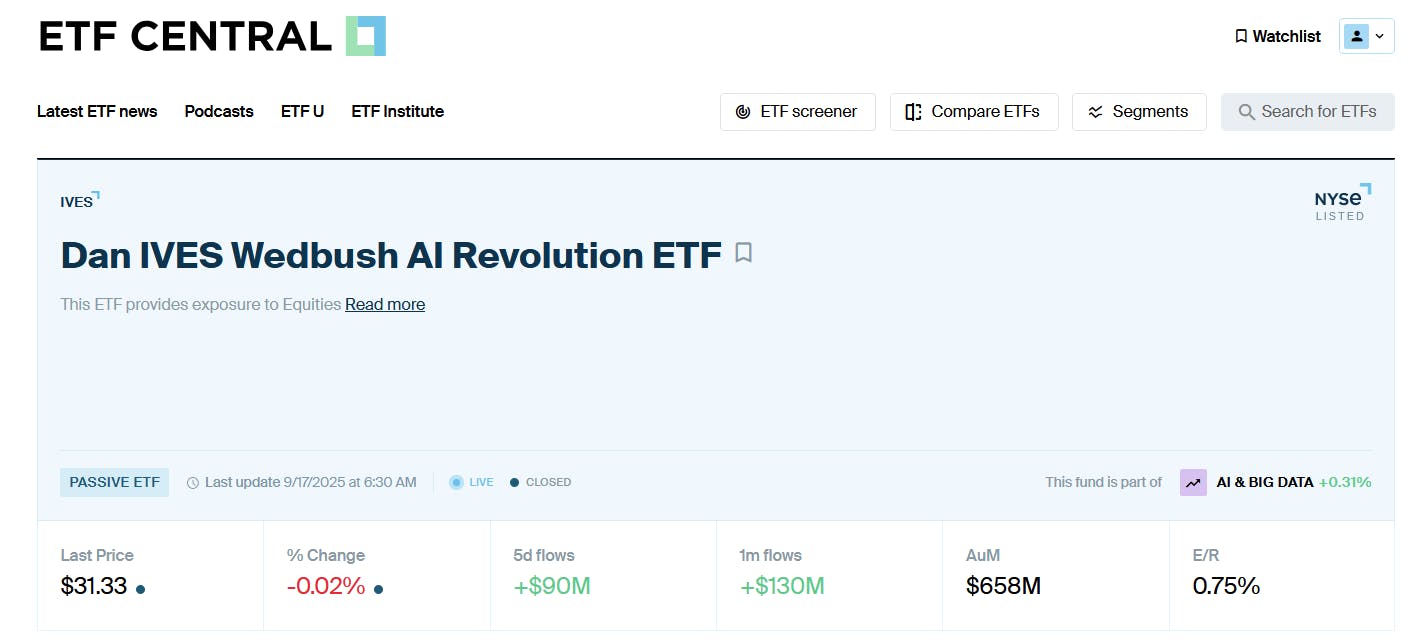
Liquidity has been excellent, with a 30-day median bid-ask spread of just 0.048%. Authorized participants have also kept the fund’s trading price closely aligned with NAV, with an average 30-day premium/discount of +0.07%.
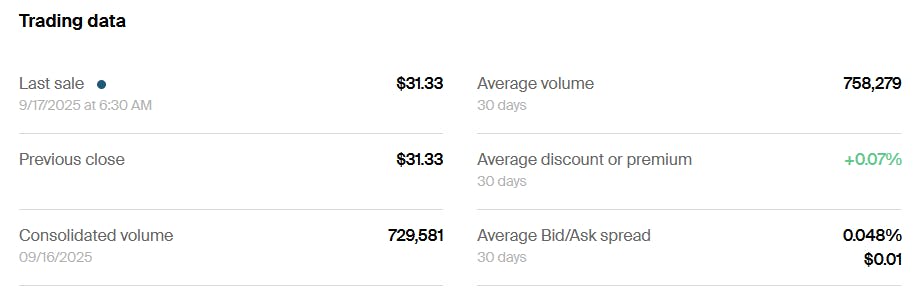
These metrics matter because they show the ETF is running smoothly. Strong asset growth ensures viability, tight spreads keep trading costs low, and stable NAV alignment confirms the creation-redemption process is working properly.
In the case of IVES, everything appears to be executed well, suggesting the fund is operationally sound rather than “wonky” like some newer niche products.
IVES: the basket
Contrary to what some might assume, IVES
Instead, Wedbush partnered with Solactive, well known for building custom benchmarks, to create the bespoke Solactive Wedbush Artificial Intelligence Index. I like this setup because it gives investors and analysts a transparent, rules-based framework for how the portfolio is built, rather than the “black box” approach typical of active management.
The index universe starts with U.S.-listed equities (plus ADRs) that meet liquidity and size requirements. To qualify, companies must have at least $250 million in free float market cap and $1.5 million in average daily trading volume. Importantly, they also need to be included in the “Dan Ives AI 30” research list, which acts as a thematic filter.
From there, Solactive’s ARTIS natural language processing system screens company filings and public sources for AI relevance. Only firms deriving at least 50% of revenue from AI-related business fields, like semiconductors, cloud infrastructure, AI software, networking, or hardware, make the cut.
Weighting is also rules-based but designed to prevent overconcentration. Companies are weighted by a capped, adjusted market-cap formula that sets a minimum of 1% and a maximum of 4% per holding. Additional constraints limit the combined weight of the largest stocks, ensuring the index doesn’t become top-heavy in just a handful of mega-caps.
The end result is a concentrated basket of fewer than 50 stocks. Unlike many AI ETFs that simply buy the entire tech sector, IVES is selective, with only 23% overlap by weight with the Nasdaq 100 and just 15 names in common. That gives it a higher active share and more differentiated exposure.
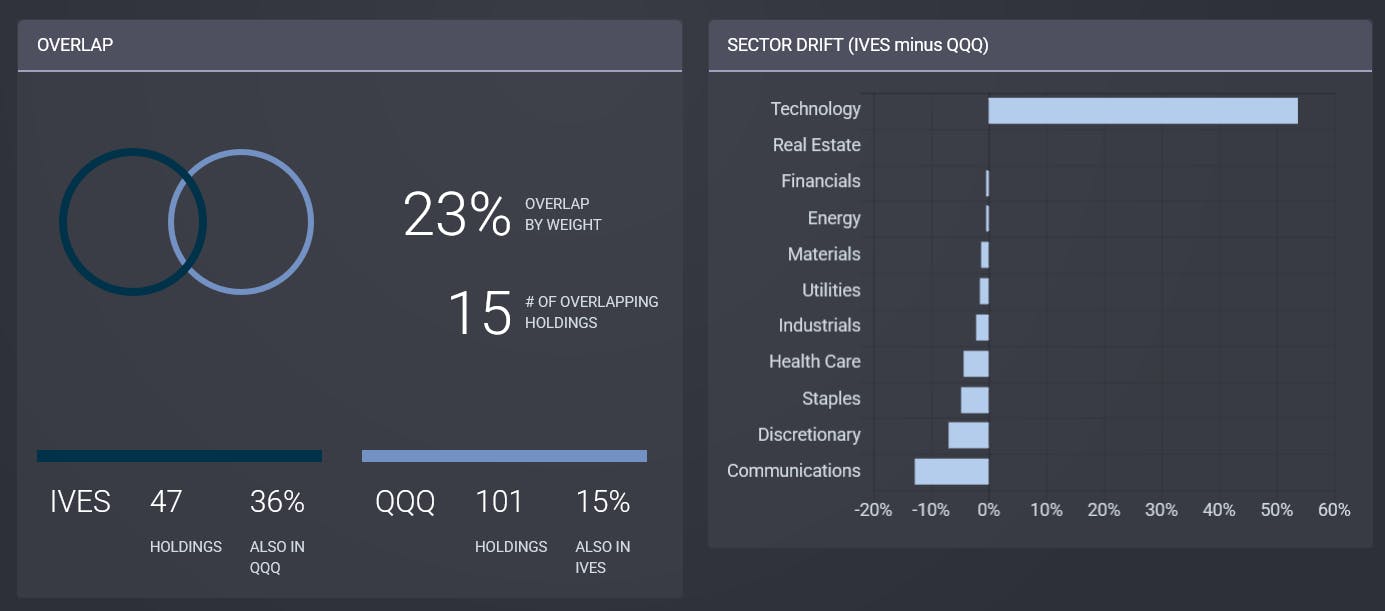
At the same time, IVES hasn’t missed the key drivers of AI. The fund holds the mega-cap growth stocks pouring billions into AI capex—companies like Oracle, Broadcom, Alphabet, Nvidia, and Apple, but weights them differently than broad benchmarks.
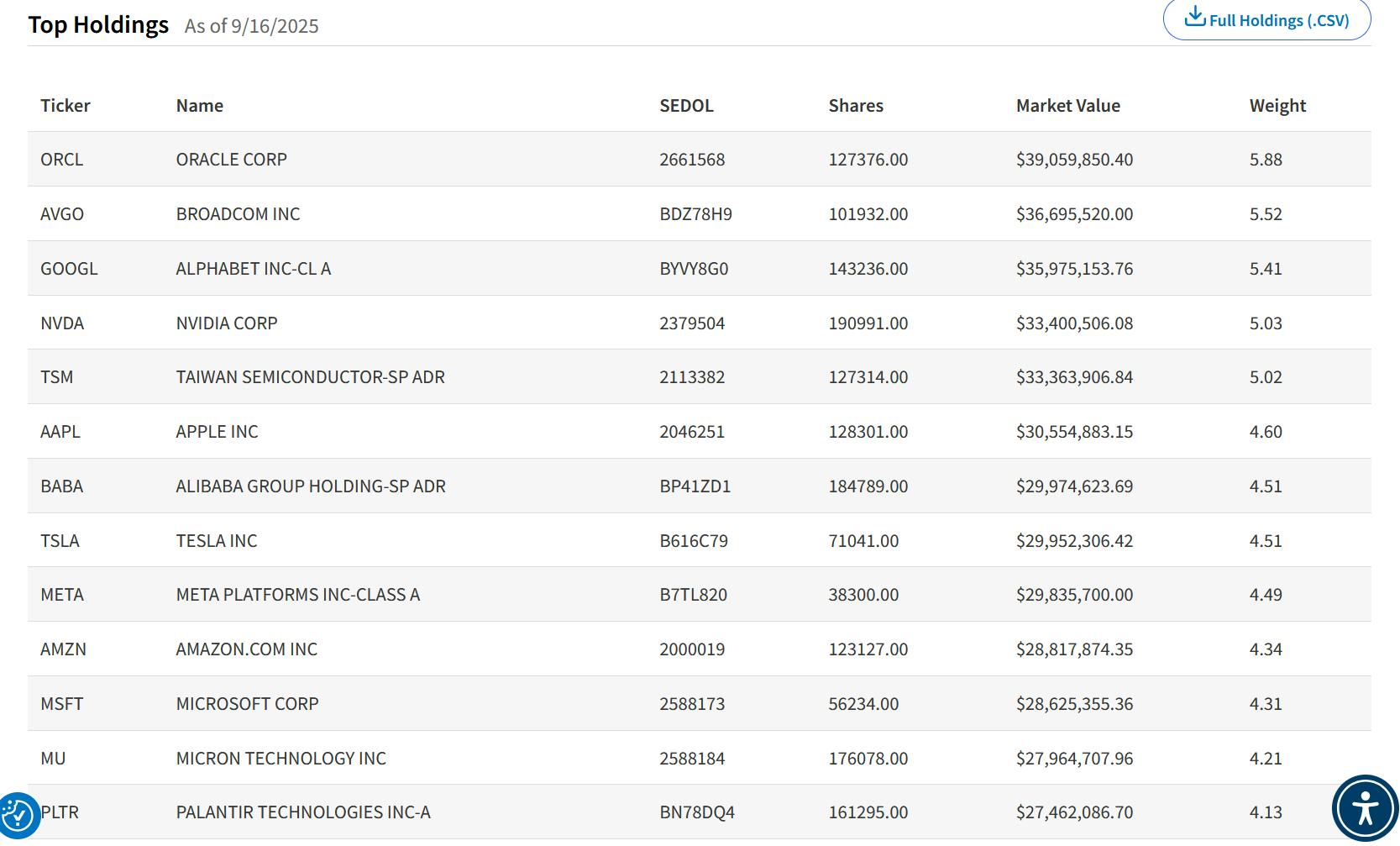
It also ventures beyond U.S. borders with names like Taiwan Semiconductor, Alibaba, and Baidu, which broad U.S.-only AI ETFs typically exclude. This balance between established leaders and out-of-benchmark exposures is part of what has helped IVES stand out in a crowded field.
IVES: my thoughts
From an industry analyst perspective, Wedbush did everything right in launching an ETF tied so closely to the reputation and calls of Dan Ives. Despite the firm’s backing, make no mistake: this product lives and dies on Ives’s ability to sell the strategy.
So far, he has delivered. The trading volume and pace of industry engagement have been impressive, with constant appearances on CNBC and Bloomberg, presence at NYSE events, and participation in conferences. Dan has been relentless in promoting the ETF, and it shows in the asset growth.
Looking at the ETF construction itself, there are positives and negatives. On the plus side, I appreciate the partnership with Solactive to create a customized index with clear, rules-based criteria. It ensures transparency and avoids the closet-indexing problem that plagues many thematic ETFs.
The portfolio also meaningfully diverges from the Nasdaq 100, both in stock selection and weightings, which is critical for differentiation. On the downside, the 0.75% expense ratio feels high. To stay competitive in the crowded AI ETF niche, I’d like to see that lowered to around 0.60%.
As for performance, it’s still too early to make strong calls. Returns will be tied directly to AI capex spending and, at a macro level, the benefit of the recent 25 basis point rate cut. Expect IVES to remain volatile, particularly around quarterly earnings from the mega-cap tech names that dominate its portfolio. Investors should be prepared for sharp moves both up and down.
Please note that this article reflects the author’s personal views and does not represent the opinions of the publication or its affiliates. It is for informational purposes only and does not constitute investment advice. It is essential to seek guidance from a registered financial professional before making any investment decisions.


Latest ETF News
See all ETF newsBeyond Big Tech: The Increasing Specialization of AI ETFs

There's an ETF for That? Humanoid Robotics and Physical AI

How Some ETF Issuers Use Their Own Funds for Cash Management

These Public-Private ETFs Invest in Polymarket and Anduril

There's an ETF for That? Frontier Markets



 Advantages of ETFs over Mutual Funds1/6
Lower Costs
In this guide, we'll explore the advantages of ETFs over mutual funds, giving you valuable insights into why ETFs have gained significant popularity among investors like yourself.
Leveraged ETFs: Unlocking the Potential for Amplified Returns1/6
Understanding Leveraged ETFs
Explore leveraged ETFs: potential for amplified returns & risks. 5 ETFs to consider across equities, commodities & fixed income.
What is a Leveraged ETF?1/6
Introducing Leveraged and Inverse ETFs
In this guide, we'll dive into the world of leveraged ETFs, exploring their definition, mechanics, potential risks, and rewards.
Recent educational content
First Look ETF
First Look ETF: Income, International, and Cash Flow ETFs
In this season 6 episode of First Look ETF, Stephanie Stanton @etfguide examines the latest ETF marketplace trends with NYSE and guests.


ETF Trends
ETF Industry KPIs October 5, 2026
This week’s KPI data overview highlights key metrics and trends shaping the ETF landscape.

ETF Trends
ETF Industry KPIs September 28, 2026
This week’s KPI data overview highlights key metrics and trends shaping the ETF landscape.
ETF Trends
ETF Industry KPIs September 22, 2026
This week’s KPI data overview highlights key metrics and trends shaping the ETF landscape.